Your Guide to a Powerful Retention Marketing Strategy
Build a retention marketing strategy that drives repeat sales and customer loyalty. This guide covers segmentation, loyalty programs, and key metrics.
A solid retention marketing strategy is all about keeping the customers you already have happy, engaged, and coming back for more. It’s a deliberate shift away from the constant, costly chase for new leads to instead nurturing the relationships you’ve already built. The goal? Turn one-time buyers into loyal, repeat customers who are the bedrock of sustainable growth.
Why Retention Is Your Most Powerful Growth Strategy
While the thrill of landing a new customer often gets all the attention, the real, long-term growth for any e-commerce brand comes from the people who decide to stick around. With ad costs soaring and competition just a click away, your existing customer base is your most valuable—and profitable—asset. For any DTC or Shopify merchant, a smart retention strategy isn't just a "nice-to-have"; it's an essential profit engine.
The math is simple and powerful. It famously costs anywhere from 5 to 7 times more to acquire a new customer than to keep an existing one. Even better, research from Bain & Company shows that boosting customer retention by just 5% can increase profits by a staggering 25–95%. For many established brands, 65–80% of their total revenue already comes from existing customers.
This simple flow really brings it home, showing how retention connects expensive acquisition efforts to profitable, long-term growth.
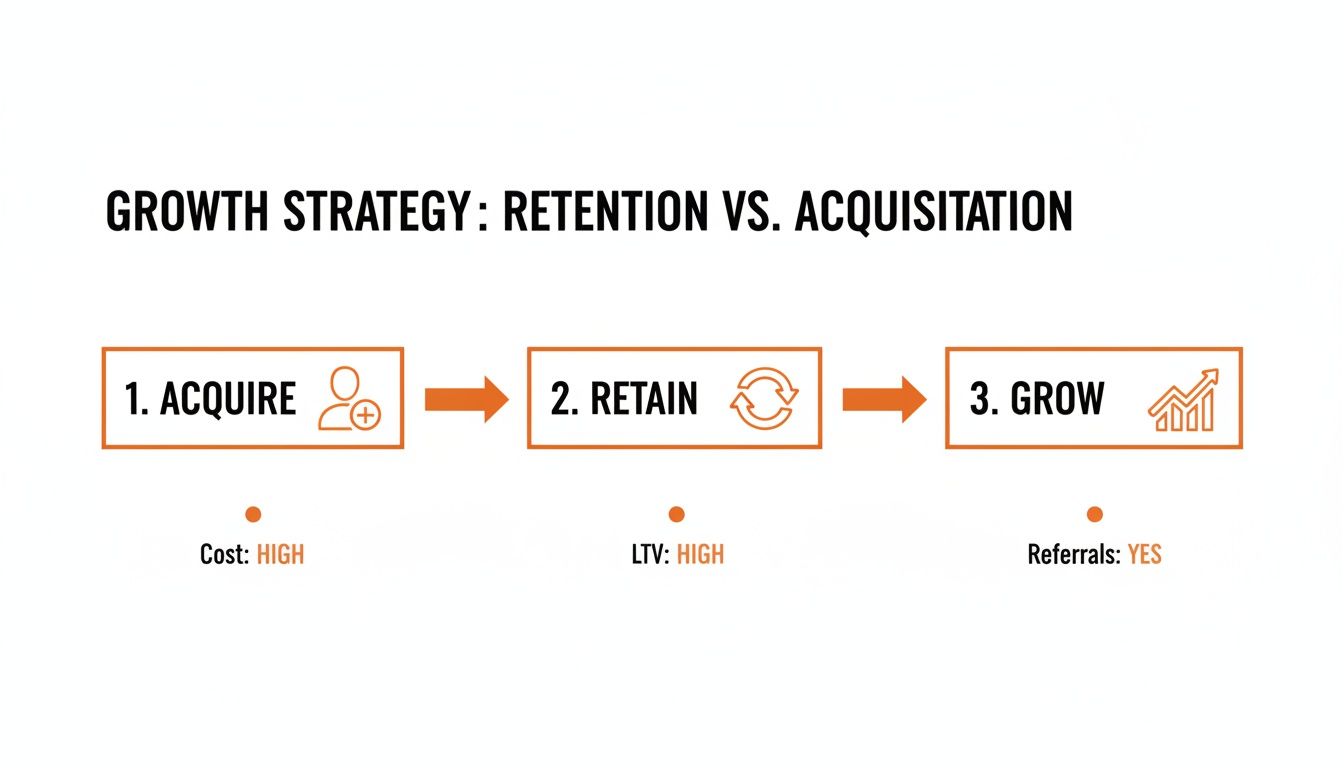
The big takeaway here is that a focus on retention builds a powerful, self-sustaining growth loop. It's what allows you to slowly pull back on that expensive ad spend without losing momentum.
The Compounding Value of a Loyal Customer
A loyal customer’s value goes way beyond their next transaction. They become a predictable and reliable source of revenue, giving your business a stable foundation to build on.
Just think about the ripple effects:
- Higher Lifetime Value (LTV): Repeat buyers naturally spend more with you over time, which dramatically increases their total worth to your brand.
- Increased Purchase Frequency: They already trust your quality, so they’re more likely to buy again, and sooner.
- Willingness to Try New Products: Your best audience for a new product launch is always your existing customers. The trust is already there.
- Authentic Brand Advocacy: Happy, loyal customers become your most powerful marketing channel through genuine word-of-mouth referrals.
"Focusing on retention isn't just about preventing churn; it's about actively building an asset. Your loyal customers are a moat around your business that competitors can't easily cross."
For a Shopify merchant, this isn't just theory—it's cash in the bank. A small bump in your repeat purchase rate, say from 30% to 35%, can lead to double-digit profit gains without spending a single extra dollar on ads. For a more detailed breakdown, check out our guide on customer retention vs. customer acquisition to see how these two sides of the coin work together.
Comparing Retention vs Acquisition Metrics
When you start focusing on retention, your key metrics will naturally shift. While acquisition is all about the cost to get someone in the door, retention is about the long-term value they bring.
Here’s a quick comparison of the KPIs you'd track for each approach:
| Metric | Acquisition Focus | Retention Focus |
|---|---|---|
| Primary Goal | Bringing in new customers | Maximizing value from existing customers |
| Key Performance Indicator (KPI) | Customer Acquisition Cost (CAC) | Customer Lifetime Value (LTV) |
| Supporting Metrics | Conversion Rate, Cost Per Click (CPC) | Repeat Purchase Rate, Churn Rate |
| Time Horizon | Short-term (single transaction) | Long-term (customer relationship) |
Shifting your perspective to retention-focused metrics helps you build a more resilient and profitable business model for the long haul.
Ultimately, a strong retention marketing strategy creates a flywheel effect. Satisfied customers buy more, refer their friends, and provide invaluable feedback—all of which fuels even more growth. To get this powerful engine running, explore these 8 effective strategies to improve customer retention and start building a more durable business today.
Setting Retention Goals That Actually Matter
Before you even think about launching a campaign or designing a loyalty program, you need to answer a simple question: what does success actually look like? If your goal is just to "improve loyalty," you're setting yourself up for failure. That's not a goal; it's a wish.
To build a retention strategy that actually works, you have to anchor it in hard data. We need to move past surface-level stats and dig into the Key Performance Indicators (KPIs) that tell the real story of your business's health. Guesswork has no place here. Your goals must be crystal clear, measurable, and tied directly to your bottom line.
Core Retention Metrics to Master
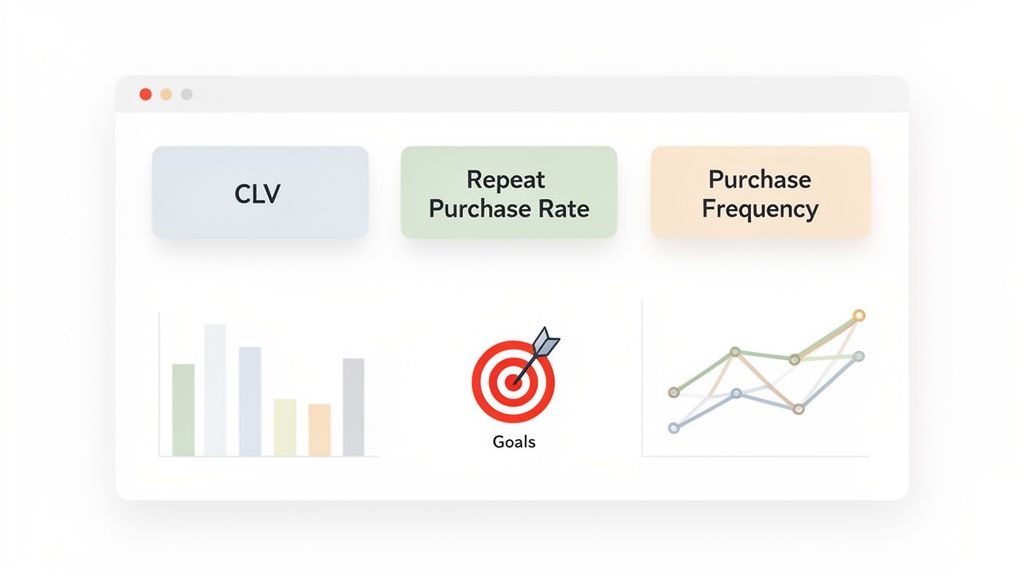
For most e-commerce brands, the health of your retention efforts boils down to three foundational metrics. Think of them as the vital signs for your customer base. They work together to paint a full picture of how people behave after that first purchase.
-
Customer Lifetime Value (CLV): This is the big one. It's the total profit you can expect from the average customer over their entire relationship with your brand. A rising CLV is the ultimate proof that what you're doing is working.
-
Repeat Purchase Rate (RPR): This tells you exactly what percentage of your customers have come back for a second, third, or fourth time. It's a direct measure of your ability to turn one-time buyers into loyal fans.
-
Purchase Frequency: This calculates how often a customer buys from you in a given period, like a year. It shows you how well you’re staying top-of-mind and giving people a reason to return.
Tracking these numbers isn't about getting a pat on the back. Their real power is in diagnosing specific weak spots in your customer journey.
A high Repeat Purchase Rate is fantastic, but if Purchase Frequency is low, you have a problem. It could mean your post-purchase experience is weak, and customers only remember you when they happen to need your product, not because you've built a real relationship with them.
Turning Data Into a Diagnosis
Once you have these KPIs in hand, you can finally set realistic goals and build a strategy based on evidence, not just assumptions. What's considered "good" will vary based on your industry and product, but the goal is always the same: continuous improvement.
Let’s look at a real-world example. Imagine a Shopify store that sells premium coffee beans. They dig into their numbers and find:
- CLV: $150
- RPR: 25%
- Purchase Frequency: 1.5 times per year
This data tells a very clear story. While a quarter of their customers do come back (which isn't bad!), they don’t return very often. A bag of coffee might last a month, so a purchase frequency of 1.5 is a huge red flag.
This single insight gives them a laser-focused goal: Increase Purchase Frequency from 1.5 to 3.0 within six months.
This is a powerful goal. It’s specific, measurable, and completely actionable. Now the team knows exactly where to focus their energy. Maybe it’s time to launch a subscription program, set up automated replenishment emails, or build a loyalty system that rewards more frequent buys.
If you want to go deeper on the metrics that should be on your dashboard, our complete guide to customer retention KPIs has all the formulas and benchmarks you'll need.
Setting Realistic Benchmarks
Without a clear baseline, you’re just flying blind. To set goals that will actually move the needle, you need to know where you stand today and aim for steady, incremental progress.
-
Calculate Your Baseline: Pull your data for the last 12 months. What are your current CLV, RPR, and Purchase Frequency? This is ground zero.
-
Look at Industry Standards: Do some digging. A fashion brand's repeat purchase cycle looks very different from a company selling blenders. Context is everything.
-
Set Phased Goals: Don't try to double your CLV overnight. That’s a recipe for burnout. Instead, set ambitious yet achievable quarterly goals, like "Increase RPR by 5% in Q3."
By grounding your strategy in these core metrics, you transform retention from a vague idea into a predictable growth engine. Every email you send, every campaign you launch, will have a clear purpose tied to a real number.
Get Personal: How to Segment Your Customers for Maximum Impact
A one-size-fits-all retention strategy is doomed from the start. You wouldn't talk to your best friend the same way you'd talk to a complete stranger, right? The same logic applies here. Lumping your most loyal VIPs in with customers who haven't bought anything in a year just won't cut it.
The secret to a killer retention program lies in smart customer segmentation. When you group customers based on their behavior and value, you can finally stop shouting into the void and start having meaningful conversations that actually resonate. This is how you move from generic email blasts to targeted, relevant messages that make people want to come back.
A Classic for a Reason: The RFM Model
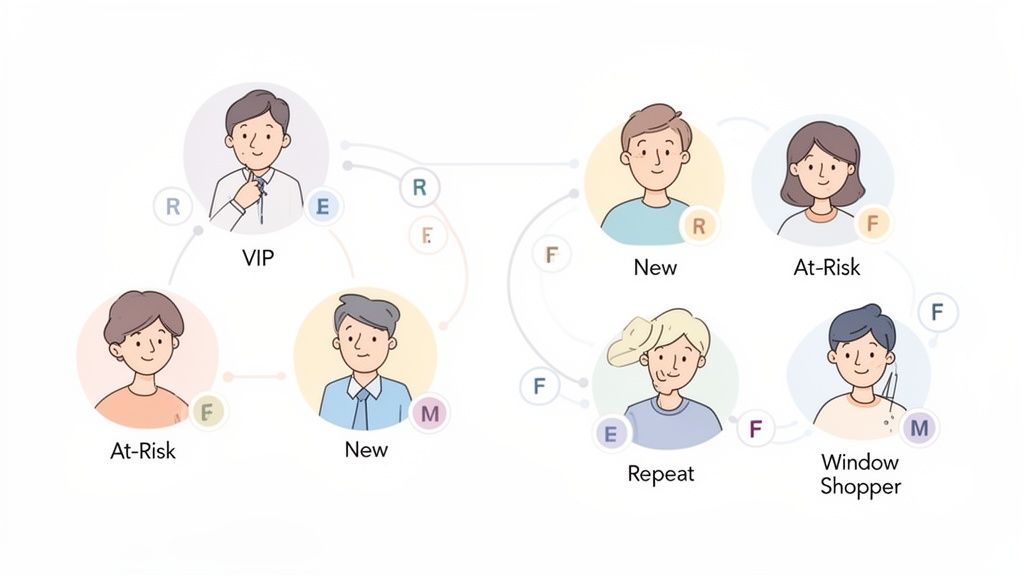
One of the most powerful frameworks I've seen in e-commerce is the RFM model. It’s been around forever because it’s simple, yet incredibly effective. It breaks down customer behavior into three core dimensions:
- Recency: When was their last purchase?
- Frequency: How often do they shop with you?
- Monetary: How much have they spent overall?
By scoring customers on these three factors, you can quickly see who your best customers are. But the real goal isn't just to find your superstars; it's to understand all your customer groups so you can tailor your approach.
Let’s say you’re a Shopify merchant selling athletic apparel. Using RFM, you might spot a "Hibernating High-Spender"—someone who spent a lot in the past (High Monetary) but hasn't ordered in six months (Low Recency). Instead of sending them the same 10% off coupon everyone else gets, you hit them with a targeted "We Miss You" campaign, maybe with an exclusive deal on a new product that’s similar to their past buys. That personal touch is what gets results.
Moving Beyond RFM: Value and Behavior
RFM is a fantastic starting point, but you can get even smarter by building segments based on customer value and specific actions. This helps you get ahead of the curve and address different needs across the customer lifecycle.
Here are a few essential value-based segments every DTC brand should have in their playbook:
- VIP Customers: These are your top 5-10% of spenders. Treat them like gold. Give them exclusive perks, early access to launches, and maybe even a personal thank you note.
- New Customers: They've made their first purchase—now the real work begins. The mission is to drive that crucial second purchase with a stellar onboarding experience and a compelling offer to come back soon.
- At-Risk Customers: These folks used to be regulars, but their buying has slowed down. It's time to intervene with a gentle win-back offer or a quick survey asking for feedback. Don't let them slip away.
- Loyalists: They might not be your biggest spenders, but they are the consistent, reliable backbone of your business. Reward their loyalty with points, surprise gifts, or shout-outs.
The real magic of segmentation is its ability to help you predict what's next. When you can spot an 'at-risk' customer before they're gone for good, you can step in and save that relationship. That’s a direct win for your bottom line.
Don't Forget What They Bought
Finally, let's talk about product-based segmentation. Knowing what people buy opens up a world of hyper-relevant cross-selling and up-selling opportunities.
Imagine someone buys a high-end espresso machine from your store. They're in a completely different category now than the person who just bought a bag of coffee beans. The machine owner is the perfect audience for campaigns about premium grinders, descaling kits, or a subscription for exclusive single-origin beans.
By layering these different segmentation models, you create a sophisticated strategy that feels personal to each customer. For a deeper dive, check out this great example of customer segmentation we put together. Ultimately, this is all about making your customers feel seen and understood—and that’s the foundation of true, long-term loyalty.
Designing a Loyalty Program Customers Will Love
Okay, so you’ve sliced and diced your customer data into meaningful segments. Now what? It’s time to build the machine that actually keeps them coming back. A great loyalty program isn't just about handing out discounts; it's a genuine value exchange. You reward your best customers, and they reward you with their business and, just as importantly, their advocacy.
The right program can turn one-time buyers into lifelong fans. The wrong one? It can feel cheap, transactional, or worse, get completely ignored. The trick is to design something that feels like a natural extension of your brand and how your customers already shop. This is where you can get really creative.
Points-Based Programs: The Classic Choice
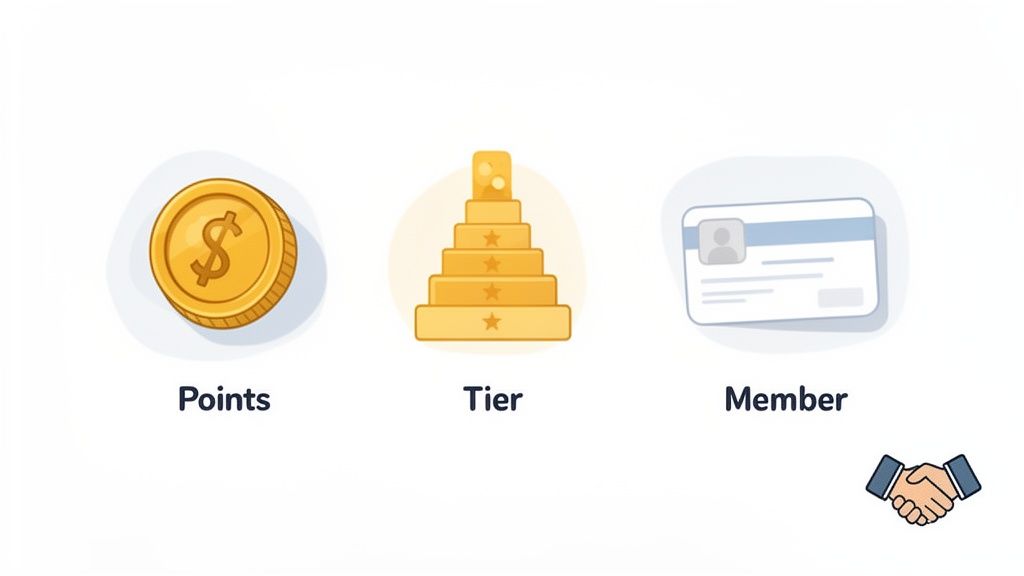
The classic points system is the most common model for a reason: everyone gets it. Customers perform actions—usually spending money—and they earn points. Those points can be cashed in for discounts, free products, or other perks. Simple.
This model is a slam dunk for brands with high purchase frequency. Think coffee, cosmetics, or supplements. It creates a simple, satisfying loop: buy, earn, redeem, repeat. You're essentially gamifying the shopping experience, giving customers a clear goal to work toward with every purchase they make.
If you’re on Shopify, this is pretty easy to set up. You could offer 10 points for every $1 spent, and a redemption value of 1,000 points = $10 off. Clarity is everything here. If a customer needs a calculator to figure out what their points are worth, you've already lost them.
I see this mistake all the time: brands set the redemption bar way too high. If someone has to spend $500 just to get a $5 coupon, the reward feels impossible. It won’t change their behavior. You have to find that sweet spot where the reward feels generous but you're still protecting your margins.
Tiered Programs: For Aspirational Loyalty
Tiered programs add a layer of status and exclusivity on top of a points system. Customers “level up” to unlock better perks as they spend more or engage more often. Think of it like a video game—moving from Bronze to Silver to Gold feels like an achievement, and the rewards get better at each stage.
This approach is fantastic for building aspirational loyalty. It makes your top customers feel like the VIPs they are, and it gives everyone else a reason to stick around and spend more.
Here’s a quick example for a fashion brand:
- Bronze Tier (Entry): Earn points on every purchase, get a birthday gift.
- Silver Tier (Spend $500/year): All Bronze perks, plus free shipping and early access to sales.
- Gold Tier (Spend $1,000/year): All Silver perks, plus exclusive access to limited-edition drops and a special anniversary gift.
Tiers tap into powerful psychology. The fear of losing status can be a huge motivator, encouraging customers to keep their spending up just to hold onto their hard-earned perks.
Choosing Your Loyalty Program Model
Deciding on the right structure can feel daunting, but it really comes down to your business model and customer behavior. Do you want to encourage frequency, reward your biggest spenders, or build a tight-knit community? This table breaks down the most common models to help you find the right fit.
| Program Type | Best For | Key Benefit | Example Tactic |
|---|---|---|---|
| Points-Based | High-frequency purchases (e.g., CPG, beauty) | Simple and easy to understand; encourages repeat buys. | Earn 10 points for every dollar spent; redeem 1,000 points for a $10 discount. |
| Tiered Program | Aspirational brands (e.g., fashion, luxury) | Creates a sense of achievement and exclusivity for top customers. | Unlock free shipping and early access by reaching the "Gold" tier. |
| Paid Membership | Brands with a die-hard following (e.g., subscription-like) | Generates recurring revenue and locks in your best customers. | Pay $49/year for 10% off every order and members-only products. |
| Value-Based | Mission-driven or community-focused brands | Builds an emotional connection beyond transactions. | For every 500 points earned, the brand donates $5 to a chosen charity. |
Ultimately, the best program is one that feels authentic to your brand. Don't just copy what a competitor is doing; build something that delivers real value your specific customers will appreciate.
Paid Memberships: The Ultimate Commitment
For brands with a truly dedicated customer base, a paid membership or VIP club can be a total game-changer. Here, you're asking customers to pay a recurring fee (monthly or annually) for access to premium, always-on benefits. Amazon Prime is the poster child for this model's power.
A paid program creates an incredibly strong psychological bond. Once someone has invested their own money, they're hardwired to get their money's worth. This naturally leads to much higher purchase frequency and lifetime value, making it a cornerstone of an advanced retention marketing strategy.
The catch? The value proposition has to be a complete no-brainer. The benefits must obviously outweigh the cost.
Here are some paid membership perks that actually work:
- Always-on free shipping, no minimums.
- An exclusive member discount (like 10% off) on every single order.
- Access to a "members-only" part of your store with unique products.
- A welcome gift that’s worth more than the membership fee itself.
This model isn’t for every brand, but for those who can make it work, it builds an almost unbreakable moat around your best customers.
Building a Program That Sticks
No matter which model you choose, a few things hold true. Globally, 74% of consumers say they are loyal to at least one brand, and an incredible 86% report recommending a brand they love. This just shows the massive potential here. In fact, 59% of sales leaders view loyalty programs as their most effective tool for long-term retention. You only need to look at a giant like Starbucks, where Rewards members now drive around 60% of total revenue, to see that a great program is a core pillar of modern commerce. You can find more customer loyalty statistics from Sellers Commerce that back this up.
To make sure your program truly connects, keep these principles in mind:
- Keep It Simple: The rules and rewards must be dead simple to understand at a glance.
- Offer Attainable Rewards: That first reward shouldn't feel a million miles away. Give new members a points boost just for signing up to get them started.
- Go Beyond Discounts: Coupons are great, but experiential rewards—like early access, exclusive content, or surprise gifts—build a much deeper connection.
- Promote It Everywhere: Don't hide your loyalty program. It should be splashed across your homepage, product pages, and post-purchase emails. It's a selling point, so sell it
Weaving Your Retention Strategy into Every Channel
A brilliant loyalty program is useless if your customers don’t know it exists. Worse yet, they might sign up and then completely forget about it. This is where activation comes in—it's the critical process of making your retention efforts a natural, valuable part of every single interaction they have with your brand.
You can't just build it and hope they come. You have to make it an unmissable part of their journey.
The moment someone clicks "complete purchase" is your golden opportunity. Their excitement is at an all-time high, making it the perfect time to introduce them to all the perks of sticking with you. Don’t just tuck a link to your program away on a forgotten page; make it the star of your post-purchase experience.
Nail the Onboarding for Instant Value
The goal is to make joining feel like a smart, easy next step, not another chore. A clunky sign-up form is a surefire way to kill momentum. Instead, you need a frictionless experience that delivers a little hit of instant gratification.
Here’s how you can nail that initial activation:
- The Post-Purchase Page: This is prime real estate. Use your order confirmation page to immediately invite new customers to join. An eye-catching banner that says, “You just earned 50 points! Claim them now by joining our VIP Club,” works far better than a generic link.
- The Welcome Email Flow: Don't bury the loyalty program info. Dedicate a specific email in your welcome series to it. Clearly show them the benefits they can unlock and, more importantly, how close they already are to their first reward.
- On-Site Nudges: For returning customers who haven't joined yet, use subtle but clear pop-ups or banners. A gentle reminder of the points they could be earning on their current cart can be incredibly persuasive.
This multi-channel approach makes sure every new customer sees the value of your program right out of the gate. To get more ideas on building these lasting relationships, it’s worth exploring how to develop a strong customer education strategy.
Keep the Momentum Going with Omnichannel Engagement
Once a customer is in, the real work begins. Consistent engagement is what turns a simple points program into a powerful loyalty engine. You need to keep the program top-of-mind by showing up wherever your customers are.
This means thinking way beyond just email. The most effective strategies today are built on deep personalization and omnichannel engagement. Consider this: customers who use a brand’s mobile app show 15–40% higher retention than those who only shop on the web. With 71% of global customers now expecting personalized interactions, unifying signals across every channel is no longer a "nice-to-have."
For Shopify merchants, combining loyalty tiers with segmented campaigns and tools like digital wallet passes can actually boost net revenue retention by 5–12%.
Don't make your customers hunt for their loyalty status. Bring it to them. A simple push notification that says, "You're only 100 points away from your next reward!" is incredibly effective at driving a repeat purchase.
Bridge the Gap Between Digital and Physical
For brands with a physical retail presence, connecting the online and offline experience is a massive opportunity that’s often missed. This is where digital wallet passes for Apple and Google Wallet can be a total game-changer.
When a customer adds their loyalty card to their digital wallet, your brand gets prime real estate right on their phone. This pass isn't static; it can dynamically update with their current point balance. It can even send location-based lock screen notifications when they're near one of your stores. It becomes a constant, helpful reminder of the value you offer.
Think about these powerful omnichannel plays:
- In-Store Sign-Ups: Place a simple QR code at the checkout counter. This lets customers sign up for your loyalty program and add their digital pass in a matter of seconds.
- Live Point Updates: Send automated updates to their wallet pass right after an online or in-store purchase.
- Targeted Offers: Push exclusive in-store offers directly to their digital wallet, encouraging foot traffic from your most loyal online shoppers.
By creating this seamless loop between your digital channels and physical locations, your loyalty program becomes an indispensable part of their entire shopping experience. This is how you stop just selling products and start building a real community.
Your Retention Marketing Questions, Answered
Even with a solid plan in hand, actually launching a retention marketing strategy can feel a little daunting. It's totally normal for questions to pop up when you're moving from a great idea on paper to a live program your customers will use.
Let's walk through some of the most common questions I hear from merchants. These aren't just abstract theories; they're practical answers to the real-world hurdles you'll likely face. Getting these fundamentals right from the start is often what separates a program that fizzles out from one that becomes a powerful engine for profit.
How Long Does It Take to See Results?
This is the big one, and the honest answer is: it takes a bit of patience. While you might see a quick jump in sign-ups right after you launch, the true, bottom-line impact of a good retention strategy reveals itself over months, not days.
Metrics like Customer Lifetime Value (CLV) and Repeat Purchase Rate are, by their nature, lagging indicators. You're working to shift long-term customer behavior, and that doesn't happen overnight. Generally, you can expect to see real, measurable changes within 3-6 months. That’s the typical timeframe for customers to really start engaging, earning rewards, and forming new buying habits. Consistency is everything here.
What Is the Biggest Mistake Brands Make?
Without a doubt, the single biggest misstep I see is making the program too complicated. If a customer needs a calculator to figure out your points system or sees that the "best" rewards require a truly heroic level of spending, they'll just tune out. The most effective programs are simple and elegant, offering clear value and rewards that feel achievable.
The other major pitfall is adopting a "set it and forget it" mentality.
Your loyalty program isn't a passive system; it's an active marketing channel. It needs consistent promotion, new offers, and regular communication to stay top-of-mind and remind customers of the value they're building up.
Can a Small E-commerce Store Afford This?
Absolutely. In fact, I'd argue that small brands can't afford not to invest in retention. For a growing business, every repeat customer has a huge impact on your stability and profitability. You’re not trying to beat Amazon on price—you’re building relationships they can't.
Modern loyalty platforms are built to scale, with affordable plans designed for a startup's budget. You don’t need a seven-tiered, feature-packed behemoth on day one.
- Start simple: A basic points-for-purchase system is a fantastic and easy-to-understand starting point.
- Lean on referrals: Give your earliest fans an easy way to spread the word with a simple referral bonus.
- Look at the ROI: The return from retention efforts is often far higher and more predictable than pouring that same money into increasingly expensive ad platforms.
How Do I Measure the ROI of My Retention Efforts?
Measuring the return on your retention marketing is more straightforward than it sounds. The cleanest way is to compare a group of customers engaged in your program against a group that isn't.
Here’s how you can do it:
- Define Two Groups: At the beginning of a quarter, create two clear segments: members of your loyalty program and non-members.
- Track Their Behavior: For the next 3-6 months, keep a close eye on the core retention KPIs for both groups.
- Compare the Data: Look for the differences. Is the Average Order Value (AOV) higher for members? Is their Purchase Frequency better? What about their overall CLV?
The extra profit you see from the loyalty group—minus what you spent on rewards and platform fees—gives you a rock-solid picture of your ROI. This is the data that proves the program is working and helps you justify investing even more into it.
Ready to turn your shoppers into loyal advocates? With Toki, you can launch a powerful, scalable retention marketing strategy in minutes. From tiered memberships and gamified rewards to seamless digital wallet passes, Toki gives you all the tools you need to drive repeat sales and build lasting customer relationships. See how Toki can transform your business.