8 Powerful Example of Customer Segmentation Strategies for E-commerce in 2025
Discover a powerful example of customer segmentation for e-commerce. Explore 8 actionable strategies with tactics and KPIs to boost loyalty and sales.
In a competitive e-commerce market, treating all customers the same is a recipe for missed opportunities. The key to unlocking sustainable growth, increasing customer lifetime value, and building a loyal brand following lies in understanding that different customers have different needs, behaviors, and motivations. This is where the strategy of customer segmentation comes in. By dividing your audience into distinct, manageable groups, you can deliver personalized experiences, targeted rewards, and relevant messaging that resonates on a deeper level.
This guide moves beyond theory and provides a strategic blueprint with 8 powerful examples of customer segmentation designed specifically for e-commerce merchants. For each model, we'll break down the practical application: the segment's definition, its core business objective, and the specific loyalty tactics that drive action. You'll find sample rewards, messaging, and the key performance indicators (KPIs) you need to track for success.
We'll also include quick implementation notes for leveraging loyalty platforms to bring these strategies to life. This isn't just a list; it's a playbook for transforming your raw customer data into a powerful engine for repeat revenue and genuine brand loyalty. Get ready to see how targeted segmentation can redefine your retention marketing efforts.
1. Demographic Segmentation
Demographic segmentation is a foundational example of customer segmentation that groups customers based on observable, people-based data. This method categorizes your audience using variables like age, gender, income, education level, and family status, providing a clear picture of who your customers are. For e-commerce brands, this approach is the first step toward moving beyond one-size-fits-all marketing.
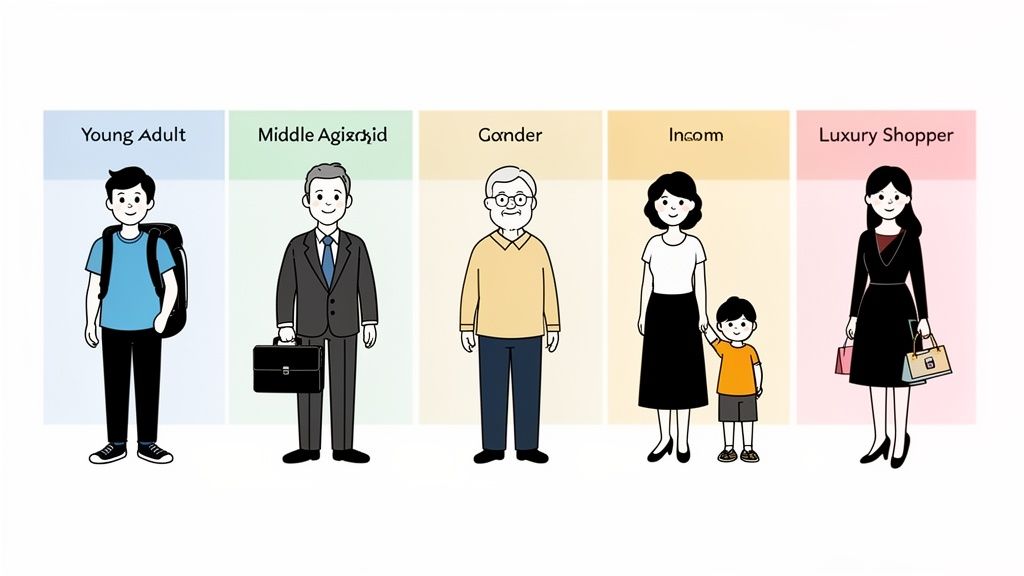
By understanding these core characteristics, merchants can tailor product recommendations, messaging, and loyalty rewards to resonate more deeply. For instance, a skincare brand can target its anti-aging line to customers aged 40+ while promoting acne solutions to a younger 18-25 segment.
Strategic Breakdown & Loyalty Tactics
- Segment Definition: Young Adults (Age 18-24, Lower-to-Mid Income, Students or Early Career).
- Business Objective: Increase average order value (AOV) and encourage initial brand loyalty among new, budget-conscious consumers.
- Recommended Loyalty Tactics:
- Points for Engagement: Reward points not just for purchases, but for social media follows and shares, which this demographic values.
- Referral Program: Implement a "give 15%, get 15%" referral system. Younger audiences are highly influenced by peer recommendations.
- Gamified Challenges: Create a "Student Starter Pack" challenge in Toki where members unlock a bonus reward after purchasing three specific, entry-level products.
Sample Campaign & KPIs
- Sample Reward & Messaging:
- Reward: A free mini-product with their next purchase over $30.
- Messaging: "Hey Student Squad! Get a free Glow Serum mini when you spend $30. Perfect for study breaks!"
- KPIs to Track:
- Customer Lifetime Value (CLV): Monitor if this segment transitions to higher-value purchases over time.
- Referral Rate: Track the percentage of new customers acquired through referrals from this segment.
- Purchase Frequency: Measure how often they return to buy after their initial engagement.
Toki Implementation Quick-Start
To apply this, use Toki to create a dynamic segment for customers whose birthdate indicates they are between 18 and 24. Then, build a points-based campaign that specifically targets this segment with double points on affordable items or exclusive access to student-focused product bundles. You can collect age data through an optional field during your loyalty program signup process.
2. Behavioral Segmentation
Behavioral segmentation is a powerful example of customer segmentation that groups customers based on their actions and interactions with your brand. This method moves beyond who customers are and focuses on what they do, analyzing data like purchase frequency, browsing history, average order value, and engagement with marketing campaigns. For e-commerce brands, understanding user behavior is critical for predicting future actions and personalizing the customer journey.
By tracking how customers interact with your store, you can identify your most loyal advocates, one-time buyers, and those at risk of churning. A brand like Sephora excels at this, using its Beauty Insider program to reward high-frequency buyers with exclusive product access, thereby encouraging the very behavior that defines them as a valuable segment.
Strategic Breakdown & Loyalty Tactics
- Segment Definition: Frequent Purchasers (Customers with 3+ orders in the last 90 days, High AOV).
- Business Objective: Retain high-value customers and increase their brand advocacy by making them feel like exclusive VIPs.
- Recommended Loyalty Tactics:
- Exclusive Tier Access: Create a top-tier level in your loyalty program (e.g., "Gold Members") that is automatically unlocked for this segment, offering perks like free shipping or early access to sales.
- Points Multipliers: Offer 2x or 3x points on all purchases to accelerate their reward earnings, reinforcing their value to your brand.
- Product Testing Invites: Grant this segment exclusive access to test new products before they launch, turning them into a valuable feedback group and making them feel like true insiders.
Sample Campaign & KPIs
- Sample Reward & Messaging:
- Reward: Early access to a new product collection 48 hours before the public launch.
- Messaging: "You're in! As one of our top customers, get exclusive early access to our new Summer Collection. Shop now before anyone else."
- KPIs to Track:
- Repeat Purchase Rate: Ensure this segment maintains or increases its high purchase frequency.
- Share of Wallet: Monitor if their AOV increases after receiving VIP treatment.
- Customer Engagement: Track open rates and click-through rates on exclusive VIP communications.
Toki Implementation Quick-Start
Use Toki to create a dynamic segment of customers who have made more than three purchases in the last 90 days. Next, assign this segment to an exclusive "VIP" tier that automatically applies a points multiplier to their future purchases. You can then use Toki's campaign builder to send this segment an email with a secret link granting them early access to a password-protected collection page on your Shopify store.
3. RFM Segmentation (Recency, Frequency, Monetary)
RFM segmentation is a quantitative example of customer segmentation that evaluates customers based on three key behaviors: Recency (how recently they bought), Frequency (how often they buy), and Monetary value (how much they spend). This data-driven approach is exceptionally valuable for e-commerce because it moves beyond who customers are to how they behave as shoppers. It provides a clear framework to identify your most valuable customers, those at risk of churning, and new customers with high potential.
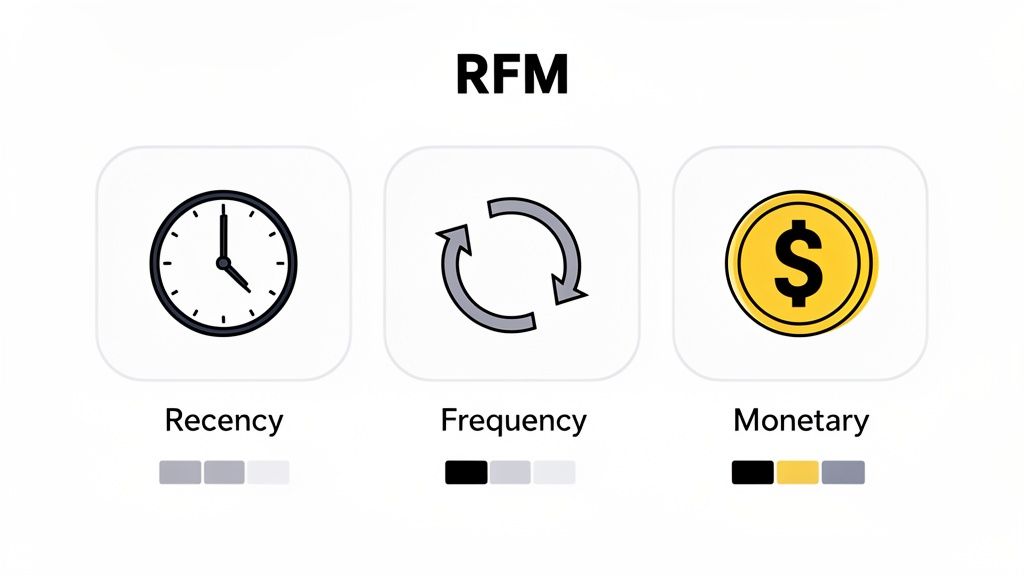
By scoring customers on these three metrics, you can create hyper-targeted segments like "Champions" (High R/F/M) or "At-Risk Customers" (Low R, High F/M). This allows you to allocate your loyalty budget efficiently, rewarding top spenders with exclusive perks while sending win-back offers to those who haven't purchased recently. Learn more about how to identify your most valuable customers using this powerful model.
Strategic Breakdown & Loyalty Tactics
- Segment Definition: At-Risk Champions (Low Recency, High Frequency, High Monetary). These were once top customers but haven't purchased in a while.
- Business Objective: Re-engage high-value customers before they churn and remind them of the brand's value to prevent losing significant CLV.
- Recommended Loyalty Tactics:
- Tier Status Reminder: Send an email highlighting their exclusive tier status and the perks they are at risk of losing.
- Targeted Bonus Points: Offer a significant points bonus (e.g., 500 bonus points) on their next purchase to create a strong incentive to return.
- Personalized "We Miss You" Offer: Use Toki's digital wallet pass to send a personalized high-value coupon directly to their mobile device, creating urgency.
Sample Campaign & KPIs
- Sample Reward & Messaging:
- Reward: 25% off their next purchase and 500 bonus points.
- Messaging: "We've Missed You, [First Name]! Come back and enjoy 25% off + 500 bonus points on us. Your VIP perks are waiting!"
- KPIs to Track:
- Re-engagement Rate: The percentage of the "At-Risk" segment that makes a purchase after receiving the campaign.
- Segment Migration: Track how many customers move from the "At-Risk" segment back to a "Loyal" or "Champion" segment.
- Average Order Value (AOV): Compare the AOV of re-engaged customers to their historical AOV.
Toki Implementation Quick-Start
Use Toki’s RFM analysis tool to automatically create a segment for customers who haven't purchased in the last 90 days (Low Recency) but have a high historical purchase frequency and monetary value. Create a campaign that triggers an automated email and a wallet pass push notification with a unique discount code exclusively for this segment. Set the campaign to run quarterly to continuously capture and re-engage these valuable shoppers.
4. Psychographic Segmentation
Psychographic segmentation is a powerful example of customer segmentation that groups customers based on their intrinsic psychological traits. This method moves beyond who customers are to understand why they buy, categorizing them by values, lifestyle, interests, personality, and attitudes. For e-commerce brands, this unlocks the ability to create emotionally resonant campaigns that build true brand affinity.
By understanding customer lifestyles and values, merchants can align their brand with what matters most to their audience. For example, a sustainable fashion brand can target eco-conscious consumers by rewarding them for choosing carbon-neutral shipping or purchasing items from a recycled collection, reinforcing shared values and strengthening loyalty.
Strategic Breakdown & Loyalty Tactics
- Segment Definition: The Eco-Conscious Advocate (Values sustainability, ethical sourcing, and minimalism; actively seeks brands that align with their principles).
- Business Objective: Foster a community of brand advocates and increase customer lifetime value by rewarding values-driven behavior.
- Recommended Loyalty Tactics:
- Tiered Membership: Create a "Green Tier" that offers exclusive access to sustainable product drops or early-bird pricing on eco-friendly items.
- Points for Action: Award bonus points to customers who recycle old products through a brand take-back program.
- Gamified Badges: Introduce a "Planet Protector" badge in Toki that members earn after making five purchases from the sustainable collection.
Sample Campaign & KPIs
- Sample Reward & Messaging:
- Reward: A 15% donation to an environmental charity of their choice on their next purchase.
- Messaging: "You're a true Eco-Advocate! On your next order, we'll donate 15% to a cause you care about. Let's make a difference together."
- KPIs to Track:
- Advocacy Rate: Measure the percentage of this segment that actively participates in referral programs.
- Engagement with Values-Based Initiatives: Track participation in recycling programs or purchases of specific sustainable products.
- Repeat Purchase Rate: Monitor if reinforcing shared values leads to higher purchase frequency compared to other segments.
Toki Implementation Quick-Start
To implement this, use Toki to run an initial survey during loyalty program signup, asking customers what they value most (e.g., sustainability, community, innovation). Tag customers based on their responses to create a psychographic segment. Then, launch a targeted challenge campaign that rewards them for making purchases that align with those declared values.
5. Geographic Segmentation
Geographic segmentation is a powerful example of customer segmentation that groups customers based on their physical location. This method uses variables like country, city, climate, or proximity to a physical store to tailor marketing efforts. For e-commerce brands with an omnichannel presence, this approach is essential for bridging the gap between online and in-store experiences.
By understanding where your customers are, you can deliver relevant offers, manage logistics more effectively, and create a sense of local community. A retailer, for example, could promote snow-clearing equipment to customers in northern regions while offering swimwear promotions to those in warmer coastal areas, making their marketing feel more personal and timely.
Strategic Breakdown & Loyalty Tactics
- Segment Definition: Urban Customers (Located in major metropolitan areas, near a physical brand store).
- Business Objective: Drive online traffic to physical stores and increase in-store purchase frequency through a unified loyalty experience.
- Recommended Loyalty Tactics:
- Geo-Targeted Wallet Passes: Send push notifications via Apple or Google Wallet with a special offer when a loyalty member is within a certain radius of a brick-and-mortar location.
- In-Store Exclusive Points: Offer double points for purchases made in-store versus online, encouraging foot traffic.
- Click-and-Collect Rewards: Create a Toki challenge that rewards members with bonus points for choosing in-store pickup, reducing shipping costs and creating upsell opportunities.
Sample Campaign & KPIs
- Sample Reward & Messaging:
- Reward: 100 bonus loyalty points for any in-store purchase this weekend.
- Messaging: (Via wallet pass push notification) "You're near our downtown store! Stop in this weekend and get 100 bonus points on any purchase."
- KPIs to Track:
- Online-to-Offline Conversion Rate: Measure the percentage of customers who receive a geo-targeted offer and then make an in-store purchase.
- In-Store Redemption Rate: Track the usage of location-specific loyalty rewards.
- Average Basket Size (In-Store): Compare the AOV of loyalty members who visit the store versus non-members.
Toki Implementation Quick-Start
Use Toki to create a dynamic segment of customers based on the city or postal codes of your physical store locations. Next, integrate with Toki’s Apple and Google Wallet pass feature to set up a geofence around each store. Build a campaign that automatically triggers a push notification with a unique offer to this segment when they enter the defined area, seamlessly connecting their digital and physical shopping journey.
6. Customer Lifecycle Segmentation
Customer lifecycle segmentation is a strategic example of customer segmentation that groups customers based on where they are in their journey with your brand. This method moves from static traits to a dynamic understanding of the customer relationship, categorizing users into stages like New, Active, At-Risk, and Lapsed. For e-commerce stores, it's a powerful way to deliver the right message at the right time.
This approach acknowledges that a first-time buyer has different needs than a long-term advocate. By tailoring interactions to each stage, brands can proactively nurture relationships, prevent churn, and guide customers toward becoming high-value, loyal advocates. For instance, a subscription box can target new subscribers with onboarding tips while offering exclusive add-ons to long-term members.
Strategic Breakdown & Loyalty Tactics
- Segment Definition: At-Risk Customers (Purchased once or twice, but have not engaged or purchased in the last 90 days).
- Business Objective: Re-engage this segment and prevent them from becoming inactive or churning, thereby protecting future revenue streams.
- Recommended Loyalty Tactics:
- Points Expiration Nudges: Send a friendly reminder that their accumulated points are about to expire, creating urgency to return and shop.
- Surprise Point Drops: Deposit a small, unexpected number of points into their account as a "we miss you" gift, encouraging them to browse.
- Exclusive Double-Points Event: Create a time-sensitive campaign offering 2x points on their next purchase, specifically for this inactive segment.
Sample Campaign & KPIs
- Sample Reward & Messaging:
- Reward: A bonus of 250 points, valid for 14 days.
- Messaging: "We've missed you! Here are 250 points to use on your next order. Don't let them go to waste!"
- KPIs to Track:
- Re-engagement Rate: The percentage of "At-Risk" customers who make a purchase after receiving the win-back campaign.
- Churn Rate: Monitor the overall percentage of customers who move from "At-Risk" to "Lapsed" status.
- Time to Next Purchase: Measure the average time it takes for a re-engaged customer to make their subsequent purchase.
Toki Implementation Quick-Start
Use Toki’s RFM analysis to automatically create a dynamic segment for customers who haven't purchased in 90 days but were previously active. Set up an automated campaign that triggers when a customer enters this segment, sending them an email or wallet pass notification with a bonus points offer. You can also create an exclusive challenge visible only to this group, rewarding them for returning to your store.
7. Value-Based Segmentation (Customer Tier)
Value-based segmentation is a powerful example of customer segmentation that groups customers into tiers based on their financial value to your business. Instead of just looking at demographics, this method prioritizes customers who contribute most to revenue and profitability, such as VIPs, high-spenders, or frequent buyers. For e-commerce brands, it's about investing loyalty resources where they will generate the highest return.
This approach aligns perfectly with tiered loyalty programs, allowing merchants to reward their most valuable customers with exclusive perks, better point multipliers, and premium service. By understanding which customers drive the most impact, you can focus on retaining them. For those focusing on customer tiering, understanding how to calculate customer lifetime value (CLV) is essential to properly define these value-based segments.
Strategic Breakdown & Loyalty Tactics
- Segment Definition: VIP Customers (Top 5% of spenders, high purchase frequency, CLV over $1,000).
- Business Objective: Maximize retention of this high-profit segment and foster a sense of exclusivity to encourage continued loyalty.
- Recommended Loyalty Tactics:
- Tiered Point Multipliers: Grant this VIP tier 2x or 3x points on every purchase, making them feel recognized for their spending.
- Exclusive Access: Offer early access to new product launches or limited-edition items before anyone else.
- White-Glove Service: Provide a dedicated customer service line or priority support to resolve issues instantly, reinforcing their VIP status.
Sample Campaign & KPIs
- Sample Reward & Messaging:
- Reward: An invitation to an exclusive virtual event with the brand founder and a free, full-sized product from an upcoming collection.
- Messaging: "You're in! As a Diamond member, you're invited to our exclusive Fall Preview event. Claim your complimentary gift inside."
- KPIs to Track:
- Retention Rate: Monitor the percentage of VIP customers retained year-over-year.
- Revenue Contribution: Track the percentage of total revenue generated by this top tier.
- Tier Migration: Analyze how many mid-tier customers are moving up into the VIP segment.
Toki Implementation Quick-Start
Use Toki to create automated Tiers based on annual customer spend (e.g., Gold: $1,000+). Set up a unique points rule that gives this "Gold" segment 2 points for every $1 spent, while other tiers get 1 point. You can then create an exclusive Toki Challenge that is only visible to the Gold tier, offering a special badge and bonus points for purchasing a newly launched premium product.
8. Engagement Segmentation
Engagement segmentation is a powerful example of customer segmentation that groups customers based on their interaction level with your brand and loyalty program. This method moves beyond purchase data to categorize customers as Highly Engaged, Moderately Engaged, or Disengaged based on touchpoints like website visits, app usage, challenge participation, and campaign responses. For merchants, it reveals how customers connect with your brand outside of transactions.
This approach is crucial for understanding the health of your customer relationships. For example, a fitness app like Peloton identifies its most engaged users through workout frequency and community participation, turning them into brand ambassadors. This segmentation allows you to nurture active users and create targeted strategies to re-engage those who are drifting away.
Strategic Breakdown & Loyalty Tactics
- Segment Definition: Highly Engaged (Logs in weekly, participates in challenges, has earned at least one badge, responsive to campaigns).
- Business Objective: Leverage this segment's enthusiasm to drive community growth and gather valuable product feedback.
- Recommended Loyalty Tactics:
- Community Leader Badges: Award exclusive "Community Hero" or "Brand Ambassador" badges in Toki to recognize top contributors.
- Exclusive Access: Grant this segment early access to new products or a seat on a "customer feedback council."
- UGC Amplification: Create campaigns that reward them for user-generated content, then feature their posts on your social channels.
Sample Campaign & KPIs
- Sample Reward & Messaging:
- Reward: An invitation to an exclusive virtual event with your product development team.
- Messaging: "You're one of our most active members! As a thank you, we'd love for you to join an exclusive sneak peek of our next collection."
- KPIs to Track:
- Referral Conversion Rate: Measure the percentage of new customers acquired through this segment’s referrals.
- UGC Submission Rate: Track the volume of user-generated content submitted during targeted campaigns.
- Segment Retention: Monitor the percentage of this segment that remains highly engaged month-over-month.
Toki Implementation Quick-Start
Use Toki’s analytics to build a dynamic segment of customers who have earned more than three badges and have a login frequency of at least once every 14 days. Create a members-only challenge specifically for this segment, offering a high-value, non-monetary reward like a featured spot in your next newsletter. To learn more, explore these advanced strategies for improving customer engagement.
8-Method Customer Segmentation Comparison
| Segmentation Type | 🔄 Implementation Complexity | ⚡ Resource Requirements | 📊 Expected Outcomes | 💡 Ideal Use Cases | ⭐ Key Advantages |
|---|---|---|---|---|---|
| Demographic Segmentation | Low — simple to collect and analyze | Low — basic profile data or onboarding surveys | Moderate — clear customer buckets for targeted offers | D2C startups, initial audience mapping, basic tiering | Easy to implement and quick to action |
| Behavioral Segmentation | Medium–High — needs event tracking & continuous updates | High — analytics, tracking, realtime data pipelines | High — predictive of repeat purchases and churn reduction | Repeat-purchase optimization, gamification, personalized rewards | Highly actionable and predictive for LTV |
| RFM Segmentation (Recency, Frequency, Monetary) | Medium — requires transactional scoring & cadence | Medium — reliable purchase history and periodic scoring | High — isolates VIPs and at‑risk groups for ROI-focused actions | Retention prioritization, budget allocation, VIP targeting | Quantitative, easy to communicate and optimize spend |
| Psychographic Segmentation | High — needs qualitative research and interpretation | High — surveys, interviews, community research | High (long‑term) — deeper brand affinity and advocacy | Brand-building, purpose-driven programs, community activation | Creates emotional connections that drive advocacy |
| Geographic Segmentation | Medium — needs geolocation & localization setups | Medium — geo‑services, regional inventory/logistics sync | Moderate — improves local relevance and omni‑channel uptake | Brands with physical stores, regional promotions, local offers | Enables hyper‑local targeting and geo‑triggered rewards |
| Customer Lifecycle Segmentation | Medium — requires defined stages and automation rules | Medium — CRM/automation, stage tracking & analytics | High — stage‑appropriate messaging boosts retention & conversion | Subscriptions, onboarding flows, win‑back campaigns | Ensures timely, relevant interventions to reduce churn |
| Value‑Based Segmentation (Customer Tier) | Medium–High — needs profitability and LTV modeling | High — finance integration, margin-aware analytics | High — optimizes ROI by concentrating rewards on high‑value customers | Tiered paid memberships, VIP service allocation, loyalty ROI | Aligns rewards with profitability and justifies premium tiers |
| Engagement Segmentation | Medium — track multi‑channel engagement metrics | Medium — platform analytics, community & gamification tools | High — early churn signals and advocacy identification | Gamified loyalty programs, community-driven brands | Actionable re‑engagement levers; predicts advocacy potential |
From Segments to Success: Your Actionable Takeaways
Throughout this guide, we have explored a diverse set of powerful customer segmentation examples, from foundational demographic and geographic splits to sophisticated RFM and value-based tiering. The core lesson is clear: generic, one-size-fits-all marketing is no longer sufficient in the competitive e-commerce landscape. True growth and lasting loyalty are forged through understanding and catering to the distinct needs, behaviors, and motivations of your specific customer groups.
Each example of customer segmentation we've detailed serves as a blueprint, not a rigid rule. The real power lies in adapting these frameworks to your unique brand and customer base. By moving beyond simple categorization and into strategic action, you transform data from a passive asset into your most potent engine for driving retention, increasing customer lifetime value, and fostering genuine brand advocacy.
Synthesizing Strategy into Action
The journey from data to profit can be distilled into a few key principles. Remember that effective segmentation is an iterative process, not a one-time setup. It requires continuous analysis, testing, and refinement as your business evolves and customer behaviors shift.
Key takeaways to implement immediately:
- Start Simple, Then Scale: Don't feel pressured to implement a complex, multi-layered segmentation model from day one. Begin with a straightforward approach, such as identifying your "At-Risk Customers" through RFM analysis or rewarding your "High-Value VIPs" based on total spend. Master one or two segments before adding more complexity.
- Align Segments with Objectives: Every segment you create should have a clear business goal attached to it. Are you trying to increase purchase frequency, re-engage lapsed customers, or encourage product discovery among new shoppers? This objective-driven approach ensures your efforts are always tied to measurable outcomes.
- Personalization is Paramount: The entire purpose of segmentation is to enable more relevant and personalized experiences. Use your segment insights to tailor everything from email subject lines and reward offers to the loyalty challenges and referral bonuses you present. A targeted message to a "High AOV Shopper" will always outperform a generic blast.
Your Next Steps to Segmentation Mastery
The most successful brands treat customer segmentation as a core business discipline. They understand that a deep-seated knowledge of their audience is the ultimate competitive advantage. This mastery allows them to anticipate needs, pre-empt churn, and build relationships that transcend simple transactions.
Strategic Insight: Your customer data is telling a story. Segmentation is the practice of learning to read that story and write the next chapter yourself, guiding customers on a journey from their first purchase to lifelong loyalty.
Embracing this philosophy means moving from theoretical knowledge to practical application. The next step for your brand is to dive into your own data. Identify just one example of customer segmentation from this article that resonates with your current business goals. Whether it's nurturing your "New Subscribers" or celebrating your "Brand Champions," launching a small, targeted campaign is the best way to build momentum and see immediate results. This hands-on experience will provide invaluable learnings that you can build upon for future, more advanced segmentation initiatives.
Ready to turn these segmentation strategies into automated, engaging loyalty programs? Toki provides the tools to effortlessly segment your customers based on RFM, spending habits, and engagement, then launch targeted points, tiers, and referral campaigns. Start building deeper customer relationships today by exploring Toki.