How Does a Referral Work and How to Build a Growth Engine
Discover how does a referral work from share to sale. Our guide breaks down the mechanics, rewards, and strategies to turn customers into powerful advocates.
At its core, a referral program turns your best customers into your most authentic sales team. It’s a beautifully simple concept: a happy customer tells a friend about your brand, and when that friend buys something, you thank both of them with a reward.
This isn't just random luck; it's a structured, measurable way to harness the power of word-of-mouth marketing.
The Three Key Players in Every Referral
The best way to get your head around how a referral works is to see it as a story with three main characters. Each one plays a distinct part, and when they all align, your business grows through genuine, trusted recommendations.
The Advocate: Your Loyal Customer
First up is the Advocate. This is your existing customer who is genuinely thrilled with your products. They’ve had a fantastic experience and are more than willing to vouch for you to their friends and family.
Their motivation often goes beyond just getting a discount. They want to share something great with people they care about. When they step into this role, they become a true brand advocate, acting as a powerful and authentic voice for your business. For a deeper dive, check out our guide on what is brand advocacy and how it can supercharge your growth.
The Friend: The Referred Lead
Next, we have the Friend (sometimes called the referee). This is a potential new customer who trusts the Advocate’s judgment. Maybe they were already in the market for what you sell, or maybe the enthusiastic recommendation was the spark that got them interested.
Trust is the magic ingredient here. A suggestion from a friend slices through the clutter of typical ads, making the Friend far more receptive. In fact, people are four times more likely to buy when referred by someone they know.
The Merchant: Your Brand
Finally, there’s the Merchant—that’s you. Your job is to set the stage for this entire interaction. You’re the one who creates the amazing products and experiences that turn a regular customer into an Advocate in the first place.
You also build the referral program itself—defining the rewards and providing the simple tools (like referral links or codes) that make sharing and tracking a breeze. Your goal is to bring in fantastic new customers more cost-effectively than you could with traditional ads.
By rewarding both the Advocate and the Friend, you create a perfect win-win-win situation:
- The Advocate feels appreciated and gets a nice bonus.
- The Friend gets an incentive to try a great new brand they can trust.
- The Merchant acquires a high-value new customer and deepens the bond with a loyal one.
The Referral Journey from Share to Sale
So, how does a referral actually work? Think of it like a digital breadcrumb trail. It’s an automated process that connects a happy customer’s recommendation directly to a new sale for your store. Let's walk through this path together, from the moment a customer shares to when the rewards are paid out.
At the heart of it all is a simple but crucial piece of tech: a unique referral link or code. Every customer who joins your program gets their own distinct link, which acts like their digital signature. This is the secret sauce that lets you track exactly who sent whom.
This flow breaks down how your customer (the Advocate), their friend, and your store all work together to make a referral happen.
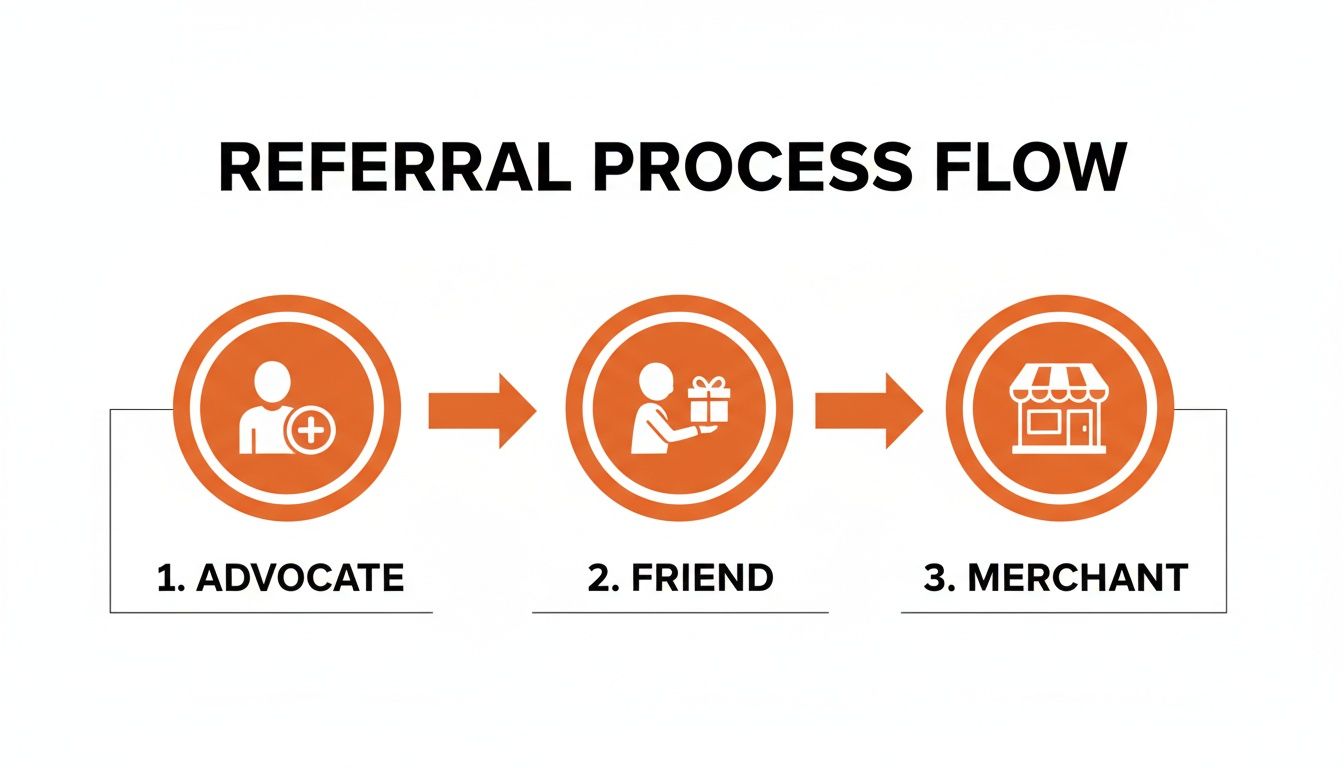
As you can see, the process starts with a simple share and creates a positive feedback loop. Everyone wins, and you get a new customer.
Step 1: The Advocate Shares Their Link
It all kicks off when one of your loyal customers decides to spread the word. They'll grab their unique referral link, which you can make available in a few places—like your program's dashboard, a pop-up after they buy something, or a dedicated email.
From there, they can send it out however they like:
- Social Media: A quick post to their Instagram story or in a relevant Facebook group.
- Messaging Apps: A simple text to a friend through WhatsApp or iMessage.
- Email: A direct recommendation to a colleague who they know would be interested.
When your customer shares that link, they’re not just passing along a URL; they're vouching for you. And that personal stamp of approval is what makes referral marketing so incredibly powerful.
Step 2: The Friend Clicks and Shops
The friend gets the recommendation and clicks the link. This is where the tracking magic begins. That click places a small tracking file, known as a cookie, on the friend’s browser. This cookie essentially tells your e-commerce platform, "Hey, this person was sent here by Jane Doe's referral link!"
This transfer of trust is ridiculously effective. A whopping 92% of consumers trust referrals from people they know over any other type of advertising, and people are 4 times more likely to buy when referred by a friend.
For the friend, the experience is totally seamless. They land on your site, and if your program offers an instant discount, it’s often applied to their cart automatically. This immediate reward makes the recommendation feel real and gives them a great reason to follow through and make a purchase.
Step 3: The System Validates and Rewards
Once the friend completes their first purchase, your referral system kicks into gear. It double-checks the tracking cookie to confirm the sale came from the advocate’s link. It also verifies that all the program rules were met—for instance, making sure the friend is genuinely a new customer or that their order hit a minimum value.
After the sale is validated (usually following a short delay to account for any returns), the system automatically triggers the rewards. The advocate gets whatever you promised them, whether that’s store credit, a discount on their next order, or cash. This closes the loop, rewarding your customer for their loyalty and making them much more likely to refer someone again. This simple mechanism is so potent that, on a global scale, about 65% of all new business comes from referrals. To dig deeper, you can explore more about the proven effectiveness of referral marketing and its ROI.
Choosing Incentives That Actually Motivate Action
The core mechanics of a referral program are simple, but the incentive is the real engine. Getting this right isn't just about giving away free stuff; it’s about understanding what truly motivates people to act. A weak incentive will fall flat, but a strategic one can turn your happy customers into a powerful growth channel.
The most successful programs almost always use dual-sided incentives. This means both the referrer (your current customer) and their friend (the new one) get a reward. This simple structure makes the whole exchange feel like a genuine gift, not a sales pitch. Your customer feels good about hooking their friend up with a deal, which is a much stronger motivator than just earning a commission.
On the flip side, you have single-sided incentives that only reward one person. While they seem simpler, they can feel a bit lopsided. Rewarding only your existing customer can make their recommendation seem self-serving. And if you only reward the new friend, what's in it for your loyal customer to even bother sharing?
Finding the Right Reward Type
The best reward for your brand will depend on your products, profit margins, and typical customer behavior. Don't just pick one at random—each type has a different psychological pull.
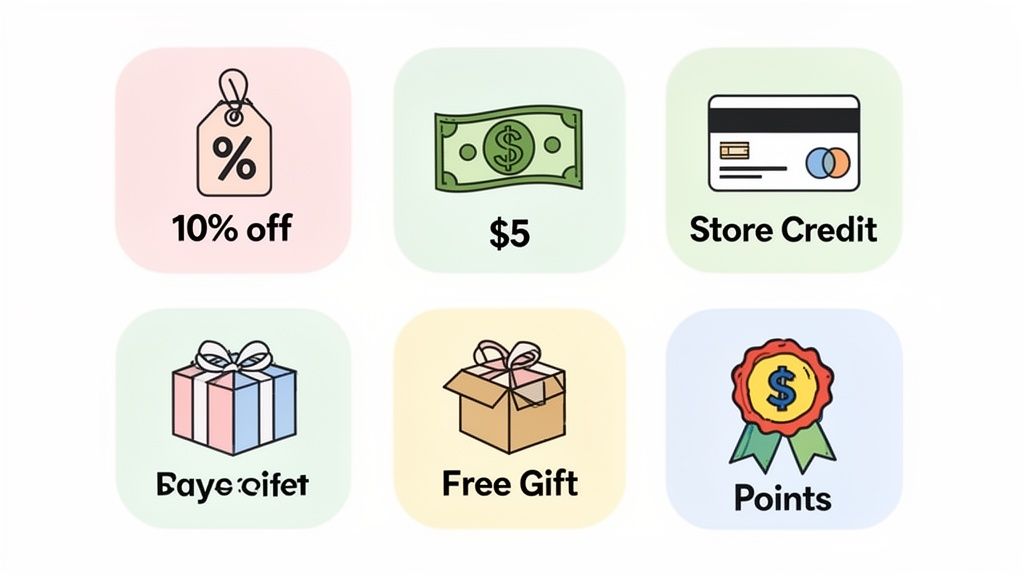
- Percentage Discounts (e.g., 20% off): These are always a crowd-pleaser because they scale. The bigger the cart, the bigger the savings, which can subtly encourage customers to spend more.
- Fixed-Amount Discounts (e.g., $10 off): This is a fantastic option for brands with lower-priced items. A $10 discount feels substantial on a $40 purchase, making the offer hard to ignore.
- Store Credit: This is my personal favorite for boosting retention. It guarantees that the reward money comes right back to your store, driving repeat purchases from both your existing customer and the new one you just acquired.
- Free Product or Gift: Want to create a "wow" moment? A free gift has a high perceived value but often costs you less than a cash discount. It’s also a great way to introduce a bestseller or a new product.
To help you decide, here’s a quick breakdown of how these common reward structures stack up against each other.
Comparing Common Referral Reward Structures
| Reward Type | Best For | Pros | Cons |
|---|---|---|---|
| Percentage Off | Brands with a wide range of price points or high AOV. | Scales with order value, encouraging larger purchases. Simple to understand. | Can cut deeply into margins on high-ticket items if not capped. |
| Fixed Amount ($) | Brands with a lower AOV or subscription models. | Easy to budget for and feels very tangible to customers. | May seem insignificant on very large orders, reducing motivation. |
| Store Credit | Businesses focused on customer retention and lifetime value. | Guarantees the reward is spent back in your store. Encourages repeat business. | Less attractive for customers who don't plan to shop again soon. |
| Free Product/Gift | Brands with high-margin products or a "hero" item to promote. | High perceived value. Can be a low-cost way to create excitement. | The gift may not appeal to everyone. Adds logistical complexity. |
Ultimately, the goal is to choose a reward structure that not only makes financial sense for your business but also feels like a genuine "thank you" to your customers.
The key is to offer something your customer genuinely values. While cash is a popular motivator, many businesses find incredible success with gift cards, service discounts, or exclusive perks. The reward should feel like a meaningful thank-you, not an afterthought.
Choosing the right structure is crucial for making your referral program work effectively. You can learn more about specific referral incentive ideas and examples to find what best fits your brand. For more advanced programs, you might even consider tiered rewards, where Advocates unlock better incentives as they refer more friends, gamifying the experience and encouraging repeat sharing.
Measuring the True Business Impact of Referrals
A great referral program does more than just rack up new sales. It’s about acquiring better customers—the kind who stick around and become your most profitable advocates. That first referred purchase is a great win, but the real magic happens over the long haul. By keeping an eye on a few key performance indicators (KPIs), you can see exactly how referrals build a stronger, more resilient business.
The single most important metric to watch is Customer Lifetime Value (LTV). This isn't just about one sale; it's the total revenue you can expect from a customer over their entire relationship with your brand. Referred customers almost always have a higher LTV because they come in with a foundation of trust, leading them to buy more often and for longer than someone who just clicked an ad.
Key Metrics That Define Referral Success
To really get what a referral program is doing for your bottom line, you have to look past the initial transaction. A few interconnected metrics will paint a crystal-clear picture of your program's profitability and how it fuels sustainable growth.
Here’s what to track:
- Average Order Value (AOV): This is simply the average dollar amount spent each time a customer places an order. Friends trust friends, so referred customers often show up ready to spend more on their very first purchase.
- Customer Retention Rate: This is the percentage of customers who come back to buy from you again. Great retention means you aren't stuck on the expensive treadmill of constantly acquiring new shoppers.
- Customer Acquisition Cost (CAC): This is what it costs you, all in, to get a new customer through the door. A well-run referral program is hands-down one of the most cost-effective ways to grow your customer base.
The financial impact here is huge. Studies consistently show that referred customers have a 16% higher lifetime value and a massive 150% higher average order value compared to customers from other channels. Even better, they stick around, boasting a 37% higher retention rate.
Calculating the Financial Payoff
When you put these numbers together, the economic advantage is undeniable. Your Customer Acquisition Cost (CAC) plummets because you're rewarding your existing loyal customers, not just feeding the ad platforms. This efficiency directly translates to a much higher Return on Investment (ROI) for your marketing spend.
To make sure your program is pulling its weight, it’s crucial to understand how to measure marketing effectiveness in a holistic way. It's not just about a single sale. It's about creating a growth flywheel where your best customers bring you more high-value customers, sparking a cycle of profitable, organic growth.
For those who want to get even more precise, you can dive deeper into exploring specific strategies for referral program tracking to fine-tune every part of the process. This data-first mindset proves that a referral is far more than just a transaction—it's a long-term investment in building a more valuable business.
Best Practices for a Successful Program Launch
Getting a referral program off the ground is one thing; making it a real growth driver is another. A great launch isn’t about just flipping a switch. It's about designing an experience so smooth and rewarding that your customers can't help but share.
The absolute fastest way to kill your program’s momentum is with a clunky, confusing user experience. Your customers need to find their referral link, grasp the offer, and share it in seconds. If they have to hunt for the page or decipher complicated rules, even your biggest fans will give up.
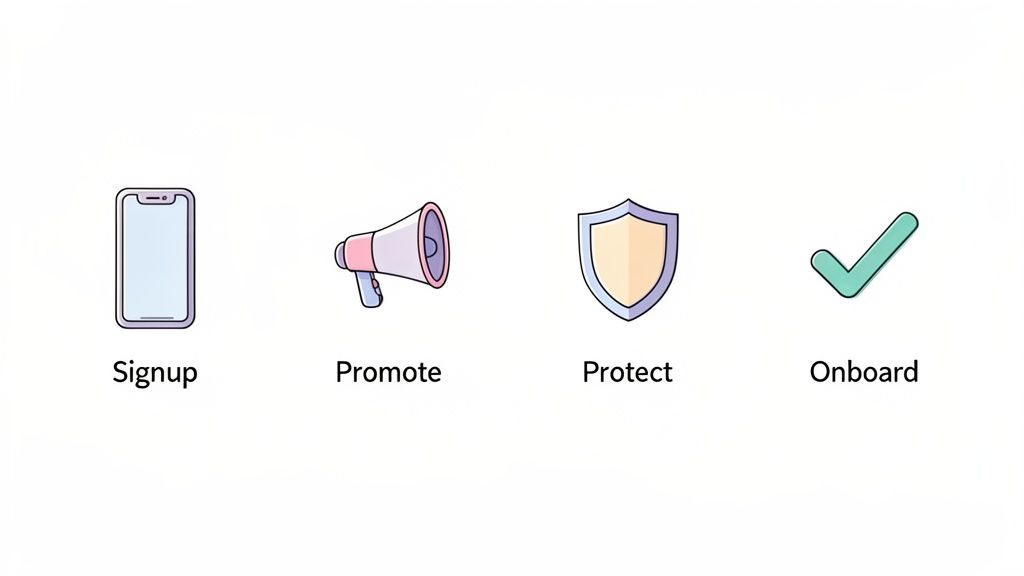
This seamless design needs to be backed up by great copy. Make the "what's in it for me?" crystal clear for both your customer and their friend. Use exciting, straightforward language that positions the referral as a cool tip or a genuine gift, not a sterile transaction.
Promote Your Program Everywhere
Don’t expect customers to magically discover your program. You have to put it right in front of them. Weave your referral program into every high-traffic touchpoint you have.
- Email Campaigns: Kick things off with a dedicated email blast to your entire list, explaining exactly how it works and what they get.
- Post-Purchase Pages: The moment after a customer buys is when they're most excited about your brand. Ask for a referral right there on the thank-you page.
- Social Media: Design some eye-catching, shareable graphics that make it dead simple for your followers to spread the word.
- Website Banners: A clean, prominent banner or a well-timed pop-up on your homepage can do wonders for grabbing attention.
A huge mistake is treating the launch like a one-and-done event. Real momentum comes from sustained promotion. Keep mentioning your referral program in newsletters, social posts, and even your order confirmation emails.
Protect Your Program from Day One
Referral marketing runs on trust, but you still need to set some ground rules to prevent people from gaming the system. A few simple guardrails can protect your budget without creating a headache for your legitimate brand advocates.
Consider setting rules like:
- New Customers Only: Rewards should only go out for acquiring genuinely new customers.
- No Self-Referrals: Block users from trying to refer themselves with a different email account.
- Minimum Spend: Make sure the referred friend's first purchase hits a certain dollar amount to qualify.
The power of referral marketing is undeniable, with 47% of companies now running a program. The tech behind it makes a huge difference, too; brands using referral software generate 2.3x more referrals than those tracking manually. This principle of leveraging networks isn't just for marketing—it applies to finding great talent, too, as companies learn how to find developers who are a perfect fit.
Common Questions We Hear from Merchants
Even when you've got the basics down, a few practical questions always pop up when it's time to build a referral program. Nailing these details is often the difference between a program that takes off and one that fizzles out. Let's walk through some of the most common questions we hear from store owners trying to figure out how referrals work in the real world.
Getting these things right from the start builds confidence and helps you launch a program that’s a win for your business and a real treat for your customers.
How Much Should I Actually Give Away as a Reward?
This is the big one, and the good news is, you don't have to guess. The sweet spot for a reward is finding that perfect balance between being exciting enough to get people to act and still protecting your profit margins. A solid place to start is tying it to your Average Order Value (AOV).
A simple, effective rule of thumb is to offer a reward that’s about 10-20% of your AOV. For instance, if your typical customer spends $100, a reward in the $10 to $20 range is a fantastic starting point. It’s a meaningful incentive that encourages sharing without cutting too deeply into your revenue.
Keep in mind, this reward is usually split when you're running a two-sided program. So for a $20 total reward, you could give the referrer $10 off their next purchase and the new customer $10 off their first one. Everyone feels like they got a great deal.
When Is the Right Moment to Ask for a Referral?
Timing is everything. Ask at the wrong moment, and it feels pushy. Ask at the right one, and it feels like a natural, welcome suggestion. The absolute best time to pop the question is right after a customer has had a great experience with your brand.
Think about these moments of "peak happiness" as your golden opportunities:
- On the post-purchase "thank you" page: The customer is feeling good—they just bought something they're excited about. A quick pop-up or banner asking them to share the love works wonders here.
- In the shipping confirmation email: They're eagerly awaiting their package. This is a great, low-pressure spot to mention your program.
- Right after they leave a 5-star review: You can't get a better signal than this. Someone who just took the time to publicly praise your brand is primed to become an advocate.
How Do I Stop People from Gaming the System?
Look, most of your customers will be honest, but it's always smart to have a few simple guardrails in place to prevent fraud. This just protects your budget and makes sure the rewards go to people who are genuinely bringing you new business.
You don't need a fortress of security; a few basic rules will do the trick:
- Block Self-Referrals: Your referral software should be able to automatically flag and block someone from referring themselves with a different email on the same device.
- Require a Minimum Spend: To make sure the new customer is legit, you can require their first purchase to be over a certain amount before any rewards are unlocked.
- Set a Reward Delay: It's a good idea to put a short hold on reward payouts (say, 7-14 days) just in case of returns or order cancellations.
These simple steps keep your program healthy without creating a bunch of hoops for your real fans to jump through.
Will a Referral Program Even Work for My Niche?
One of the biggest myths out there is that referral marketing only works for certain products. The truth is, word-of-mouth is universal. If you have happy customers, you have the raw material for a successful referral program.
The model is incredibly flexible. It doesn’t matter if you sell high-end audio gear, monthly subscription boxes, obscure craft supplies, or everyday home goods. The engine is the same: people trust recommendations from people they know. As long as your product is good and your customers love it, they’ll have a reason to share it. Your job is just to make it easy and worthwhile for them to do so.
Ready to turn your best customers into your most powerful growth channel? Toki makes it easy to launch a beautiful, automated referral program that integrates directly with your Shopify store. Stop guessing and start growing with a system designed to build loyalty and drive sales.