Build a High-Growth Friend Referral Program on Shopify
Launch a friend referral program that drives real growth. Learn proven strategies for designing incentives, preventing fraud, and acquiring loyal customers.
A friend referral program is your secret weapon. It turns your most enthusiastic customers into a genuine, high-performing sales team. Instead of sinking more money into ads, you're rewarding the people who already love your brand for spreading the word. It's a win-win that builds a cost-effective and trustworthy way to grow your business.
At its core, this strategy is all about word-of-mouth, which remains one of the most powerful forces in marketing.
The Real Value of a Shopify Referral Program
Don't think of a friend referral program as just another marketing tactic. It's a growth engine. It’s a system designed to find your biggest fans and give them a simple, compelling reason to share their favorite products with their network. This transforms casual brand love into a measurable and scalable sales channel.
Think about it. Traditional advertising can feel interruptive and impersonal. But a recommendation from a friend? That comes with instant trust baked right in. When someone you know suggests a product, it feels personal and genuine, cutting through the noise and skepticism that most shoppers have toward paid ads.
Why Peer Recommendations Crush Ads
The psychology behind it is straightforward: people trust people. An incredible 88% of consumers trust recommendations from people they know above all other forms of advertising. That trust is golden—it leads directly to higher conversion rates and, frankly, better customers.
Referred customers aren't just a quick sale. They stick around longer and spend more, boasting a 16% higher lifetime value (LTV) on average. This makes them absolute gold for DTC brands, especially those using tools like Toki to create these kinds of loyalty loops. You can dig deeper into more referral marketing stats and their impact over on our blog.
The real magic here is that you're creating a self-sustaining cycle of growth. Every happy new customer has the potential to become your next brand advocate, which can expand your reach exponentially without your marketing budget having to keep pace.
Impact on Key Business Metrics
Beyond the immediate sales bump, a smart referral program has a huge positive effect on your business's financial health. It’s one of the most proven strategies to lower customer acquisition cost because you're only paying for results.
Let’s break down the benefits:
- Slashed Acquisition Costs: You're rewarding your current customers to do your marketing for you. That’s almost always cheaper than chasing cold leads through paid ads.
- Higher Lifetime Value: Customers who come from a referral have a 37% higher retention rate. They come back again and again.
- Sky-High Conversion Rates: A warm lead from a trusted friend is far more likely to buy than a random person who saw an ad.
When you understand the full meaning of a referral program, you realize it's not just a campaign—it's an investment in a loyal community that grows your business organically from the inside out.
Defining Your Strategy and Setting Clear Goals
Diving into a friend referral program without a solid plan is a recipe for wasted effort. You might see a little activity here and there, but you’ll never get the kind of explosive growth that a truly high-impact program can deliver. It all starts with a simple, yet critical question: what are you really trying to accomplish?
The answer to that question will shape every single decision you make, from the rewards you offer to the copy on your referral page. Are you laser-focused on acquiring new customers? Or is the goal to get your existing fans to buy more often? Maybe you just want to create a ton of buzz and brand awareness. Each of these goals requires a completely different playbook. If you need some inspiration, check out these powerful referral marketing strategies to get the ball rolling.
Once you know your "why," you have to get specific about the "what." Vague goals like "get more customers" are essentially useless because you can't measure them. This is where you need to get disciplined and set SMART goals—specific, measurable, achievable, relevant, and time-bound.
Pinpointing Your Primary Objective
Let’s talk specifics. If you're a new DTC brand, your world probably revolves around customer acquisition. A great goal would be to acquire 500 new customers through referrals by the end of Q3.
On the other hand, a more established business with a loyal following might be more interested in increasing customer lifetime value (LTV). Their goal could be something like driving a 15% increase in repeat purchases from referred customers within six months.
Your objective also has to feel like it comes from your brand. A luxury brand’s program should feel exclusive and high-end. A fun, community-driven brand needs messaging that’s casual and encourages friends to share in a low-pressure way.
Expert Tip: Don’t try to do everything at once. Pick one primary objective—acquisition or loyalty—and nail it. A focused program gets better results and gives you much cleaner data to learn from. You can always add more goals later.
Setting and Tracking Your KPIs
With your goals locked in, you need to know if you're actually hitting them. Key Performance Indicators (KPIs) are the dashboard for your referral program. They tell you what's working, what's broken, and where you need to focus your attention.
Here are the non-negotiable KPIs you should be tracking from day one:
- Participation Rate: This is simple: what percentage of your customers are even bothering to sign up? If this number is low, your offer might be hard to find or just not that exciting.
- Share Rate: Of the people who sign up, how many are actually sending their referral link to friends? This is a direct measure of how engaged your advocates are.
- Referral Conversion Rate: This is the big one. It's the percentage of referral links that actually turn into a sale from a new customer.
- Cost Per Acquisition (CPA): How much are you spending on rewards to get one new customer? Your goal is for this number to be way lower than what you’re paying for customers from paid ads.
By setting these goals and KPIs before you launch, you're building a strategic growth engine, not just a marketing tactic. You’ll have a clear roadmap to guide your decisions and a reliable way to measure what’s actually driving your business forward.
Designing Incentives That Actually Motivate
Let's be honest: a referral program lives or dies by its reward. You can have the slickest tech and the most beautiful marketing, but if the incentive doesn't get people excited, the whole thing will fall flat. The real secret is designing a reward that feels genuinely generous, fits your brand like a glove, and gets both your loyal customers and their friends to actually do something.
A simple discount is a decent place to start, but we need to think bigger. We're aiming to create a win-win scenario that feels less like a sales pitch and more like one friend helping another discover something great.
Choosing the Right Reward Model
Not all rewards are created equal. Different incentives tap into different motivations, so it's crucial to pick the one that makes the most sense for your customers and your business goals.
-
Store Credit or Gift Cards: This is a fantastic way to drive repeat business. When you give both the referrer and the new customer credit, you're essentially ensuring they come back to shop again. It’s incredibly cost-effective because the value stays entirely within your ecosystem.
-
Exclusive Products or Early Access: Got a passionate, loyal following? This is your move. Offering a special product or first dibs on a new collection creates a powerful sense of VIP status. For these customers, exclusivity and community belonging can be far more valuable than a few dollars off.
-
Cash Back: Sometimes, the most straightforward approach is the best. A direct cash-back offer is universally understood and appealing, cutting straight to the point.
The most effective referral programs I've seen all have one thing in common: they feel generous. When a customer can share a great deal that also benefits their friend, it transforms the act from a self-serving promotion into a genuine, helpful recommendation.
This two-sided approach is a powerhouse. The global market for referral programs has exploded to $4.8 billion, and it's no coincidence that double-sided incentives are the most popular, used by 78% of brands. The data backs it up: 65% of referrers say they prefer to share rewards that their friends also get, which helps lift referral conversion rates by an average of 30%. You can dig into more referral marketing stats to see just how impactful this can be.
To help you decide, here’s a quick breakdown of the most common incentive structures.
Comparing Referral Incentive Models
This table compares common incentive models to help you choose the best structure for your brand and goals.
| Incentive Model | Best For | Pros | Cons |
|---|---|---|---|
| Store Credit | E-commerce brands focused on LTV | Drives repeat purchases, cost-effective (value stays in-house). | Less appealing to customers who don't plan to shop again soon. |
| Percentage Discount | Brands with varying product prices | Easy to understand, flexible across all price points. | Can devalue the brand if overused, lower perceived value on small orders. |
| Fixed Cash Amount | Subscription services, high-value items | Highly motivating and tangible. | Can be costly, doesn't guarantee the referrer will spend it with you. |
| Free Product/Service | Brands with high-margin "hero" products | High perceived value, introduces new products to customers. | Logistical complexity, may not appeal to all customers. |
| Exclusive Access | Brands with a strong community/cult following | Builds loyalty and exclusivity, very low direct cost. | Only works for highly engaged audiences, value is subjective. |
Ultimately, the right model depends on your margins, your customer base, and what you want to achieve. Don’t be afraid to test different models to see what resonates most.
Personalizing Rewards for Maximum Impact
A one-size-fits-all reward can feel impersonal and, frankly, a bit lazy. Why not treat your best customers like the VIPs they are? By segmenting your audience, you can tailor incentives that really hit home. For instance, you could offer your highest-spending customers a much more substantial reward than a first-time buyer.
One of the most effective strategies I’ve implemented is a tiered reward system. It gamifies the referral process and gives your most enthusiastic advocates a clear reason to keep sharing.
Here’s a simple structure you could adapt:
- Bronze Tier (1-3 Referrals): Start with a solid reward, like a $20 store credit.
- Silver Tier (4-9 Referrals): Level it up. How about $30 store credit plus a small free gift?
- Gold Tier (10+ Referrals): Go big for your top advocates. A $100 gift card or an exclusive product makes them feel truly valued.
Tiered systems work because they create a sense of achievement and ongoing motivation. Your best customers have a clear path to earning more, which keeps them engaged and referring month after month.
If you're feeling stuck and need some more inspiration, check out these powerful referral incentive ideas to get your creative juices flowing.
Building a Referral Experience That Just Works
Let's be honest: even the most amazing rewards won't matter if your referral process is a pain to use. A referral program lives or dies on how easy you make it for customers to share. The real goal is to get rid of every possible roadblock, so that when a customer feels that spark of excitement about your brand, sharing it is a simple, two-second tap.
This all starts with the basics: your program must instantly generate a unique, trackable referral link for every single customer. These links are the backbone of the whole system, making sure you can trace every new customer back to the person who sent them. Forget clunky systems that make people copy and paste codes—modern programs handle all of this automatically behind the scenes.
This simple flow is what we're aiming for. It's a classic win-win that keeps the cycle going.
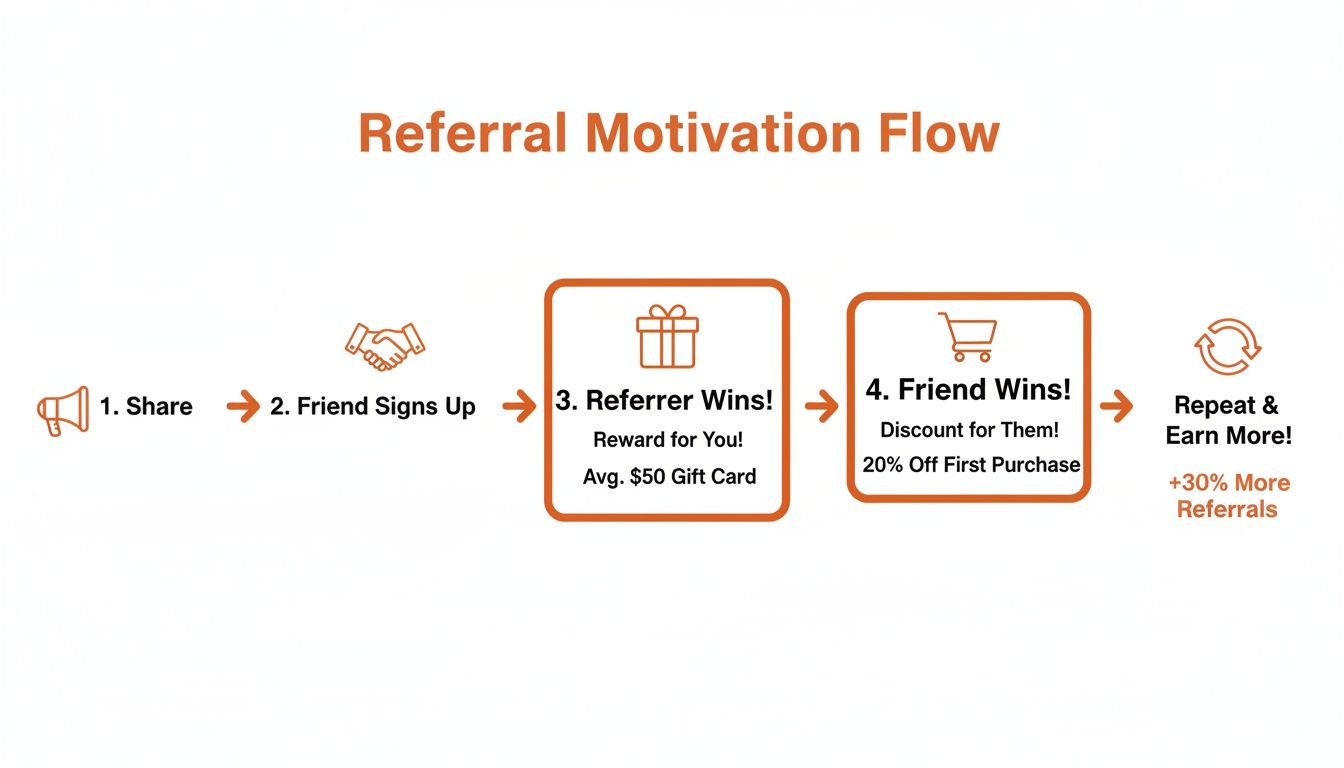
As you can see, the journey is a straightforward, rewarding loop. The original customer and their friend both get something valuable, which creates a growth engine that basically runs itself.
Making the Share Effortless
Once a customer has their link, the next hurdle is getting them to actually send it. Don't make them think about what to say. You should do the heavy lifting by providing pre-written (but editable!) messages for email, text, and social media.
Think of something simple and direct, like:
"Hey! I've been loving [Your Brand] and thought you would too. Use my link to get $20 off your first order, and I'll get a little something too. It’s a win-win!"
This small touch removes the awkwardness and dramatically boosts your share rate—the percentage of people who go from thinking about referring to actually doing it. This is also where a well-designed referral landing page comes into play, as it needs to clearly explain the offer to the new visitor and push them toward that first purchase.
Bringing Referrals into the Modern Age with Digital Wallets
In a world where everyone is glued to their phone, the smoothest experience meets customers where they live: their digital wallets. Integrating your program with Apple Wallet and Google Wallet isn't just a gimmick; it's a massive leap forward in convenience.
Picture it: a customer earns a reward, and instead of getting lost in an email inbox, it appears as a pass in their digital wallet. Your brand stays visible, and their reward is always just a tap away.
With a tool like Toki, you can automatically issue wallet passes that hold referral codes and even send push notifications when new rewards are earned. This is a brilliant way to make sure rewards actually get used, making the whole program feel incredibly polished and modern.
This approach means referral codes are never forgotten. When the friend is ready to buy—whether online or at a physical store—the code is right there on their phone, ready to be scanned. It’s the final piece of the puzzle for creating a truly frictionless experience that gets people excited to participate and gives you the best possible return.
Measuring Success and Optimizing Performance
So, you’ve launched your friend referral program. That’s a huge first step, but the real work—and the real growth—starts right now. The line between a program that fizzles out and one that becomes a powerful growth engine is drawn with data, testing, and constant improvement. If you're not tracking, you're just guessing.
Think of your program as a living, breathing part of your marketing strategy. It needs attention and small tweaks to hit its peak performance. By keeping a close eye on the right metrics, you’ll see exactly how customers are engaging, what actually gets them to share, and where your biggest opportunities are hiding in plain sight.
Identifying Your Core Program KPIs
To really understand your program’s health, you need to zero in on a few essential Key Performance Indicators (KPIs). These numbers cut through the noise and give you actionable insights into what's actually driving results.
Here’s what I recommend tracking right from the get-go.
- Participation Rate: What percentage of your customers have actually signed up for your referral program? A low number here might mean the program is buried on your site or the sign-up incentive isn't strong enough.
- Share Rate: Of the people who signed up, how many are actually sharing their referral link? This metric tells you a lot about advocate engagement and how easy you've made it for them to spread the word.
- Referral Conversion Rate: This is the big one. What percentage of those shared links lead to a purchase from a new customer? This tells you how compelling your offer is to the friend on the receiving end.
Watching these KPIs gives you a solid foundation for making smart, data-backed decisions. For a much deeper look, our guide on effective referral program tracking breaks down even more strategies to make sure you’re measuring what truly matters.
Below is a quick-glance table of the most crucial KPIs to keep on your dashboard.
Key KPIs for Your Referral Program
| KPI (Key Performance Indicator) | What It Measures | Why It Matters |
|---|---|---|
| Participation Rate | % of total customers who enroll in the program. | Indicates program visibility and the initial appeal of your offer. |
| Share Rate | % of enrolled members who share their link or code. | Directly reflects advocate engagement and the ease of the sharing process. |
| Referral Conversion Rate | % of referral link clicks that result in a purchase. | The ultimate bottom-line metric; shows the effectiveness of the friend's offer. |
| Referral Traffic | The volume of website visits from referral links. | Shows how much new traffic your advocates are driving to your store. |
| Cost Per Acquisition (CPA) | Total cost of rewards divided by new customers acquired. | Helps you understand the ROI and efficiency compared to other marketing channels. |
Tracking these consistently will quickly show you where your program is excelling and where it needs a little nudge.
Using A/B Testing to Find What Works
Once you've got your baseline numbers, it’s time to start experimenting. A/B testing is your secret weapon here. The key is to test one variable at a time to see what actually moves the needle on your KPIs. Don’t fall into the trap of changing everything at once—you’ll never know what really worked.
For example, you could test two different reward structures.
- Group A: Offer a $20 store credit.
- Group B: Offer a 15% discount coupon.
Run each offer for a set period, then compare the share rates and conversion rates. The data will tell you exactly which incentive your customers and their friends prefer.
Key Takeaway: The goal of optimization isn't to find a single "perfect" setup and then walk away. It's about building a rhythm of continuous improvement where you're always learning what motivates your specific audience.
Protecting Your Program from Fraud
As your program gains traction, you need to protect its integrity and your budget. Referral fraud—things like self-referrals, fake accounts, or coupon abuse—can quickly drain your resources and completely skew your data.
Luckily, putting some simple safeguards in place is all it takes.
- Set a minimum purchase amount. This ensures the new customer has to spend a certain amount to qualify, weeding out low-value transactions just to snag a reward.
- Reward first-time buyers only. The goal is acquiring new customers, so make sure the reward only applies to people who have never purchased from you before.
- Keep an eye out for suspicious patterns. Look for red flags like a single IP address generating tons of referrals or one person referring dozens of "friends" in a day.
Most modern referral platforms have built-in fraud detection that handles the heavy lifting for you. By being proactive, you can ensure your investment goes exactly where it should: to your genuine brand advocates and the high-value customers they bring in.
Answering Your Top Referral Program Questions
Even with a killer strategy in hand, you're bound to have questions before flipping the switch on a new marketing program. That's just smart business. A friend referral program is no exception, and getting straight answers can make all the difference between a flop and a runaway success.
Let's dive into some of the most common questions I hear from Shopify merchants right before they go live.
What's the Right Amount for a Referral Reward?
Figuring out the perfect reward is part art, part science. The sweet spot really depends on your Average Order Value (AOV) and Customer Lifetime Value (LTV). A solid rule of thumb I've seen work time and again is to offer a reward that's around 15-20% of your AOV.
So, if your average customer spends $100, a $15 or $20 reward for both the person referring and their friend is a pretty compelling deal. It feels generous enough to get people to act, but it won't kill your profit margins.
The brands that absolutely crush it with referrals don't just set their rewards and forget them. They're constantly A/B testing different offers. You might even find that an exclusive product or early access for your top advocates works better than cash.
When's the Perfect Moment to Ask for a Referral?
Timing is everything. You've got to catch customers right in that moment of post-purchase bliss when they're feeling great about your brand. That's when they're most likely to shout your name from the rooftops.
Here are the golden opportunities you should never miss:
- The order confirmation page: Their excitement is at its peak right after they've clicked "buy."
- A post-purchase email: Send it a few days after their order arrives. Give them a chance to actually use and love the product first.
- Right after a 5-star review: They just told you they love you. That's your cue to ask them to tell their friends, too.
Set up automations for these touchpoints. It ensures you're consistently asking at the best possible time without any extra effort on your part.
How Do I Stop People From Cheating the System?
Referral fraud is a legitimate worry, but you can absolutely keep it under control with a few simple safeguards. The first step is just having clear, easy-to-understand rules.
From there, a multi-layered defense is your best bet:
- Set a minimum purchase amount for the friend's first order.
- Limit rewards to first-time customers only. This keeps the focus on genuine new business.
- Use a platform that can flag suspicious activity, like multiple referrals from the same IP address.
A good referral app will do the heavy lifting, automatically spotting weird patterns—like one person referring dozens of "friends" in a single afternoon. Having clear terms backed by smart technology is the key to protecting your budget and ensuring your program's integrity.
Ready to turn your loyal customers into your most effective sales team? Toki makes it incredibly simple to launch a fully customized friend referral program on Shopify. It comes complete with tiered rewards, built-in fraud protection, and slick digital wallet integration. Start building your growth engine today.