Build a High-ROI Customer Retention Program
Learn how to build a powerful customer retention program that drives loyalty and repeat sales. Our step-by-step guide covers design, launch, and measurement.
At its core, a customer retention program is a deliberate system you build to cultivate relationships with the people who have already bought from you. The goal is simple: turn one-time shoppers into loyal, repeat customers. It’s a proactive strategy that uses smart rewards, personalization, and great experiences to get the most value out of every customer you've worked so hard to win over.
This shift in focus is crucial because keeping a customer is always more profitable than finding a new one.
Why Customer Retention Is Your New Growth Engine
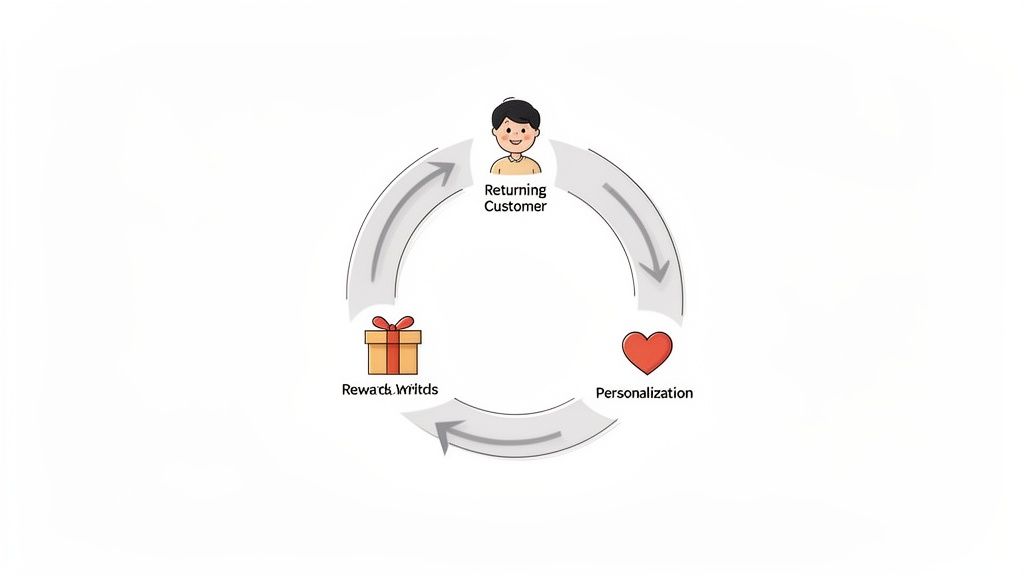
For years, e-commerce growth has been a one-track conversation about acquisition. It's an endless, expensive chase for new eyeballs and clicks, fueled by skyrocketing ad costs and relentless competition. But what if your biggest growth opportunity wasn't "out there" somewhere, but right here, with the customers you already have?
That's the game-changing perspective a customer retention program offers.
Instead of operating like a leaky bucket you’re constantly scrambling to refill, a solid retention strategy builds a powerful flywheel. Every positive experience, personalized touch, and well-timed reward adds momentum. This makes each subsequent sale easier and far more profitable, turning your existing customer base into a self-sustaining engine for growth.
The Staggering Cost of Neglecting Loyalty
Ignoring retention isn’t just a small oversight; it’s a financial hemorrhage. By 2025, it’s estimated that US brands will lose a mind-boggling $168 billion every year simply because customers don't stick around. That number throws a harsh spotlight on the real cost of failing to keep your audience engaged.
On the flip side, the value of keeping them is just as dramatic.
A loyal customer is one of your most valuable assets. Repeat buyers can be worth up to 10 times their first purchase over their lifetime. Even better, they tend to spend 67% more in their third year with a brand than they did in their first six months.
The massive gap between the cost of customer churn and the value of loyalty makes it obvious: retention isn't just a nice-to-have. It’s a business necessity. You can dive deeper into these dynamics in our guide on customer retention vs customer acquisition.
Reframing Retention as a Growth Strategy
Thinking of retention as just a defensive play to reduce churn is a huge missed opportunity. It’s an offensive strategy that drives growth across your entire business.
A well-executed program delivers some serious perks:
- Boosts Customer Lifetime Value (CLV): By giving customers compelling reasons to come back, you significantly increase the total revenue each person generates for your store.
- Improves Profit Margins: Keeping an existing customer is much cheaper than acquiring a new one. That difference goes straight to your bottom line.
- Creates Brand Advocates: Happy, loyal customers become your best marketers. They drive powerful word-of-mouth referrals that bring in high-quality new business for free.
- Gathers Valuable Insights: Engaged customers are more likely to give you honest feedback, providing the data you need to improve your products and overall experience.
To see this concept in action, it's worth exploring how a renewal engine can power growth in paid groups. At the end of the day, a retention program isn't just about keeping people from leaving. It’s about building a thriving community of advocates who actively fuel your brand's growth and make your business more resilient.
The Building Blocks of a Winning Loyalty Program
Think of your customer retention program as an engine for growth. Now, let’s pop the hood and see what makes it run. Building a great one is like building a house: you need a solid foundation, strong walls, and a welcoming front door. Each piece has its own job, but they all work together to create something people want to come back to again and again.
A winning program is more than just throwing random discounts at people. It’s a carefully crafted system designed to make customers feel seen, valued, and genuinely motivated to stick with you. A robust Loyalty Program isn't just a nice-to-have; it's a core part of building lasting customer relationships.
Let's break down the essential components you'll need to build your own.
Creating a Journey with Loyalty Tiers
One of the most powerful tools in your retention toolkit is the simple idea of progress. Loyalty tiers transform the customer journey from a flat line into an exciting climb. Instead of a one-size-fits-all approach, you create a ladder for your best customers to ascend.
This structure taps into our basic human desire for status and achievement. Everyone starts at a base level—let's call it Bronze—and unlocks better perks as they shop more, moving up to Silver, Gold, or even an exclusive VIP tier. The trick is making the benefits at each level genuinely worth striving for.
- Bronze Tier: The starting line. This could be as simple as earning 1 point for every dollar spent. It gets them in the game.
- Silver Tier: Now they feel like they're getting somewhere. Maybe they earn points faster (1.5x points per dollar) and get early access to sales.
- Gold Tier: Reserved for your true VIPs. They get the best of everything—2x points, free shipping on all orders, maybe even an exclusive annual gift.
A tiered system always gives customers a clear goal, a reason to consolidate their spending with your brand instead of shopping around.
Designing Rewards That Actually Motivate
The rewards you offer are the lifeblood of your program. If they aren’t compelling, the whole system falls flat. The best rewards find that sweet spot between being valuable to the customer and sustainable for your business.
A simple points-for-discount system is a classic for a reason, but don't stop there. Real loyalty is built on an emotional connection, not just a transaction.
The most effective rewards aren't always the most expensive. Often, they are experiential or exclusive, creating a sense of being an insider that a simple discount can't replicate.
To appeal to different people, think about offering a mix of reward types:
- Transactional Rewards: Your bread and butter. Think discounts, free products, or store credit. They're straightforward and everyone gets it.
- Experiential Rewards: This is where you can get creative. Offer early access to new products, invites to special online events, or a personal styling session.
- Community Rewards: Foster a shared sense of purpose. Let customers donate their points to a charity your brand supports.
Turning Customers into Brand Evangelists with Referrals
Your happiest customers are your most authentic marketers. A referral program simply puts a structure around this natural word-of-mouth, turning it into a predictable growth channel. It’s a win-win-win: your current customer gets a reward, their friend gets a discount, and you get a new, high-intent customer for next to nothing.
It’s not just about getting new customers, either. Referred customers are often better customers, with a 16% higher lifetime value. They walk in the door with a built-in layer of trust.
A common setup might give the advocate $10 in store credit for every friend who makes a purchase, while the new customer gets 10% off their first order. This simple give-and-get model keeps the growth flywheel spinning.
Adding Fun and Engagement Through Gamification
Finally, never underestimate the power of fun. Gamification is the secret ingredient that makes interacting with your brand feel less like a chore and more like a game. It’s about adding elements like badges, challenges, and progress bars to your program.
This approach hooks into deep-seated psychological drivers like our love for competition and the satisfaction of completing a task. It’s also a fantastic way to reward customers for things other than just spending money.
- Badges for Milestones: Award a "Super Fan" badge for making 10 purchases or a "Social Butterfly" badge for sharing your brand online.
- Point Multiplier Events: Run a "Double Points Weekend" to inject some energy into a typically slow sales period.
- Interactive Challenges: Offer bonus points for simple actions like "Complete Your Profile" or "Write a Product Review."
Each of these building blocks—tiers, rewards, referrals, and gamification—is powerful on its own. But when you weave them together, you create a comprehensive program that builds not just repeat business, but genuine, lasting loyalty.
How To Design Your Customer Retention Program
Building a customer retention program that actually works isn't a guessing game. It's an act of deliberate, strategic design. Think of it like building a bridge. You wouldn't just start throwing planks across a canyon and hope for the best, would you? Of course not. You'd start with a solid blueprint, measure your materials carefully, and engineer every part for strength and longevity.
The same exact principle applies here. A great program is built on a foundation of crystal-clear goals, a real understanding of your best customers, and a structure that provides genuine value. Let’s walk through the essential steps to build a program that doesn't just keep people coming back, but actually drives sustainable growth for your business.
Step 1: Define Clear and Measurable Goals
Before you even dream about points, tiers, or rewards, you have to define what success actually looks like. Your goals are your North Star, the fixed point that guides every single decision you'll make. Vague ideas like "increase loyalty" just won't cut it. You need specific, measurable, achievable, relevant, and time-bound (SMART) goals.
So, what are you really trying to accomplish?
- Increase Repeat Purchase Rate: Maybe you want to boost the percentage of customers who make a second purchase by 20% within six months.
- Boost Customer Lifetime Value (CLV): You could set a goal to increase the average CLV of your program members by 15% over the next year.
- Reduce Customer Churn: Or perhaps you need to target a 10% reduction in your customer churn rate within the first quarter after launch.
Having these concrete targets in place transforms your program from a fuzzy marketing idea into a measurable business strategy with a clear, defensible ROI.
Step 2: Understand Your Most Valuable Customers
Let's be honest: not all customers are created equal. Some will buy from you once during a Black Friday sale and then vanish forever. Others are the absolute lifeblood of your business. Your entire mission is to identify and build your program around that second group.
It's time to dive into your e-commerce data to find your VIPs. Look for the patterns that tell a story:
- High Spenders: The customers with the highest average order value (AOV).
- Frequent Buyers: The ones who purchase from you regularly, even if their orders are on the smaller side.
- Brand Advocates: The people who are already referring others or shouting you out in reviews.
Once you know exactly who your best customers are, you can design a program that speaks their language and rewards the very behaviors that make them so valuable to your brand.
Step 3: Choose the Right Program Model
With your goals set and your best customers identified, you can now pick the right structure for your program. There are several proven models out there, and each has its own unique strengths. The trick is to select one that feels authentic to your brand and makes sense for how your customers shop.
This is how the core components—tiers, rewards, and referrals—often fit together to create a powerful loyalty engine.
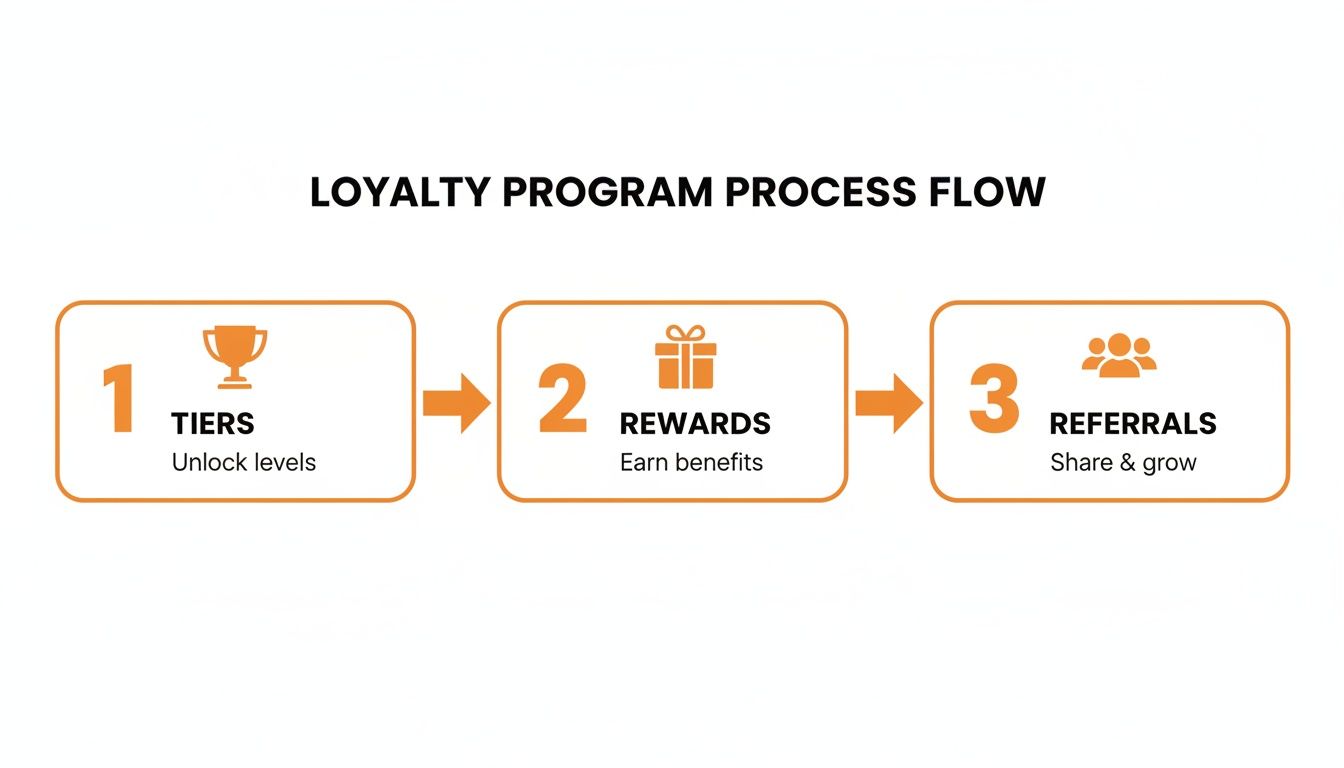 Each piece builds on the last, creating a complete system that encourages customers to stay engaged and tell their friends about you.
Here are a few of the most popular models to consider:
- Points-Based Program: This is the classic for a reason. Customers earn points for purchases and other actions (like writing a review), which they can then cash in for rewards. It’s simple, flexible, and super easy for everyone to understand.
- Tiered Program: This model taps into our desire for status and progression. Customers unlock better perks and more exclusive rewards as they move up through different levels (e.g., Bronze, Silver, Gold). It’s brilliant for encouraging higher spending to reach that next level.
- Paid Membership (VIP Program): Here, customers pay an upfront fee to get instant access to your best benefits, like free shipping on every order or members-only discounts. This is a fantastic way to create a highly engaged community of your most dedicated fans.
If you want to go deeper on crafting the perfect structure, check out our detailed guide on loyalty program design.
Step 4: Structure Rewards That Motivate and Sustain
The rewards are the heart and soul of your program. They need to be desirable enough to actually motivate your customers, but also financially sustainable for your business. A miscalculation here can quickly turn your retention engine into a money pit.
The best rewards strike a perfect balance between tangible value (like discounts) and emotional value (like exclusivity). They make customers feel smart for shopping with you and special for being part of your inner circle.
Offer a compelling mix of rewards to appeal to different types of customers:
- Financial Rewards: Discounts, free shipping, or store credit.
- Product Rewards: Free products or early access to new collections.
- Experiential Rewards: Invitations to exclusive online events or access to behind-the-scenes content.
Make no mistake, this isn't just a trend; it's a fundamental shift in commerce. The global loyalty management market is on track to explode from $15.19 billion in 2025 to a staggering $41.21 billion by 2032, all driven by the demand for smarter personalization. This shows just how vital a well-designed customer retention program is for Shopify merchants who want to thrive.
Step 5: Promote and Integrate Your Program
You’ve done the hard work, but it's not over yet. Even the most incredible program on earth will fail if no one knows it exists. A successful launch demands a multi-channel promotional blitz and, just as importantly, seamless integration into your website and tools.
Your launch plan should be firing on all cylinders:
- Email Campaigns: Announce the program to your entire email list, maybe with a special bonus for signing up early.
- On-Site Promotion: Use eye-catching banners, pop-ups, and a dedicated landing page to clearly explain all the benefits.
- Social Media Buzz: Build excitement with posts, stories, and maybe even a giveaway to drive those crucial first sign-ups.
Finally, make sure your program works flawlessly with your e-commerce platform. For Shopify merchants, a platform like Toki is designed for this, integrating smoothly to handle everything from tiered memberships to referral engines, which makes the whole technical side of your launch infinitely simpler.
Measuring Success With KPIs That Actually Matter
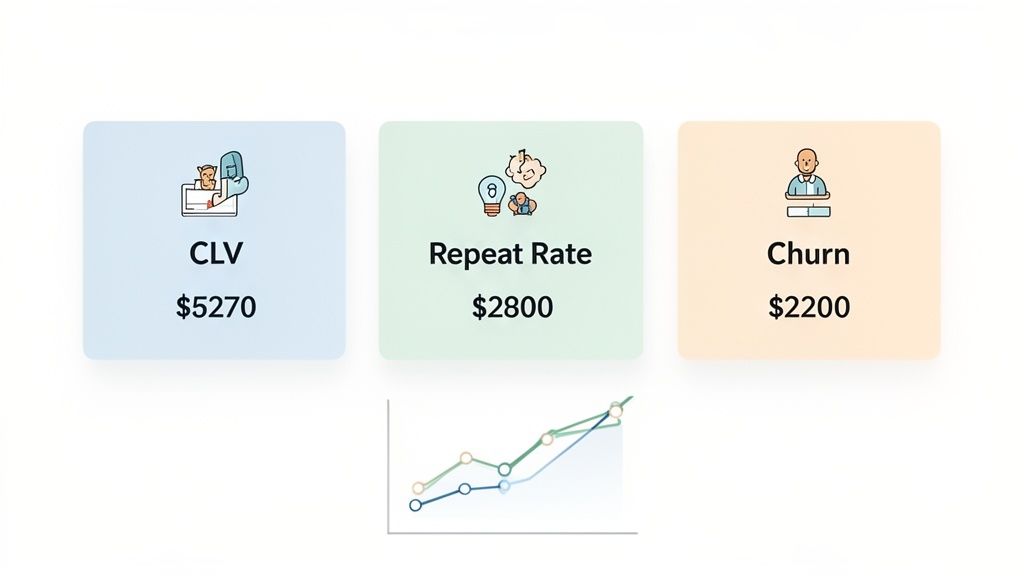
So, you’ve launched a customer retention program. How do you know if it's actually working?
Guessing won't cut it. Launching a program without a way to measure its impact is like flying a plane with no instruments—you might feel like you're moving, but you have no clue if you’re gaining altitude or heading for a nosedive. To prove your program’s worth, you have to get specific with Key Performance Indicators (KPIs) that tell the true story of your success.
These aren't just fluffy numbers for a report. Think of them as the vital signs of your customer relationships. They offer a clear, data-backed view of whether your hard work is actually paying off in real business growth. Tracking the right KPIs is how you prove your program's ROI, make smarter choices about your rewards, and tweak your strategy for the best possible results.
The Metrics That Move the Needle
Forget about getting bogged down in dozens of data points. You only need to focus on a handful of core metrics that directly show the health of your customer base. These three KPIs are the bedrock of any solid retention dashboard and give you an instant, powerful snapshot of how you’re doing.
-
Customer Lifetime Value (CLV): This is the big one. It’s the total profit you can expect from a single customer over the entire time they shop with you. When your CLV is climbing, it’s the clearest sign that your retention efforts are working. It means customers aren't just sticking around longer; they're also spending more.
-
Repeat Purchase Rate: A beautifully simple yet powerful metric. This is the percentage of your customers who have made more than one purchase. It's a direct reflection of loyalty and shows that your program is giving people a solid reason to come back for a second, third, or even tenth time.
-
Customer Churn Rate: This is the other side of the retention coin. Churn tracks the percentage of customers who stop buying from you over a given period. A primary goal of any retention program is to get this number as low as humanly possible, turning would-be lost customers into loyal fans.
By focusing on these core metrics, you shift the conversation from "Are people using our loyalty program?" to "How is our loyalty program impacting the bottom line?" This is the key to demonstrating real, measurable value.
To help you get started, here's a quick reference table with the most important KPIs to track.
Essential KPIs for Your Customer Retention Program
A practical guide to the key metrics for measuring the effectiveness and ROI of your loyalty initiatives, including formulas and what each metric reveals.
| KPI | How to Calculate It | Why It Matters |
|---|---|---|
| Customer Lifetime Value (CLV) | (Average Purchase Value) x (Average Purchase Frequency) x (Average Customer Lifespan) | Reveals the total long-term value of a customer, proving that loyalty directly boosts revenue. |
| Repeat Purchase Rate | (Number of Customers with >1 Purchase / Total Number of Customers) x 100 | Shows how many customers are coming back. It’s a direct indicator of customer satisfaction and loyalty. |
| Customer Churn Rate | (Customers Lost in a Period / Customers at Start of Period) x 100 | Measures customer attrition. Lowering this number is a primary goal of any retention strategy. |
| Average Order Value (AOV) | Total Revenue / Number of Orders | Helps you understand if your program encourages customers to spend more per transaction. |
| Purchase Frequency | Total Orders / Total Unique Customers | Tells you how often the average customer buys from you. A great program should increase this number. |
Tracking these metrics gives you a 360-degree view of your program's performance, connecting your efforts directly to business outcomes.
Putting Your Data Into Action
Knowing your numbers is only half the battle; the real magic is in understanding what they’re telling you. Your KPIs are a roadmap, pointing out what’s working and highlighting where you need to make a change.
For instance, is your Repeat Purchase Rate looking a bit anemic? That could be a sign that your rewards aren't compelling enough to get shoppers back for that crucial second purchase. If you’re a Shopify merchant, a platform like Toki can give you the analytics to spot this trend immediately and the tools to experiment with new rewards to fix it.
On the other hand, if your Customer Churn Rate takes a nosedive right after you launch your program, you have a clear win to celebrate. This is the kind of hard data that justifies your investment and proves the financial power of a well-run customer retention program.
For a deeper dive into the numbers that matter, check out our complete guide on the most important customer retention KPIs.
Ultimately, measurement isn't a one-and-done task—it’s a continuous loop. Regularly checking in on these KPIs allows you to be proactive, constantly improve your program, and build a powerful, data-driven engine for sustainable growth.
Common Mistakes to Sidestep When Building Your Program
Even the most well-intentioned customer retention program can fall flat if you stumble into a few common traps. These missteps might seem minor on the surface, but they can quickly drain the excitement out of your program and leave customers feeling more frustrated than valued.
Think of it like tending a garden. You can have the best seeds (your rewards) and the richest soil (your customer base), but if the watering schedule is a riddle and you never tell anyone when things are blooming, you won't see much growth. Let’s break down the most frequent mistakes and, more importantly, how you can steer clear of them.
Overly Complex Rules and Structures
The fastest way to kill a loyalty program is to make it feel like work. If your customers need a calculator and a user manual to figure out how to earn points or what those points are even worth, they’ll check out before they even get started. Complexity is the ultimate engagement killer.
When you have a dozen different earning rules, confusing expiration policies, and a convoluted redemption process, you’re creating friction. Customers should be able to understand the deal in a heartbeat.
Here’s how to fix it:
- Keep it simple: Stick to a straightforward earning rule, like 10 points for every $1 spent.
- Make it clear: The value should be obvious. For example, 500 points = $5 off.
- Create a home base: Design a clean, simple landing page where customers can see their status and rewards at a glance.
The goal is to make joining in feel effortless and genuinely rewarding, not like they're studying for an exam.
Rewards That Don't Feel Rewarding
This is a big one. You offer a reward that you think is valuable, but your customers just shrug. A 10% discount might sound nice, but if a quick Google search turns up a better coupon code, your "exclusive" reward instantly feels worthless. The value has to be real from their point of view.
This usually happens when brands get too focused on protecting their margins instead of genuinely delighting their customers. A reward that feels cheap or insignificant can actually do more harm than good—it signals that you don’t really value their business all that much.
A great reward isn't just about giving something away for free. It’s about making your customer feel smart and special for being part of your community. It’s all about the perceived value.
To get this right, offer a mix of rewards that cater to different people. Combine transactional perks like discounts with experiential ones, like early access to a new collection or members-only content. That way, you’ve got something for everyone.
Poor or Non-Existent Communication
You could build the best loyalty program on the planet, but if no one knows about it—or if they signed up and immediately forgot—it’s going to fail. A "set it and forget it" mindset is a surefire way to waste your investment. Out of sight is truly out of mind here.
Common communication failures include a weak launch, no follow-up reminders about point balances, and a total silence on new perks or chances to earn.
To keep your program top-of-mind, you need to be proactive:
- Launch with a bang: Announce your new program everywhere—email, social media, and on your website with impossible-to-miss banners.
- Automate your reminders: Set up emails to notify customers about their point balance, let them know when they’ve unlocked a reward, or give them a heads-up before their points expire.
- Weave it into the experience: Mention the program on product pages ("Earn 50 points with this purchase!") and highlight it again during checkout.
When you make communication a core part of the journey, your customer retention program becomes an exciting and visible part of shopping with you, not just another forgotten gimmick.
Your Customer Retention Program Launch Checklist
Alright, you've got the strategy down. Now for the exciting part: bringing your customer retention program to life. Think of this as your pre-flight checklist before takeoff. It distills everything we've talked about into a simple, actionable playbook to get you from concept to reality.
Follow these steps, and you’ll launch a program that builds real, lasting relationships from day one.
The Five Core Launch Steps
-
Define Your Earning Rules: Don't overcomplicate it. Your customers should understand the value proposition in a split second. A simple, clear rule like 10 points for every $1 spent is the perfect place to start. This is the foundation of your entire program, so make it rock-solid and easy to grasp.
-
Create Compelling Reward Tiers: Take your customers on a journey. Map out at least three distinct tiers—think Bronze, Silver, and Gold—with perks that get better as they climb the ladder. The jump from one level to the next needs to feel genuinely rewarding, giving them a real reason to stick around and spend more.
-
Design On-Site Branding and Communication: Make your program a core part of your store's experience, not an afterthought. Build a dedicated landing page that clearly spells out the benefits, and design some sharp-looking banners for your homepage. When your program looks and feels like it belongs, customers will take it seriously.
-
Set Up Your Referral Engine: It's time to turn your happy customers into your best marketers. A simple give-and-get offer, like "Give $10, Get $10," is a classic for a reason—it works. This approach creates a win-win, rewarding both your loyal advocate and the new customer they bring in.
-
Launch a Promotional Campaign: You've built it, now go tell the world! Kick things off with a bang. Send a targeted email blast to your existing customer base, letting them know about the new perks. Follow it up with a coordinated social media push to build buzz and drive those initial sign-ups.
This checklist isn't just about ticking boxes. It's a blueprint for building momentum. Nail these five steps, and you'll have all the essential pieces in place for a successful program right from the start.
Frequently Asked Questions
Even with the best plan in hand, you're bound to have questions when you're setting up something as important as a new loyalty system. Let's tackle some of the most common ones we hear from e-commerce merchants.
What Is a Good Customer Retention Rate?
Everyone wants to hit 100%, but that's not realistic. What's considered "good" really depends on your industry. A great rate for a subscription box service will look very different from that of a fashion boutique.
As a general benchmark, the average retention rate for e-commerce and retail hovers around 30%. If you're beating that, you're in a great spot. The real goal isn't to chase some magic universal number; it's to steadily improve your own rate, month after month.
How Quickly Can I See Results?
Building true, lasting loyalty is a marathon, not a sprint. That said, you can absolutely see some encouraging signs pretty quickly. Most brands start noticing a lift in engagement and more repeat purchases within the first 3 to 6 months of launching a well-designed retention program.
The first wins usually come from the initial launch excitement and from your most dedicated fans jumping on board. Deeper metrics, like a significant rise in Customer Lifetime Value, will build more gradually as the program becomes a core part of your customer experience.
What Are the 3 Rs of Customer Retention?
The "3 Rs" are a simple but powerful way to think about what your program should be doing. It boils everything down to three connected goals.
- Retention: This is the baseline—simply keeping your customers happy, engaged, and coming back to buy again.
- Related Sales: This is about growing the value of those customers you've kept. Think strategic cross-sells and upsells that make sense for them, boosting their overall spend.
- Referrals: This is the ultimate goal. You turn your loyal customers into your best marketers, getting them to bring in new shoppers just like them.
Nail these three, and your program will do more than just stop customers from leaving—it will become a powerful engine for growth.
Ready to put all this into practice? Toki gives Shopify merchants all the tools they need to build and run a customer retention program that actually drives results, from tiered memberships to automated referral campaigns. Start building lasting customer relationships today.