Unlocking Growth with Customer Retention and Customer Loyalty
Explore proven strategies for customer retention and customer loyalty. Learn to build lasting relationships that drive sustainable growth and profitability.
You can think of customer retention as the actions you take to keep customers around, while customer loyalty is the deep-seated feeling that makes them want to stick with you. It's the classic leaky bucket analogy: acquisition is pouring water in, but a smart strategy for customer retention and customer loyalty plugs the holes so you don't lose what you've already worked so hard to get.
Why Retention and Loyalty Are Your Secret Growth Engines
In a marketplace overflowing with options, it's easy to get caught up in the constant chase for new customers. But here’s the thing: focusing on the people you’ve already won over is almost always the more profitable move. While new business is great, it’s that solid base of repeat customers that lets you build a stable, predictable, and truly scalable company.
Putting your energy into customer retention and loyalty isn't just about warm fuzzy feelings; it's a direct line to a healthier bottom line.
Happy, returning customers are the lifeblood of any thriving business. They spend more over their lifetime, cost far less to support, and eventually become your best salespeople through word-of-mouth. In fact, getting a new customer can cost five times more than keeping an existing one. That makes your current customer list your single most valuable asset. For a deeper look into the numbers, check out our guide on customer retention vs. customer acquisition.
The Business Case for a Customer-First Mindset
When you shift your focus from "always be closing" to "always be helping," you unlock some serious advantages that fuel sustainable growth. A solid retention and loyalty strategy moves your business from a series of one-off transactions to a network of lasting relationships.
This shift pays dividends over and over again.
- Sky-High Profitability: A small 5% bump in customer retention can increase profits by a staggering 25% to 95%. Why? Because repeat buyers come back more often and tend to spend more each time.
- Built-In Brand Resilience: Loyal customers are more likely to forgive a minor slip-up and won't jump ship the second a competitor dangles a discount. They give you a reliable revenue stream, even when the market gets choppy.
- Authentic Social Proof: Nothing sells your brand better than a crowd of genuine fans. Loyal customers leave real reviews, give glowing testimonials, and refer their friends—all of which is more powerful than any ad you could run.
The big idea is simple: instead of constantly chasing the next new lead, invest in creating experiences so good that your current customers would never dream of leaving. This guide will walk you through exactly how to build that kind of unbreakable bond.
Customer Retention Versus Customer Loyalty
It’s easy to use the terms customer retention and customer loyalty interchangeably, but they’re really two different things. Getting the distinction right is crucial for any business that wants to do more than just get by—it's how you build a solid foundation of repeat business and turn customers into genuine fans.
Think of it this way: retention is about the transaction. It’s logical. A customer might stick around because you’re convenient, your price is right, or simply out of habit. They’re retained, but their connection to you is fragile. If a competitor comes along with a slightly better offer, they’re gone.
Loyalty, on the other hand, is all about the relationship. It’s emotional. A loyal customer will choose you even when there are cheaper or easier options available. They stick with you because they feel a real connection, trust what you deliver, and align with what your brand represents.
The Gym Membership Analogy
Here’s a simple way to picture the difference. Imagine a local gym.
- Retention: This is the person paying their monthly fee but hardly ever showing up. The gym has retained them, but only because canceling is a hassle or they keep telling themselves, "I'll go next week." Their relationship is just a line item on a bank statement, not a real connection.
- Loyalty: Now picture the gym regular. They know the trainers by name, join the group classes, and feel like they’re part of a community. Leaving for another gym is unthinkable because this place is a meaningful part of their routine. Their relationship is built on positive experiences and a sense of belonging.
A retained customer is just a transaction waiting for a better deal. A loyal customer is a true partner in your brand's story.
This is exactly why both retention and loyalty are fundamental to sustainable growth. They form the base of the pyramid, supporting everything else you do.
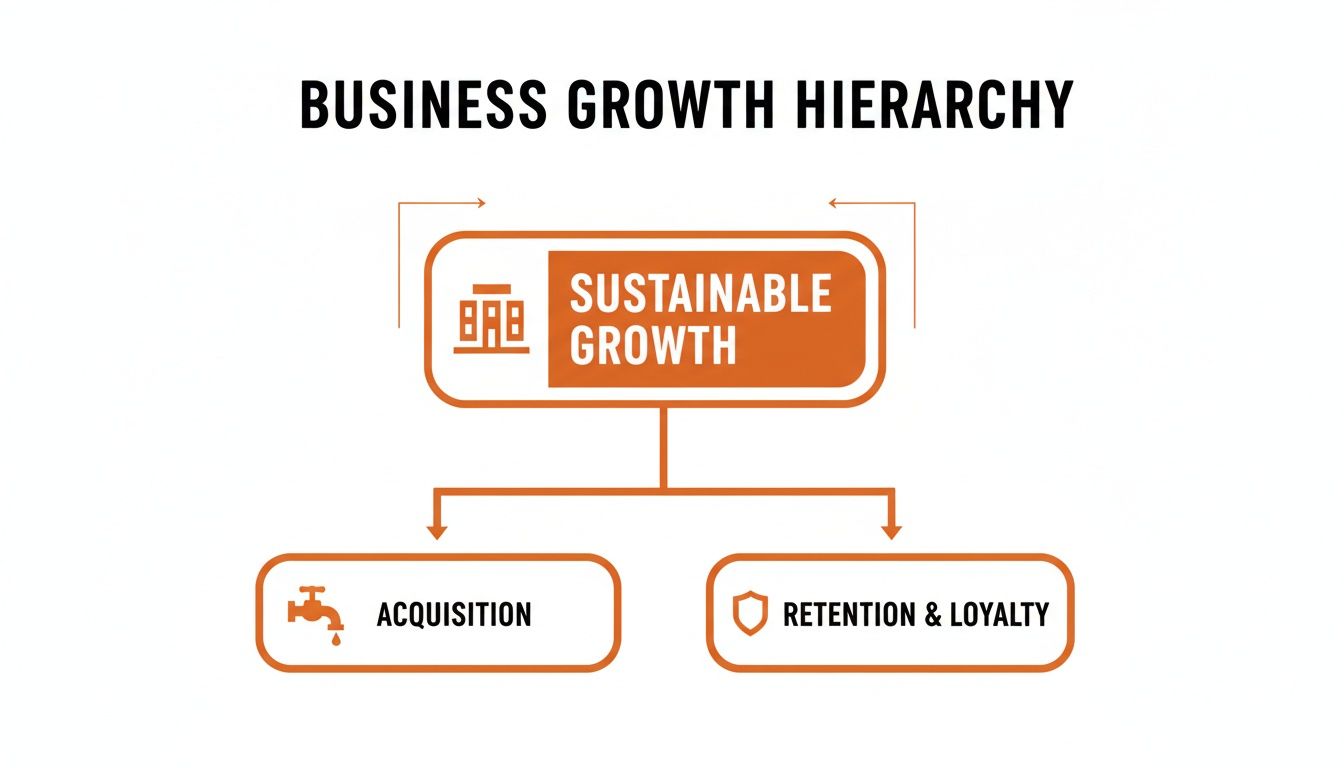
As you can see, acquiring new customers is important, but true stability and long-term success come from building a strong foundation of people who keep coming back.
Why The Difference Matters for Your Business
Knowing whether you’re chasing retention or building loyalty has a massive impact on your strategy. Tactics focused on retention, like deep discounts, might win a sale today. But they can also eat into your profit margins and attract bargain hunters who will leave the second they find a better price.
On the flip side, strategies that build loyalty—like creating a vibrant community or providing unforgettable service—forge an emotional bond that pays off for years. This is especially critical in certain industries. For instance, media and professional services enjoy high average retention rates of 84%, while e-commerce often hovers at a much lower 38%. This gap shows just how hard e-commerce brands have to work to create experiences that build that deeper, lasting connection. You can dig into more of these industry benchmarks by checking out the latest customer retention statistics.
The real goal is to guide customers from one stage to the next. You want to turn a customer who stays for convenience into an advocate who stays because they believe in you—and tells their friends about it.
Retention vs Loyalty At a Glance
To make it even clearer, let's break down how retention and loyalty differ across a few key areas. This table highlights their fundamental differences, from what drives a customer to the long-term impact on your business.
| Dimension | Customer Retention | Customer Loyalty |
|---|---|---|
| Customer Mindset | Transactional: "Is this the most convenient or cheapest option right now?" | Relational: "I trust this brand and feel connected to its values." |
| Key Driver | Inertia, convenience, price, lack of better alternatives. | Positive experiences, emotional connection, trust, shared values. |
| Business Objective | Reduce churn and prevent customer defection. | Build advocacy and encourage word-of-mouth marketing. |
| Vulnerability | High: A customer can be easily swayed by a competitor's offer. | Low: A customer is more forgiving and less likely to switch. |
| Example Strategy | Offering a "win-back" discount to a customer who hasn't purchased recently. | Creating an exclusive members-only community with early access to products. |
When you see it laid out like this, it’s obvious that while both are valuable, loyalty is the far more powerful asset. Retention stops your bucket from leaking, but loyalty makes the bucket itself stronger and more resilient for the long haul.
Why You Must Measure Retention and Loyalty
There’s a classic saying in business: if you don't measure it, you can't improve it. This couldn't be more true when it comes to customer retention and customer loyalty. Without hard numbers, you’re just guessing, hoping your efforts are hitting the mark.
Tracking the right metrics transforms that guesswork into a clear, actionable roadmap. You can finally see what’s truly working, what’s falling flat, and where you should focus your time and money for the best results. The data behind retention and loyalty isn't just a "nice-to-have"—it's a direct reflection of your company's health and its potential for growth.
The financial case for measuring this stuff is impossible to ignore. Study after study confirms that small gains in retention lead to massive gains in profit. A tiny 5% bump in customer retention can boost your profitability by anywhere from 25% to 95%.
Why? Because existing customers aren't just one-and-done buyers; they tend to spend 67% more than new ones. They become a reliable, compounding source of revenue.
Key Performance Indicators to Track
So, where do you start? To get a real handle on your customer relationships, you need to watch a few key metrics. Think of these KPIs as the vital signs for your business, telling you the story of both retention and loyalty.
-
Customer Lifetime Value (CLV): This is the big one. It's the total amount of money you can realistically expect to earn from a single customer over their entire time with you. When CLV is on the rise, you know your loyalty strategies are working.
-
Churn Rate: In simple terms, this is the percentage of customers you lose over a given period. A high churn rate is a flashing red light, signaling that something is wrong with your product, your service, or the overall experience.
-
Repeat Purchase Rate: This straightforward metric shows you what percentage of your customers come back for a second purchase. It’s a great, immediate indicator of whether your retention tactics are making an impact.
-
Net Promoter Score (NPS): A powerful measure of loyalty, NPS boils it all down to a single question: "How likely are you to recommend us to a friend?" This score sorts your customers into Promoters, Passives, and Detractors, giving you a crystal-clear snapshot of customer sentiment.
By keeping a close eye on these numbers, you stop simply hoping customers will stay loyal and start building a predictable system that encourages them to. These metrics are the bedrock of any smart customer retention and customer loyalty plan.
From Metrics to Actionable Insights
Knowing your numbers is step one. The real magic happens when you use that data to make smarter decisions.
Is your repeat purchase rate low? That might mean your post-purchase experience needs some serious attention. A tanking NPS could point to a new issue with product quality. For a closer look, our guide on how to measure customer loyalty offers more advanced techniques.
Beyond these core KPIs, it’s also crucial to understand how customers are interacting with your brand on a day-to-day basis. Learning how to measure customer engagement effectively can reveal who is on the path to becoming a long-term fan.
When you bring all these data points together, you get the full picture. You can pinpoint problems, jump on opportunities, and invest with confidence in the strategies that will keep your best customers coming back for more.
Proven Strategies to Drive Retention and Loyalty
Okay, you get the why behind customer retention and loyalty. Now for the fun part: the how. This is where we stop talking theory and start putting proven tactics into action—the kind that build real, lasting relationships with your customers and create predictable revenue.
Think of these seven strategies as your playbook for turning a first-time buyer into a lifelong fan. Each one is a powerful tool you can use to not only improve your retention metrics but also deepen that crucial emotional bond people have with your brand.
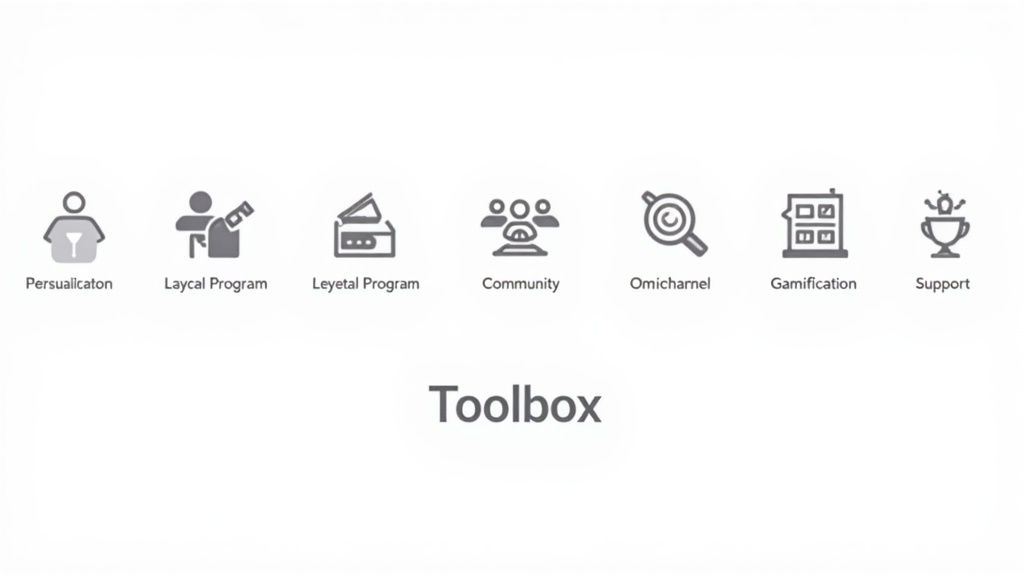
This isn't just a random list; it's a complete toolkit. These strategies work together to cover every stage of the customer journey, reinforcing the value you provide at every turn.
Personalize Communication with Smart Segmentation
Let's be blunt: generic, one-size-fits-all marketing is dead. Your customers expect you to know them, and segmentation is how you prove it. It’s all about grouping your audience based on shared behaviors or traits so you can talk to them about what they actually care about.
Instead of sending the same email to every single person, you can get specific. Group customers by:
- Purchase History: Are they obsessed with a certain product? Do they only buy during a sale?
- Engagement Level: Who are your die-hard fans versus the people who need a little nudge to come back?
- Demographics: Is a message more relevant to customers in a specific city, or a certain age group?
When a customer feels like you're speaking directly to them, their connection to your brand goes way up. It’s no surprise that personalized emails deliver 6x higher transaction rates—they just work.
Design Tiered Loyalty Programs That Reward Engagement
A good loyalty program is more than just a glorified discount card. It should make your customers feel special and give them a compelling reason to stick with you. Tiered programs are fantastic at this because they introduce a sense of progress and achievement.
Think of it like leveling up in a game. As customers spend more, they unlock new tiers with better perks.
- Bronze Tier: The starting line. Customers get basic rewards, like points for every dollar spent.
- Silver Tier: Things get better. Maybe they unlock free shipping or get early access to sales.
- Gold Tier: The VIP experience. This could include exclusive products, a dedicated support person, or invitations to special events.
This structure motivates people to keep coming back because they have a clear goal to work toward. It turns a simple transaction into a rewarding, long-term relationship. For a deeper dive, check out these 10 Proven Customer Retention Strategies to Maximize LTV.
Build Referral Programs That Turn Customers Into Marketers
Who is your most powerful marketing channel? Your happiest customers. A referral program is simply a structured way to tap into that power, rewarding them for bringing new people to your business. It's a true win-win-win.
Your current customer gets a bonus, the new customer they refer gets a welcome offer, and you get a high-quality lead that already trusts you. It makes sense when you realize people are 92% more likely to trust a recommendation from someone they know over any other kind of advertising.
Pro Tip: Don't make them work for it. The referral process needs to be dead simple. Give them a unique link they can share with one click. The less friction, the more referrals you'll get.
Create Exclusive Membership Communities
At our core, we all want to belong to something. When you create a membership or community around your brand, you’re tapping into that fundamental human need. This moves your relationship beyond just "buyer and seller" into something much more meaningful.
And I don't just mean a Facebook group. A real community provides value people can't get anywhere else.
- Exclusive Content: Give them behind-the-scenes access, special tutorials, or live Q&As with your team.
- Direct Access: Create a space for them to connect with each other and with you.
- A Shared Identity: Make them feel like insiders—part of a tribe that "gets it."
When someone feels like they're part of your club, their loyalty becomes almost bulletproof. Just look at Costco. Their executive members pay a higher fee, yet they drive over 70% of total sales.
Deliver a Seamless Omni-Channel Experience
The way people shop today is all over the place. They might see an ad on Instagram, browse on their laptop, ask a question on your chatbot, and then buy from their phone. An omni-channel experience means making sure that entire journey is smooth, consistent, and connected.
This means their shopping cart should sync between their phone and desktop. It means a support agent can see their past orders. It means your brand looks and feels the same everywhere.
By removing all that friction, you make it effortless to do business with you. That convenience is a massive driver of both retention and loyalty.
Use Gamification to Make Engagement Fun
Gamification is all about adding game-like elements—like points, badges, and leaderboards—to your marketing. It’s a surprisingly powerful way to make interacting with your brand more engaging and, honestly, a little bit addictive.
Instead of just earning points, customers can complete specific missions or unlock achievements.
- Challenges: "Make three purchases this month to earn 500 bonus points."
- Badges: Award a digital badge for their one-year customer anniversary or for leaving their first review.
- Leaderboards: Stir up some friendly competition by showing the top point-earners of the month.
These simple mechanics tap into our natural desire for achievement and recognition, keeping people engaged with your brand even when they aren’t actively buying something.
Establish Proactive Customer Service and Feedback Systems
At the end of the day, nothing builds trust like incredible customer service. But the best service isn't just about fixing problems—it's proactive. It’s about anticipating what a customer might need and solving issues before they even have to ask.
This also means creating strong feedback loops. Don't wait for them to complain. Actively ask for their opinions with surveys and reviews. Most importantly, show them you're actually listening by making changes based on their suggestions.
When your customers genuinely feel heard, they feel valued. And that feeling is the bedrock of both customer retention and customer loyalty.
Real-World Examples of Retention and Loyalty Mastery
It’s one thing to talk about theory, but seeing these strategies work in the real world is where the lightbulb really goes on. Let's break down how two household names built empires by getting customer retention and customer loyalty right. These aren't just success stories; they're practical blueprints for creating an unbreakable bond with your customers.
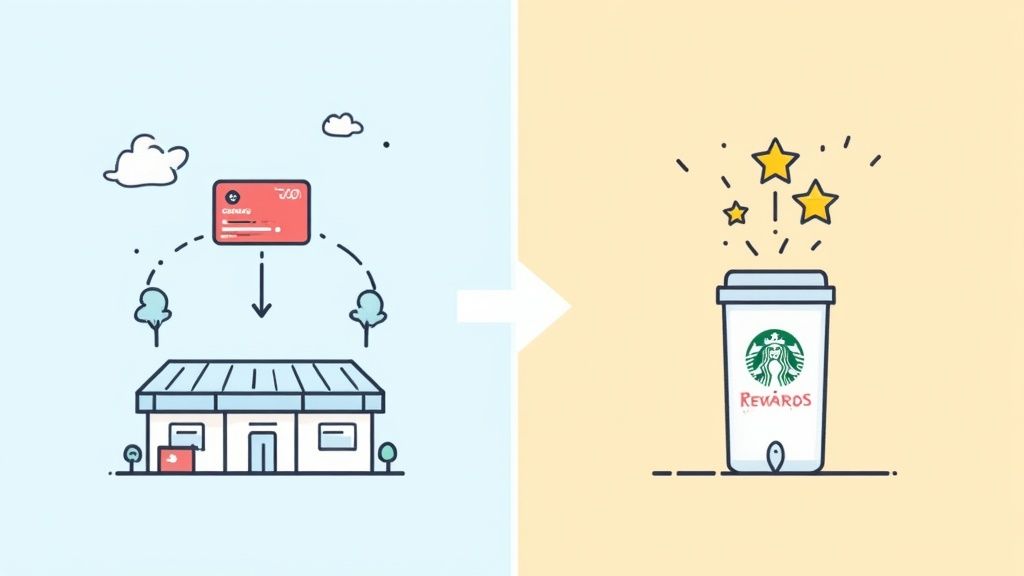
These examples prove it’s not about just handing out discounts. They are carefully designed systems that weave themselves into a customer's life, making loyalty the easiest and most satisfying choice.
Costco: The Membership Powerhouse
Costco’s entire business model is a masterclass in paid memberships. By asking customers to pay an annual fee, they create a strong psychological commitment right out of the gate. Once you've paid to be a member, you feel compelled to get your money's worth, which naturally leads to more frequent visits and bigger shopping carts.
The real genius, though, is the Executive Membership. For a higher annual fee, members get 2% cash back on most of what they buy. This single incentive turns their best customers into their most profitable ones, rewarding them for the very behavior Costco wants to encourage.
The result is an exclusive "club" atmosphere that delivers real, tangible value, making the decision to renew each year almost a no-brainer.
Costco has turned a simple fee into a powerful retention tool. By creating a high-value membership, they ensure that their most engaged customers are also their most frequent shoppers, creating a self-reinforcing cycle of loyalty.
The numbers don't lie. While executive members are less than half of Costco's total membership base, they drive an astounding 73% of all sales. It’s a perfect illustration of how a well-designed paid program can send customer lifetime value through the roof.
Starbucks Rewards: Gamifying the Coffee Run
Starbucks took the daily coffee run and turned it into an addictive, game-like experience with its incredibly successful rewards app. It’s a brilliant fusion of personalization, convenience, and habit-forming design that keeps millions of people coming back every single day.
Their approach pulls together several of the key strategies we’ve talked about:
- Gamification: You earn "Stars" for every purchase, which you can trade in for free drinks and food. This simple point system gives a clear sense of progress and makes every purchase feel more rewarding.
- Personalization: The app learns your habits and sends you personalized offers, fun challenges like "Double Star Days," and suggestions for new things you might like.
- Convenience: The ability to order and pay ahead right from the app is a game-changer. It removes all the friction of waiting in line, making a Starbucks run faster and easier than going anywhere else.
This powerful combination has built a fiercely devoted community. Today, the 34 million active Starbucks Rewards users are responsible for a massive 60% of the company's revenue. This kind of success is why the global CRM market is projected to reach $57 billion by 2025, as more businesses invest in the tech to build similar programs. For more stats, check out this great resource on customer retention rates and their impact.
Turning Loyal Customers Into Brand Advocates
We’ve walked through the whole journey, from customer retention to customer loyalty, and a powerful truth has emerged: your greatest business asset isn't some future sale, but the customer you’ve already won over. It’s a subtle but crucial shift. We’ve seen how retention is about the transaction, but loyalty is about the heart.
This isn’t just about deploying a few new tactics; it’s a complete change in how you see your business. Think of every interaction, every touchpoint, not as a one-off event, but as another chance to deepen that customer bond. When you build a business on exceptional experiences, you’re creating a foundation of trust that a competitor’s 20% off coupon just can’t touch.
From Loyalty to Advocacy
The final, and most powerful, stage in this entire process is advocacy. This is where the magic really happens. A brand advocate doesn’t just stick around; they go out and actively bring others into the fold.
They're the ones leaving five-star reviews, defending your brand in a comments section, and generating the kind of authentic word-of-mouth that no ad campaign could ever dream of buying. This is the ultimate ROI for every bit of effort you've put into building those relationships.
The real goal is to build a business so focused on the customer that they become your best salespeople. Their genuine passion is far more convincing than any marketing message you could ever craft.
Ready to put these ideas into motion? To learn exactly how to rally your most passionate customers and turn them into a volunteer marketing army, check out our guide on how to turn customers into advocates.
It's time to stop the endless chase for new leads while neglecting the people who already believe in what you do. When you balance acquisition with a solid retention and loyalty strategy, you build a business that’s more profitable, more resilient, and frankly, more respected. The tools are here. Go build your community.
Frequently Asked Questions
Let's tackle some of the most common questions that come up when businesses start getting serious about customer retention and loyalty. These are the things people often wonder about, and getting clear answers can help you move from thinking about a strategy to actually building one.
What Is a Good Customer Retention Rate?
This is the million-dollar question, but the honest answer is: it depends. There’s no universal “good” number because retention benchmarks are all over the map depending on your industry. A B2B software company might be aiming for 90% annual retention, while an online clothing boutique could be thrilled with 35%.
The best benchmark is your own past performance. Instead of getting hung up on industry averages, focus on improving your own rate month after month. That steady, upward trend is the real sign that what you're doing is working.
How Can a Small Business Create a Loyalty Program on a Budget?
You absolutely don't need a huge budget to inspire loyalty. In fact, some of the most effective rewards have little to do with deep discounts. For a small business, it’s all about making your best customers feel seen and appreciated.
Here are a few high-impact ideas that won't break the bank:
- Exclusive Content: Give your members special access to how-to guides, insider videos, or other valuable content no one else gets.
- Early Access: Let your loyal fans be the first to know about new products or upcoming sales. The feeling of being an insider is a powerful reward.
- A Simple Digital Punch Card: Forget printing costs. Use a simple app or email tracker to reward a customer after a certain number of purchases—think "your tenth coffee is on us."
The most powerful rewards aren't always the most expensive. Exclusivity and recognition can build a stronger emotional connection than a simple discount ever could, fostering genuine customer loyalty.
Where Should I Start If My Customer Churn Is High?
When you see a lot of customers leaving, it’s a flashing red light that something fundamental in their experience is off. Before you start throwing solutions at the wall to see what sticks, you need to play detective. The first, most critical step is to figure out why they're walking away.
Your investigation starts with gathering feedback.
- Analyze Exit Surveys: As soon as a customer churns, ask them for the reason. Even a simple, one-question survey can give you a goldmine of information.
- Review Support Tickets: Your customer service inbox is full of clues. Look for patterns and recurring complaints—these are the friction points that are driving people away.
- Talk to Your Customers: Don’t be afraid to pick up the phone or send a personal email to a few people who recently left. A quick, candid conversation can reveal problems you never even knew you had.
Once you have a handle on the root causes, you can stop guessing and start building a smart, targeted plan to fix the leaks.
Ready to build a loyal community that drives repeat sales? Toki provides all the tools you need to launch powerful loyalty, membership, and referral programs in minutes. Start building lasting customer relationships today.