Points Based Loyalty Programs: Boost Retention with Simple, Scalable Rewards
Explore points based loyalty programs and how to design, launch, and optimize rewards that drive repeat customers and lasting brand loyalty.
At its heart, a points-based loyalty program is a simple but powerful idea: you reward customers for their business by giving them a special kind of currency—points—that they can only earn and spend with you. It’s a way to turn every purchase into a step toward a future reward, making shopping feel less like a transaction and more like a fun, engaging game.
This approach is easily the most popular and straightforward way to build real, lasting relationships with the people who buy from you.
How Do Points-Based Loyalty Programs Actually Work?
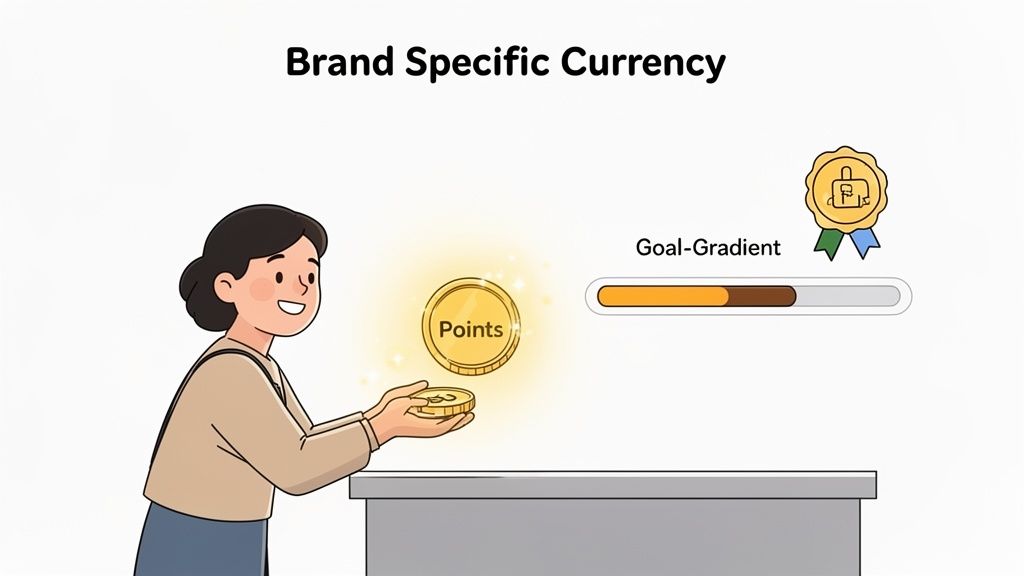
Think of it like creating your store's very own private money. Customers earn this currency by shopping with you, and they can only spend it within your brand's world. This simple concept is what makes points-based loyalty programs so effective. Suddenly, a purchase isn't just a one-and-done deal; it's an investment that brings a customer closer to their next perk.
The magic here lies in tapping into some basic human psychology. It’s not just about giving a discount; it’s about creating a sense of progress and achievement. Watching that point balance climb feels good, giving customers a tangible sense of momentum.
Psychologists call this the goal-gradient effect. The closer someone gets to reaching a goal, the harder they work to cross the finish line. A customer who has 800 points and only needs 1,000 for a free product is far more motivated to make another purchase than someone just starting out at zero.
It’s More Than Just a Purchase
A smart points program shifts the entire customer dynamic. You move from a purely transactional relationship—where they just buy something—to a relational one. It becomes an ongoing conversation where you constantly recognize and reward them for being part of your community.
And you don't have to limit points to just purchases. You can reward all sorts of valuable actions:
- Making a purchase: The classic. Customers earn a set number of points for every dollar they spend.
- Creating an account: An easy win to get new customers onboarded and feeling rewarded from day one.
- Following on social media: A great way to boost your brand's presence across different channels.
- Writing a product review: You get valuable social proof, and they get rewarded for their time.
There's a reason these programs are everywhere. The global loyalty management market is on track to explode from $8.6 billion to over $18.2 billion by 2026. This isn't just a fad; it's a direct response to what customers want. In fact, a whopping 69% of shoppers say that the chance to earn points influences where they decide to shop. You can dive deeper into the loyalty stats and benchmarks that show just how powerful this trend is.
When you gamify the shopping experience, you're building an emotional connection. Customers aren't just buying something; they're actively participating, earning status, and unlocking special value that your competitors simply can't offer.
The True Power of Perceived Value
At the end of the day, points give you a powerful shield against the race-to-the-bottom pricing game. When a customer has a stash of points with your brand, they have a very real reason to come back, even if a competitor dangles a slightly lower price.
This creates a "switching cost"—not in money, but in lost value. It’s this feeling that transforms a casual, one-time shopper into a loyal fan who chooses you again and again.
Why Your E-commerce Store Needs a Points Program
It’s one thing to know how a points-based loyalty program works, but it's another thing entirely to see what it can actually do for your business. This isn't just about giving customers a nice little perk. A well-built program is a serious engine for growth, capable of changing customer behavior and delivering a real financial return.
The first and most obvious win is a big jump in Customer Lifetime Value (CLV). Once a customer has points in their account, they have a concrete reason to come back. That simple hook can turn a one-time buyer into a loyal repeat customer, which dramatically increases how much you earn from them over the long haul.
This is huge for your bottom line. Think about it: acquiring a brand new customer can cost five times more than keeping an existing one happy. By investing in loyalty, you're spending less on expensive ads and can redirect that cash into other parts of your business.
Push Your Average Order Value Higher
A points program is also a sneaky-effective way to get customers to spend more on each purchase. You can use point thresholds to gently nudge shoppers into adding just one more item to their cart.
Imagine a customer is checking out and sees they're only $10 away from earning enough points for a free shipping coupon. What do they do? More often than not, they’ll go find another small item to buy. Just like that, your Average Order Value (AOV) creeps up, turning your rewards system into an active sales tool.
Build a Moat Against Competitors
In a crowded market, it's easy to get dragged into a price war with competitors. A loyalty program is your best defense against that race to the bottom. It creates a "moat" of brand loyalty around your best customers that has nothing to do with being the cheapest.
When a shopper has a stash of points with your store, they have something to lose by going elsewhere. This creates a natural switching cost that makes your brand the easy choice, even if a competitor is running a sale. You stop being just another store selling a product and become a brand that offers ongoing value.
Loyalty programs shift the customer's focus from "what's the lowest price today?" to "what long-term value am I getting here?" This change in perspective is how you win and keep your most profitable customers.
This isn't just a tactic; it's a fundamental part of modern e-commerce. Points programs are a key piece of the puzzle, fitting into broader ecommerce growth strategies focused on retention.
At the end of the day, it's about creating a relationship where everyone wins. Your customers feel appreciated for their business, and you get more sales, stronger retention, and a brand that can stand the test of time.
Designing Your High-Impact Points Program
Alright, you're sold on the 'why'—now for the 'how'. This is where a good idea becomes a real, profit-driving strategy. Designing a points program that people actually want to use is an art, a delicate balance between keeping customers excited and making sure it's sustainable for your business.
Think of it like you're building a house. You wouldn't just start nailing boards together without a solid blueprint. The same goes for your loyalty program.
You need to make a few key decisions that will define how your program works and feels. The goal is simple: create a system that's easy to understand, compelling enough to get customers to come back, and smart enough to protect your margins.
The best part? You don't have to start from scratch. The most successful programs are built on a foundation of clear, simple rules for earning and redeeming points.
Setting Your Earning Rules
First things first: how will customers rack up points? This is the core of the experience, where you reinforce every valuable action a customer takes with a small, tangible reward. Keep it simple. Seriously.
Think about the behaviors you want to encourage and attach points to them. While purchases are the most obvious one, a truly great program rewards customers for engaging with your brand in other ways, too.
- Points Per Dollar Spent: This is the bedrock of most programs. A straightforward rule like "Earn 10 points for every $1 spent" is easy for anyone to get.
- Account Creation Bonus: Give new members an instant win. Offering 200 points just for signing up makes them feel invested from the get-go.
- Social Engagement Rewards: Turn loyal customers into brand advocates by giving them small point bonuses for following you on social media or sharing a post.
- Product Reviews: Need more user-generated content? Offer points for writing a review. It’s a win-win: the customer gets rewarded, and you get powerful social proof for future shoppers.
By creating multiple ways to earn, you keep customers engaged even when they aren't actively buying. It sends a clear message that you value their entire relationship with your brand, not just their wallet.
Defining Redemption Options and Point Value
Once your customers have a nice stash of points, they need something exciting to spend them on. This is where their effort pays off. If the rewards feel cheap or impossible to reach, people will check out fast.
A critical piece of the puzzle is point valuation. A safe and common place to start is the "1% back" model. For instance, if a customer earns 10 points per dollar, and 1,000 points gets them a $10 discount, then each point is worth a penny.
1,000 points = $10 reward $10 reward / 1,000 points = $0.01 per point This simple math keeps your program profitable while still feeling generous.
But don't just stop at discounts. Offer a menu of redemption options to appeal to different people.
- Dollar-Off Coupons: The crowd-pleaser (e.g., 500 points for a $5 discount).
- Percentage Discounts: A great alternative that can feel more valuable on larger orders (e.g., 1,000 points for 15% off).
- Free Products: Offer exclusive items or best-sellers that can only be "bought" with points.
- Free Shipping: This is a low-cost reward for you but a highly valued perk that can easily push a customer to complete their purchase.
The data backs this up. Recent studies show that a whopping 82% of consumers prefer discounts, while 57% love getting free shipping.
To give you some inspiration, here’s a quick look at how you could structure these rules.
Earning and Redemption Rule Examples
| Action (Earning) | Suggested Points | Reward (Redemption) | Suggested Point Cost |
|---|---|---|---|
| Create an account | 200 Points | $5 off coupon | 500 Points |
| Make a purchase | 10 Points per $1 spent | $10 off coupon | 1,000 Points |
| Follow on Instagram | 50 Points | Free shipping | 1,200 Points |
| Write a product review | 150 Points | 15% off coupon | 1,500 Points |
This table is just a starting point, of course. The key is to create a balanced "earn and burn" economy that feels both achievable and rewarding for your customers.
Gamifying with Tiers and Urgency
Want to take your program from good to great? Add a little gamification. Tiers and point expiration are two powerful ways to create a more dynamic and engaging experience.
A tiered loyalty program groups customers based on how much they spend or engage. As they climb from "Bronze" to "Silver" to "Gold," they unlock better perks, like earning points faster or getting early access to sales. This taps into our natural desire for status and makes your best customers feel like the VIPs they are.
Point expiry policies can also be incredibly effective, as long as you're fair about it. Setting an expiration date (say, 12 months of inactivity) creates a gentle nudge. It encourages customers to use their points instead of letting them collect dust, which boosts redemption rates and drives more repeat purchases. If you're curious about what makes these tactics work so well, you can dive deeper into the psychology of rewards in loyalty programs.
Ultimately, a well-designed program isn't just a "nice-to-have"—it's a growth engine.
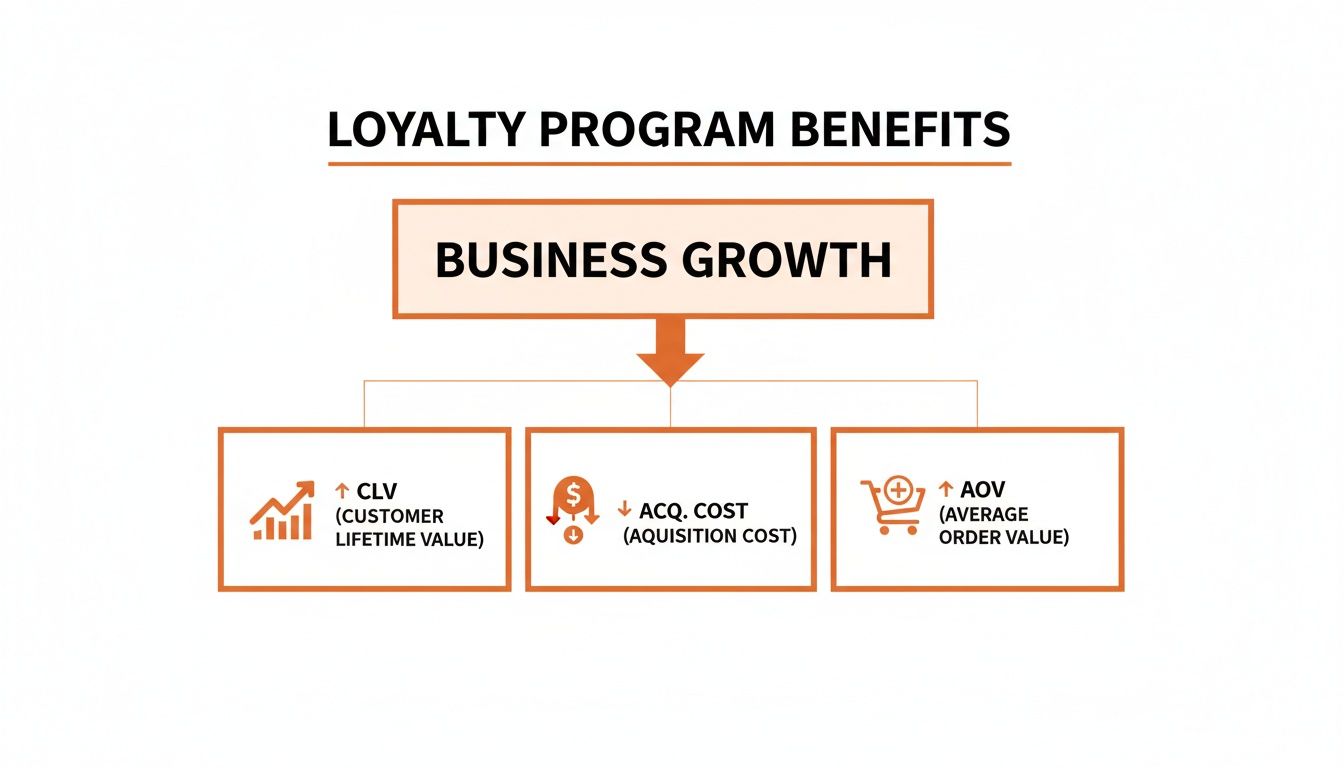
When you nail the earning rules, redemption options, and engagement drivers, you create a system that directly boosts Customer Lifetime Value (CLV), lowers acquisition costs, and increases Average Order Value (AOV).
Launching Your Program on Shopify
A well-designed points program is a great blueprint, but a successful launch is what actually brings it to life. For Shopify merchants, turning that strategy into a live, engaging experience for your customers is pretty straightforward, but it definitely requires some thoughtful planning and execution. A strong launch builds immediate momentum and gets customers excited to start earning from day one.
Think of it like the grand opening of a new store. You wouldn't just quietly unlock the doors without telling anyone. Your loyalty program launch needs that same kind of coordinated effort to make sure customers don't just know it exists, but are genuinely excited to join.
The first move is choosing and setting up the right app from the Shopify App Store. This is the engine that will power your entire program, handling everything from tracking points to redeeming rewards. Getting this foundation right is critical; if you're just starting out, a guide on setting up a Shopify store can walk you through the essentials before you even think about adding a loyalty program.
Your Pre-Launch Checklist
Before you flip the switch to "live," a few key steps will ensure everything rolls out smoothly and professionally. This isn't just about the tech—it's about weaving your new program into the fabric of your brand experience from the very beginning.
-
Customize Your Rewards Widget: Your loyalty program should never feel like a clunky, third-party add-on. Spend a little time customizing the rewards widget or panel so it perfectly matches your store’s branding, colors, and fonts. A seamless look builds trust and makes the program feel like it truly belongs.
-
Import Existing Customers: Don't make your most loyal shoppers start from scratch. Most Shopify loyalty apps let you import your existing customer base and even award them points retroactively based on their past purchases. This is a huge gesture that instantly shows you value their history with your brand.
-
Prepare Your Customer Service Team: Your support team is about to become your front line for all things loyalty. They'll be fielding questions about how to earn, how to redeem, and everything in between. Get them ready with a detailed FAQ document so they can give fast, consistent, and accurate answers.
A smooth launch is all about anticipation. By preparing your assets and team ahead of time, you eliminate friction for the customer and create a positive first impression that encourages immediate sign-ups.
This prep work sets the stage for a launch day that feels polished and exciting, not rushed and confusing. You're not just turning on a feature; you're orchestrating a marketing event.
Creating Your Launch Day Marketing Blitz
Once the technical side is buttoned up, it’s time to shout it from the rooftops. On launch day, your goal is to make it impossible for a customer to visit your store without learning about your new rewards program. A multi-channel marketing push is the only way to drive that initial flood of sign-ups.
Here are a few marketing actions to put on your list:
-
Build a Dedicated Landing Page: This is your program's official home. Create a clean, visually appealing page that spells out how the program works, all the ways to earn points, and the awesome rewards up for grabs. Make it dead simple to understand and even easier to join.
-
Craft an Email Announcement Campaign: Your email list is gold. Announce the program to all your subscribers with a special launch-day offer, like bonus 200 points just for signing up. That immediate reward gives them a powerful nudge to get involved right away.
-
Promote Across Social Media: Use your social channels to build some real hype. Create sharp graphics and short videos that showcase the benefits. You could even run a contest or giveaway to celebrate the launch and get people talking.
-
Add On-Site Banners and Pop-Ups: Use prominent banners on your homepage and maybe a pop-up during checkout to catch every single visitor. Make sure your call-to-action is clear, compelling, and hard to ignore.
Successfully launching points based loyalty programs on Shopify really comes down to this coordinated effort. If you’re looking for the right tools, a great place to start is by exploring the best options for a Shopify loyalty app that fits your brand’s goals. By combining a solid technical setup with a powerful marketing push, you can ensure your program doesn't just launch—it soars.
Optimizing Your Program for Long-tTrm Success
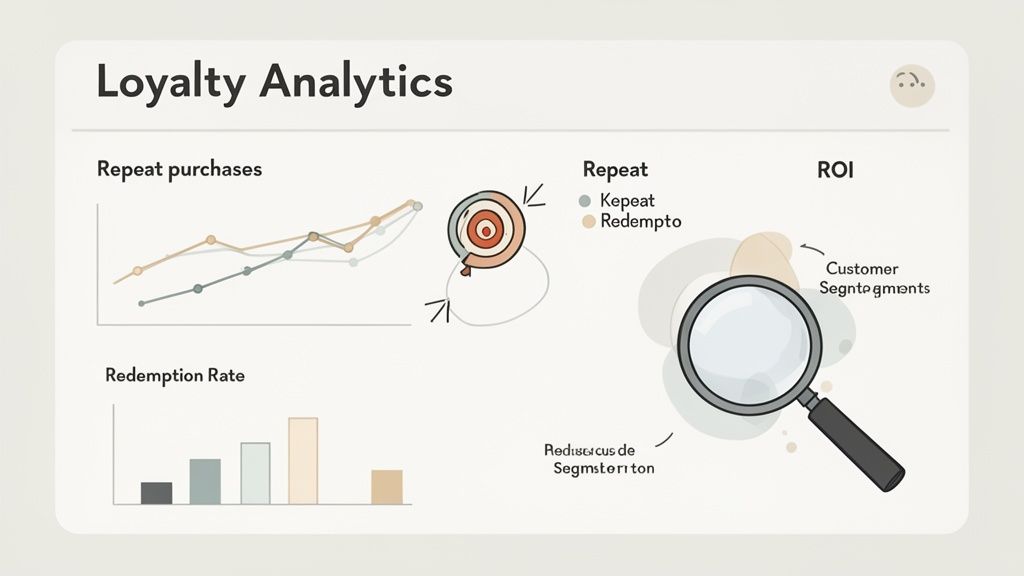
Launching your points program isn't the finish line; it’s the starting gun. The real work begins now. A loyalty program that becomes a core growth driver is one that you constantly tweak and improve. To get there, you have to treat it like any other critical marketing channel—by tracking its performance, digging into the data, and making smart adjustments over time.
This means looking past simple sign-up numbers. You need to get into the nitty-gritty of how customers are actually using your program. This data is your roadmap to building something truly engaging and, most importantly, profitable.
Tracking the Right Loyalty KPIs
You can't improve what you don't measure. Focusing on a handful of essential metrics will give you a clear picture of your program's health and show you where the opportunities are. These numbers tell a story about customer behavior and how well your program is really working.
Here are the core KPIs you should have on your dashboard:
- Redemption Rate: This is the big one. What percentage of earned points are customers actually cashing in for rewards? If this number is low, it’s a red flag that your rewards might be too hard to reach, uninteresting, or just poorly communicated.
- Repeat Purchase Frequency: How often do loyalty members come back to buy compared to regular customers? A strong program should create a noticeable lift here, proving it’s encouraging repeat business.
- Customer Lifetime Value (CLV): Are your loyalty members becoming more valuable over the long haul? Comparing the CLV of members to non-members is the ultimate gut-check for your program's financial impact.
- Program ROI: This is the bottom line. It calculates the revenue generated from loyalty members minus your program costs (like rewards and software fees). This metric proves your program is a worthwhile investment.
For a deeper dive into these metrics, check out this comprehensive guide on the most important loyalty program KPIs to track. It'll help you build a dashboard that gives you real, actionable intelligence.
Turning Analytics into Actionable Insights
Data is useless until you do something with it. Your loyalty analytics dashboard, especially inside a platform like Toki, is a goldmine for customer insights. By segmenting your audience, you can start to see who your most valuable members are and what truly motivates them.
By analyzing redemption patterns, for instance, you might discover that your VIP tier overwhelmingly prefers redeeming points for exclusive products over simple discounts. That's a huge insight. It tells you to double down on what works and source more exclusive items just for them.
This data-driven approach takes the guesswork out of the equation. It helps you spot customers who are drifting away, pinpoint your most popular rewards, and understand the true cost-benefit of every promotion you run.
Integrating and Personalizing the Experience
A truly great program doesn't exist in a vacuum. The magic happens when you integrate your loyalty data with your other marketing tools, like your email platform or SMS provider. This is how you unlock next-level personalization and create campaigns that feel like they were made for just one person.
For example, you could:
- Win back at-risk customers: Set up an automated email that offers bonus points to members who haven't shopped in 90 days.
- Reward your VIPs: Surprise your top-tier members with a "just because" gift of 500 points to show them some love and deepen their brand loyalty.
- Promote relevant rewards: If a customer has just enough points to claim a specific reward, send them a quick notification to remind them.
This level of personalization isn't just a nice-to-have anymore; it's expected. Research shows that 73% of people agree it’s harder than ever for retailers to maintain loyalty. Customers are demanding more personalization (47%) and flexible ways to spend their points (40%). By continuously analyzing your data, testing new ideas, and personalizing the experience, you ensure your points program remains a powerful engine for long-term growth.
Got Questions About Points Programs? We’ve Got Answers.
Jumping into a points-based loyalty program is exciting, but it’s natural to have a few questions. Most merchants we talk to have similar concerns about profitability, keeping customers engaged, and whether these programs really work.
Let’s clear up some of the most common questions we hear. Getting these answers straight will help you launch your program with confidence and set it up for success right from the start.
Are Points-Based Loyalty Programs Still Effective?
Yes, absolutely. You might think points are old news, but they tap into some really powerful human psychology—our natural desire to make progress, earn status, and be rewarded. Today’s best programs aren’t just about handing out points; they’re about creating a personalized experience that makes customers feel genuinely seen and valued.
Far from losing their shine, points have become something many shoppers expect. When you weave a points program into your broader marketing strategy, it becomes one of the best tools you have for keeping customers around. In a crowded market, it gives them a real reason to stick with you instead of bouncing to a competitor.
How Do I Calculate the Value of Each Loyalty Point?
This is the big one. You need to find that sweet spot where your program feels generous to customers but doesn't hurt your bottom line. A great, safe place to start is the "1% back" model.
It’s pretty simple: a customer earns 1 point for every $1 they spend, and they can redeem 100 points for a $1 reward.
With this model, each point is worth exactly one cent ($0.01). It keeps the math straightforward for everyone, which avoids confusion and protects your margins.
Of course, this is just a starting point. The right value for your business depends on your product margins and what you want to achieve. For instance, you could offer a higher point value on high-margin products to subtly guide customers toward your most profitable items. The key is to run the numbers and find a balance that's both exciting for shoppers and sustainable for you.
How Can I Encourage Customers to Redeem Their Points?
Seeing a pile of unredeemed points can be frustrating—it often means your customers aren't fully engaged. Earning points is only half the story. Getting customers to actually use them is what brings them back to your store and proves the program's value.
If you’re worried about low redemption rates, here are a few proven tactics to get things moving:
- Make Rewards Attainable: Don’t make everything a massive, far-off goal. Offer a mix of rewards, like free shipping for 500 points, alongside bigger prizes. This ensures everyone has something to aim for.
- Communicate Proactively: A friendly nudge can work wonders. Use email or SMS to remind customers about their point balance, especially when they’re just a few points away from a reward.
- Create a Little Urgency: Spark some excitement with special events. Think "Double Points Weekends" or exclusive, limited-time rewards that encourage customers to cash in their points now.
Ready to put these ideas into practice? Toki gives you everything you need to design, launch, and grow a loyalty program that gets real results for your Shopify store. Start building lasting customer loyalty today.