A Guide to Building a Loyalty Program for Ecommerce
Discover how to build a loyalty program for ecommerce that drives repeat sales and customer retention. Learn to choose the right model and measure ROI.
At its core, an ecommerce loyalty program is a marketing strategy built to reward repeat customers and build genuine brand affinity. It's about moving beyond the one-and-done sale. You create a value exchange where shoppers get real perks—like points, discounts, or early access—for sticking with you, turning casual buyers into your most profitable, long-term advocates.
Why a Loyalty Program Is No Longer Optional
In today's crowded market, getting a new customer is only half the battle. The real work is in keeping them. A loyalty program for ecommerce has gone from a "nice-to-have" feature to an absolute must for sustainable growth. Think of it as your brand's exclusive membership club.
Here’s a simple way to look at it: one-time buyers are like tourists just passing through. They might grab a souvenir, but they have no real connection to your brand. A loyalty program is your invitation for them to become locals. It gives them a compelling reason to stay, engage, and feel like they're part of the community you’re building. This shifts the dynamic from purely transactional to truly relational.
Creating a Competitive Moat
A well-designed program creates a powerful, 'sticky' experience that your competitors can't easily copy. Once a customer has earned points or unlocked a special status with your brand, they have a tangible reason to come back to you instead of clicking on a competitor’s ad. This builds a defensive barrier around your customer base, protecting you from price wars and the ever-rising costs of acquiring new customers.
A key reason loyalty programs are indispensable is their direct impact on customer retention. To truly understand the importance, explore effective ecommerce customer retention strategies.
Turning a Cost Center into a Profit Engine
Too many merchants see loyalty programs as just another expense on the balance sheet. The data tells a very different story. They are powerful revenue generators that encourage customers to spend more, more often. Your best customers aren't just buying products; they're buying into an experience that recognizes and rewards their commitment.
The numbers back this up. As of 2025, over 90% of companies around the world have some form of loyalty program in place. The global loyalty management market was valued at $15.19 billion in 2025 and is expected to skyrocket to $41.21 billion by 2032. This massive investment proves a critical point: building a profitable loyalty system isn’t just for enterprise giants anymore. It’s a vital strategy for any modern ecommerce store that's serious about long-term success.
Choosing the Right Loyalty Program Model
Picking the right structure for your loyalty program is less about finding a one-size-fits-all solution and more about choosing the right tool for a specific job. You wouldn't use a hammer to turn a screw. In the same way, the loyalty model you land on has to feel like a natural extension of your brand, resonate with how your customers shop, and directly support your business goals.
Let's break down the most popular models to help you find that perfect fit.
The decision to even start this process often comes down to your current business reality. This flowchart gives you a simple, clear-eyed way to think about whether now is the right time to invest in a structured loyalty initiative.
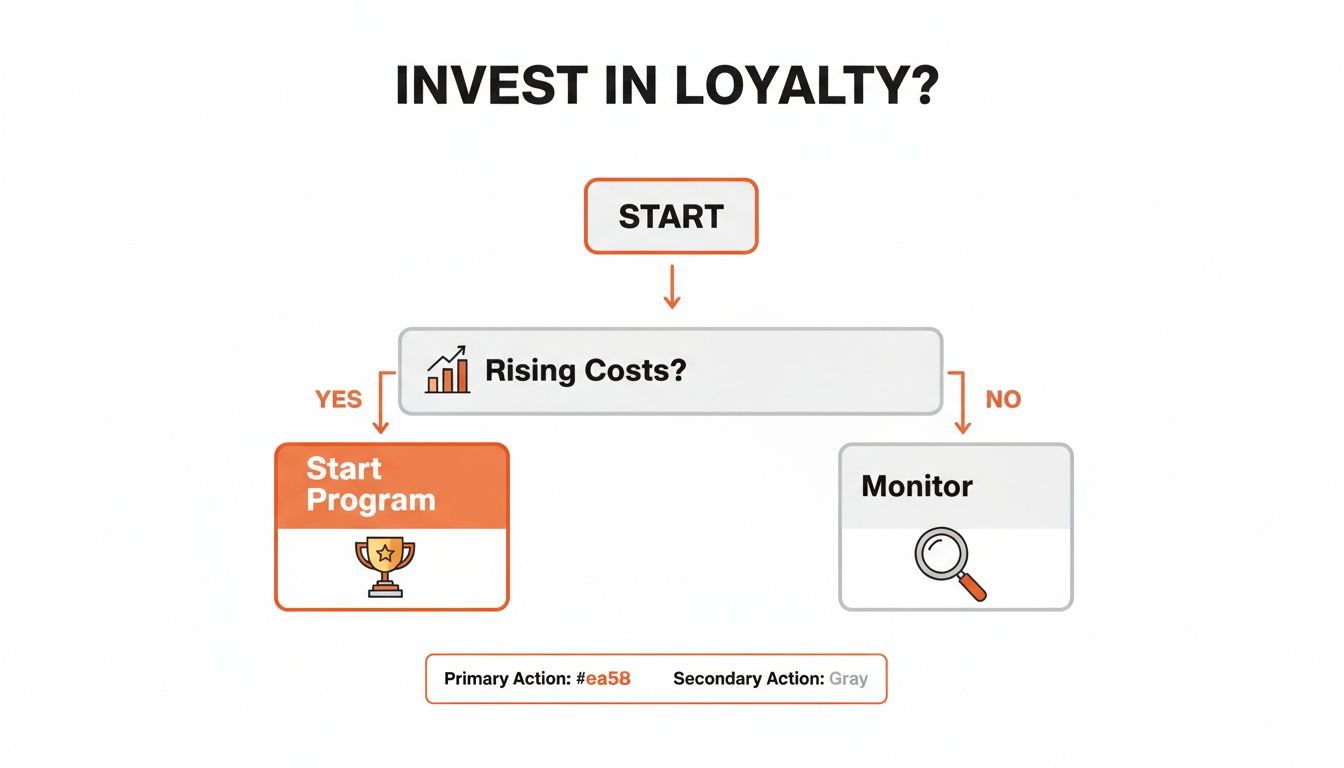
As you can see, rising customer acquisition costs are a huge trigger. When it gets too expensive to buy new customers, investing in the ones you already have isn't just a defensive move—it's one of the smartest growth strategies you can deploy.
Points Programs: Your Digital Punch Card
The points-based model is the bread and butter of loyalty for a reason: it's simple, intuitive, and it just works. Think of it as the modern version of the paper punch card from your local coffee shop. For every dollar spent or action taken (like writing a review), a customer earns points they can cash in for rewards down the line.
This model is a home run for businesses with high-frequency purchases—think cosmetics, coffee beans, or pet supplies. The constant, visible accumulation of points creates a satisfying little feedback loop that nudges customers to make their next purchase sooner. It's not uncommon for a shopper to add an extra item to their cart just to cross a reward threshold, giving your average order value a nice, organic boost.
The only real catch? If the rewards aren't compelling or the earning rules are too confusing, points can feel a bit generic. Keep it simple and make the rewards something your customers actually want.
Tiered Programs: The Frequent Flyer Status
Tiered loyalty programs tap directly into our human desire for status and achievement. It’s the same psychology that airlines use with their frequent flyer programs. Customers unlock new levels—like Silver, Gold, Platinum—and increasingly valuable perks as their spending and engagement grow.
This approach is perfect for aspirational brands or retailers with a wide range of price points. By offering exclusive benefits like early access to new drops, free express shipping, or a dedicated support line for top-tier members, you create a powerful incentive for customers to "level up."
This feeling of exclusivity is a massive motivator. The apparel brand LSKD, for instance, created a secret "Legacy" tier. Customers don't even know it exists until they unlock it, generating incredible buzz from shoppers who want to get into the exclusive club.
The main challenge here is making sure the benefits of each tier feel substantial enough to be worth the effort. A tiny discount for spending hundreds more just won't cut it.
Paid Memberships: The Exclusive VIP Club
A paid loyalty program, often called a VIP membership, turns the traditional model on its head. Instead of earning their way in, customers pay an upfront fee for access to a suite of premium, always-on benefits. The most famous example, of course, is Amazon Prime.
This model is a fantastic fit for brands that can offer high-value, recurring benefits that more than justify the cost of entry. The big win for you is the creation of an incredibly committed customer base. Once someone pays for a membership, they have a strong financial incentive to shop with you over anyone else to get their money's worth.
Plus, that upfront revenue creates a predictable income stream you can count on. The key is making the value proposition a no-brainer—the perceived value of the benefits has to absolutely dwarf the membership fee. To figure out which software can handle programs like this, you can learn more about the leading ecommerce loyalty platforms and what they offer.
Referral Programs: Turning Customers into Advocates
While it's often baked into other loyalty models, a referral program can be a powerhouse all on its own. This approach simply rewards your existing customers for bringing new people into the fold. In effect, you're turning your most passionate fans into a highly motivated, trusted sales team.
Dropbox famously used this playbook to achieve explosive growth by offering free storage to both the person referring and the new user. For an ecommerce brand, that might look like giving a customer $20 in store credit for every friend who makes their first purchase, while that friend also gets 20% off. It's a win-win.
This model is brilliant because it taps into the single most powerful form of marketing: word-of-mouth. We trust recommendations from friends far more than we trust ads. It’s a low-cost way to acquire high-value customers who are already primed to love your brand.
Comparison of Ecommerce Loyalty Program Models
To help you visualize which path might be best for your store, here's a side-by-side look at the models we've covered. Think about your products, your customers, and your ultimate goals as you review the options.
| Model Type | Best For | Primary Benefit | Potential Drawback |
|---|---|---|---|
| Points | Brands with high-frequency purchases (e.g., consumables, beauty). | Simple for customers to understand; encourages repeat purchases. | Can feel impersonal or transactional if rewards aren't compelling. |
| Tiers | Aspirational or high AOV brands with a wide customer base. | Fosters long-term loyalty and makes top customers feel valued. | Tiers must offer substantial value to motivate customers to level up. |
| Paid | Businesses that can offer high-value, ongoing perks (e.g., free shipping). | Creates a highly committed customer base and predictable revenue. | The value proposition must be strong enough to justify the upfront cost. |
| Referrals | Any brand looking for low-cost, high-trust customer acquisition. | Leverages word-of-mouth marketing to attract high-quality new customers. | Success depends on making the sharing process seamless and attractive. |
Ultimately, the best program is one that feels authentic to your brand and offers genuine value to your community. You can even mix and match elements, like adding a referral component to your tiered program, to create a system that’s uniquely yours.
Measuring the Success of Your Program
Launching a loyalty program without a way to measure its success is like sailing without a compass. You’re definitely moving, but you have no idea if you’re heading toward treasure or just sailing in circles. To turn your program into a genuine revenue driver, you have to get out of the guessing game and into the hard numbers.
This means tracking the right Key Performance Indicators (KPIs). Think of these metrics as the vital signs of your loyalty program. They tell you what's working, what's falling flat, and where your biggest opportunities are hiding. More importantly, they provide the concrete evidence you need to prove your program isn't just a fun feature, but a powerful investment.
Core KPIs for Program Health
You could track dozens of data points, but getting lost in spreadsheets won't help you grow. A few core metrics tell most of the story. Focusing on these will give you a clear, actionable snapshot of your program's performance.
-
Customer Lifetime Value (CLV): This is the big one. It's the total profit you expect from a customer over their entire relationship with your brand. The ultimate goal of any loyalty program is to increase the CLV of its members, making them demonstrably more valuable than non-members.
-
Repeat Purchase Rate (RPR): This shows you what percentage of your customers come back for a second, third, or fourth purchase. It’s a direct measure of retention and one of the clearest indicators that your loyalty efforts are actually creating loyalty.
-
Redemption Rate: This is the percentage of earned rewards that customers actually use. A healthy redemption rate, usually somewhere between 15-25%, is a great sign. It means your rewards are desirable and achievable enough to keep people engaged.
-
Average Order Value (AOV): This one's simple: how much does the average customer spend per order? You'll want to compare the AOV of loyalty members to non-members. If your program is working, you should see members consistently spending more to hit those reward thresholds.
Keeping a close eye on these metrics will give you a solid foundation for understanding your program's impact. To go even further, check out this comprehensive guide to loyalty program KPIs and how to track them.
Calculating Your Return on Investment
At the end of the day, every business owner asks the same question: is it making me money? Calculating your Return on Investment (ROI) answers that question directly, putting your program's performance into the language of the bottom line.
A simple formula is all you need to get a clear picture.
ROI Formula: (Incremental Revenue from Loyalty Members - Total Program Costs) / Total Program Costs
Let’s break that down into plain English:
- Incremental Revenue: This is the extra money your loyalty members are spending—revenue you wouldn't have captured otherwise. You can estimate this by comparing the spending habits of members against a control group of non-members.
- Total Program Costs: This includes everything. Think software fees, the cost of the rewards themselves (like the margin on discounted products), and any marketing spend dedicated to the program.
For example, if your program generated $50,000 in incremental revenue over a year and it cost $10,000 to run, your ROI would be a stellar 400%. That’s a powerful number to have when you're talking about the program's value.
The data backs this up time and time again. Research shows that 64% of loyalty members spend more to maximize their points and rewards. Even a small 5% increase in customer retention can boost profits by as much as 25%. When you consider that 57% of consumers say they actively spend more on brands they are loyal to, the financial case for a well-measured program becomes crystal clear. You can dig into more loyalty program spending trends to see just how valuable these customers are.
By focusing on these clear KPIs and a straightforward ROI, you can stop guessing and start managing your loyalty program with confidence, ensuring it remains a profitable engine for growth.
Your Step-by-Step Implementation Plan
Launching a loyalty program can feel like a huge undertaking. But if you break it down into a clear, step-by-step process, it becomes totally manageable. Think of it like building a piece of furniture—instead of staring at a confusing pile of parts, you just follow the instructions.
This roadmap is designed to do exactly that. We'll walk through it in four phases, turning what seems like a complex project into a straightforward, actionable plan.
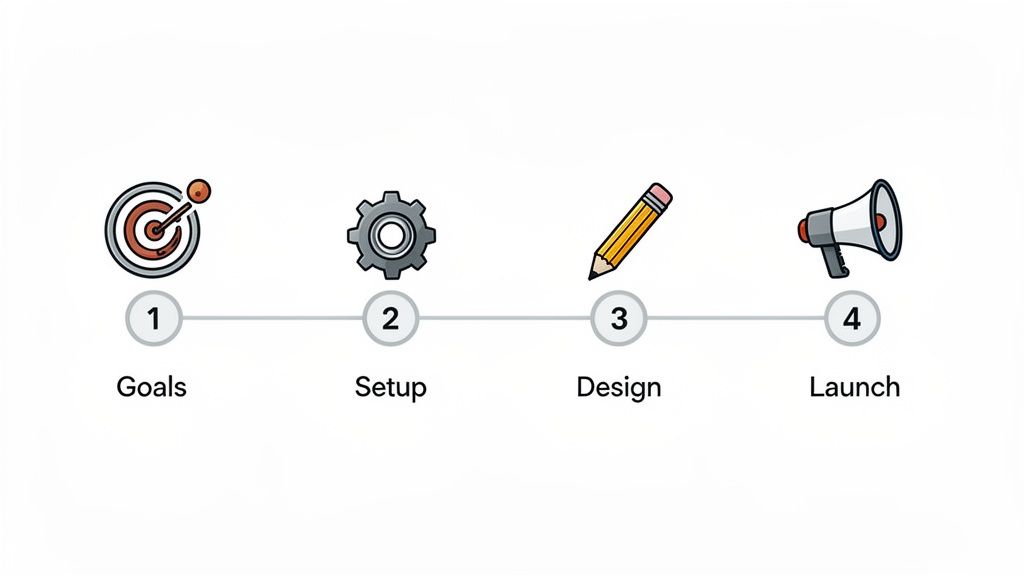
Phase 1: Define Your Goals and Rewards
Before you even look at software, you need to be crystal clear on what you’re trying to achieve. What’s the main goal here? Are you trying to get customers to buy more often? Increase their average order value? Or maybe you just want more user-generated content like photo reviews.
Your goals will shape every other decision, especially what rewards you offer. The rewards are the heart of the program, so they need to be genuinely exciting for your customers. Go beyond simple discounts and think about what your best customers really want.
- Transactional Rewards: These are the classics for a reason. Think points for purchases, percentage-off coupons, or free shipping. They provide immediate, tangible value.
- Experiential Rewards: This is where you make members feel special. Offer early access to new products, exclusive members-only content, or invitations to online events. It’s all about creating that insider feeling.
- Community-Based Rewards: Get customers involved in building your brand. Award points for things like leaving a photo review, sharing their purchase on social media, or referring a friend.
Phase 2: Choose Your Platform and Set It Up
Once you have a solid strategy, it's time to pick the tech to bring it to life. The right loyalty platform should obviously support your rewards model, but it also needs to plug directly into your ecommerce store without any headaches, especially if you're on a platform like Shopify. Most modern loyalty apps are built for merchants, not developers, so setup is usually a breeze.
This is where you'll get into the nuts and bolts. You'll set your earning rules (like 1 point per $1 spent), decide on redemption options, and link the app to your email and SMS marketing tools. The days of needing a developer for this are long gone; it’s mostly just clicking through intuitive settings.
Phase 3: Design the Customer Experience
Okay, now for the fun part—giving your program a personality. It needs a name that fits your brand. Are you launching a "VIP Club," a "Rewards Circle," or something more creative that ties into your brand's story? Whatever you choose, make sure it’s woven into all your marketing.
Beyond the name, the experience has to be dead simple. Customers need to be able to find the program, quickly understand how to earn points, check their balance, and redeem rewards without thinking twice. If it’s confusing, they just won’t use it. Design clear banners for your site, create a dedicated landing page explaining the benefits, and make sure the rewards widget is easy to find and use.
Phase 4: Plan Your Launch and Promotion
Launching a loyalty program without telling anyone is like throwing a party and not sending invitations. You need a real plan to build buzz and drive those crucial first sign-ups. The goal is to make a splash and get your best customers on board from day one.
Don't just quietly switch the program on and hope people find it. A coordinated launch campaign across email, social, and your website is the key to building momentum right out of the gate.
Here’s a sample 30-day timeline to get you started:
- Week 1 (Internal Prep): Get all your creative assets finalized. Do a full end-to-end test of the user experience. Most importantly, train your customer service team so they can answer any questions that come up.
- Week 2 (Pre-Launch Teaser): Start dropping hints on social media and in your email newsletters. Build some curiosity by letting people know something exciting is coming soon, without giving away all the details.
- Week 3 (Official Launch): This is the big day. Send a dedicated email blast to your entire list announcing the program. Be sure to offer a nice sign-up bonus to get people to join immediately. Update your website with prominent banners and pop-ups.
- Week 4 (Post-Launch Reinforcement): Keep the momentum going. Send follow-up emails that spotlight specific rewards and member perks. Share screenshots or testimonials from new members on social media to create some social proof and encourage others to sign up.
Advanced Tactics to Scale Your Program
So, your loyalty program is up and running. You're signing up members and seeing some repeat purchases. That's a great first step, but it’s just the beginning. To really transform your program from a simple perk into a serious growth engine, you have to move past the basics of just rewarding transactions.
It's time to start actively shaping customer behavior by making your program smarter, more engaging, and deeply personal. Let's dig into the advanced tactics that take a good loyalty program for ecommerce and make it truly unforgettable.
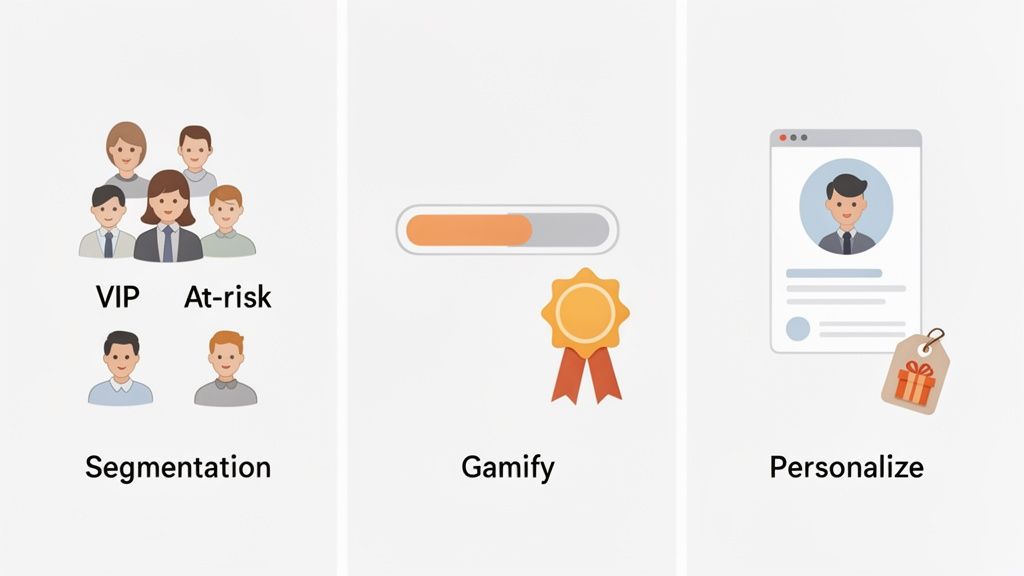
Go Beyond One-Size-Fits-All with Segmentation
Not all customers are created equal, so why treat them all the same? Segmentation is simply the practice of splitting your customer base into smaller groups based on their behavior. This allows you to ditch the generic email blasts and send targeted, relevant offers that actually resonate.
Think about it. A brand-new customer needs a warm welcome and a little nudge to make that second purchase. Your VIP who shops every month doesn't need a basic discount; they're looking for exclusivity and a sign that you recognize their value.
Here are a few key segments to start with:
- VIP Customers: These are your top spenders, the lifeblood of your business. Reward them with early access to new products, exclusive merch they can only get with points, or priority customer service. Make them feel like the insiders they are.
- At-Risk Customers: These are members who haven't bought anything in a while. Don't just let them fade away. A well-timed "we miss you" campaign with some bonus points can be incredibly effective at pulling them back in before they're gone for good.
- Brand Advocates: These are the people who constantly refer friends or leave glowing reviews. You need to acknowledge and encourage this. Give them extra points for social shares or every time a friend they referred makes a purchase.
When you tailor your approach like this, you make each customer feel seen. That level of personalization is what separates a program people use from one they forget.
Make Participation Fun with Gamification
Let's be honest, humans are wired to enjoy a good challenge. We love tracking progress and hitting goals. Gamification taps directly into these psychological drivers by adding game-like elements to your program, making it feel less like a transaction and more like a fun journey.
Instead of just earning points for purchases, you can create an experience that keeps people coming back for more. The goal is to make engagement a habit. To see how modern tech can boost these relationships, check out how speed creates customer loyalty through AI automation.
Gamification introduces an element of play that transforms the customer journey. By creating challenges and rewarding milestones, you’re not just encouraging purchases; you’re building an emotional connection and making your brand more memorable.
Here are a few ways to bring gamification to life:
- Introduce Badges: Award digital badges for completing certain actions, like making five purchases or writing three reviews. They're simple, but they act as powerful status symbols within your brand community.
- Create Challenges: Run limited-time challenges, like "Spend $100 this month to earn 500 bonus points." This creates a sense of urgency and drives specific buying behaviors you want to see.
- Use Progress Bars: Nothing is more motivating than seeing a goal within reach. A visual progress bar showing a customer how close they are to the next tier or reward is a powerful nudge to close that gap with another purchase.
These simple tactics keep your program from getting stale. For even more inspiration, read our guide on using gamification in loyalty programs.
Unify the Online and Offline Experience
If your brand has both a digital and a physical footprint, a seamless omni-channel loyalty experience isn't a "nice-to-have"—it's a must. Your customers don't see you as "online store" and "physical store." To them, you're one brand, and your program needs to reflect that. A disconnected experience is just another point of friction that can kill engagement.
The goal is simple: let customers earn and redeem points effortlessly, no matter where they shop. Someone should be able to earn points buying something in your brick-and-mortar shop and then spend those points later on your website, no questions asked.
Modern tools make this easier than ever. QR codes at the point-of-sale or digital passes for Apple and Google Wallet let your in-store team instantly identify members, apply rewards, and add points. This bridges the gap between your channels, creating one cohesive brand experience that builds real, lasting loyalty.
Common Loyalty Program Mistakes to Avoid
Launching a loyalty program is a huge step, but it’s easy to get tripped up by a few common stumbles right out of the gate. I’ve seen countless well-intentioned programs fall flat, not because the core idea was bad, but because of small, avoidable mistakes in the execution.
Let’s be honest: if your customers need a spreadsheet to figure out how to earn and spend points, they’re just not going to bother. The goal is to get them excited, not give them homework. That's probably the single biggest mistake I see brands make.
Another classic pitfall? Boring rewards. A loyalty program is meant to build an emotional connection. If your perks are just lukewarm discounts they could probably find with a quick Google search, you're not giving them a real reason to stick around.
Keeping It Simple and Desirable
The secret to avoiding these issues is to build your program on a foundation of simplicity and real-world value. This doesn’t mean it has to be basic—far from it. It just means the core idea should click with your customers instantly.
Here are a few common traps I see and how to sidestep them:
-
Mistake 1: Overly Complicated Rules: I'm talking about fractional points, weird conversion rates (like 2.75 points per dollar), or requiring 850 points for a simple $5 coupon. This just creates confusion and makes rewards feel impossibly far away.
-
Solution: Keep it clean. A $1 equals 1 point system is a classic for a reason. It’s dead simple, and customers can track their progress without breaking a sweat.
-
Mistake 2: Unappealing Rewards: Offering only small, percentage-off discounts doesn’t create that "insider" feeling you're after. These rewards lack the punch needed to make someone feel truly valued.
-
Solution: Get creative! Mix in experiential perks that have a high perceived value. Think early access to new collections, members-only products, or even something as simple and beloved as free shipping on all orders.
Don't just set it and forget it. One of the silent killers of a great loyalty program is poor promotion. If you don't shout about it from the rooftops, even the most amazing rewards will go unnoticed.
Finally, one of the biggest oversights is simply failing to promote the program. You could design the most brilliant loyalty program for ecommerce, but if it's tucked away on a forgotten page of your site, it’s going to wither on the vine. A strong launch needs a real marketing push—email campaigns, social media announcements, and prominent on-site banners to get that crucial initial momentum.
Steer clear of these common traps, and you'll be on your way to building a program that customers don't just understand, but are genuinely excited to be a part of.
Frequently Asked Questions
Even with the best-laid plans, you're bound to have some questions pop up. It's only natural when you're launching something new. Let's walk through some of the most common questions we hear from merchants about getting a loyalty program off the ground.
How Much Does It Cost to Start a Loyalty Program?
The cost really depends on the size of your business and the platform you end up choosing. These days, most modern platforms offer flexible pricing. For a startup or a smaller store, you can often find plans starting in the $50-$150 per month range. For larger, more complex operations, enterprise-level solutions can run from several hundred to thousands each month.
When you're mapping out your budget, you'll want to think about three main costs:
- The monthly or annual fee for the loyalty software itself.
- The actual cost of the rewards you give out (think product margins on discounted items).
- Any money you'll spend on marketing to get the word out.
The best way to think about it is as an investment. If you track it correctly, you'll see a direct return in higher customer lifetime value and more repeat sales.
Can a Loyalty Program Work for a Small Shopify Store?
Absolutely. In fact, loyalty programs can be a small store's secret weapon. They're one of the best ways to build a genuine community around your brand and encourage repeat business, which is always cheaper than finding new customers.
Don't worry if you're not a developer. Modern loyalty apps are built with merchants in mind. Most offer a quick, code-free installation and a straightforward setup, so you can get rolling without needing a tech team.
Even a simple program—like rewarding points for purchases and offering a bonus for referrals—can make a huge difference for a growing brand right away.
What Are the Most Effective Rewards to Offer?
The best rewards are the ones that make your customers feel like insiders. While a simple discount is a good starting point, the real magic happens when you offer exclusive perks that can't be found anywhere else.
Think about offering things your competition can't easily copy:
- Early access to new products before anyone else.
- Free shipping on all orders, no strings attached.
- Access to limited-edition or members-only merchandise.
- A free product of their choice after they've made a few purchases.
Ultimately, your best rewards will connect back to what your brand is all about. Not sure what that is? Just ask! Sending a quick survey to your best customers is a fantastic way to find out what they actually want.
Ready to turn your customers into loyal advocates? Toki provides all the tools you need—from points and referrals to VIP tiers and digital wallet passes—to build a loyalty program that drives real growth. Start building lasting customer relationships today.