Choosing the Best Ecommerce Loyalty Platforms for Growth
Discover the top ecommerce loyalty platforms. This guide compares features, pricing, and integrations to help Shopify and DTC brands boost customer retention.
In a market this crowded, smart brands know the real money isn't just in finding new customers—it's in keeping the ones you already have. This is where ecommerce loyalty platforms come in. They aren't just another piece of software; they're the engine that turns a first-time shopper into a repeat buyer and, eventually, a true fan of your brand. Think of it as your secret weapon for boosting customer lifetime value while keeping acquisition costs in check.
The Strategic Value of Ecommerce Loyalty Platforms
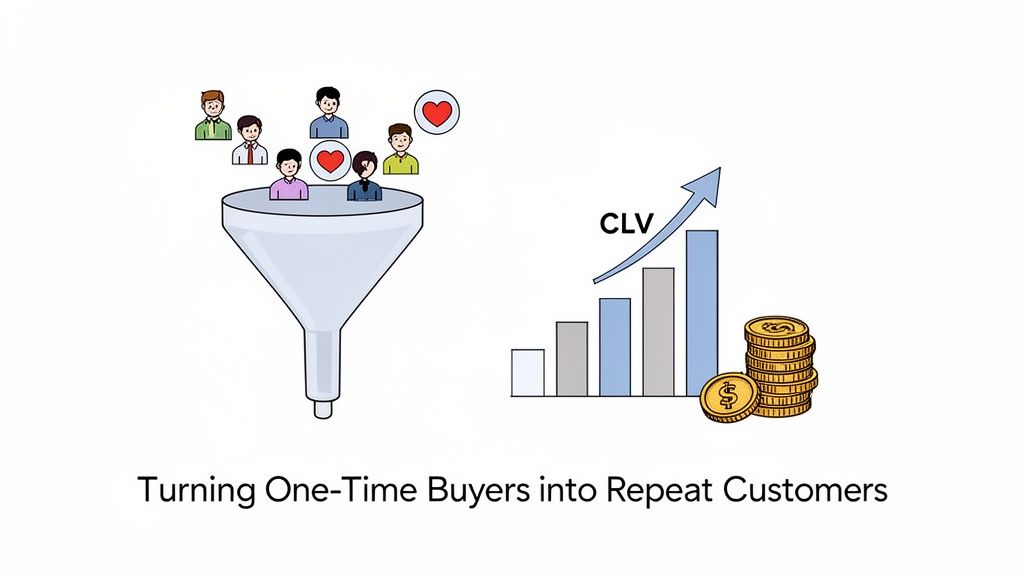
It’s easy to dismiss a loyalty program as a simple marketing add-on, but that's a huge mistake. A well-designed program, powered by the right platform, becomes the very core of your business strategy. It has a direct and measurable impact on your bottom line.
The whole point is to build real relationships that generate predictable, recurring revenue. It's a simple, powerful trade: customers get real, tangible perks for sticking with you, and in return, you get a loyal base of shoppers who aren't easily swayed by a competitor's discount.
Financial Impact and Brand Growth
Let's talk numbers, because the financial case for a loyalty platform is hard to argue with. When you give customers a reason to come back, you’re directly increasing their Customer Lifetime Value (CLV). A single loyal customer who shops with you for years is infinitely more valuable than a dozen people who buy once and disappear.
At the same time, you're not constantly throwing money at expensive ads to acquire new customers. It's no wonder the global loyalty management market was valued at $13.31 billion in 2024 and is expected to explode to $41.21 billion by 2032. That kind of growth tells you just how essential these platforms have become. To see the full picture, it's helpful to view these programs as a key part of your digital marketing strategies for ecommerce growth.
A loyalty program is your defense against the race-to-the-bottom pricing wars. It shifts the conversation from "who is cheapest?" to "who provides the most value?" This transition is key to building a resilient, long-term brand.
Establishing Your Evaluation Criteria
Picking the right platform is everything. As we go through this guide, we’ll be judging the options based on a few non-negotiable criteria. Understanding the benefits of a loyalty program will give you a head start on what to look for.
Here’s what really matters:
- Deep Integrations: How cleanly does it plug into Shopify, your POS, and the other tools you rely on? A smooth integration means no data headaches and a seamless experience for your customers.
- Robust Feature Set: Can it handle tiered memberships, referrals, fun gamification elements, and digital wallets? The right features are what keep people engaged and excited to come back.
- Scalability: Will this platform grow with you? You need a solution that’s just as effective when you’re a multi-million-dollar brand as it is when you’re just starting out.
Key Capabilities to Evaluate in a Loyalty Platform
When you're choosing a loyalty platform, it's easy to get distracted by flashy dashboards and big marketing promises. But to build a program that actually keeps customers coming back and grows your revenue, you need to look under the hood. The best platforms are built on a solid foundation of deep integrations, flexible rewards, and smart engagement tools that all work together without a hitch.
If that foundation is shaky, even the most creative loyalty strategy will fall flat. It just won't connect with your customers or give you a decent return on your investment. Let's break down the must-have capabilities you should be looking at before you sign any contracts.
Deep and Seamless Integrations
Honestly, this is the most critical piece of the puzzle. A loyalty platform has to integrate deeply with the tools you already use. If it doesn't, you're looking at a future of data headaches, frustrated customers, and hours of manual work for your team. This isn't just a tech detail—it’s the very core of a good customer experience.
You’ll want to zero in on three key areas:
- Ecommerce Platform: If you're on Shopify, you need a native, certified app. It should sync customer data, order history, and points in real-time, feeling less like a bolted-on tool and more like a natural part of your Shopify admin.
- Point of Sale (POS): For anyone with a brick-and-mortar store, smooth POS integration is non-negotiable. Customers expect to earn and spend points whether they’re on your website or in your shop. Nothing kills the vibe faster than telling someone their online points don't work at the register.
- Marketing Stack: Your platform absolutely must talk to your email and SMS tools, like Klaviyo or Attentive. This is how you automate messages that matter—think "your points are about to expire" reminders or a "welcome to the gold tier!" email.
We get into the nitty-gritty of this in our guide on successful loyalty program integration, which is worth a read if you want to make sure all your systems are communicating properly.
Flexible Reward and Engagement Structures
A simple "spend more, get points" system just doesn't cut it anymore. People expect experiences that feel personal and dynamic. The best loyalty platforms give you a whole toolbox of options so you can build a program that really fits your brand and gets your specific customers excited.
Look for a platform that gives you more than one way to structure rewards and get people involved.
Tiered VIP Programs Tiers are fantastic because they turn loyalty into a game. Customers are motivated to spend more to unlock the next level of status and get better perks. It's a proven way to build a sense of exclusivity that can turn casual shoppers into your biggest fans.
Referral and Affiliate Programs Your happiest customers are your best marketers, period. A built-in referral engine lets you turn them into brand advocates, rewarding them for sending new business your way. This is a super-effective way to lower your customer acquisition costs by leaning into word-of-mouth.
Paid Memberships If you have a strong, engaged community, a paid membership can be a game-changer. It creates a steady, predictable revenue stream by offering serious, exclusive benefits—like free shipping on everything or members-only products—for a monthly or annual fee.
The real goal here is to move past basic transactional rewards. A great platform lets you build a community by mixing financial perks, exclusive access, and status-driven benefits that make customers feel like they're truly part of something.
Advanced Analytics and Customer Experience
Finally, a top-tier platform has to deliver on two fronts: powerful analytics for you and a fantastic experience for your customers. You need clear, actionable data to know what's working, and your customers need a dead-simple way to track and use their rewards.
Here are a few key features to look for:
- ROI Tracking: Your dashboard should give you the important stuff at a glance. Think repeat purchase rate, the customer lifetime value (CLV) of members versus non-members, and how often rewards are actually being redeemed.
- Digital Wallet Passes: Integration with Apple and Google Wallet is a modern must-have. It lets customers pull up their loyalty status and points right on their phone, which is perfect for bridging the online-to-in-store experience.
- Gamification: Features like earning badges, completing challenges, or getting surprise point drops add a layer of fun that keeps people engaged even when they aren't actively shopping.
Comparing the Top Ecommerce Loyalty Platforms
Picking the right loyalty platform isn't about chasing the longest feature list. It's about finding the right fit for your business stage, your daily operations, and where you want to go next. A platform that’s perfect for a scaling Shopify store could be total overkill for a brand new DTC startup.
To give you some clear, practical advice, I've broken down this comparison into three common merchant profiles. This way, we can skip the generic checklists and look at how different ecommerce loyalty platforms actually perform in the real world.
For the DTC Startup Launching Its First Program
If you're a direct-to-consumer startup, you need a loyalty platform that's easy to set up, won't break the bank, and nails the basics of retention. Your main goal is to start building that loyal customer base from the get-go, without getting lost in complicated features.
- Platform Archetype (e.g., a basic Shopify App): These tools are all about speed and simplicity. Think straightforward points-for-purchase systems, basic referral rewards, and a simple customer widget that plugs right into your Shopify theme. The idea is to get a working program live in hours, not weeks.
- Key Capabilities: You're looking for the essentials: point-based rewards, simple referral links, and a customizable on-site display. Analytics are usually pretty basic, focusing on member count and points redeemed, which is all you really need at this stage.
- Limitations to Consider: The biggest thing to know is that you'll probably outgrow these platforms. They often don't have advanced features like membership tiers, deep marketing integrations, or support for in-person POS systems.
For a new brand, the main thing is to test the loyalty concept and start collecting data. A simple, low-cost platform is the perfect way to get started.
For the Scaling Shopify Brand
Once your Shopify brand starts to take off, your needs get a lot more complex. You start thinking about customer segmentation, deeper marketing automation, and creating a more memorable brand experience. This is where more powerful platforms like Toki really come into their own.
- Platform Archetype (e.g., Toki): Solutions in this category are built for growth. They offer a whole suite of tools that go way beyond just earning points. You get access to things like tiered VIP programs, paid memberships, and even affiliate management tools, all designed to boost customer lifetime value.
- Key Capabilities: A deep integration with Shopify and your marketing tools, like Klaviyo, is non-negotiable. These platforms let you trigger automated emails and texts based on loyalty data—like when a customer hits a new VIP tier or has points that are about to expire.
- Real-World Scenario: Picture a growing beauty brand. With a platform like Toki, they could create a "Glow Getter Club" with three tiers: Silver, Gold, and Platinum. Gold members might get early access to new products, while Platinum members get exclusive content and free shipping. It gamifies the experience and encourages people to spend more to unlock better perks. You can dig deeper into how different loyalty program platforms manage these kinds of features in our detailed guide.
A key differentiator for scaling brands is the ability to build a community, not just a rewards program. Platforms that support paid memberships and exclusive content create a powerful moat around your brand, making it much harder for competitors to poach your best customers.
This infographic breaks down the core features that are essential for any brand focused on growth.
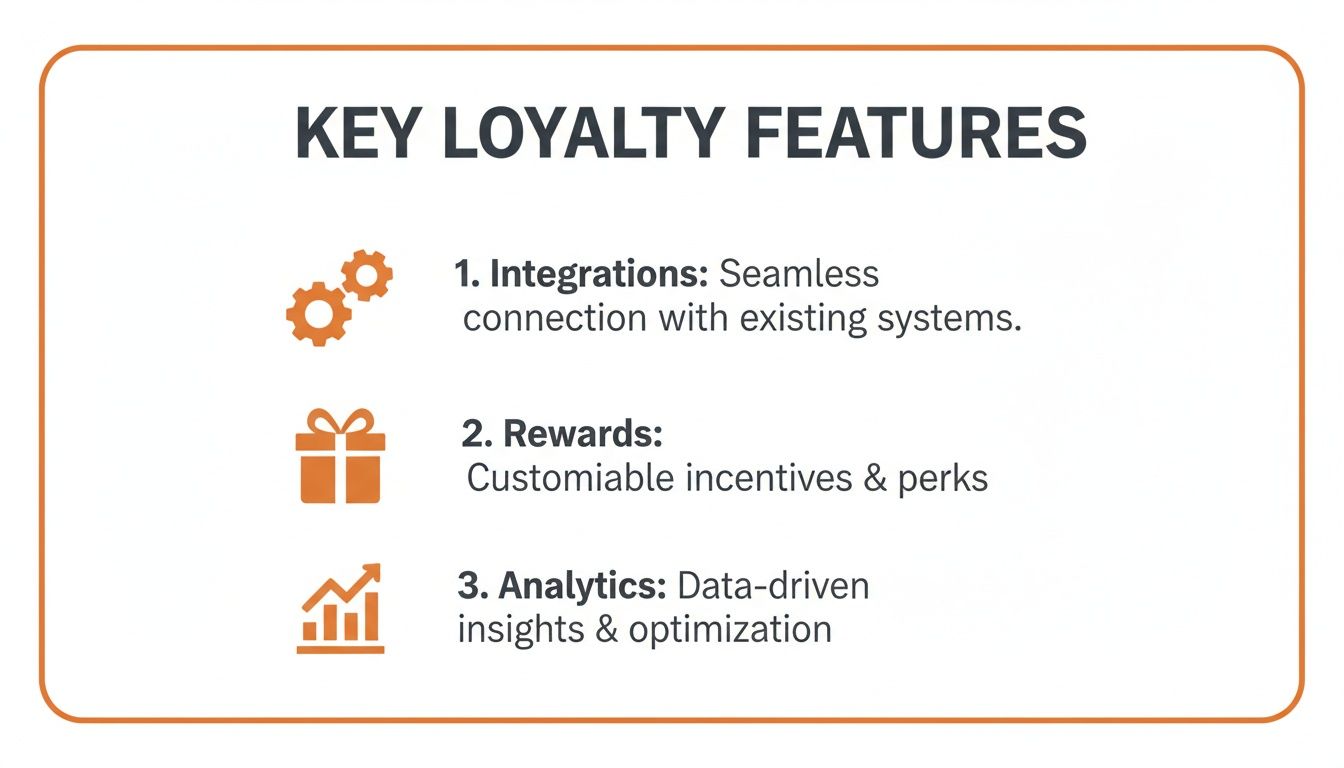
These three pillars—smooth integrations, flexible rewards, and clear analytics—are what make a program both fun for customers and profitable for your business.
For the Omnichannel Retailer
Omnichannel retailers have a unique puzzle to solve: how to create one seamless loyalty experience for customers who shop both online and in their physical stores. For them, the platform choice comes down to flawless POS integration and tools that connect the digital and physical worlds.
- Platform Archetype (e.g., Enterprise-level or Custom Solutions): These platforms are built to handle complexity. They offer robust APIs, dedicated support for custom POS setups, and features specifically designed for an omnichannel customer journey.
- Key Capabilities: The absolute must-have is perfect POS integration. A customer has to be able to earn points online and redeem them at the register instantly, with zero hassle. Advanced features like digital wallet passes for Apple and Google Wallet are also huge, letting customers carry their loyalty status right on their phones.
- Real-World Scenario: Think about a fashion retailer with 50 brick-and-mortar stores and a busy Shopify site. With an enterprise platform, a customer could earn points online on Monday, get a push notification on their phone on Wednesday about an in-store deal, and then redeem their points at their local shop on Saturday. It creates a unified brand experience that drives traffic everywhere.
This level of integration is critical in modern retail. When you're thinking about how different solutions might plug into your stack, it helps to understand the foundational platforms they support by comparing leading ecommerce platforms like Shopify and WooCommerce.
The data backs this up. Research shows that 74% of consumers feel more loyal to brands that offer a great loyalty experience. And the fact that 59% use their programs 1-3 times a week shows just how powerful a well-designed platform can be for driving repeat business. This is especially true when you can connect your online and physical stores into one cohesive experience.
Loyalty Platform Feature Comparison For Different Merchant Needs
To make this even clearer, here's a table that maps key features to the different merchant profiles we've discussed. It's a quick way to see which capabilities you should prioritize based on your business model.
| Feature/Capability | Ideal for DTC Startups (e.g., Basic Loyalty App) | Ideal for Scaling Shopify Stores (e.g., Toki) | Ideal for Enterprise Omnichannel (e.g., Custom Platform) |
|---|---|---|---|
| Points & Rewards | Basic points for purchases, simple dollar-off discounts. | Multi-faceted earning rules, free products, exclusive access. | Complex, tiered rewards; experiential perks; dynamic offers. |
| Integrations | Shopify-native, works "out of the box." | Deep integration with Shopify, Klaviyo, Gorgias, etc. | Custom API integrations, POS systems, ERP, and mobile apps. |
| Membership & Tiers | Not a primary feature; may offer a simple VIP level. | Multi-level VIP tiers, paid memberships, community features. | Fully customized tier structures tied to omnichannel spend. |
| Referrals & Affiliates | Simple customer-to-customer referral links. | Advanced referral tracking, affiliate management, and payouts. | Sophisticated partner and influencer program management. |
| Gamification | Basic earning notifications and on-site widget. | Points-earning challenges, birthday bonuses, progress bars. | In-app games, location-based check-ins, interactive events. |
| Analytics & Reporting | Core metrics like member count and redemption rate. | Customer segmentation, LTV tracking, campaign ROI analysis. | Predictive analytics, cohort analysis, cross-channel attribution. |
| Scalability & Support | Designed for low volume; community or email support. | Handles high order volume; dedicated success manager. | Built for massive scale; enterprise-level SLAs and dev support. |
This breakdown should help you pinpoint exactly where your needs lie. What’s essential for an enterprise retailer is often unnecessary for a startup, and vice-versa. Focus on the tools that will solve today's problems while giving you room to grow tomorrow.
How to Choose the Right Platform for Your Business
Alright, you've seen the comparisons. Now it's time to make a decision. Choosing the right ecommerce loyalty platform is more than just ticking feature boxes; it's a strategic investment that needs to fit your business like a glove. It’s easy to get sidetracked by a slick interface, but you need to think about implementation, how it will scale with you, and what the true total cost of ownership really is.
The whole process gets a lot easier when you start with a single, guiding question: what is my primary objective? For example, a startup laser-focused on growth will need a powerful referral engine. A more established brand wanting to foster an exclusive vibe should be looking for best-in-class tiered membership tools.
Aligning Platform Features with Your Business Goals
The best platform is the one that directly helps you hit your most critical business goals. Before you even glance at a pricing page, you have to define what success actually looks like for your brand. This simple step creates a lens that brings your evaluation into sharp focus.
So, what’s your main goal for the next 12-18 months? Is it getting customers to buy again and again? Pushing up your average order value? Or maybe it's cutting down on how much you spend to acquire new customers? Once you nail that down, you can map specific features directly to that outcome.
-
Goal: Increase Repeat Purchases: You'll want to prioritize platforms with solid points-based systems and fun gamification, like earning badges for completing challenges. Deep integration with your email tool, like Klaviyo, is also a must for sending out automated reminders when points are about to expire.
-
Goal: Build a Strong Brand Community: Look for platforms that really shine with VIP tiers and paid memberships. The secret sauce here is the ability to offer exclusive content, early product access, and special members-only events.
-
Goal: Lower Customer Acquisition Costs (CAC): A built-in referral program is non-negotiable. Make sure it's dead simple for customers to share their unique links and for you to track the results clearly on your end.
A classic mistake is getting wowed by a feature that sounds cool but doesn't actually solve a problem you have. Your primary goal is your North Star—it ensures you invest in a tool that will actually move the needle on your key metrics.
Critical Questions for Vendor Demos
Vendor demos can feel like a whirlwind of features and promises. To get past the sales pitch and understand what a platform can really do, you need to show up with a specific list of questions. These questions are designed to uncover how the software performs in the real world, not just in a perfectly rehearsed presentation.
Use this checklist during your next demo to get the answers that matter:
-
On Integration Depth: "Can you walk me through a live example of how your platform syncs loyalty data with our Shopify POS and Klaviyo? I want to see the entire journey of a customer earning points in-store and then getting an automated email based on that action."
-
On Customization and Branding: "How much control do we get over the look and feel of the on-site loyalty widget and emails? Can we use our own brand fonts and custom colors without needing a developer to step in?"
-
On Scalability and Performance: "What’s your game plan for massive traffic events like Black Friday? Do you have safeguards to ensure the loyalty system won't slow down our website when we're slammed with orders?"
-
On Support and Onboarding: "What does your onboarding process involve, and who will be our dedicated contact? What are your guaranteed response times for support tickets, especially if something urgent comes up?"
-
On Total Cost of Ownership: "Looking beyond the monthly fee, are there any other costs for implementation, migrating data from our current system, or for premium support? What are the overage charges if we go past our plan's limits?"
Asking these tough questions forces vendors to skip the generic claims and show you concrete proof of their platform’s value. Making a confident investment in one of the many ecommerce loyalty platforms out there starts by knowing what to ask. This approach empowers you to find a true partner that will deliver real results for years.
Getting Set Up, Switching Over, and Measuring What Matters
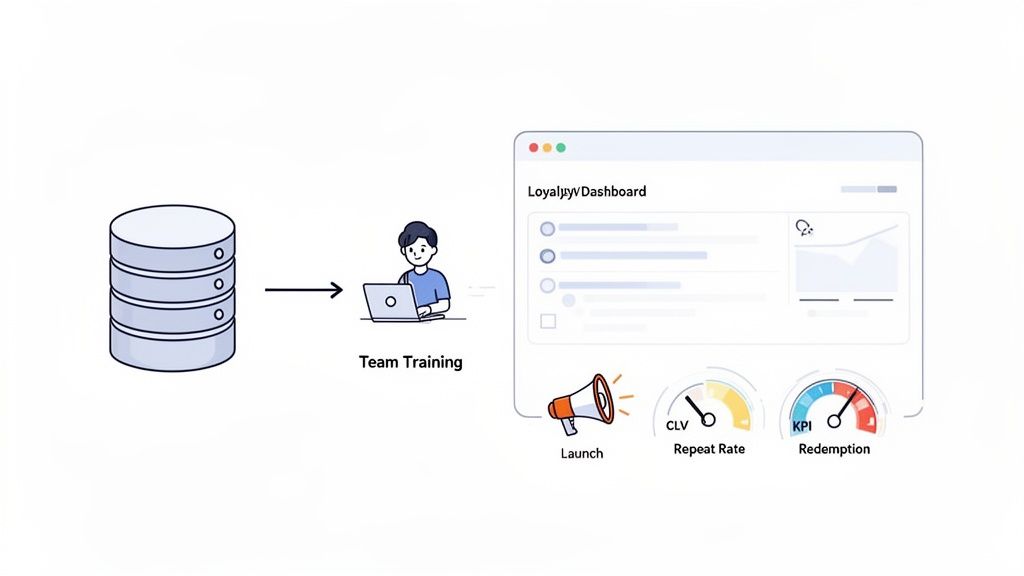
Picking the right platform is a huge step, but the real work starts the moment you sign up. A great launch is so much more than just flipping a switch. It’s about carefully moving your customer data, getting your team ready, and making a bit of noise to get your customers excited and signed up from day one.
Switching from an old system—even if it's just a spreadsheet—has to be handled with care. The last thing you want is to frustrate your best customers. The top ecommerce loyalty platforms know this and provide solid tools and real human support to make the transition smooth, ensuring every point and every customer tier is transferred without a hitch.
Best Practices for Data Migration and Launch
A clean migration is the bedrock of a successful program launch. If you get this part wrong, you risk alienating the very people you're trying to reward. Your focus should be squarely on data integrity and clear, honest communication.
Here's a practical checklist to help you navigate the move:
- Clean Your Data First: Before you even think about exporting, tidy up your existing customer data. Get rid of duplicate accounts, fix typos in email addresses, and double-check that everyone's point balance is correct. This simple step prevents the classic "garbage in, garbage out" problem.
- Run a Test Migration: Never, ever do a full migration on your first try. Work with your new platform’s team to move a small, representative batch of customer data. This is your chance to spot and fix any mapping issues before they become a real headache.
- Train Your Team Early: Your customer service crew is on the front line. They need to know the new program inside and out before it goes live. Give them thorough training on how the system works, what questions customers will likely ask, and how to troubleshoot any migration bumps.
- Talk to Your Customers Proactively: Announce the new and improved loyalty program well in advance. Explain what’s great about it and, most importantly, reassure them that all their hard-earned points and status are safe. A simple, transparent email can save you from a flood of support tickets.
A loyalty program launch is a marketing event. Don’t just quietly turn it on. Build excitement with a multi-channel campaign that includes email announcements, social media teasers, and a prominent banner on your website to maximize enrollment from day one.
Measuring What Matters: Key Performance Indicators
Once you're live, your focus has to shift to measuring the impact. Without clear metrics, a loyalty program is just an expense. By tracking the right Key Performance Indicators (KPIs), you can prove its value and make smart, data-driven decisions to improve it over time.
This is where the real power of modern ecommerce loyalty platforms shines. The math behind customer retention is incredibly compelling; it consistently costs 5-7 times more to bring in a new customer than it does to keep one you already have. Considering that repeat buyers can drive up to 65% of a company's revenue, a good loyalty program is a direct investment in your bottom line. You can discover more insights about these retention economics on Clutch.com.
Core KPIs for Tracking Loyalty Program ROI
Your platform's dashboard will be full of charts and numbers, but you need to zero in on the metrics that tie directly to revenue and growth.
Repeat Purchase Rate (RPR) This is the most straightforward measure of loyalty. It shows you the percentage of your customers who come back to buy a second, third, or fourth time. An RPR that's climbing is a clear signal that your program is hitting the mark.
- How to Calculate It: (Number of Customers with >1 Purchase / Total Number of Customers) x 100
Customer Lifetime Value (CLV) This KPI forecasts the total amount of money a customer is likely to spend with your brand over their entire relationship. The key here is to compare the CLV of your loyalty members against non-members. You want to see a much higher CLV for your members.
Reward Redemption Rate This metric tells you how many of the rewards you're giving out are actually being used. A low rate could mean your rewards aren't very exciting or the process to claim them is too confusing. You're looking for a healthy balance—if it's too high, you might be hurting your margins, but if it's too low, it means nobody's engaged.
Common Questions About Loyalty Platforms
When you're sifting through all the different ecommerce loyalty platforms, a lot of practical questions pop up. You start thinking about timelines, customer data, and how a new system will actually fit with your business. Getting straight answers is the only way to feel good about your choice.
This section is all about tackling those common hurdles. We'll skip the high-level marketing talk and get right into the nuts and bolts that will make or break your program's launch.
How Long Does It Take to Launch a New Loyalty Program?
The timeline really depends on what you're trying to build and who you have to help build it. Some of the simple, plug-and-play solutions for Shopify can be up and running in a couple of days. They're built for speed and usually stick to basic points-for-rewards systems.
If you’re aiming for something more sophisticated, you’ll need more time. A custom program with different membership tiers, unique branding, and a deep POS integration will probably take somewhere between 2-4 weeks to get right. This window accounts for the technical setup, finalizing your rewards strategy, creating marketing assets for the launch, and getting your support team up to speed. A platform with a clear, guided setup can make this process a lot less painful.
Can I Migrate Existing Customer Data to a New Platform?
Absolutely. Any serious ecommerce loyalty platform is designed to handle data migration. This is a non-negotiable for any brand that already has a customer list—you can't afford to lose the loyalty you've already earned.
The process usually involves exporting your customer data (names, emails, point balances) from your current system and uploading it into the new one. The best platforms offer specific tools or even a dedicated support person to walk you through it.
Before you sign any contract, get a clear confirmation on how they handle data migration. A clean switchover is crucial. It avoids frustrating your customers and shows your most loyal fans that you value them right from the start.
What Is the Most Important Feature for an Omnichannel Brand?
If you have both a website and a physical store, nothing is more important than a solid Point of Sale (POS) integration. It has to work flawlessly. Your loyalty program needs to recognize customers and apply rewards instantly, whether they're checking out online or standing at your counter.
This is what ties the entire customer experience together and encourages people to shop with you, no matter where they are. I'd also look for platforms that support digital wallet passes for Apple and Google Wallet. It’s such a simple, effective way to bridge the online-offline gap. Customers can carry their loyalty card right on their phone, which is not only convenient but also keeps your brand front and center.
Ready to turn casual shoppers into lifelong brand champions? Toki provides all the tools you need—from tiered memberships and referrals to seamless digital wallet integration—to build a loyalty program that drives real growth. Start building stronger customer relationships today.