Loyalty Program Ecommerce: Boost Repeat Sales and CLV
Discover loyalty program ecommerce tactics that drive repeat purchases and increase customer lifetime value. Learn KPIs, rewards, and best practices.
Picture two customers walking into your online store.
One buys a product and you never hear from them again. The other comes back, buys again, and then starts telling their friends about you. That difference isn't just a stroke of good luck—it's loyalty. A smart loyalty program ecommerce strategy isn't just another marketing gimmick anymore; it's a core engine for survival and growth.
Why a Loyalty Program Is Essential for Ecommerce Growth
Not too long ago, the path to business growth was all about acquiring new customers, whatever the cost. But the game has changed. With digital ad costs constantly climbing, just chasing new buyers is an expensive, never-ending treadmill. The real, sustainable path to profitability is right in front of you: it's in nurturing the customers you already have.
This is where a modern loyalty program becomes your secret weapon. It’s a fundamental shift in how you think about your business, moving from a laser focus on one-time transactions to maximizing customer lifetime value (LTV). You stop just selling a product and start building a relationship.
The Shift from Acquisition to Retention
Here's a hard truth: acquiring a new customer can cost five times more than keeping an existing one. A loyalty program tackles this problem head-on by giving your customers solid reasons to come back for more. We've moved way beyond the simple "buy ten, get one free" punch cards. Today's programs create a connected system that rewards repeat business, turning casual shoppers into genuine fans of your brand.
This strategic shift pays off in a few key ways:
- Increased Repeat Purchases: Customers have a clear, tangible reason to choose you over a competitor next time they need something.
- Higher Average Order Value (AOV): You'll see shoppers adding just one more item to their cart to hit a reward threshold or unlock a new tier. It works.
- Powerful Brand Advocacy: A great program naturally encourages referrals, turning your happiest customers into your most authentic and effective marketing team.
The Data-Driven Advantage of Loyalty
Modern loyalty platforms are much more than just point dispensers; they are powerful data-gathering machines. In fact, a recent industry analysis showed that 70% of brands report a direct increase in customer engagement because of their loyalty initiatives. What’s more, nearly 64% of loyalty program members openly admit to spending more just to earn better rewards.
Why? Because every time a customer interacts with your program, they're giving you valuable clues about their habits and preferences. You learn what actually motivates them, allowing you to create personalized experiences that make them feel seen and strengthen their connection to your brand. Dive deeper into these loyalty program trends to get the full picture.
Think of a loyalty program not as a cost center, but as a profit engine. It completely changes the economic equation of your business by making each customer relationship more valuable over time, cutting down on churn, and building a predictable stream of revenue.
To really get the most out of your loyalty program, it needs to work hand-in-hand with a smart conversion rate optimization strategy that's always pushing for growth. Platforms like Toki bring this level of strategic marketing within reach for every merchant, giving you the tools you need to turn one-time buyers into your most passionate brand advocates.
The Core Mechanics of a High-Impact Loyalty Program
Think of a great loyalty program like a well-built engine. It’s not just one part doing all the work; it’s a collection of core mechanics humming along in perfect harmony to move your business forward. Getting a handle on these foundational pieces is the first step toward building a program that does more than just hand out discounts—it builds real, lasting relationships with your customers.
Each mechanic serves a different purpose and appeals to different customer motivations. You’ve got the simple satisfaction of racking up points, the exclusive feeling of reaching a VIP tier, and everything in between. These are the tools you'll use to create a dynamic, engaging experience that keeps people coming back for more.
Ultimately, the goal is to guide customers along a journey: from their first purchase (acquisition), to becoming a regular (retention), and finally, to being a true brand champion (advocacy).
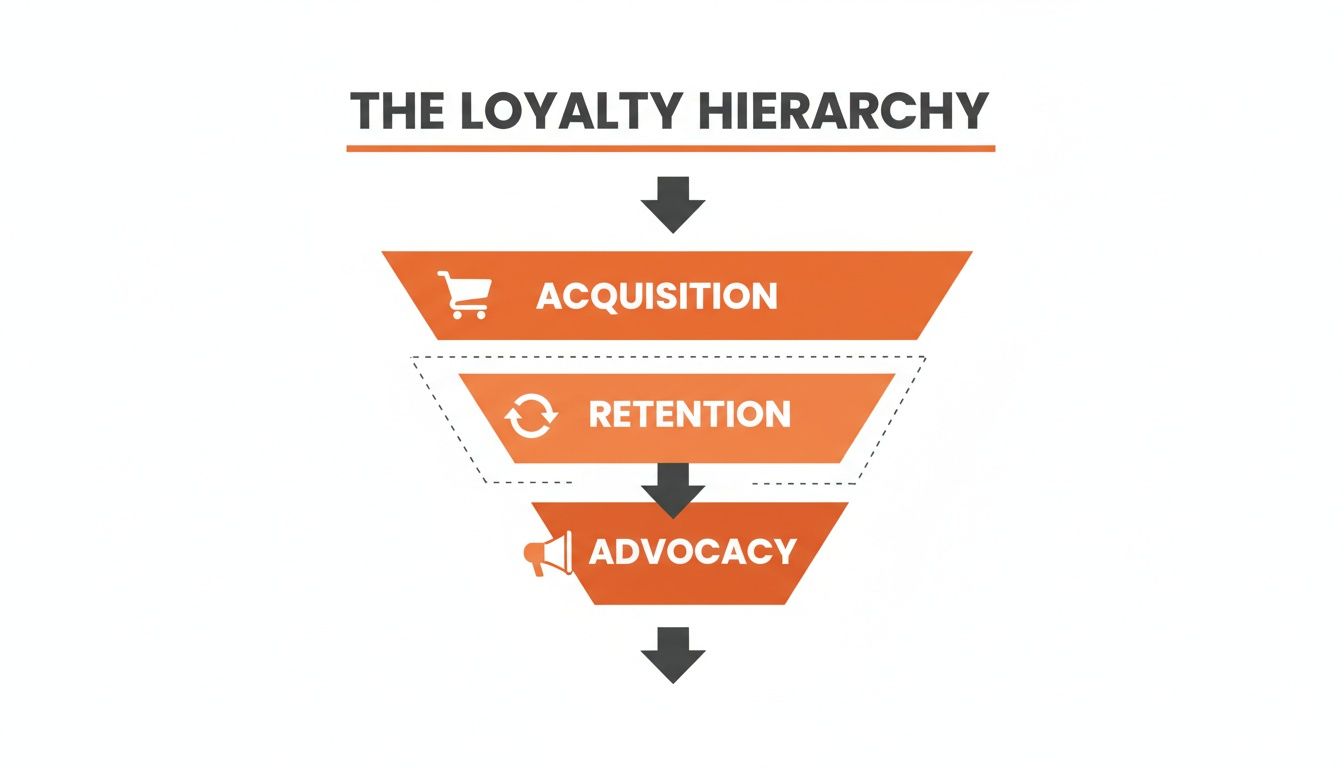
This journey shows how a smart program builds on itself, turning a casual shopper into a powerful, self-sustaining source of growth. Let's pop the hood and look at the individual parts that make this engine run.
Points Systems: The Currency of Loyalty
Points are the most classic and straightforward tool in the loyalty playbook. Think of them as your brand’s own private currency. Customers earn them for doing things you want to encourage—making a purchase, sure, but also writing a review or following you on social media. Then, they can "spend" those points on rewards.
The beauty is in its simplicity. The logic is crystal clear: engage more, earn more. For every dollar spent, a customer might earn five points. Once they hit 500 points, they can cash them in for a $5 discount or a free product. It’s an easy-to-understand system that works.
The real magic of a points-based system is its flexibility. It rewards every valuable interaction, not just transactions. This teaches customers all the ways they can engage with your brand and consistently reinforces positive behavior.
This creates a satisfying feedback loop that makes every interaction feel worthwhile. It's a foundational layer for many of the most effective ecommerce loyalty platforms and often serves as the base for more sophisticated strategies.
Tiered Programs: A Path to VIP Status
If points are the currency, then tiers are the status symbols. A tiered program operates a lot like an airline's frequent flyer club. The more a customer engages or spends over time, the higher they climb, unlocking better and better perks with each new level.
This approach taps into powerful psychological drivers like our desire for achievement and exclusivity. A new customer might start in a "Bronze" tier with basic point-earning benefits. But as they keep shopping, they can graduate to "Silver" to unlock free shipping, and eventually hit "Gold" for early access to new product drops.
Here’s a quick look at what a tiered structure could offer:
- Entry Tier (e.g., Bronze Member): Earn points on purchases and get a birthday reward.
- Mid-Tier (e.g., Silver Member): All Bronze benefits, plus free shipping on every order.
- Top Tier (e.g., Gold Member): All Silver perks, plus exclusive access to new products and double-points days.
Tiers give your best customers a clear goal to shoot for. It's an incredibly effective way to boost both how often they buy and how much they spend when they do.
Referral Systems: Turning Customers into Marketers
Let's be honest: your happiest customers are your most authentic and affordable marketers. A referral program simply puts a structure around this by rewarding them for spreading the word. It’s a win-win system that formalizes word-of-mouth marketing.
The mechanics are dead simple. A current customer (the advocate) shares a unique link with a friend. When the friend makes their first purchase through that link, both of them get a reward. Maybe the friend gets 15% off their first order, and the advocate gets a $10 coupon for their next one.
This creates a powerful growth loop. Research shows that referred customers are incredibly valuable, boasting a 16% higher lifetime value on average. A referral system transforms your loyalty program from a simple retention tool into a potent customer acquisition engine.
Paid Memberships: The Ultimate Commitment
A paid membership, or subscription-based loyalty program, is reserved for your die-hard fans. It's the model that Amazon Prime made famous: customers pay a recurring fee (monthly or annually) for instant access to a suite of premium, always-on benefits.
For an ecommerce store, this might look like a $50 annual fee that unlocks:
- Unlimited free two-day shipping.
- A permanent 10% discount on every single purchase.
- Access to members-only products and exclusive content.
This model fosters an incredible sense of value and belonging. Because customers have skin in the game, they're highly motivated to shop with you to make their investment worthwhile. It gives your business a predictable revenue stream and all but guarantees your best customers won't even think about shopping with a competitor.
Driving Engagement with Personalization and Gamification
A solid loyalty program does more than just hand out points for purchases; it builds a real, emotional connection with your customers. Once you've got the basic mechanics down, it's time to make your program an experience—something memorable and engaging. This is where personalization and gamification really shine. They're the secret ingredients that turn a simple points system into an interactive journey customers actually enjoy.
Without these touches, even the best-designed program can feel a bit generic. Customers have seen it all before. But when you start tailoring rewards and adding game-like elements, you make people feel uniquely valued. You give them compelling reasons to interact with your brand that go way beyond just hitting "buy." It's the difference between a program they forget their password for and one they check every day.
Making Customers Feel Uniquely Valued with Personalization
Personalization means ditching the one-size-fits-all approach. It’s about using the customer data you already have—their purchase history, what they look at on your site, even their birthday—to offer rewards that feel like they were picked just for them. Think about it: which is more exciting? A generic "10% off" coupon sent to everyone, or bonus points for buying more of the product you already love?
This kind of tailored interaction makes customers feel seen and understood, not just like another number in your system. This isn't just a hunch; recent research shows that 57% of shoppers feel more emotionally connected to the brands they’re loyal to, and that feeling is often sparked by personal touches. There's also a clear generational shift happening: 71% of Gen Z shoppers say they get personalized interactions, compared to just 56% of Gen X.
Using customer data lets you create those "surprise and delight" moments that build truly deep loyalty. A simple, automated birthday reward can make a customer feel like part of a community, not just an order number.
Here are a few practical ways you can start personalizing your program:
- Birthday Bonuses: Automatically send a customer some points on their birthday. It’s a simple gesture that has a huge impact.
- Targeted Offers: Notice a customer who always buys from a specific product category? Offer them double points on their next purchase from that collection.
- Win-Back Campaigns: Create a segment for customers who haven't shopped in a while and send them a special "we miss you" point offer to bring them back.
Turning Loyalty into a Game
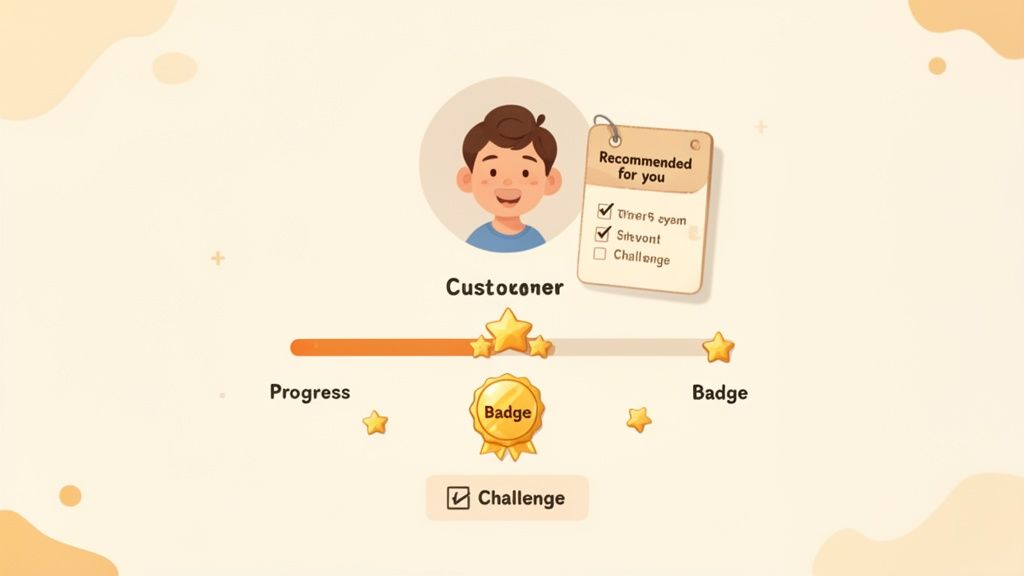
Gamification is all about applying game mechanics to things that aren't games—and it’s a perfect match for a loyalty program ecommerce setup. It taps into our natural drive for achievement, competition, and reward. By adding things like challenges, badges, and progress bars, you make interacting with your brand genuinely fun.
Instead of just passively collecting points, customers are actively encouraged to complete specific tasks. This is a massive win for engagement, but it also helps you hit key business goals, like getting more social media followers or encouraging customers to leave product reviews. When you get it right, gamification makes your program feel less like a marketing tactic and more like a fun part of the shopping experience. You can learn more about how to pull this off in our guide to gamification in loyalty programs.
Effective gamification strategies often involve elements like:
- Achievement Badges: Award digital badges for hitting milestones, like making five purchases or referring a friend.
- Challenges and Quests: Run limited-time challenges, like "Spend $100 this month to unlock 500 bonus points."
- Progress Bars: Give customers a visual of how close they are to their next reward or VIP tier. It’s a powerful motivator to close that gap.
The real magic happens when you combine personalization and gamification. Imagine sending a customer a personalized challenge based on their past purchases—it's fun, relevant, and makes them feel special. This is how you build a loyalty program that doesn't just keep customers around, but turns them into your biggest fans.
Integrating Your Loyalty Program Across Every Channel
Think about how your customers actually shop. Their journey is rarely a straight line. They might see your product on Instagram, browse on their laptop later that night, and then pop into your physical store to buy it. If your loyalty program ecommerce strategy only exists online, you’re not just missing an opportunity—you’re creating a frustrating, disjointed experience that undermines the very loyalty you want to build.
Imagine this: a loyal customer racks up points online, feeling great about their next purchase. They head to your brick-and-mortar store, ready to cash in, only to be told their points are "online only." That's not just a minor inconvenience; it’s a moment that erodes trust and makes your program feel more like a marketing gimmick than a genuine reward.
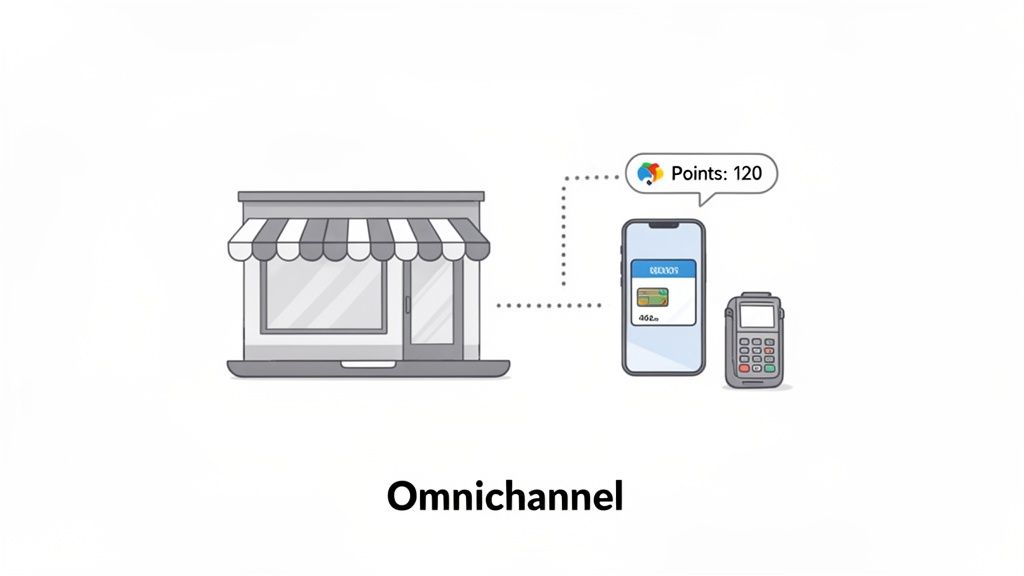
A truly great loyalty program needs to be wherever your customers are. This seamless, unified approach is what we call an omnichannel strategy. It means a customer's points, tier status, and rewards are the same whether they’re on their phone, their desktop, or standing at your checkout counter. It turns your program from a simple website feature into a core part of their relationship with your brand.
Bridging the Online and In-Store Gap
The single most important step in going omnichannel is connecting your digital and physical storefronts. This all comes down to a rock-solid integration between your ecommerce platform (like Shopify) and your Point of Sale (POS) system.
When these two systems communicate seamlessly, the magic happens. A customer can earn points from an online purchase and see them reflected instantly when they visit your shop the next day. They can redeem a reward they earned in-store on their next website order. This kind of consistency is what builds confidence and makes the program feel truly valuable.
An omnichannel approach breaks down the invisible walls between your sales channels. For the customer, there's no "online store" and "physical store"—there is only one brand, and their loyalty is recognized everywhere.
This unified view isn't just great for the customer. It gives you, the merchant, a complete 360-degree picture of their behavior. You finally see the full story of their journey, not just isolated snapshots from different channels. To dive deeper, our guide on building an omnichannel loyalty program provides a more detailed roadmap.
Unlocking Convenience with Digital Wallet Passes
One of the most effective tools for tying this whole experience together is the Digital Wallet Pass. Think of it as a dynamic loyalty card that customers can add to their native Apple Wallet or Google Wallet with just a tap. No separate app download needed.
This simple move solves one of the biggest problems with loyalty programs: they get forgotten. Instead of asking customers to remember a password or carry a plastic card, their loyalty status lives right on the device they never leave home without.
The benefits here are huge:
- Persistent Presence: Your brand is always there, right next to their credit cards and boarding passes. Talk about top-of-mind.
- Targeted Push Notifications: You can send updates directly to their lock screen about new points, expiring rewards, or special member-only sales.
- Geo-Fenced Alerts: The wallet pass can even trigger a reminder notification when a customer is near one of your physical stores, nudging them to pop in and use a reward.
Digital passes create a constant, low-friction bridge between you and your customer, making it effortless for them to engage with your program and feel its value in their day-to-day life.
Measuring Success with KPIs That Actually Matter
Launching a loyalty program is a great first step, but without the right metrics, you’re just flying blind. Data without context is noise. To really understand your program's impact, you have to zero in on the key performance indicators (KPIs) that track its health and, most importantly, its return on investment. It's time to forget vanity metrics like total sign-ups and focus on the numbers that actually drive business growth.
This means digging deeper than surface-level stats to monitor the real engines of profitability. A great loyalty program doesn’t just hand out discounts; it actively and measurably changes how your customers shop. By tracking the right KPIs, you can see exactly what's working and make smart, data-driven decisions to keep improving.
Tracking Customer Lifetime Value
If you track only one thing, make it Customer Lifetime Value (LTV). This is the single most important metric for understanding the long-term success of your loyalty program. LTV tells you the total revenue you can realistically expect from a customer over their entire relationship with your brand. A program that’s doing its job should make this number go up—a lot.
So, are your loyalty members spending more over time than your non-members? The answer to that question reveals the true financial punch of your efforts. A healthy program will show a clear, upward trend in LTV for your most engaged members.
Your loyalty program is an investment in future revenue. Tracking LTV is how you measure the return on that investment, proving that keeping customers is far more profitable than constantly chasing new ones.
Analyzing Repeat Purchase Rate
The most obvious sign of a winning retention strategy is your Repeat Purchase Rate. This KPI simply measures the percentage of customers who come back for a second, third, or fourth purchase. It’s a direct reflection of how happy people are with your brand.
If your rewards and tiers are genuinely compelling, this number will climb. It’s proof that customers find real value in sticking with you instead of hopping over to a competitor. As a benchmark, a healthy ecommerce business should aim for a repeat purchase rate somewhere in the 20-40% range.
Monitoring Redemption Rate
Your Redemption Rate is the pulse of your program's engagement. It calculates the percentage of points or rewards that customers actually use. A low redemption rate is a huge red flag; it probably means your rewards aren't desirable enough or the process is just too confusing.
- What it means: A high redemption rate, typically over 20%, shows your rewards are motivating and easy to access.
- Why it matters: When customers redeem rewards, they almost always make another purchase. This not only boosts immediate revenue but also strengthens their connection to your brand.
Measuring Customer Advocacy
Finally, Customer Advocacy shows how well your program turns happy customers into brand evangelists. The easiest way to track this is through the success of your referral program. How many new, paying customers are your members bringing in?
This KPI is proof that you're building genuine enthusiasm, not just transactional relationships. Customers who come from referrals are gold—they tend to have a higher LTV and stick around longer than customers you find through paid ads. To get the full picture of your program's impact and make sure it's adding to your bottom line, it's critical to learn how to measure marketing ROI from all your efforts.
Common Mistakes That Can Derail Your Loyalty Program
Launching a loyalty program ecommerce strategy is a fantastic move, but it's easy to stumble right out of the gate. I've seen countless well-intentioned programs fizzle out, not because the concept was flawed, but because the execution ended up frustrating the very customers it was designed to celebrate.
Let's walk through a few of the most common pitfalls so you can sidestep them and build a program that actually works.
One of the biggest blunders is making things too complicated. If your customers need a PhD in mathematics to figure out your points system, they're going to check out. Fast. The best programs are the ones you can understand in five seconds. Simplicity is everything.
Along the same lines, if your program feels like a chore, you've already lost. Forcing customers to jump through a dozen hoops or wait six months for a tiny reward isn't rewarding—it's just annoying. The whole point is to make them feel special, not to test their patience.
Making Rewards Feel Unattainable
A loyalty program dies the moment customers feel like the rewards are a carrot on a stick they can never reach. If someone has to spend an astronomical amount just to get a small discount, they won't even bother trying. It does the opposite of what you want; instead of encouraging loyalty, it can make your brand feel disconnected and greedy.
The rewards themselves also have to be, well, rewarding. A generic 5% off coupon isn't going to get anyone excited. You need a compelling mix that speaks to different customer desires:
- Transactional Rewards: Think straightforward stuff like discounts and free products. These provide immediate, tangible value.
- Experiential Rewards: This is where the magic happens. Offer exclusive perks like early access to new launches or invites to members-only events. This builds an emotional connection that a simple discount never could.
A loyalty program's true value isn't measured in points, but in its ability to change customer behavior. If your rewards aren't compelling enough to inspire that next purchase, the program isn't delivering a return on your investment.
Forgetting to Promote the Program
This one might be the most common and costly mistake of all: the "if you build it, they will come" mindset. You could design the most brilliant loyalty program in the world, but if no one knows it exists, it’s just a ghost in the machine.
Think of your program as a new product—it needs marketing. It should be everywhere. Put it on your homepage banner, on your product pages, in your email signatures, and all over your social media. Consistent and clear promotion ensures every customer, new and old, knows exactly what they're missing out on. This is how you turn a simple program into a real engine for growth.
Frequently Asked Questions About Ecommerce Loyalty Programs
Even with the best strategy in hand, it's smart to have questions before you dive in. Let's walk through some of the most common things merchants ask when they're thinking about adding a loyalty program ecommerce strategy.
How Much Does an Ecommerce Loyalty Program Cost?
It's tempting to look at a loyalty program as just another line item on the expense sheet, but that's the wrong way to think about it. A well-built program isn't a cost center; it's a profit driver.
Sure, there are platform subscription fees. But the real "cost" is the rewards you give out—and that's a good thing! It means the program is only spending money when customers are taking actions that make you money, like making a purchase or referring a new shopper. The key is to shift your mindset from "cost" to "investment" and focus on the return. When your loyalty members are outspending and out-shopping everyone else, the program is paying for itself over and over again.
How Quickly Can I Expect to See Results?
You'll see some results almost right away, but the biggest wins take a little time to build. You’ll definitely notice an immediate jump in sign-ups if your launch offer is compelling. You might even get a quick bump in average order value as people try to hit that first reward.
But the metrics that truly matter are the ones that tell a story of long-term, sustainable growth.
- Customer Lifetime Value (LTV): This is the big one. It grows over months and years, showing you the real financial impact of keeping your customers happy and coming back.
- Repeat Purchase Rate: Seeing this number tick up consistently is a sign that you’re not just getting one-off sales, you're building habits.
Think of it like planting a tree. The sprout pops up quickly, which is exciting, but the real value comes from the strong, fruit-bearing tree it becomes over time.
Can a Loyalty Program Work for a New Ecommerce Store?
Absolutely. In fact, starting a loyalty program early can be a massive advantage. When your store is new, every single customer is gold. A loyalty program gives you a structured way to start building genuine relationships right from the very first transaction.
Waiting until you think you're "big enough" is a classic mistake. A loyalty program is one of the very tools that helps you get big. It builds a bedrock of repeat business that gives you the stable revenue to keep growing.
Modern platforms make it totally feasible for a brand of any size to launch a great loyalty program ecommerce strategy. By starting early, you turn your first-ever customers into your biggest fans, creating a loyal core that will stick with you for the long haul.
Ready to turn your customers into lifelong fans? Toki provides all the tools you need—from points and referrals to VIP tiers and digital wallet passes—to build a powerful loyalty program that drives repeat sales and boosts customer lifetime value. Start building your loyal community with Toki today.