Improve Business Today: improving customer loyalty with proven strategies
Discover how improving customer loyalty fuels repeat sales with proven programs and strategies that turn customers into advocates.
Improving customer loyalty is about more than just dangling points and discounts in front of people. It’s about creating a genuine connection, making your customers feel seen and valued. When you get that right, one-time buyers start turning into lifelong fans, and your marketing shifts from a costly acquisition game to a powerful, self-sustaining growth engine.
Why Customer Loyalty Is Your E-Commerce Superpower
In e-commerce, we often get stuck on a treadmill, constantly chasing new customers. It feels like filling a leaky bucket—you keep pouring money into ads, only to see most new buyers make a single purchase and vanish. The real advantage comes from plugging that leak.
Focusing on the customers you already have is the secret. Understanding how to increase user retention isn’t just a nice-to-have; it's the core of building a resilient and profitable online store.
Moving Beyond Simple Transactions
Modern loyalty isn't just a transactional back-and-forth. It’s about building a community and making customers feel like they belong to something bigger than just a store. A discount might hook them for one sale, but an emotional connection keeps them coming back for years.
This approach has a direct, measurable impact on the metrics that matter most:
- Customer Lifetime Value (CLV): Loyal customers simply buy more, more often. In fact, a 5% increase in customer retention can boost profits by a staggering 25% to 95%.
- Average Order Value (AOV): Once a customer trusts your brand, they’re more willing to try higher-priced products or add that extra item to their cart without a second thought.
- Brand Advocacy: Your most loyal customers become your best marketers. They tell their friends, post on social media, and defend your brand—all for free.
The goal is to evolve from a brand customers buy from to a brand they believe in. This is the foundation for sustainable growth, creating a business that isn't at the mercy of ever-rising ad costs.
The Proven Impact of Loyalty Programs
The numbers don't lie. Strategic loyalty programs deliver real, tangible returns. A staggering 83% of businesses with a loyalty program report a positive ROI, and on average, these programs generate an impressive 5.2x return on investment.
It’s no wonder that nearly a third (31.4%) of marketing budgets are now dedicated to loyalty and retention efforts. The industry knows where the smart money is.
The great news is that sophisticated tools are no longer just for the enterprise giants. Platforms like Toki now let Shopify stores of any size roll out powerful strategies, from tiered memberships to digital wallet passes.
For a deeper dive into how retention and loyalty work together, check out our guide on customer retention and customer loyalty.
Defining Your Loyalty Goals and Metrics
Before you even think about points or perks, you need a blueprint. A great loyalty program isn't just about giving stuff away; it's about solving a specific business problem. Without clear goals from the start, you're just throwing spaghetti at the wall, hoping something sticks. You'll have no real way to know if your investment is actually paying off.
The right goals always depend on where your business is right now. A brand new DTC store is probably obsessed with turning one-time buyers into two-time buyers. A more established company, on the other hand, might be focused on getting their top-tier VIPs to spend just a little bit more. The key is to get specific and tie your objective directly to a core business outcome.
Choosing Goals That Align With Your Business
So, what's your biggest headache? Are you seeing a ton of first-time buyers who never come back? Is your average order value stuck in a rut? Let these challenges steer your strategy.
For example, a subscription box company's main goal might be to keep subscribers around longer, stretching that average subscription length from three months to six. A fashion retailer might instead aim to get their top 10% of customers to buy one extra time per year. It's about moving past a vague idea like "we want more loyalty" and zeroing in on a tangible result.
Your loyalty program shouldn't be an isolated marketing tactic. Think of it as a strategic tool built to fix a specific problem—whether that’s cutting down on churn, boosting your margins, or finding a more cost-effective way to bring in new customers.
Translating Goals Into Measurable KPIs
Once you know what you want to achieve, you need to figure out how to measure it. It’s easy to get sidetracked by vanity metrics that look impressive on a dashboard but don't actually tell you if your business is healthier. The trick is to focus on the Key Performance Indicators (KPIs) that track the specific customer behaviors you're trying to encourage.
Before we get into the nitty-gritty of KPIs, it's helpful to see how specific business goals map directly to the metrics that matter most.
Mapping Loyalty Goals to Key Performance Indicators
| Loyalty Program Goal | Primary KPI to Track | How to Measure It |
|---|---|---|
| Increase customer retention | Repeat Purchase Rate | The percentage of customers who have made more than one purchase. |
| Boost customer lifetime value | Customer Lifetime Value (CLV) | The total predicted revenue a customer will generate over their entire relationship with your brand. |
| Encourage more frequent shopping | Purchase Frequency | The average number of orders per customer over a specific time period (e.g., a month or quarter). |
| Drive larger cart sizes | Average Order Value (AOV) | The total revenue divided by the number of orders. |
| Grow your customer base | Referral Conversion Rate | The percentage of referred friends who make a purchase. |
| Improve program engagement | Redemption Rate | The percentage of earned loyalty points that are actually redeemed for rewards. |
This table gives you a clear starting point. By connecting a clear goal to a specific metric, you create a powerful feedback loop. You can see exactly how your loyalty program is performing and make smart, data-driven adjustments to get even better results.
Let's walk through a few of the most crucial KPIs every e-commerce brand should have on their radar:
- Customer Lifetime Value (CLV): This is the holy grail. CLV tells you the total worth of a customer over time, making it the perfect metric for seeing if your program is creating genuinely more valuable relationships.
- Repeat Purchase Rate: This one is simple but powerful. It’s the percentage of your customers who come back for a second, third, or fourth purchase. For any brand trying to build a sustainable business, this is a non-negotiable metric to watch.
- Purchase Frequency: How often are your customers actually buying? A successful program should shorten the time between orders, which is a fantastic sign that you're becoming a regular part of their lives.
- Redemption Rate: This tells you if people actually care about your rewards. If you're giving out millions of points but nobody is using them, it's a huge red flag that your rewards aren't compelling or the program is too confusing.
Imagine a specialty coffee brand that wants its customers to buy beans more often. Their goal is to increase purchase frequency. The KPI they'd obsess over is the average number of orders per customer, per quarter. To hit that goal, they could build a tiered system where customers who order monthly get early access to new, limited-edition roasts—a perfect incentive to drive that repeat behavior.
This methodical approach ensures your efforts in improving customer loyalty are strategic and impactful right out of the gate.
Designing Loyalty Programs That Actually Drive Engagement
Okay, so you've mapped out your goals and know what you're measuring. Now for the fun part: building the engine of your loyalty strategy. A loyalty program is so much more than just a points system. It's a powerful tool you can use to shape customer behavior, foster a real sense of community, and create experiences that stick with people. The real trick is picking the right mechanics that feel authentic to your brand and genuinely resonate with what your customers care about.
The best programs I've seen aren't just about giving stuff away—they're interesting. They make customers feel smart for participating and give them a clear sense of progress and achievement. Let's dig into the most effective loyalty models and how you can make them work without just handing over your profit margins.
This simple process shows how to connect your big-picture goals to tangible success.
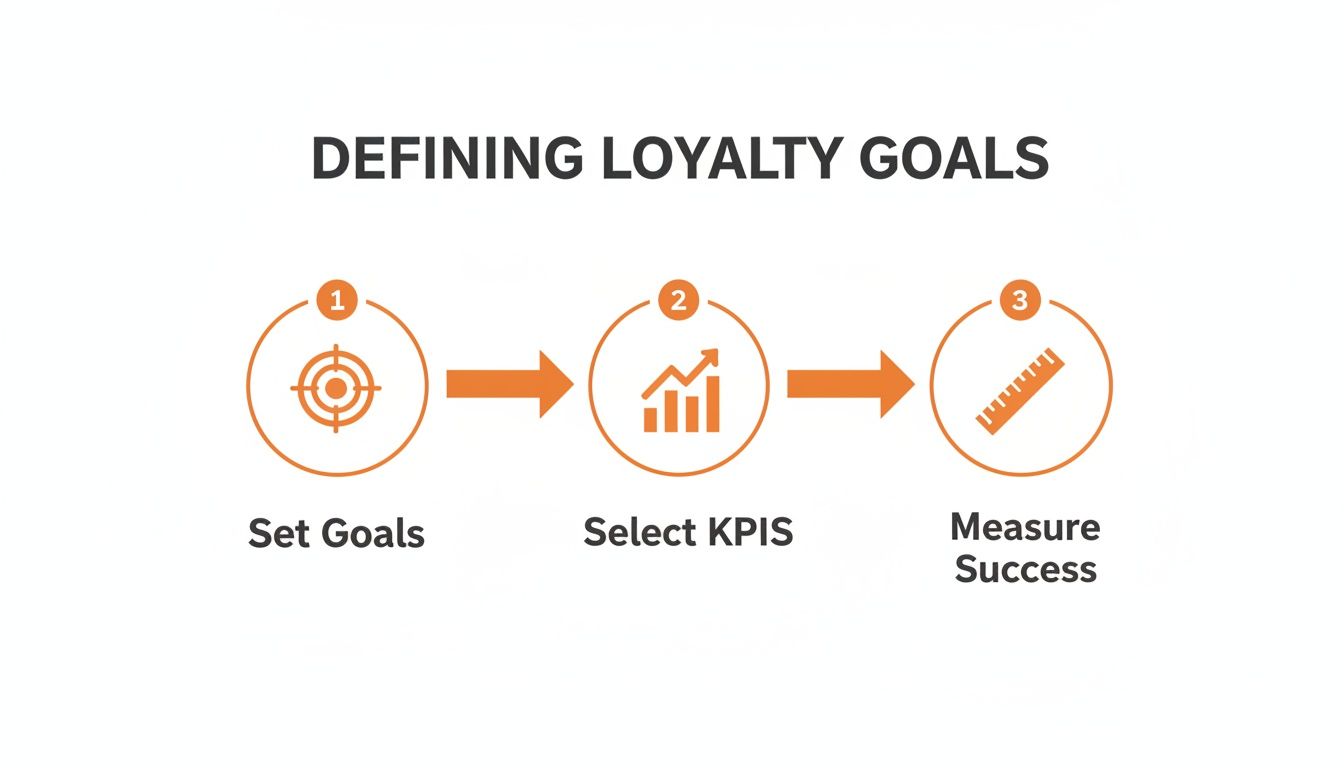
As you can see, a solid loyalty program starts with a clear objective, is steered by the right KPIs, and is proven out through careful measurement.
The Classic Points-Based System
This is the bread and butter of loyalty for a good reason—it works. Customers earn points for doing things you want them to do, like making a purchase, leaving a review, or following you on social media. They can then cash those points in for rewards. It's simple, people get it, and it’s a fantastic way to encourage repeat business.
The magic, though, is in the details. A common mistake I see brands make is creating a confusing point-to-reward ratio or making the rewards feel impossible to reach. A good rule of thumb is to structure it so a customer can earn something meaningful after their third or fourth purchase. For example, a Shopify store selling skincare could offer 10 points for every $1 spent, with a $10 off coupon available for 1,000 points. That gives customers a clear, achievable path to value.
Aspirational Tiers That Motivate
Tiered programs introduce a bit of aspiration into the mix, which can be a huge driver for improving customer loyalty. As customers spend or engage more, they unlock new levels of status and better perks. It taps into that natural human desire to level up, just like in a video game.
Tiers are most effective when the benefits are truly desirable and create a feeling of exclusivity.
- Entry Tier (e.g., Bronze): This should be the baseline, offering basics like earning points on purchases and a small birthday reward.
- Mid-Tier (e.g., Silver): Here, you can sweeten the deal with bonus point multipliers (like 1.25x points), free shipping, and early access to sales.
- Top Tier (e.g., Gold/VIP): This is where you pull out all the stops. Reserve your best benefits for this group—think exclusive products, a dedicated support line, or invitations to special events.
A fashion brand, for instance, could offer its VIP members a free personal styling session each year. It’s a low-cost perk for the brand but feels incredibly valuable and personal to the customer.
Don’t just give discounts; give status. Tiers make your best customers feel recognized and appreciated, transforming them from frequent buyers into true brand advocates who feel like insiders.
Paid Memberships for Exclusive Communities
Want to take loyalty to the next level? Consider a paid or premium program. By asking customers to pay an upfront fee, you get a self-selected group of your most committed fans. Amazon Prime perfected this model, and it works because the value of the benefits far outweighs the membership cost.
For a direct-to-consumer brand, this could be a $50/year VIP club that offers:
- Free shipping on all orders, no minimum spend required.
- A permanent 15% discount on every single purchase.
- Access to a members-only part of the website with limited-edition drops.
This kind of structure doesn't just open up a new revenue stream; it locks in loyalty. Once a customer has skin in the game, they're far more likely to shop with you to get their money's worth. For a deeper dive, check out our complete guide on strategic loyalty program design.
Gamification That Makes Loyalty Fun
Modern loyalty isn't just about transactions anymore. People crave engaging experiences, and gamification is a brilliant way to deliver that. We're talking about adding game-like elements such as challenges, achievement badges, and leaderboards to your program. This is more important than you might think; one recent survey found a massive disconnect where 90% of executives think customer loyalty is growing, but only 40% of consumers feel the same way.
With 80% of customers now saying that the experience is just as important as the product, features like digital badges and challenges are no longer just gimmicks. They're essential. If you’re using a platform like Toki, you could create a "Weekend Warrior" challenge where customers earn bonus points for buying something between Friday and Sunday. These little interactive hooks keep your brand top-of-mind and make participating fun.
Referral Programs That Turn Customers Into Marketers
Your happiest customers are your best, most authentic, and most cost-effective marketing channel. A smart referral program gives them a little nudge to spread the word. The secret is to make it a win-win-win: the advocate gets a reward, their friend gets a discount, and you get a brand-new customer.
A classic and highly effective model is the "Give $10, Get $10" approach. The existing customer receives a $10 credit after their referred friend makes their first purchase using a special $10 off link. It creates a powerful, organic growth engine fueled by genuine trust.
Using Personalization to Build Deeper Connections
A generic, one-size-fits-all loyalty program is a missed opportunity. To genuinely boost customer loyalty, you have to ditch the blanket discounts and start creating experiences that make each person feel seen and valued. This is where personalization isn't just a feature—it's your most powerful tool for turning a simple rewards system into a real relationship.
Think of it this way: you want to stop talking at your customers and start a conversation with them. The data they share with you—every click, every purchase, every abandoned cart—is the key. It lets you craft a loyalty experience that feels less like a marketing tactic and more like a genuine, well-timed thank you.
Segmentation The Smart Way
Before you can personalize anything, you have to understand that your customers are not all the same. Smart segmentation is about grouping your audience into meaningful clusters based on what they do, not just who they are. This lets you deliver far more relevant and impactful offers that actually hit the mark.
Instead of vague, broad categories, get specific with action-based segments:
- Purchase History: Group customers by the categories they actually shop. A beauty brand, for instance, could create a segment for "skincare enthusiasts" and another for "makeup lovers," then offer them bonus points on new product launches they'll genuinely care about.
- Engagement Levels: Who are your ride-or-dies? Identify members who log in frequently, redeem points, and open every email. A surprise perk or an exclusive early access drop shows them you see and appreciate their commitment.
- Customer Lifecycle Stage: Where is each customer in their journey with you? A brand-new member needs a warm welcome, while a "lapsed" customer (someone who hasn't bought in a while) needs a gentle nudge. Your top spenders, of course, deserve the VIP treatment.
A well-crafted segment is the foundation of a personalized offer. It's what allows you to send the right message to the right person at precisely the right time, dramatically increasing the chances it will connect instead of getting ignored.
Crafting Targeted Rewards That Actually Resonate
Once you have your segments, the fun begins. This is where you can design rewards that feel like they were made just for that person. A generic "10% off" coupon is forgettable, but a thoughtful, personalized offer creates a memorable moment that builds a real connection.
Let’s take a pet supply store as an example. They see a customer who consistently buys the same brand of premium dog food every single month. Instead of another generic coupon, they could send a perfectly timed offer: "Hey, get double points on your next bag of [Brand Name] dog food!" It’s a small touch, but it shows they're paying attention and adds real value to that customer's life.
Here are a few more tried-and-true ideas that work:
- Birthday Surprises: A simple "Happy Birthday!" email with a freebie or a generous point bonus is an easy win. It’s a classic for a reason—people love to feel celebrated.
- "We Miss You" Offers: For that "at-risk" segment, a friendly nudge with an exclusive discount on a previously purchased item can be incredibly effective at rekindling their interest.
- Milestone Rewards: Celebrate anniversaries! Acknowledge a customer's one-year mark of joining your loyalty program with a special badge or a surprise point drop into their account.
Blending Technology with a Human Touch
Personalization is an absolute powerhouse for customer loyalty. In fact, the product experience and interaction experience combined account for over 66% of what drives loyalty changes. But there’s a catch.
While AI and automation are brilliant at crunching data, 71% of customers still want human oversight, feeling a bit wary of brands that rely solely on algorithms. The sweet spot is blending smart analytics with customizable rewards that feel genuinely personal. You can see just how critical this is in this deep dive into customer loyalty statistics.
Ultimately, this data-driven approach is about building an emotional connection. And that's what truly matters today. Research shows that 64% of shoppers now prioritize this emotional bond over a familiar brand name. When you create personalized campaigns that make customers feel truly understood, you don't just increase their intent to repurchase—you start turning them into your most passionate brand champions.
Weaving Your Loyalty Program Across Every Channel
Your brand is more than just a website. For many businesses, the customer experience is a constant dance between an e-commerce storefront, social media feeds, and the front door of a physical shop. To really make your customer loyalty strategy stick, that experience needs to feel like one continuous, connected conversation, no matter where your customer is.
This is where an omnichannel approach comes in. It's all about knocking down the walls that separate your sales channels. It means the points a customer earns buying a product online are ready and waiting for them to use in-store. This isn't just a nice-to-have feature anymore; it’s an expectation. In fact, 73% of customers hop between multiple channels on their path to purchase, and they expect a smooth ride.
Connecting Your Digital and Physical Worlds
The secret to a killer omnichannel loyalty program lies in deep integration, especially between your e-commerce platform and your point-of-sale (POS) system. This connection is the digital plumbing that allows data to flow seamlessly, giving you a single, complete picture of every customer.
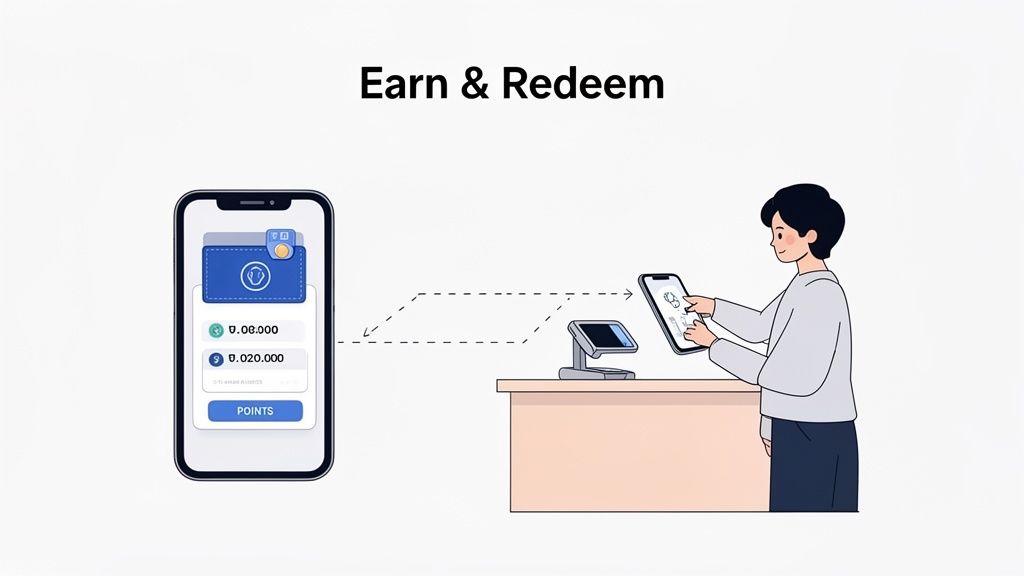
Let's walk through a real-world example. A customer is scrolling through your Shopify store on their phone. They add something to their cart, instantly earning loyalty points, and get a notification to add a digital wallet pass to their Apple or Google Wallet. A few days later, they're in your brick-and-mortar store. When they get to the counter, they just flash their phone. The cashier scans the pass, and they can apply their points for a discount right then and there.
This kind of fluid experience makes joining in feel effortless. It removes the friction and meets customers on their own terms, which is exactly what a good loyalty program should do.
What an Integrated System Looks Like
To pull this off, your loyalty platform has to be the central nervous system connecting every customer touchpoint. Here’s what a truly integrated system delivers:
- Unified Customer Profiles: A single account for each customer, where their point balance, tier status, and reward history are identical whether they’re on their laptop or at your cash register.
- Real-Time POS Syncing: The moment a purchase is made in person, points hit their account, triggering reward notifications or tier upgrades instantly. No lag, no waiting.
- Flexible Redemption: Customers get to choose. They can redeem points online for a checkout code or in-store with a quick scan of their wallet pass.
An omnichannel strategy elevates your loyalty program from a simple marketing tactic to a fundamental part of your brand experience. It sends a clear message: we value you, wherever you choose to shop with us.
Why This Unified Approach Is So Powerful
This isn't just about convenience. When you create a consistent experience, you reinforce your brand identity at every turn, building a much stronger and more durable relationship with your customers. The proof is in the pudding—companies that nail this see much higher customer retention rates.
Think about a clothing boutique. They could use their loyalty app to send a push notification about a new arrival. A customer might browse the collection online, add a few items to a wishlist, and then pop into the store to try them on. They buy their favorite piece in person, earning points that they decide to redeem online for a different item a month later.
Every one of these interactions is linked. The customer feels seen and valued throughout their entire journey, and that's the kind of experience that turns a one-time buyer into a lifelong advocate.
Measuring Success and Optimizing for Growth
Getting your loyalty program live isn't the end of the project—it's just the beginning. The real work starts now, turning that initial strategy into a living, breathing part of your business that actually grows with your customers. This is where you circle back to those initial goals and metrics you set, making sure every reward, email, and perk is pulling its weight.
Think of your analytics dashboard as your mission control. It’s where you’ll find the real story behind the numbers. Are your VIPs actually using the exclusive rewards you created for them? Is that referral bonus bringing in new, high-value shoppers, or just costing you margin? The data is what separates wishful thinking from smart, strategic decisions.
Turning Data Into Actionable Insights
Raw data on its own is just noise. The magic happens when you start asking the right questions. A high redemption rate might look great on the surface, but you need to dig in and see who is redeeming and what they’re choosing. That’s how you uncover the insights needed to refine your offers and make a real impact.
Here are the metrics I always keep a close eye on:
- Redemption Rate: This is your gut check. It tells you if your rewards are genuinely appealing. If this number is low, it’s a red flag that your perks are either too difficult to earn or just not exciting enough.
- Customer Lifetime Value (CLV) of Program Members: This is the big one. You need to compare the CLV of loyalty members against non-members. A healthy gap between the two is the clearest proof that your program is delivering long-term financial value.
- Referral Conversion Rate: This shows you how effective your brand advocates really are. It’s not just about how many referral codes are shared, but what percentage of those referred friends actually follow through and make a purchase.
A loyalty program isn't a "set it and forget it" feature. The best ones are treated like a core product—something that needs constant attention, testing, and fine-tuning. This commitment to continuous optimization is what separates a decent program from a truly great one.
The Power of A/B Testing and Optimization
Once you have a handle on what’s working (and what’s not), you can start experimenting. A/B testing is your best friend here, allowing you to try out new ideas without betting the farm on a single change. It’s all about making small, calculated adjustments to see what really moves the needle.
Instead of guessing, you could run a few simple tests:
- Tweak Your Rewards: Offer one customer segment a $10 coupon and another a 20% discount for the same number of points. See which one gets used more often. You might be surprised by the results.
- Experiment with Communication: Announce a bonus points weekend to one group via email and to another with an SMS push notification. Then, measure which channel drove more engagement and, ultimately, more sales.
- Adjust Tier Thresholds: Is the spending requirement for your top VIP tier too high? Or maybe too low? Test different entry points to find that perfect balance that motivates customers without feeling impossible to reach.
This kind of iterative process creates a powerful feedback loop, ensuring your loyalty program evolves right alongside your customers' habits and preferences. And to make sure your efforts are driving sustainable growth, it helps to incorporate proven 7 customer retention tips into your overall strategy.
This data-driven approach transforms your loyalty program from a simple marketing tactic into a reliable engine for business growth. To get even deeper into tracking performance, be sure to check out our guide on the core pillars of loyalty program analytics.
Got Questions About Customer Loyalty? We've Got Answers
When merchants first start thinking seriously about a loyalty strategy, the same questions tend to pop up. Let's get them answered so you can move forward with confidence and set the right expectations for your program.
How Long Until I Actually See Results?
This is the big one, isn't it? The honest answer is, it varies. If your program is well-designed with rewards that people actually want, you can see some encouraging signs within the first 90 days. Think little wins like a bump in repeat purchases or a flurry of early redemptions.
But for the big-picture return on investment (ROI)—a real, measurable lift in Customer Lifetime Value—you should plan for a 6-12 month timeline. Things like how often people naturally buy from you, how good your rewards are, and how well you promote the program all play a huge role. This isn't a "set it and forget it" kind of deal; it's all about consistent tweaking and improvement.
Can Loyalty Programs Even Work for Brands with Infrequent Purchases?
Yes, absolutely. But you have to change your game plan. If you sell something like mattresses or high-end furniture that people buy once every few years, a standard points-for-purchase system is dead on arrival.
Instead, your focus needs to shift from rewarding transactions to rewarding engagement. You're playing the long game.
- Offer bonus points when a customer leaves a detailed review with a photo.
- Give exclusive access to valuable content, like a home styling guide or a behind-the-scenes video.
- Create a sense of community status by rewarding customers who help others in a Q&A forum on your site.
For these kinds of brands, loyalty isn't about getting the next sale tomorrow. It's about building such a strong connection that when your customer is ready to buy again, you're their first and only thought.
What are the Biggest Mistakes People Make?
It's easy to get caught up in the excitement of launching a new program, but a few common slip-ups can stop you in your tracks. If you can sidestep these, you're already way ahead of the curve.
The number one mistake I see is making the rules way too complicated. If your customers need a spreadsheet to figure out your points system, they're just going to tune out. Simplicity is your best friend.
Another killer is poor communication. Your program can't be a secret. It needs to be front-and-center on your homepage, product pages, and especially in your emails after someone makes a purchase. Finally, don't offer lame rewards. A tiny discount that takes an eternity to earn is more insulting than inspiring. Make your rewards feel generous and, crucially, achievable.
Ready to turn one-time shoppers into lifelong fans? With a platform like Toki, you can launch a powerful loyalty and rewards program that actually drives growth. It's time to start building those deeper customer relationships. Explore Toki's features and see how it works.