Launch a Powerful Friends Referral Program on Shopify
Discover how to build a friends referral program that drives real growth. Learn to set incentives, promote, and track your program for maximum ROI on Shopify.
At its core, a friends referral program is a beautifully simple idea: turn your happiest customers into your most powerful marketers. You give them a little something—a discount, store credit, a special gift—for telling their friends about you. And, to make the deal even sweeter, their friends get a reward too when they make their first purchase. It’s a classic win-win.
Why a Friends Referral Program Is Your Next Growth Channel
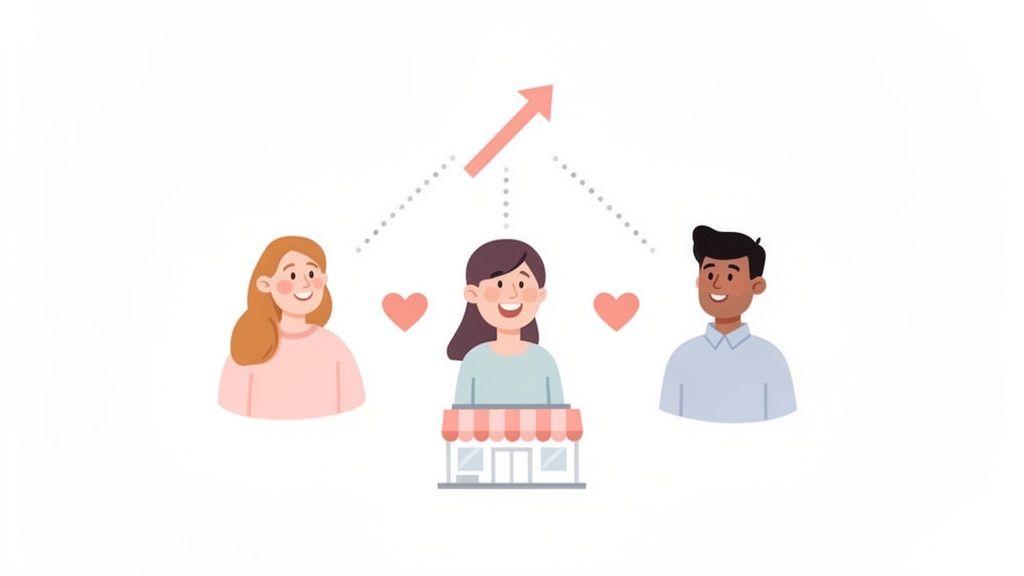
Think beyond your typical marketing channels for a moment. A referral program isn't just another tactic to check off your list; it's a living, breathing growth engine for your Shopify store. You’re tapping into the genuine enthusiasm of people who already love what you do, turning their authentic recommendations into a seriously effective way to find new customers.
Let's be honest, a suggestion from a friend just hits differently than a paid ad. It cuts through the noise. That built-in trust means the people they send your way are already warmed up, more likely to buy, and often become loyal customers themselves down the line.
The Real Impact on Your Bottom Line
One of the biggest wins here is the direct path to a lower customer acquisition cost. We all know how unpredictable ad spend can be. Instead of just throwing money at ads and hoping for the best, a referral program is an investment in your existing customer base—an asset you already own.
The payoff is real, and you'll see it in a few key areas:
- Higher Customer Lifetime Value (LTV): The data doesn't lie. Customers who come from a referral often have a 16% higher LTV. They stick around longer because they came in with a baseline of trust.
- Better Conversion Rates: Referrals convert like crazy. That personal endorsement from a friend erases a ton of the usual hesitation and skepticism that comes with discovering a new brand.
- Authentic Brand Advocacy: This is word-of-mouth marketing, supercharged. You're giving your biggest fans a structured, easy way to shout about your brand from the rooftops, building a genuine community in the process.
By rewarding both the person sharing and the friend they invite, you kickstart a powerful, self-sustaining loop of growth. It’s a simple, reciprocal model that just works.
Ultimately, a well-executed referral program does so much more than just drive a few extra sales. It deepens the bond with your current customers, fosters a real community around your brand, and builds a far more efficient and profitable path to growth. And with tools like Toki, getting a sophisticated program up and running is easier than you might think.
Crafting Referral Incentives That Actually Motivate
The heart of any great referral program is the incentive. It’s the fuel. If the reward doesn’t feel exciting or valuable, even your most die-hard fans won’t bother to share. Your job is to find that sweet spot—an offer that makes both the referrer and their friend feel like they're getting a genuinely great deal, but one that doesn't sink your profit margins.
This isn't about just slapping a generic discount code on a landing page and calling it a day. It's about understanding what truly motivates your customers. The perfect incentive for a monthly coffee subscription is going to look very different from what works for a brand selling high-end furniture.
Should You Reward One Person or Two?
First things first, you need to decide who gets the reward. Do you only give something to the person doing the referring (one-sided), or do you reward both the referrer and their friend (two-sided)?
While a one-sided program can work, it often feels a bit transactional. The programs that really take off are the ones where everyone wins. This is where the double-sided incentive model really shines. It reframes the referral from a self-serving act ("I get a discount") into a generous one ("I'm giving my friend a great deal, and I get a little something, too!"). That small psychological shift makes people far more likely to share.
For direct-to-consumer brands, this approach is a proven winner. We've seen that 10-35% of new customers can come from referrals, and these aren't just any customers—they have a 37% higher retention rate and 16% greater lifetime value than people you acquire through ads. The explosive growth of Cash App is a classic example. A simple $15 reward for both the referrer and the new user showed just how powerful double-sided incentives can be. Today, 78% of referral programs use this model because it just works.
Choosing the Right Type of Reward
Okay, so you've decided on a two-sided structure. Now, what's the actual prize? You've basically got three main options, and the best one for you really depends on your business.
- Cash or Discounts: This is the most straightforward route. An offer like "$20 off" or "15% off your next purchase" is easy for anyone to understand and value immediately. It’s a rock-solid choice for brands with a broad audience and products people buy fairly regularly.
- Store Credit: Giving someone "$25 in-store credit" is a brilliant way to guarantee a repeat purchase. Unlike a simple discount they use once and forget, store credit brings them right back to your shop. This directly fuels future sales and builds lifetime value, making it a perfect fit for fashion, beauty, or any brand selling consumable goods.
- Products or Exclusive Perks: Sometimes money isn't the best motivator. Offering a free product, early access to a new collection, or exclusive content can make your customers feel like insiders. This creates a sense of community and VIP status that a discount just can't match. It’s an especially powerful tactic for brands with a passionate following or for subscription models where a "free month" is a very tangible, desirable reward.
Pro Tip: Don't underestimate non-cash rewards. One study found they can be 24% more effective than cash because they feel less like a payment and more like a thoughtful gift from the brand.
If you want to get the creative juices flowing, you can explore a wide range of creative referral incentive ideas to find what might click for your store.
To help you weigh your options, here's a quick breakdown of the most common incentive structures.
Comparing Referral Incentive Structures
| Incentive Type | Best For | Pros | Cons |
|---|---|---|---|
| Fixed Discount ($) | High AOV brands or one-time purchases. | Easy to control costs; feels substantial for big-ticket items. | May not be as compelling for smaller, frequent purchases. |
| Percentage Discount (%) | Brands with varied product prices and repeat buyers. | Scales with order value; very motivating for larger carts. | Can be costly on high-value orders; harder to forecast. |
| Store Credit | Fashion, beauty, and consumable goods. | Drives repeat business and increases LTV; cost is contained. | Less appealing for brands where customers buy infrequently. |
| Free Product/Service | Subscription models or brands with high-margin "hero" products. | High perceived value; feels like a true gift, not a transaction. | Logistical complexity; requires a product with broad appeal. |
Ultimately, picking the right model comes down to knowing your numbers and your customers.
Aligning Incentives with Your Business Model
The final piece of the puzzle is making sure your incentive makes sense for your business. A mismatched reward can either fall flat with customers or, even worse, become a money pit.
For example, if you're selling mattresses or electronics, a percentage-based discount could get expensive fast. A fixed-dollar amount, like "$100 off," is much more sustainable while still feeling like a huge win for the customer.
On the other hand, if you run a subscription box, offering a free month or a hefty credit towards the next box is a no-brainer. That kind of reward directly reinforces the value of your service and encourages long-term commitment from both the original subscriber and their newly referred friend.
Always run the numbers. Calculate the cost of the reward and weigh it against your average Customer Acquisition Cost (CAC) and Lifetime Value (LTV). Your incentive needs to be generous enough to get people talking, but sustainable enough that you can scale the program without breaking the bank.
Getting Your Referral Program Live with Toki and Shopify
You’ve landed on the perfect incentive structure. Awesome. Now for the fun part: actually building the thing. The technical side of launching a referral program can feel a bit daunting, but I promise it's easier than you think. With the right tools, you don't need to write a single line of code.
We're going to use a platform like Toki, which plugs directly into your Shopify store, to get a professional-grade program up and running in minutes. The real goal here is to make the entire experience dead simple for both your loyal customers (the advocates) and their friends. Think unique referral links, on-brand pop-ups, and automated emails that just work.
Connecting Toki to Your Shopify Store
First things first, let's get the app connected. You can get started by installing the Toki app right here. Just follow the quick onboarding prompts.
Once you’ve installed it, Toki automatically starts syncing with your customer data. This is crucial because it’s how the system knows who referred who and when to send out rewards. No manual tracking, no spreadsheets.
The dashboard basically becomes your command center for the whole program. This is where you’ll plug in the rewards you just mapped out—whether that’s a $10 discount, a 20% off coupon, or store credit. You can easily set up that double-sided incentive, giving one reward to your advocate and a different one to their friend.
Making the Program Look and Feel Like Your Brand
Let's be honest, a generic-looking referral program that screams "third-party app" isn't going to get anyone excited. It needs to feel like a seamless part of your store. This is where a little customization goes a long way.
Toki gives you control over all the customer-facing pieces so you can match everything to your brand’s colors, fonts, and voice.
- The Referral Widget: This is that little pop-up or button that invites customers to join. You can tweak its design and placement to make sure it gets noticed without being annoying.
- A Dedicated Landing Page: This is your program's home base. It's where customers grab their unique sharing link and see the rewards pile up. Use this page to clearly explain your "Give $20, Get $20" offer and add easy one-click sharing buttons for social media and email.
- Automated Emails: You’ll want to set up emails that fire off automatically when someone earns a reward. Customize them with your logo and brand voice to keep the experience consistent and build trust.
At its core, the referral process is incredibly straightforward, which is why it works so well. An advocate shares a great offer, and their friend gets a nice little reward for trying your brand.
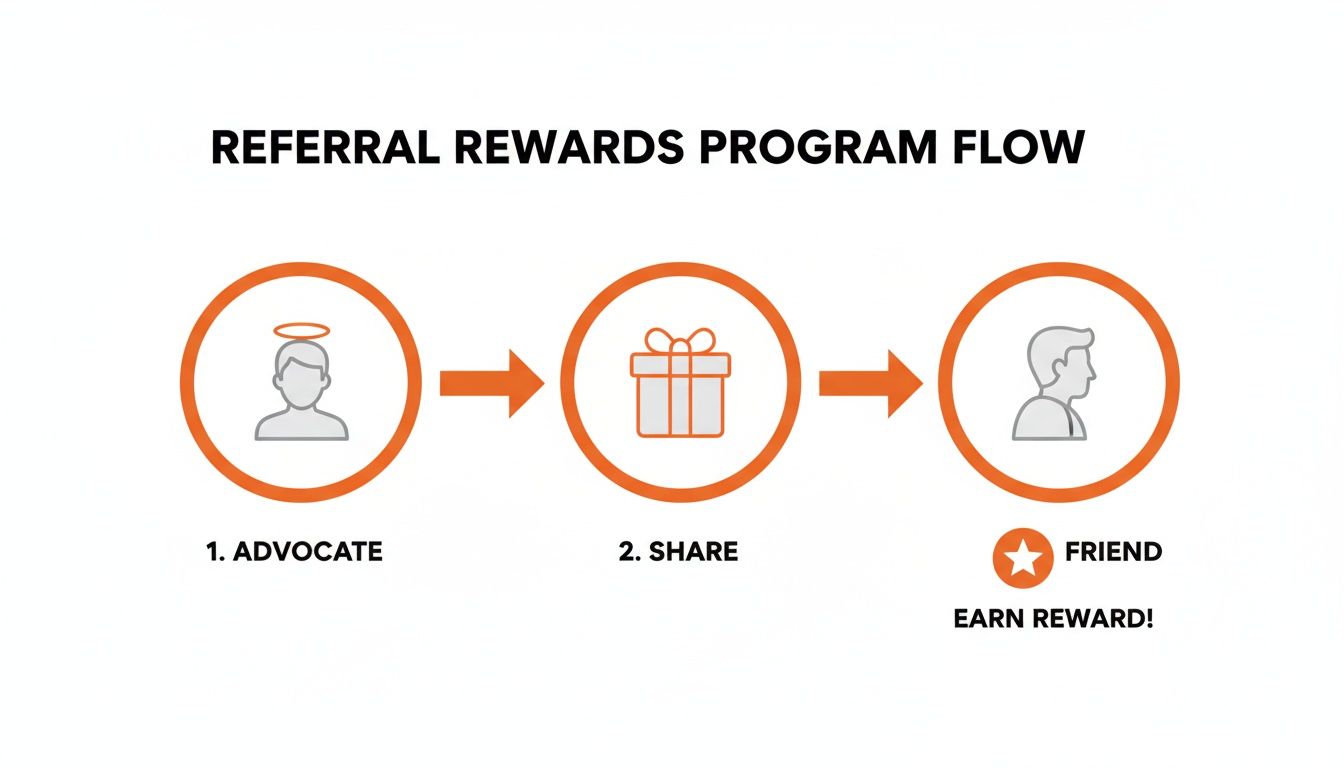
The less friction you have at each step, the more people will actually participate. It's that simple.
Flipping the "On" Switch
Once you’ve set your incentives and styled the visuals, you're pretty much ready to launch. Inside the Toki dashboard, it's as simple as toggling your program from "Draft" to "Active."
But hold on. Before you blast this out to your entire email list, I highly recommend doing a quick test run. Seriously, this will save you headaches later. Grab a test account (or create a new one) and walk through the whole process yourself:
- Sign up for the program as if you were a customer.
- Copy and share your new referral link.
- Open that link in an incognito or private browser window (this simulates being a new visitor).
- Go through checkout and make a test purchase with the friend discount.
- Finally, check your original test account to see if the advocate reward was correctly applied.
I can't stress this enough: running a quick end-to-end test is the single best thing you can do to ensure a smooth launch. It catches any weird quirks before your customers do and prevents a flood of support tickets.
With a successful test under your belt, your tech setup is officially complete. The system will now hum along in the background, handling all the link generation, conversion tracking, and reward payouts. Now, you can shift your focus to the most important job: letting your customers know about it.
Getting the Word Out: How to Promote Your Program and Drive Engagement
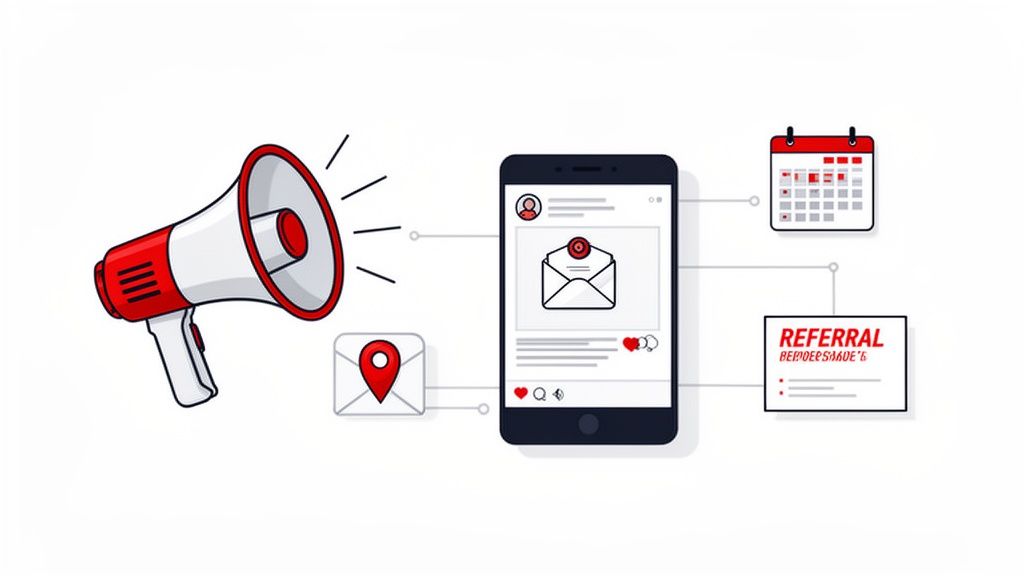
Alright, you've designed a killer incentive and the technical side is humming along perfectly. Now for the most important part: letting people know this awesome program actually exists.
A friends referral program can't build momentum if it's tucked away in a dusty corner of your website. Promotion isn't a one-time thing; it’s about weaving the program into the very fabric of your customer journey so it feels like a natural part of the experience.
Your goal is to make discovering and sharing your program feel effortless. Think of it less as a "hard sell" and more as an exclusive perk—a genuine thank you for being a customer and a simple way for them to share a brand they already love.
Weave Referrals into Your Email Strategy
Email is your promotional workhorse. It's a direct line to your most loyal customers, making it the perfect channel to get the word out. The trick is to avoid sending one big launch email and then going silent. Instead, integrate your program into every relevant communication you send.
Using powerful email marketing campaigns is the key to consistently keeping your program top-of-mind. Here are the touchpoints you absolutely need to focus on:
- Transactional Emails: These are pure gold. Post-purchase confirmations and shipping notifications have incredibly high open rates. A simple, clean banner at the bottom saying, "Love your purchase? Give a friend $20 off and get $20" is non-intrusive and highly effective.
- Newsletter Mentions: Add a permanent, visually appealing section about your referral program right in your newsletter footer. You can also feature it more prominently from time to time, especially when you want to give participation a boost, like around the holidays.
- Dedicated Campaigns: Every so often, send a dedicated email that’s all about the referral program. Frame the message around community and appreciation with a headline like, “Share the Love (and Get Rewarded).”
My Personal Tip: The post-purchase email is the single most valuable piece of real estate for promoting your referral program. A customer's excitement is at its absolute peak right after they've bought something. You have to capitalize on that positive emotion.
Make Sharing Impossible to Miss on Your Website
Your website is your brand's home base, so it needs to show that your referral program is an important part of the customer experience. The key is visibility without being annoying. You want to make it incredibly easy for someone to find their referral link the moment the thought of sharing pops into their head.
A few strategic placements can make all the difference:
- Customer Account Page: This is non-negotiable. When a logged-in customer views their account, they should see a clear, dedicated section for "Refer a Friend." This is their personal hub for copying their unique link and tracking their rewards.
- Website Footer: A permanent link in your site-wide footer ensures the program is always just one click away. Keep the text simple and benefit-driven: "Refer & Earn" or "Give $20, Get $20."
- Homepage Banner (Sparingly): This is a great tool for launching the program or for special, limited-time promotions. Think: "Refer a friend this week and we'll double your reward!" Just use it selectively to maintain its impact.
Timing Your Ask for Maximum Impact
Knowing when to ask for a referral is just as crucial as knowing how. The absolute best time is immediately after a customer has had a positive experience. Their satisfaction is at its highest, which makes them far more likely to take action.
Look for these "moments of delight" in their journey:
- After a 5-Star Review: When someone leaves a glowing review, they've just told you they love your product. It’s the perfect time for an automated email follow-up: "Thanks for the amazing review! Know someone else who might love us? Here's a special link to share."
- On the Order Confirmation Page: Right after a successful purchase, the customer is feeling great about their decision. A simple pop-up or on-page section inviting them to share can capture that excitement in real time.
- During a Positive Support Interaction: If a customer service chat ends on a high note, empower your support agents to mention the program. A simple, "So glad we could help! By the way, we have a great referral program if you ever want to share us with a friend," feels authentic and helpful.
By strategically timing your promotional efforts, you transform the "ask" from a generic marketing message into a relevant, timely suggestion. That subtle shift is what turns happy customers into active brand advocates and makes your friends referral program a true engine for growth.
Tracking Program Performance and Preventing Fraud
Getting your friends referral program live is a huge milestone, but the real work starts now. Your focus needs to pivot to two critical areas: tracking what’s actually working and protecting your program from people trying to game the system.
Without a firm grasp on your data and some basic security, even the most creative program can quickly go off the rails. Think of it this way: your data is the dashboard telling you how the engine is performing, and fraud prevention is the lock on the fuel tank. You need both.
Key Metrics to Monitor in Your Dashboard
Your Toki dashboard is your mission control. It's easy to get lost in a sea of numbers, so my advice is to zero in on a handful of key performance indicators (KPIs) that give you the clearest picture of your program's health.
Here are the core metrics I always keep a close eye on:
- Participation Rate: This is simply the percentage of your customers who have signed up to be an advocate. If this number is low, it’s a good sign that your program isn't visible enough or the initial offer just isn’t grabbing their attention.
- Share Rate: Of the people who signed up, how many are actually sharing their link? This tells you if your advocates are truly engaged and whether the sharing process is as easy as it should be.
- Referral Conversion Rate: This is the big one. It's the percentage of referred friends who click a link and follow through with a purchase. A high conversion rate is a fantastic sign that your incentives are hitting the mark and your advocates are bringing in high-quality traffic.
Tracking these numbers is the only way to measure the true return on investment (ROI) of your program. For a deeper look at the numbers that matter, we put together a guide on essential metrics for referral program tracking to help you build out your reporting.
Measuring the True Value of Referred Customers
Looking beyond that first sale is where you'll find the real magic of a friends referral program. These new customers aren't just one-time buyers; they often become your most loyal fans.
The data backs this up again and again. Referred customers have a 37% higher retention rate and a 16% higher lifetime value compared to customers acquired through other channels. For Shopify merchants fighting churn, that’s gold. When a friend vouches for you, that built-in trust often translates directly into repeat business and a much higher customer lifetime value. You can find more stats on the power of referral marketing that paint a very clear picture.
Protecting Your Program from Referral Fraud
Unfortunately, wherever there are rewards, there will be people trying to cheat. From my experience, it’s far easier to prevent fraud from the start than to clean up the mess later. A little vigilance goes a long way in protecting your budget and making sure rewards go to genuine advocates.
The most common scheme you'll see is self-referral—someone creating fake accounts with different email addresses to claim both the advocate's reward and the friend's discount.
Don't wait for fraud to become a problem. By implementing a few simple safeguards from day one, you can protect your program’s integrity and ensure your investment goes toward acquiring real, valuable customers.
Here's how to build a solid defense against the most common tactics:
- Implement a Reward Delay: Don't issue rewards instantly. Set a "pending" period to make sure the friend's order is legitimate and past your standard return window before the advocate gets their payout.
- Require Email Verification: This is a simple but effective hurdle. Forcing both the advocate and the referred friend to verify their email address deters casual fraudsters who rely on disposable email services.
- Utilize Automated Fraud Detection: A platform like Toki has built-in fraud detection that can automatically flag suspicious activity. This is great for catching things like multiple referrals coming from the same IP address or device—a dead giveaway for self-referrals.
- Set Clear Terms and Conditions: Your official rules should explicitly state that self-referrals are forbidden and that the friend offer is only for new customers. This gives you clear grounds to deny fraudulent rewards and shut down offending accounts.
By combining diligent tracking with robust fraud prevention, you'll build a secure and transparent referral program that can grow with your store and drive predictable revenue.
A Few Common Questions About Referral Programs
Even with the best plan, a few questions always pop up when you're getting ready to launch. It's totally normal to wonder about the nitty-gritty details of incentives, fraud, and how to get the word out.
Think of this as your quick-reference guide for those last-minute "what ifs." Getting these details right will give you the confidence to launch a program that’s not just effective, but also a breeze to manage. Let's dive in.
What’s the Best Incentive to Offer?
This is the big one, and the honest answer is: it depends entirely on your product and how often people buy it. There's no magic bullet, but there’s a simple way to figure out what will work for your store.
For products people buy over and over—think skincare, supplements, or coffee subscriptions—store credit or loyalty points are your best bet. Why? Because they directly encourage the next purchase. This turns a one-time referral into a long-term habit for both the original customer and their friend, building customer lifetime value right into your program.
But if you sell big-ticket items that people buy infrequently, like furniture or a high-end bike, a straightforward cash discount is almost always more powerful. A $100 off coupon feels much more tangible and exciting than store credit that someone might not use for another year.
The most successful structure, no matter what you choose, is a double-sided reward. Giving something to both the person referring and their friend always drives the highest engagement. It feels less like a sales pitch and more like sharing a genuine gift.
How Do I Stop People from Gaming the System?
Keeping your program honest is crucial, but it’s easier than you might think. You don't need a digital fortress; you just need a few smart guardrails in place from the start. The goal is simply to make cheating harder than using the program correctly.
First, your terms and conditions are your first line of defense. State clearly that referred friends must be new customers with unique email and shipping addresses. Simple.
Next, let technology do the heavy lifting. Modern referral tools like Toki have fraud detection built right in. They can automatically flag suspicious activity, like a bunch of referrals coming from the same IP address—a classic sign of someone trying to refer themselves.
Finally, one of the most effective tactics is a simple operational tweak:
- Set a reward "pending" period. This is non-negotiable. By holding the reward until after the new customer's order is fulfilled and past the return window, you guarantee you're only paying out for real, completed sales.
When Is the Best Time to Ask for a Referral?
Timing is everything. Asking at the right moment can be the difference between a customer eagerly sharing your brand and your request getting completely ignored.
The perfect time to ask is right after a customer has had a genuinely positive experience. You want to catch them when their enthusiasm is at its peak. These moments are gold:
- Right on the order confirmation page. They're excited and just committed to your brand.
- In the same email where you ask for a product review. They’re already in the mindset of sharing their opinion.
- Immediately after they leave a 5-star rating. This is the ultimate green light.
Hitting these key moments makes the request feel natural and timely, not like a random marketing blast.
How Can I Promote My Program Without Being Annoying?
Great promotion feels less like an ad and more like a helpful reminder. The secret is to weave your referral program into the places your customers already are, making it feel like a natural part of their experience.
Forget about constant, annoying pop-ups. Instead, focus on consistent, subtle placements:
- Add a clean banner to your email newsletters and transactional emails (like order and shipping confirmations).
- Put a permanent link in your website footer so it's always easy to find.
- Create a dedicated section in the customer account dashboard, turning it into their personal referral hub.
When you post on social media, don't just "promote the program." Frame it as a thank-you to your community—a way for them to share a brand they love and get rewarded for it. That feels authentic and strengthens your relationship with your best customers.
Ready to turn your customers into your most powerful growth channel? With Toki, you can launch a fully customized friends referral program on Shopify in minutes. Stop wondering and start growing. Explore Toki and get started today.