Customer retention automation: Turn Buyers into Loyal Fans
Explore how customer retention automation drives repeat purchases, boosts lifetime value, and turns one-time buyers into loyal customers.
Customer retention automation is all about using technology to keep your existing customers engaged and coming back for more, all without you having to lift a finger for every single interaction. It’s a smart, proactive way to shift your focus from one-and-done sales to building long-term relationships that generate predictable revenue. By automating the right touchpoints, you make sure no customer gets forgotten.
Moving Beyond the First Sale with Automation
The old e-commerce playbook is broken. For too long, brands have been stuck on a hamster wheel, constantly chasing new customers. This approach is like trying to fill a leaky bucket—you keep pouring expensive new leads in, but they drain out just as fast. It's a costly and unsustainable cycle.
The real secret to growth isn't just about getting that first sale. It's about turning the customers you already have into repeat buyers and, eventually, genuine fans of your brand.
This is where customer retention automation comes in. It’s the tool that finally patches the holes in that leaky bucket. Instead of manually trying to re-engage every single person, you build smart, automated systems to do the heavy lifting for you. Don't think of it as just another piece of software; see it as your brand's 24/7 relationship-building engine. It works around the clock to nurture, reward, and talk to your customers, making them feel valued long after they’ve clicked "buy."
Why Automation Is the Key to Sustainable Growth
Let's be honest: without automation, retention efforts are usually hit-or-miss. Your marketing team might send out a "we miss you" email blast every now and then, but it's impossible to manually track every customer's unique journey and reach out at just the right time. To truly grow, brands have to nail this part of the business by optimizing the post-purchase customer experience and turning those initial buyers into loyal advocates.
Customer retention automation cracks this code. It allows you to create repeatable, trigger-based workflows that respond to what your customers actually do.
Automation isn't about replacing the human touch; it's about scaling it. It ensures every customer receives a timely, relevant, and personalized interaction that would be impossible to deliver manually, fostering a sense of connection that builds true loyalty.
These automated systems can handle all sorts of critical tasks for you:
- Welcome new customers with an onboarding series that shows them what makes your brand special.
- Reward your best shoppers with points, exclusive discounts, or early access to new products.
- Win back at-risk customers who haven't shopped in a while with a tempting offer.
- Ask for referrals by automatically inviting happy customers to share your brand with their friends.
By setting up these kinds of workflows, you fundamentally change your business from a simple transaction machine into a brand that builds real relationships. This shift is how modern e-commerce stores solve the puzzle of sustainable growth, creating a reliable revenue stream from their most valuable asset: their existing customers.
Why Automated Retention Delivers the Highest ROI
Every marketing dollar is under the microscope these days. Brands are constantly asking themselves a tough, but fair, question: where do we get the most bang for our buck? While the excitement of winning new customers is always tempting, the hard data points somewhere else entirely.
Focusing on the customers you already have through customer retention automation isn't just a smart move—it’s the single most profitable strategy you can invest in.
It all comes down to simple economics. Bringing in a new customer is an expensive gamble, often burning through significant ad spend and marketing hours. On the other hand, keeping an existing customer happy is a far more efficient and predictable way to grow your revenue.
The financial argument for automation is rock-solid. Automated retention delivers tangible returns that leave acquisition efforts in the dust. The numbers don't lie: it costs 5 to 25 times more to acquire a new customer than to keep an existing one. Plus, the probability of selling to a customer you already have is 60-70%, a stark contrast to the 5-20% chance you have with a brand-new prospect.
This simple chart paints a clear picture of customer flow, showing just how vital retention is for a healthy, growing business.
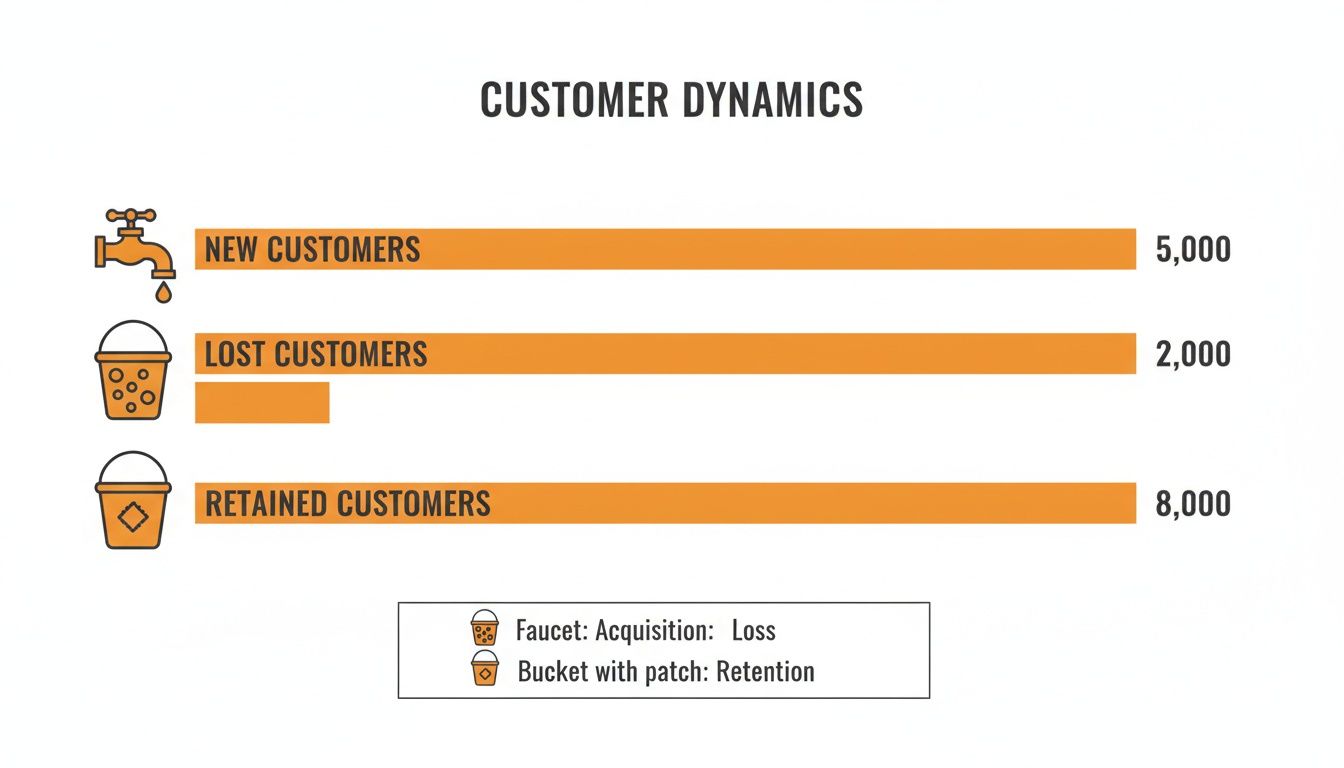
As you can see, even with a steady stream of new customers, a leaky bucket will sink the ship. Plugging those leaks by retaining your existing base is what really fuels sustainable growth.
The Automation Advantage Over Manual Efforts
Not too long ago, meaningful customer retention felt like a luxury reserved for massive corporations with armies of marketers. It meant manually tracking what people bought, sending out one-off emails, and wrestling with spreadsheets to manage a loyalty program. This old-school approach is not only slow and inefficient; it's completely impossible to scale.
Customer retention automation changes the game entirely.
It gives brands of all sizes the power to run sophisticated, personalized retention campaigns that work for you 24/7, no manual babysitting required. Even foundational elements of the customer experience, like great product presentation, play a role here. Solid imagery is key to satisfaction and has been shown to be effective in cutting return rates by 30%, which shows how automation and core business practices work hand-in-hand.
By automating key touchpoints in the customer journey, you're doing more than just saving time. You're building a reliable system that consistently grows Customer Lifetime Value (CLV) while keeping your Customer Acquisition Costs (CAC) from spiraling out of control. It's a direct investment in your bottom line.
Quantifying the Return on Investment
Let's get down to brass tacks. The table below shows just how different the results are when you compare automated retention workflows to their manual, time-consuming counterparts. The difference in efficiency, personalization, and, most importantly, conversion rates is night and day.
ROI of Automated Retention Workflows at a Glance
| Automated Strategy | Typical Conversion Impact | Why It Works |
|---|---|---|
| Loyalty Program Points | 20-40% increase in repeat purchase rate | Automation instantly rewards purchases, creating a powerful feedback loop that makes customers want to shop again without you lifting a finger. |
| Abandoned Cart Emails | 10.5% average conversion rate | A timely, automated reminder with a clear nudge to complete checkout captures revenue that would otherwise have vanished. Manual follow-ups are just too slow. |
| Personalized Win-Back Offers | 5-10% reactivation of lapsed customers | Data-driven triggers automatically spot at-risk customers and send tailored offers to bring them back—a task that's nearly impossible to manage by hand. |
| Referral Program Rewards | 15-25% higher CLV for referred customers | Automation handles all the tracking, reward payouts, and reminders, turning your happiest customers into a consistent and scalable growth engine. |
Ultimately, putting money into customer retention automation isn't just about playing defense to stop customers from leaving. It’s an offensive strategy that actively nurtures your most valuable asset—your existing customer base—delivering the highest and most predictable ROI you can get from any marketing initiative.
The Core Automated Workflows That Drive Repeat Sales
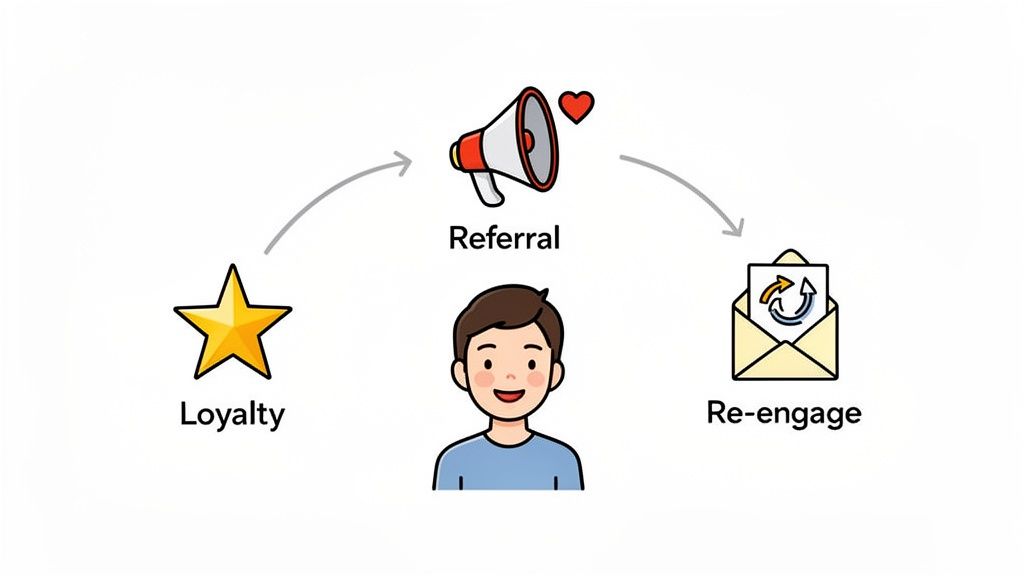
It’s one thing to talk about the benefits of customer retention automation, but it’s another to see how it actually works in the real world. The real magic happens within a few core, automated workflows that can completely change customer behavior and generate predictable, recurring revenue.
These aren’t just one-off campaigns. Think of them as strategic, always-on engines running quietly in the background, constantly nudging customers to make their next purchase.
Each workflow is designed to target a specific point in the customer journey, from rewarding your most loyal fans to winning back those who have gone quiet. By setting them up, you stop playing defense with your marketing and start proactively building relationships, 24/7.
The proof is in the numbers. The marketing automation market is on track to hit $15.58 billion by 2030, showing just how central it's become to growth. Companies that jump in see their revenue increase by 34% on average—a massive win for any e-commerce store. More specifically, 60% of marketers see higher engagement and 58% report better loyalty when using AI-powered automation. You can find more stats on this over at emarsys.com.
Automated Loyalty Programs: The Foundation of Repeat Business
At its heart, a loyalty program is a simple deal: customers give you their repeat business, and you give them something valuable back. An automated loyalty program just puts this entire exchange on autopilot.
Forget about manually tracking points or dealing with clunky punch cards. With customer retention automation, the system handles everything. A customer makes a purchase, and points instantly appear in their account. They hit a reward threshold, and a notification pops up, ready for them to redeem. That instant gratification is a powerful motivator.
An automated loyalty program is so much more than just discounts. It taps into our natural desire for progress and status. When you add tiers, badges, and exclusive perks, customers feel like they're part of an inner circle, which deepens their connection to your brand.
Here’s a quick look at how it plays out:
- Points for Purchases: This is the classic model. Every dollar spent earns points that can be cashed in for discounts, free shipping, or even free products.
- Tiered Memberships: Customers unlock new levels of benefits—think Bronze, Silver, and Gold—as their spending increases. It gamifies the experience, making them want to hit that next tier.
- Exclusive Access: The system can automatically tag your VIPs, giving them early access to sales or new product launches without you lifting a finger.
This workflow is foundational. It gives every single customer a clear and compelling reason to choose you over a competitor next time they need to buy something.
Automated Referral Programs: Turning Customers into Marketers
Your happiest customers are your best, most authentic, and most affordable marketing channel. An automated referral program takes that raw potential and turns it into a growth machine. It removes all the hassle for both the person sharing and their friend.
The old "please refer a friend" plea at the bottom of a newsletter just doesn't cut it anymore. Automation makes it both simple and rewarding. When a customer has a great experience—maybe after their second purchase or leaving a 5-star review—the system automatically invites them to the referral program.
Once they share their unique link, the platform tracks everything. If their friend buys something, both of them get a reward—automatically. This creates a self-sustaining loop of growth, all powered by genuine excitement for what you sell.
Here’s how a referral workflow could look:
- The Trigger: A customer makes their third purchase.
- The Invitation: An automated email goes out: "Love our stuff? Give your friends $10 off their first order, and you'll get $10 for each friend who buys!"
- The Share: The customer blasts their unique link on social media.
- The Conversion: Their friend clicks the link and makes a purchase.
- The Reward: The system automatically issues a $10 credit to both the advocate and the new customer.
This workflow doesn't just bring in new customers; it brings in better ones. Referred customers typically have a much higher lifetime value and are more loyal right from the get-go.
Automated Re-Engagement Campaigns: Winning Back At-Risk Customers
No matter how awesome your products are, some customers will just drift away. It happens. An automated re-engagement campaign—often called a "win-back" campaign—is your safety net. It automatically spots customers who are at risk of churning and sends them a timely, personal message to pull them back in.
Trying to manually track every customer's last purchase date is an impossible task. Automation makes it a breeze. You can set a simple rule: if a customer hasn't bought anything in 90 days, trigger a specific email sequence. This isn't about sending a generic "we miss you" email to everyone. It's about precision. For more on structuring these sequences, check out our guide on drip campaign best practices.
The most effective win-back campaigns are multi-step and get progressively more enticing:
- Step 1 (The Gentle Nudge): After 90 days of inactivity, send a friendly email showcasing your latest bestsellers or what's new in the store.
- Step 2 (The Incentive): If they don't bite, follow up a few weeks later with a real offer, like "Here's 15% off to welcome you back."
- Step 3 (The Last Chance): For those still on the fence, a final email with a high-value, time-sensitive offer can create the urgency needed to win them back for good.
This kind of automated vigilance plugs the leaks in your revenue bucket. It's a targeted, cost-effective way to fix a problem before it gets out of hand.
Using Personalization to Power Your Automation
Automated workflows are incredibly efficient, but they fall flat without a human touch. Firing off a generic, one-size-fits-all message might check a box, but it does absolutely nothing to build a real connection with your customers. The true magic of customer retention automation happens when it's fueled by deep, meaningful personalization.
Think of it this way: automation is the engine, but personalization is the high-octane fuel. The engine can run all day, but it won’t get you anywhere special without the right energy source. This isn't about being robotic; it's about using customer data to make every single person feel seen and understood, all at a scale that would be impossible to manage by hand.
This is exactly where a modern retention platform like Toki comes in. It takes all that raw customer data—purchase history, browsing behavior, quiz answers—and transforms it into timely, relevant interactions. The result? Communication that feels less like marketing and more like a genuinely helpful conversation.
From Broad Strokes to Individual Portraits
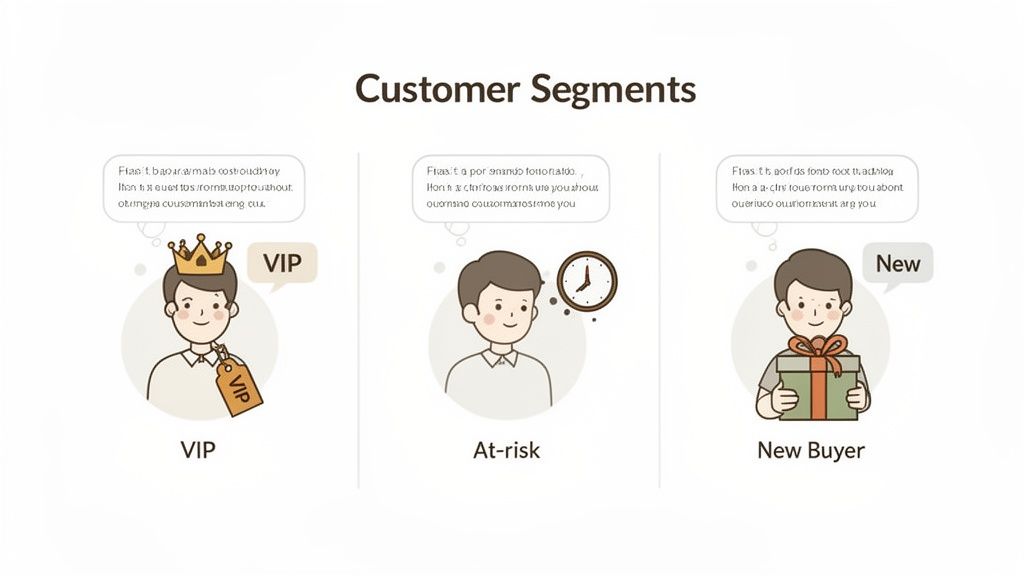
The first step toward powerful personalization is to stop treating your entire customer base as one giant, faceless group. You have to break them down into smaller, more focused segments based on their unique behavior and history with your brand. This simple move allows you to tailor your automated messages with stunning precision.
Here are three foundational customer segments you can start with:
- VIP Customers: These are your ride-or-dies—the top spenders and most frequent buyers. Forget generic discounts. Your automation should be sending them exclusive early access to new products, surprise bonus points, or a simple "thank you" for being so loyal.
- At-Risk Customers: We all have them. These are the shoppers who haven't made a purchase in a while and are slowly drifting away. An automated workflow can trigger a personalized "we miss you" offer based on products they've bought before, gently reminding them of what they loved.
- New Buyers: A first-time customer needs a warm welcome, not a hard sell. Use automation to deliver a welcome series that tells your brand story, shows off a few bestsellers, and maybe offers a small incentive to come back for a second purchase.
By segmenting your audience, you're making sure your automated messages always land at the right time with the right tone. It's the difference between shouting into a crowd with a megaphone and having a thoughtful, one-on-one dialogue.
Using Triggers for Perfectly Timed Interactions
Beyond just segmenting, the most effective personalization hinges on triggers—specific actions or events that kick off an automated response. This is how you deliver the right message at the exact moment it will have the most impact. It’s what separates a random marketing blast from a perfectly timed, helpful nudge.
Personalization is the art of showing your customers you've been listening. When an automated message arrives at the perfect time, triggered by a specific action or milestone, it reinforces their value and strengthens their emotional connection to your brand.
Just think about these powerful, trigger-based examples:
- The Birthday Reward: The system automatically sends a special discount or free gift on a customer's birthday. It's a small gesture that creates a huge moment of surprise and delight.
- The Post-Purchase Check-in: A week after an order is delivered, an automated email can ask for a review or offer tips on how to get the most out of their new product. It shows you care beyond the transaction.
- The Category Interest Follow-Up: If a customer browses your "running shoes" category several times but doesn't pull the trigger, a triggered message can showcase your top-rated pairs or offer a guide on choosing the right fit.
These small, timely interactions prove you're paying attention to their individual needs. In a world of constant digital noise, that's the kind of relevance that cuts through and builds lasting loyalty.
The Predictive Power of AI
The next frontier of personalization uses artificial intelligence (AI) to shift your strategy from being reactive to predictive. AI can analyze massive amounts of customer data to spot patterns a human analyst could never see, allowing you to get ahead of churn risks and identify upsell opportunities before they even happen.
For example, AI might detect a subtle change in a customer's purchasing frequency, flag them as "at-risk," and automatically trigger a retention workflow designed to win them back. It’s a total game-changer. This approach also helps you understand what your customers really want by analyzing their preferences and behaviors to serve up better recommendations—a concept rooted in collecting what's known as zero-party data.
The data backs this up, big time. A whopping 71% of consumers now expect personalized interactions, and 60% say personalization directly encourages them to become repeat buyers. And the payoff is huge: companies that nail this generate 40% more revenue than their average competitors. Add AI to the mix, and 83% of its users report direct revenue growth.
Ultimately, combining smart automation with genuine personalization is how you build a retention engine that doesn't just keep customers around—it turns them into passionate advocates for your brand. It’s about using technology to scale thoughtfulness and make every single shopper feel like they’re your only customer.
Building Your Customer Retention Automation Strategy
Jumping into customer retention automation can feel like a huge project, but it really doesn't have to be. The secret is breaking it down into a clear, step-by-step plan that lets you build a powerful system without getting bogged down. We're going to move from idea to action and get a strategy in place that actually delivers results you can see.
Think about it like building a house. You wouldn’t start by throwing up walls, right? You’d pour a solid foundation first. For your retention strategy, that foundation is a seamless connection to your existing e-commerce platform. This is the critical first step. It ensures all your customer data—from purchase history to browsing habits—flows straight into your retention tool, giving you the fuel you need for true personalization.
Once that connection is solid, you can get to the fun part: designing the rules and rewards that will bring customers back again and again, creating real loyalty.
Phase 1: Laying the Groundwork
This first phase is all about getting the basic setup right and figuring out what you want to achieve. It’s where you turn your business goals into simple, automated actions. The key is to start small and focus on the things that will make the biggest difference right away.
- Integrate Your Platform: First things first, connect your retention software to your e-commerce store (like Shopify). This lets the tool see what your customers are doing in real-time.
- Define Your First Loyalty Rules: Decide on a straightforward points system. A great starting point is something simple like "10 points for every $1 spent." This becomes the backbone of your entire program.
- Set Up Foundational Workflows: Get two high-impact campaigns running immediately: a welcome series for new customers and an abandoned cart recovery sequence. These are classic quick wins that start showing an ROI almost instantly.
Getting this initial setup done gives you a solid framework to build on. Once these pieces are in place and humming along, you can shift your focus to seeing how they’re performing and making them even better.
Phase 2: Measuring and Optimizing Performance
You can't improve what you don't measure. As soon as your first campaigns are live, your attention needs to turn to tracking Key Performance Indicators (KPIs). These numbers are your guide—they tell you if the strategy is working and pinpoint exactly where you can make improvements. Without good data, you’re just flying blind.
A successful customer retention automation strategy isn’t a "set it and forget it" machine. It’s a living system that requires consistent monitoring and optimization. The data tells you what your customers love, allowing you to double down on what works and refine what doesn’t.
Here are the essential KPIs you should be watching from day one:
- Repeat Purchase Rate: This is the ultimate report card for retention. It tells you the percentage of your customers who are coming back for a second, third, or fourth purchase.
- Customer Lifetime Value (CLV): This metric calculates the total amount of money a customer is expected to spend with your business over time. When your CLV is climbing, you know your retention efforts are paying off.
- Redemption Rate: This shows you how many people are actually cashing in their loyalty points or rewards. If this number is low, it could be a sign that your rewards just aren't exciting enough.
By keeping a close eye on these numbers, you get the clarity you need to make smart, informed decisions. For example, if your redemption rate is lagging, you might try offering a different type of reward to see if it moves the needle. This constant loop of measuring and tweaking is what leads to long-term success. If you're exploring different platforms, our guide on the best customer retention software can offer some more great ideas.
Got Questions About Retention Automation? We've Got Answers.
Jumping into a new strategy always brings up a few questions. And when it’s something with as much potential as customer retention automation, it’s smart to get the details sorted out first. Here are some straightforward answers to the things we hear most often from e-commerce brands just like yours.
We'll tackle everything from how fast you can expect a return on your investment to the big one: whether automation makes your brand feel robotic. These are the real-world concerns on every merchant's mind.
How Long Until I Actually See Results?
This is usually the first thing people ask, and it’s a great question. The answer really has two parts: you'll see some wins almost immediately, while the bigger, more foundational results build up over a few months.
It’s best to think of it in two waves:
- Quick Revenue Recovery (Days to Weeks): Some workflows, especially abandoned cart recovery, get to work the second you flip the switch. You can literally start recapturing sales you would have lost and see a direct bump in revenue within the first week. It’s the fastest, most concrete proof that this stuff works.
- Deeper Loyalty Building (3 to 6 Months): The more profound impact on metrics like Customer Lifetime Value (CLV) and repeat purchase rate takes a little more time. As your customers start earning points, redeeming rewards, and getting used to your loyalty program, their buying habits begin to change. That’s where you see the real, sustainable growth kick in.
The trick is to know your numbers before you start. Get a clear baseline for your current repeat purchase rate and CLV. That way, you can actually see the powerful, compounding effect your new system has over time.
Isn't This Stuff Too Expensive for a Small Business?
Nope. That’s a common myth that keeps a lot of great brands from growing. Modern retention platforms are built to be affordable and to scale right alongside your business. It's much more accurate to see this as a high-return investment, not just another monthly expense.
Don't forget the golden rule of e-commerce: keeping a customer is 5 to 25 times cheaper than finding a new one. A smart automation system pays for itself—often very quickly—through more repeat sales, higher order values, and recovered carts that would have otherwise vanished.
Many platforms, Toki included, offer flexible pricing that lets you get started without a huge upfront commitment. You can roll out the core features, prove the value for yourself, and then expand as your revenue grows. You don’t need a massive budget to make it work.
Will Automation Make My Brand Feel Impersonal?
It's a totally fair question, but the truth is actually the exact opposite. Good automation, when done right, makes your personalization better. It lets you create thoughtful, relevant interactions at a scale you could never manage by hand.
The point isn't to replace the human element; it's to give it superpowers. Instead of blasting your whole list with the same generic email, automation lets you use your customer data to send things like:
- A special discount on their birthday.
- An offer for a product that complements something they've bought before.
- A quick tip on how to get the most out of an item they just received.
The system handles the boring logistics, which frees you up to think about the creative strategy behind these "wow" moments. It’s not about being robotic; it’s about scaling thoughtfulness.
What's the Best Automated Workflow to Start With?
If you're looking for the biggest bang for your buck right out of the gate, the answer for most e-commerce stores is a one-two punch: a points-based loyalty program and an abandoned cart recovery flow.
Starting with these two gives you the best of both worlds. A loyalty program gives every single customer a compelling reason to come back and connect with your brand, turning a simple transaction into a relationship. It’s the foundation for everything else.
At the same time, abandoned cart automation is a quick and dirty win that plugs a major leak in your sales funnel and shows a clear, immediate ROI. Nail these two first, and you’ll build the momentum—and the cash flow—to add more advanced strategies like referrals and tiered memberships down the line.
Ready to turn one-time buyers into loyal fans? With Toki, you can launch powerful loyalty, referral, and membership programs that drive repeat sales on autopilot. Start building lasting customer relationships today.