A Complete Guide to the CAC LTV Ratio for Profitable Growth
Master the CAC LTV ratio with our complete guide. Learn how to calculate it, avoid common mistakes, and use proven strategies to drive profitable growth.
Think of your business as a car getting ready for a road trip. The cost to get a new customer in the door—all your marketing and sales spend—is like the fuel you put in the tank. That's your Customer Acquisition Cost (CAC).
The total value that customer brings in over their entire time with you is how far you get on that tank of gas. That's the Customer Lifetime Value (LTV). The CAC:LTV ratio is the metric that ties it all together.
Understanding the CAC:LTV Ratio: Your Business Health Check
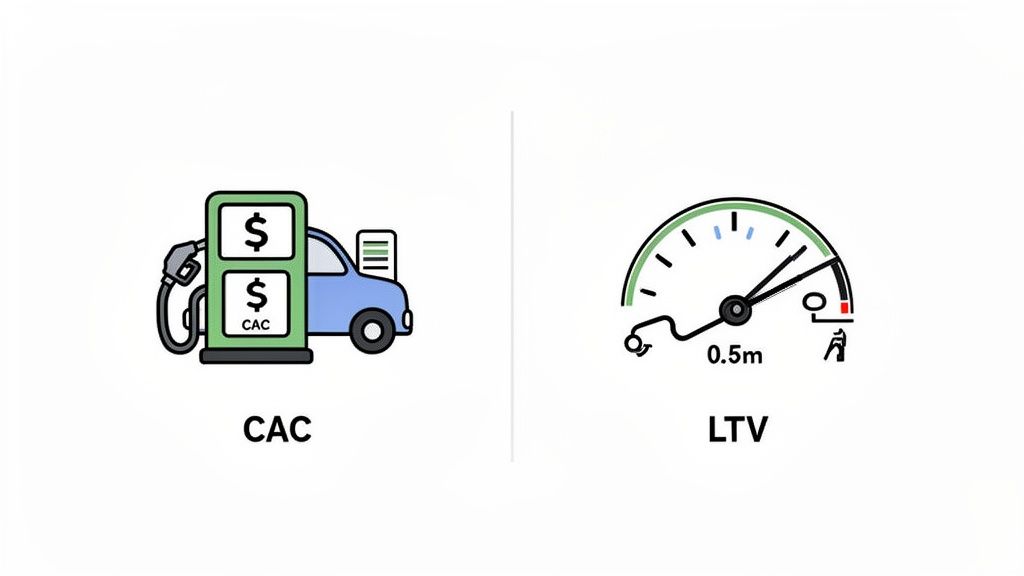
The CAC:LTV ratio answers one simple, yet critical, question: are we spending our money wisely to grow the business? For every dollar we put into acquiring a customer, how many dollars do we get back over the long haul?
This simple comparison gives you a powerful snapshot of your business's financial health and long-term viability. It tells you whether your growth engine is actually profitable or just spinning its wheels.
Why This Ratio Is More Than Just Numbers
It's easy for e-commerce brands to get tunnel vision, focusing only on short-term metrics like Return on Ad Spend (ROAS). ROAS is fine for measuring the immediate impact of a single ad campaign, but it misses the bigger picture entirely.
What if a customer makes a small initial purchase, resulting in a so-so ROAS, but then comes back again and again, becoming one of your most loyal fans? The CAC:LTV ratio captures that entire journey, forcing you to look beyond a single transaction to see the real value of your acquisition strategy.
By focusing on the LTV to CAC ratio, you shift from a campaign-centric mindset to a customer-centric one, building a business model that is not just growing, but is built to last.
The Gold Standard for Growth
So, what's a "good" ratio? For most e-commerce and DTC brands, a 3:1 ratio is the classic benchmark for healthy, sustainable growth. It means that for every $1 you spend to bring in a new customer, you get $3 back in gross margin over their lifetime.
Here’s a quick guide to interpreting your ratio:
- 1:1 Ratio: This is a red flag. You're essentially losing money on every new customer once you account for the cost of goods sold (COGS) and other operating expenses.
- 3:1 Ratio: You’re in a great spot. This is a solid, profitable model that allows you to cover costs and reinvest in more growth.
- 5:1+ Ratio: You’re running an incredibly efficient machine. But, a ratio this high might also mean you're underinvesting in marketing and sales. You could probably be growing even faster.
Getting a handle on this fundamental metric is the first, most important step toward building a truly resilient and profitable brand.
How To Calculate Your LTV:CAC Ratio Step By Step
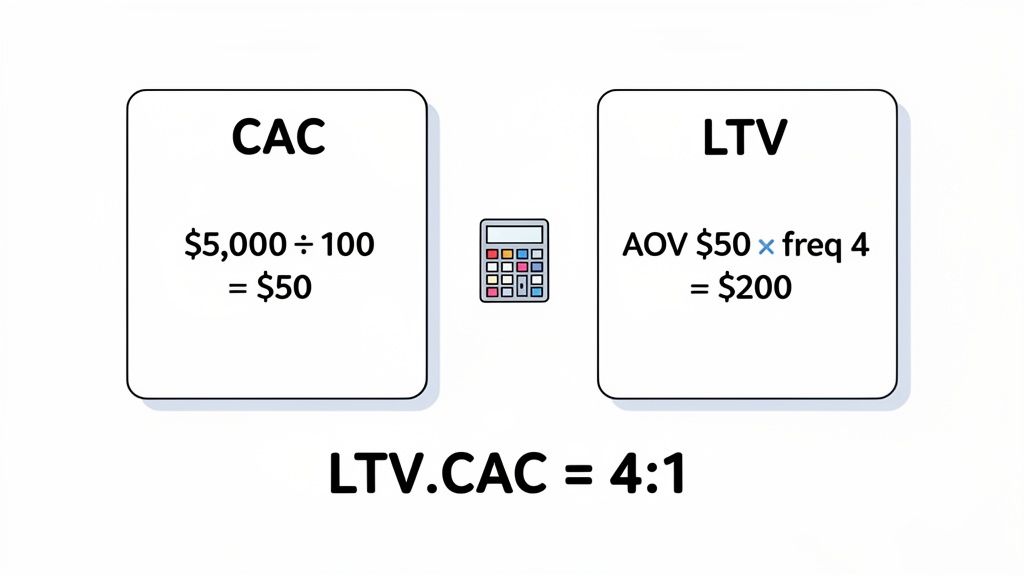
Alright, let's move from theory to action. Calculating your LTV to CAC ratio isn't about getting lost in complex algebra; it's about being diligent with your data. The final calculation is simple division, but the real magic—and accuracy—lies in how you figure out the inputs.
Let's walk through the math, piece by piece, starting with what you spend.
Step 1: Calculate Your Customer Acquisition Cost (CAC)
First up is your Customer Acquisition Cost (CAC). Think of this as the total, all-in price you pay to get one new customer in the door over a specific period. It’s not just your ad spend—it’s the full cost of your growth engine.
To get your CAC, you add up all your sales and marketing costs and then divide that by the number of new customers you brought in during that same window.
The Formula for CAC:
(Total Marketing Spend + Total Sales Spend) / Number of New Customers Acquired
So many brands make the mistake of only counting their direct ad costs. A true CAC has to include every penny that contributes to winning that new customer. For a deeper look at what to include, check out our guide on calculating the cost of customer acquisition.
Here’s what should be in your total spend:
- Ad Spend: The obvious one—everything you spend on Meta, Google, TikTok, and other platforms.
- Team Salaries: The portion of salaries for your marketing and sales staff.
- Software and Tools: Your subscriptions for marketing automation, analytics, and CRM platforms.
- Content and Creative: Any costs for freelancers, agencies, or producing ad creative.
Let's Run an Example: Imagine your e-commerce store had these costs last month:
- Ad Spend: $3,500
- Marketing Team Salaries: $1,000
- Software Subscriptions: $500
Your total spend is $5,000. If you acquired 100 new customers that month, your CAC is a clean $50.
Step 2: Calculate Your Customer Lifetime Value (LTV)
With CAC figured out, it's time for the other side of the coin: Customer Lifetime Value (LTV). This metric estimates the total revenue a single customer will generate for your brand over their entire relationship with you.
For e-commerce and DTC, a simple and powerful way to calculate LTV is to multiply your average order value by how often customers buy and how long they stick around.
The Formula for LTV:
Average Order Value (AOV) x Purchase Frequency x Customer Lifespan
To calculate the LTV to CAC ratio, you first need to understand its individual parts. The table below breaks down the key variables required for each metric, complete with simple example calculations to guide you.
CAC and LTV Formula Components
A breakdown of the variables needed to calculate Customer Acquisition Cost and Customer Lifetime Value accurately.
| Metric | Component Variables | Example Calculation |
|---|---|---|
| CAC | Total Marketing & Sales Spend: All associated costs (ads, salaries, tools). New Customers Acquired: The count of new customers in a period. | ($3,500 Ads + $1,500 Other Costs) / 100 New Customers = $50 CAC |
| LTV | Average Order Value (AOV): Total Revenue / Total Orders. Purchase Frequency: Total Orders / Unique Customers. Customer Lifespan: Average time a customer remains active. | $100 AOV x 2 Purchases/Year x 2-Year Lifespan = $400 LTV |
Understanding these components is the key to an accurate LTV:CAC ratio that truly reflects your business's health.
Let's Run an Example: Pulling data from the past year, let's say your brand's numbers look like this:
- Average Order Value (AOV): $100
- Purchase Frequency: Your customers buy about 2 times per year.
- Customer Lifespan: The average customer stays loyal for 2 years.
Putting it together: $100 (AOV) x 2 (Purchases/Year) x 2 (Years) = $400 LTV.
Step 3: Put It All Together
You've done the hard work. Now for the easy part: calculating the LTV to CAC ratio. Simply divide your LTV by your CAC.
The Ratio Formula:
LTV / CAC
Using our numbers from the examples above:
- Your LTV is $400.
- Your CAC is $50.
Your LTV to CAC ratio is $400 / $50 = 8, which we write as 8:1. This is a fantastic result. It means that for every $1 you spend to acquire a customer, you get $8 back in revenue over their lifetime. That’s the sign of a healthy, profitable growth model.
So, you've done the math and calculated your CAC:LTV ratio. Now for the million-dollar question: what does that number actually mean? Is it good? Bad? Somewhere in between?
Knowing the industry benchmarks is like knowing par on a golf course—it gives your score context. Without it, you're just hitting a ball in a field.
What's a Good LTV to CAC Ratio for E-commerce?
The widely accepted gold standard for a healthy, sustainable business is an LTV to CAC ratio of 3:1.
Think of it this way: for every dollar you put into acquiring a customer, you should get at least three dollars back in gross margin over their lifetime. This 3:1 ratio is the sweet spot that signals you’ve built a profitable growth engine. It means you have enough cash coming in to cover your costs, pay your team, and reinvest in scaling the business.
How to Interpret Your Ratio
While 3:1 is the magic number to aim for, your actual ratio tells a unique story about your business's health and current strategy.
- Below 3:1 (e.g., 2:1): This is a red flag. On paper, you might look profitable, but your margins are probably razor-thin after you factor in all your operating costs. It’s a clear sign you’re spending too much to get customers relative to the value they bring, which puts your long-term survival at risk.
- Excellent (4:1): A 4:1 ratio points to a highly efficient and profitable business. You've struck a fantastic balance between acquiring new customers and getting real, long-term value from them. Keep doing what you're doing.
- Exceptional (5:1 or higher): This looks amazing, and it is! But it can be a double-edged sword. An extremely high ratio might suggest you're actually underinvesting in growth. You could be leaving money on the table by not spending more aggressively to capture market share.
A healthy CAC to LTV ratio isn't just about being profitable; it's about finding the right balance. Too low, and you're inefficient. Too high, and you might be missing a major opportunity to grow faster.
Why Benchmarks Matter More Than Ever
Striking this balance has never been more important. With fierce competition on platforms like Meta, Google, and TikTok, customer acquisition costs have skyrocketed by roughly 60% over the last decade.
For Shopify merchants and DTC brands, this means the old way of looking only at immediate ROAS (Return on Ad Spend) is no longer enough. Every single campaign needs to be judged by its CAC:LTV profile to ensure it’s contributing to sustainable growth, not just short-term sales. You can find more e-commerce benchmarks and insights at Deliberate Directions.
Putting It All into Practice
Let's walk through a real-world example. Imagine you’re running two different marketing campaigns for your online store.
- Campaign A (Social Media Ads): This campaign brings in customers for a low CAC of $50. The problem? They're mostly bargain-hunters who don't stick around, resulting in a low LTV of $120. That gives you a risky 2.4:1 ratio.
- Campaign B (Content Marketing): This one costs more upfront, with a CAC of $80. But these customers are a better fit for your brand. They come back again and again, leading to a much higher LTV of $400. The result is a stellar 5:1 ratio.
If you only looked at the initial acquisition cost, you'd probably double down on Campaign A. But when you look at the full picture through the lens of LTV to CAC, it's clear that Campaign B is the real winner, building a much healthier and more profitable business for the long haul.
Where People Go Wrong with the CAC:LTV Ratio
Calculating your LTV:CAC ratio seems simple on the surface, but a few common missteps can turn this powerful metric into a misleading one. Get it wrong, and you could end up cutting a profitable ad channel or, even worse, pouring money into one that's secretly bleeding you dry.
Think of it like navigating with a wonky compass. You might feel like you're making great progress, but you're actually heading in the completely wrong direction. To make sure your ratio is a reliable guide for growth, let's unpack the most common calculation traps and how to sidestep them.
The Blended CAC Problem
One of the biggest mistakes I see is relying only on a "blended" CAC. This is what happens when you average acquisition costs across all your marketing channels—organic, paid search, social, affiliates—into one big, company-wide number. While it’s fine for a quick, high-level health check, it hides the real story of what’s working and what isn’t.
Let's say you get customers from two places:
- Organic Search (SEO): These customers cost you $10 each.
- Paid Social Ads: These customers cost $100 each.
Your blended CAC might be a respectable-looking $55. But that average completely masks the fact that one channel is a hyper-efficient goldmine and the other is incredibly expensive. If you use that $55 figure to make budget decisions, you might starve your best channel (SEO) or fail to realize your ads need a serious overhaul.
The Fix: Always, always segment your CAC by channel. This is the only way to see which channels are your true growth engines and which ones need a tune-up. It lets you put your money where it will actually work.
Ignoring Cohort Analysis
The second major pitfall is failing to group your customers into cohorts. A cohort is just a fancy term for a group of customers who all signed up or made their first purchase during the same time frame, like "January 2024 Customers." When you lump all your customers together, you miss crucial trends in their behavior over time.
For example, a cohort you acquired during a big Black Friday sale might have a low initial purchase value and disappear forever. On the other hand, a cohort from a brand-focused campaign might cost more upfront but stick around for years, showing a much higher LTV.
Without cohort analysis, you can’t answer critical questions like:
- Are the customers we're acquiring today more valuable than the ones from last year?
- Did that new loyalty program we launched in Q2 actually make customers stick around longer?
- How many months does it take for a customer from our podcast ads to become profitable?
Looking at your business through the lens of cohorts turns your LTV from a static, one-time number into a moving picture of your company’s health.
Choosing the Wrong Timeframe
The "lifetime" in Customer Lifetime Value is a bit of a misnomer. Are we talking 3 months? 12 months? 3 years? Picking the wrong time window can seriously warp your LTV:CAC ratio and lead to bad calls.
A mattress company, for instance, might have a very long customer lifespan but see purchases only every few years. For them, a 3-year or even 5-year LTV window makes sense. But for a subscription coffee brand, customers are buying every single month. A 12-month LTV is probably a much more actionable metric for their day-to-day decisions.
Using too short a window makes you undervalue your most loyal customers and might cause you to kill a channel that’s actually a long-term winner. But using an overly optimistic, long timeframe can make your business look healthier than it really is, hiding a potential cash flow crisis just around the corner. It's all about aligning the timeframe with your business cycle and, crucially, your payback period.
Using Gross vs. Net LTV
This one is critical. A surprisingly common mistake is using gross revenue to calculate LTV. This paints a dangerously rosy picture because it ignores your costs. For this metric to mean anything, your LTV must be based on gross margin, not top-line revenue.
This means you have to subtract your Cost of Goods Sold (COGS)—the direct costs of making your product, like raw materials and manufacturing—from the revenue a customer brings in.
Here’s why it’s a night-and-day difference:
- Gross LTV: A customer spends $300 over their lifetime.
- COGS: It costs you $120 to produce and ship those goods.
- Net LTV (Gross Margin LTV): The actual value this customer delivered is just $180.
Let's say your CAC for this customer was $75. If you use gross LTV, you get a 4:1 ratio ($300 / $75). You’d be patting yourself on the back. But using the correct Net LTV reveals a far more sobering 2.4:1 ratio ($180 / $75). That number doesn't scream "success"—it whispers "we need to improve." Always subtract your COGS to get a ratio that reflects real, actual profitability.
Proven Strategies to Improve Your CAC LTV Ratio
Knowing your CAC:LTV ratio is the first step. Actually improving it is where real, sustainable growth begins. A healthy ratio doesn't just happen by accident—it’s the direct result of a smart, deliberate strategy that works on both sides of the equation.
To build a more profitable and resilient business, you really only have two levers to pull. You can either lower what it costs to get a new customer, or you can increase how much that customer is worth to you over their lifetime. Let's dig into some practical ways to do both.
Lowering Your Customer Acquisition Cost
Bringing your CAC down is all about getting more efficient with your marketing budget, not just slashing it. The goal is to get smarter about where your money goes so you can bring in more customers for the same spend—or even less. This directly strengthens your ratio.
Here are a few proven ways to lower your CAC:
- Optimize Ad Spend Ruthlessly: Stop treating all your ad channels as equals. Dive deep into your analytics and find the campaigns that deliver customers with the best LTV to CAC ratio, not just the lowest cost-per-click. Double down on what works and don’t be afraid to cut the losers.
- Build an Organic Engine: Paid ads get you quick results, but organic channels like SEO and content marketing are the gifts that keep on giving. A high-ranking blog post can bring in valuable customers for years to come with almost no ongoing cost. It's a long-term play that pays massive dividends.
- Launch a Referral Program: Your happiest customers are your most convincing salespeople. A well-designed referral program gives them a real reason to spread the word, bringing in high-quality, high-trust leads for a fraction of what you'd spend on a cold ad.
For a deeper dive, exploring actionable digital marketing strategies for small business can offer some fantastic, practical guidance.
Boosting Your Customer Lifetime Value
While lowering CAC is important, the real secret to a world-class CAC:LTV ratio often lies on the other side of the formula. Increasing LTV is where brands forge lasting relationships and build a moat around their business that competitors can't easily cross.
The data on this is incredibly compelling. One study found that a 1% improvement in customer retention can boost customer value by anywhere from 2.45% to 6.75%. In contrast, a 1% drop in acquisition cost only improved value by 0.02% to 0.32%.
The math is clear: a tiny improvement in retention has an outsized impact on your bottom line. It’s the ultimate growth lever.
This is exactly why platforms focused on loyalty and retention are so critical. A tool like Toki, for instance, is built from the ground up to increase LTV through proven mechanics that encourage customers to come back and spend more.
Here’s how you can start boosting LTV today:
- Implement a Tiered Loyalty Program: Reward your best customers with points, exclusive perks, and early access. A tiered system gives them a clear goal to strive for, encouraging them to spend more to unlock the next level of benefits.
- Offer Paid Memberships: Create a VIP club with exclusive benefits like free shipping or members-only products. The recurring revenue from memberships provides predictable cash flow and dramatically increases the LTV of your most dedicated fans.
- Personalize the Customer Journey: Use your customer data to deliver personalized recommendations, targeted offers, and rewards that actually feel relevant. When customers feel like you "get" them, their loyalty skyrockets. For more ideas, check out our complete guide to improve customer lifetime value.
Strategies to Improve Your CAC LTV Ratio
Balancing both sides of the ratio—cutting costs and increasing value—is the key to a powerful growth flywheel. Here's a quick comparison of how different tactics impact your business.
| Strategy Area | Tactic | Primary Impact | Example Implementation |
|---|---|---|---|
| Lowering CAC | Ad Spend Optimization | Reduces marketing waste | Pause underperforming ad sets on Facebook and reallocate budget to top-performing Google Ads campaigns. |
| Lowering CAC | Organic Growth (SEO) | Builds a low-cost acquisition channel | Create blog content that answers common customer questions and ranks for valuable long-tail keywords. |
| Lowering CAC | Referral Program | Acquires high-intent customers cheaply | Offer a "Give $10, Get $10" program to incentivize word-of-mouth marketing from existing customers. |
| Boosting LTV | Loyalty Program | Increases purchase frequency & AOV | Launch a points-per-dollar system where customers can redeem points for discounts or free products. |
| Boosting LTV | Paid Membership | Creates recurring revenue & loyalty | Start a "VIP Club" for $49/year that includes free shipping on all orders and early access to sales. |
| Boosting LTV | Personalization | Improves customer retention | Use purchase history to send targeted emails with product recommendations and relevant offers. |
Getting these strategies right starts with having accurate numbers. Unfortunately, many businesses trip up on the calculations.
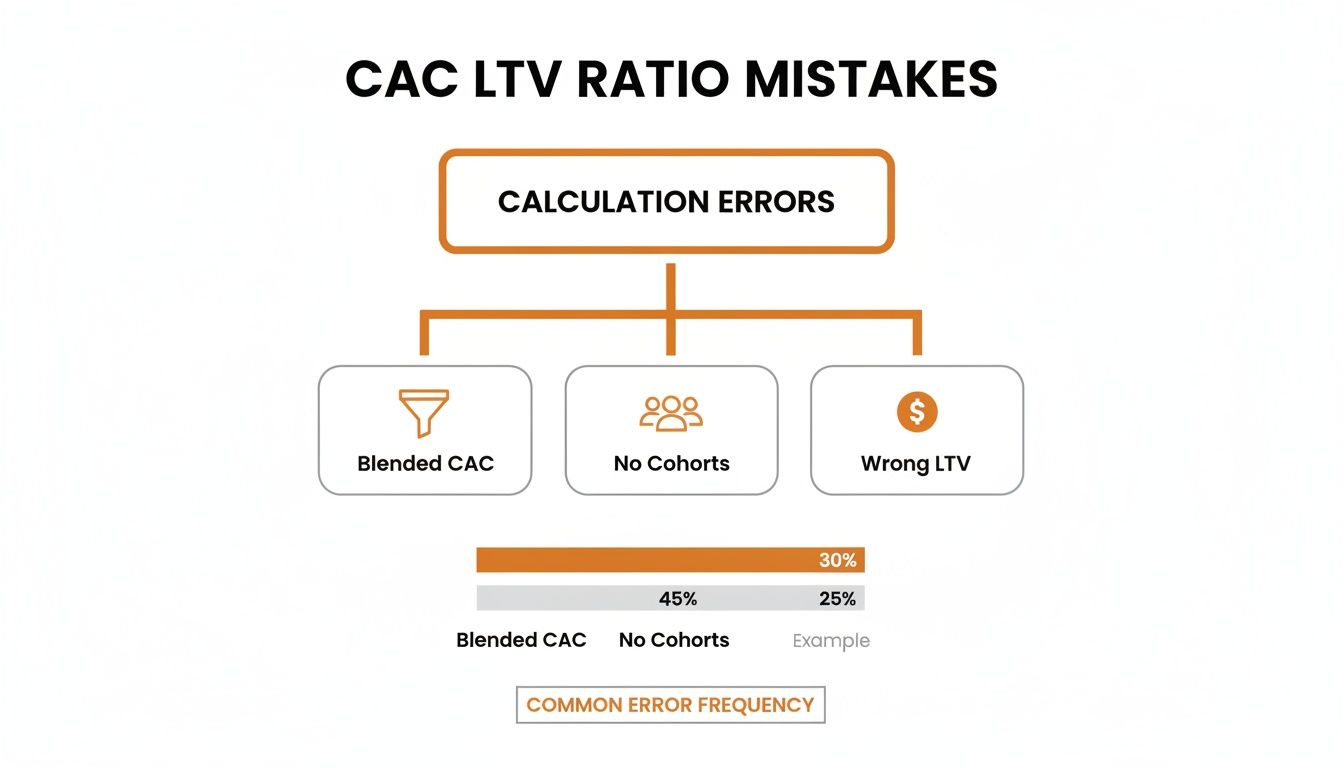
As this image shows, using blended CAC, failing to segment customers into cohorts, or using the wrong LTV formula can completely distort your perception of business health. By avoiding these pitfalls and focusing on both sides of the equation, you put your brand on the path to profitable, long-term success.
Why Customer Retention Is Your Most Powerful Growth Lever
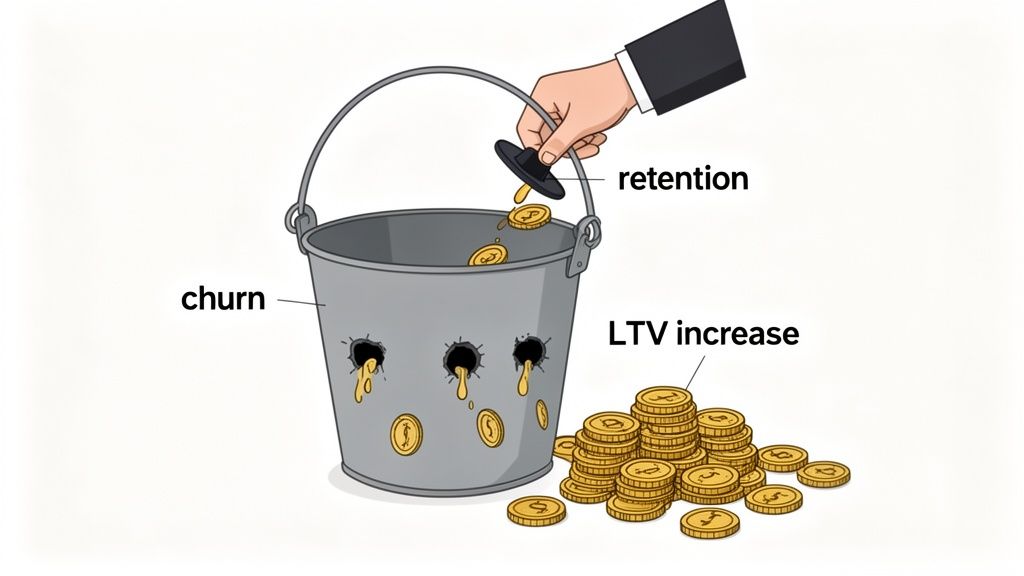
If you focus only on acquiring new customers, you're just pouring water into a leaky bucket. You might be filling it up, but you're losing just as much out the bottom. This endless cycle of acquisition is a fast track to burning through your marketing budget and hitting a growth ceiling.
The secret to a healthy CAC LTV ratio isn't just about finding cheaper ads. It’s about plugging the leaks. The real magic happens when you focus on customer retention, which directly pumps up the LTV side of the equation without adding a single dollar to your acquisition spend.
The Lopsided Economics of Growth
The financial gap between acquiring a new customer and keeping an existing one is massive. In fact, getting a new customer can cost anywhere from 5 to 25 times more than holding onto one you already have.
Think about the probabilities, too. An existing customer has a 60–70% chance of buying from you again. A new prospect? Their likelihood can be as low as 20%. This imbalance makes it nearly impossible to maintain a strong ratio without a solid retention game plan.
This is exactly why retention-focused platforms like Toki are so valuable. They give you the tools—like memberships, points programs, and referrals—to systematically build loyalty and, in turn, boost your LTV.
How Retention Supercharges Your LTV
Every time a customer comes back to buy again, their LTV goes up, which automatically improves your overall ratio. You only paid to acquire them once; every sale after that is pure profit against that initial investment. If you're serious about this, exploring guides on how to increase customer lifetime value is a non-negotiable.
Here are a few ways retention directly impacts your bottom line:
- More Frequent Purchases: Loyal customers simply buy more often.
- Higher Average Order Value (AOV): Happy, trusting customers are more willing to try new products and spend more each time they check out.
- Lower Churn: A great retention program keeps your customer base from eroding, creating a stable foundation for growth.
The numbers don't lie. A small 5% increase in retention can skyrocket profits by an incredible 25–95%. That kind of impact blows minor tweaks in media buying out of the water. Your existing customers are your greatest asset.
Ultimately, the customer retention vs. customer acquisition conversation isn't about picking a side. It’s about understanding that retention is the engine that makes all your acquisition efforts truly profitable and sustainable for the long haul.
Got Questions? We've Got Answers
Even when you've got the basics down, real-world questions about the CAC:LTV ratio always pop up. Let's tackle some of the most common ones we hear from e-commerce merchants so you can start using this metric with confidence.
How Often Should I Be Looking at This Ratio?
The honest answer? It depends on what you're trying to figure out.
If you need a high-level, "state of the union" view of your business health, calculating your blended CAC:LTV ratio quarterly is perfect. This timeframe smooths out the inevitable bumps and gives you a stable, reliable picture of your overall profitability and how efficiently you're growing.
But for making faster, tactical decisions, you'll want a more frequent pulse check. We recommend tracking CAC monthly and breaking down the LTV of specific monthly customer cohorts. This lets you see trends as they emerge—like a new ad campaign that's knocking it out of the park or a sudden drop in customer value—so you can act on it now, not three months from now.
Is It Possible for My CAC:LTV Ratio to Be Too Good?
Yes, absolutely. It sounds strange, but an extremely high ratio—say, 10:1 or more—is often a red flag for underinvestment. Sure, it proves that every customer you bring in is wildly profitable. But it also screams that you aren't spending anywhere near enough on marketing to actually reach your full potential.
An unusually high ratio means you're leaving money on the table. It's a safe bet your competitors are busy acquiring the very customers you could be winning.
A ratio somewhere in the 4:1 to 5:1 range usually hits the sweet spot. It shows you've got a profitable model while still pursuing an aggressive, sustainable growth strategy to claim your market share.
What Tools Should I Use to Track All This?
No single tool is a magic bullet, but you can build a killer analytics stack by combining a few platforms.
- For Acquisition Costs: Your ad platforms (Meta and Google) are your source of truth for spend, while Google Analytics helps connect that spend to customer sources.
- For Customer Value: Your e-commerce platform's built-in tools, like Shopify Analytics, are great for tracking purchase behavior and calculating a baseline LTV.
- For Deeper Insights: When you're ready for advanced cohort analysis and a single source of truth, dedicated analytics tools like Triple Whale or Glew are game-changers.
- For LTV Impact: To see exactly how your retention programs are moving the LTV needle, a loyalty platform is non-negotiable.
Keeping a close eye on these metrics and taking action to improve them is how you build a business that lasts. Toki gives you the tools—from loyalty and memberships to referrals—designed specifically to increase LTV and turn one-time buyers into your most valuable brand champions.