Branding a Community Customers Will Love
Discover how to master branding a community that drives loyalty. Learn to build a strong identity, engage members, and grow your e-commerce brand.
Branding a community is all about creating a distinct identity that turns a group of customers into a tribe of loyal advocates. It’s about figuring out the why—the unique purpose and personality of your group—to build a sense of belonging that goes way beyond just buying stuff. Honestly, this is the most critical first step, long before you even think about picking a platform or designing a logo.
Defining Your Community's Core Identity

Before you can build anything that lasts, you have to lay the right foundation. This part isn’t about flashy graphics or clever taglines, not yet anyway. It's about establishing the very soul of the space you want to create.
A strong community identity makes members feel like they’ve finally found their people. It’s what turns passive customers into active participants who feel a real sense of ownership. This initial branding phase is what separates a forgettable forum from an indispensable hub and will steer every decision you make down the line.
Articulate Your Community's Purpose
First things first, ask yourself one simple question: Why should this community exist? If your only answer is "to sell more products," you've already lost. The purpose has to be centered around your members, giving them something valuable they can’t just get anywhere else.
Think about the unique value you're offering. It usually falls into one of these buckets:
- Connection: A place for people with shared interests to swap stories and build real relationships.
- Support: A go-to channel for product help, troubleshooting, and advice from other users.
- Co-creation: An invitation for your most passionate fans to help shape what you do next.
- Exclusivity: A members-only club with access to unique content, early product drops, or a direct line to your team.
For example, a skincare brand could build its community around sharing user-generated routines and celebrating skin positivity, not just pushing the latest sale. That kind of purpose-driven approach feels authentic and gets people talking. If you need a little inspiration, check out these powerful brand community examples to see how a clear purpose drives incredible engagement.
Craft a Distinct Brand Voice
Your community’s voice should feel like a natural extension of your e-commerce brand, but maybe a bit more relaxed. Think of it as your brand letting its hair down—it’s more conversational, informal, and collaborative than your typical marketing messages.
A community isn't just another marketing channel; it's a conversation. The voice you use sets the tone for how members talk to you and, more importantly, to each other. It should sound less like a corporate announcement and more like a message from a friend you trust.
To nail down this voice, brainstorm some adjectives. Is the vibe witty and playful? Or is it more encouraging and educational? Write these traits down and use them as your guide for everything from welcome emails to moderation rules.
This consistency is the secret to branding a community that feels genuine and cohesive, making members comfortable enough to open up. A well-defined voice is what builds the trust needed for real connection to happen.
Crafting an Unforgettable Member Experience
Once you've nailed down your community's identity, it’s time to start shaping the member journey. A great community isn't a static forum; it's a living, breathing space where casual browsers slowly but surely become your most passionate advocates. This doesn't just happen on its own. It's built on a thoughtfully designed experience that delivers more and more value as members get more involved.
Think of it like a video game. You wouldn't throw a new player into the final boss battle on day one, right? You'd guide them, level by level, with challenges and rewards that build their confidence and get them hooked. That's exactly what we're doing here—mapping out a path that makes every step feel like a win.
How to Structure Compelling Membership Tiers
One of the best ways to build that sense of progress is with membership tiers. Tiers give people a clear roadmap for how to engage and a tangible goal to work toward. Instead of a one-size-fits-all approach, you're creating distinct levels that celebrate different degrees of commitment.
This structure is also perfect for delivering more tailored value. A new member might just want to dip their toes in the water and read discussions. A die-hard fan, on the other hand, would probably lose their mind over a chance to video chat with your lead product designer.
A tiered system transforms passive browsing into an active pursuit. It plays on our innate desire for status and accomplishment, proving to members that their contributions are seen and genuinely valued.
A classic three-tier structure is a great starting point because it encourages people to climb the ladder:
- Bronze (The Newcomer): This is your welcome mat. It's free to join, and it gives people the basics—they can join discussions, ask questions, and soak up the community vibes.
- Silver (The Contributor): Members level up to Silver by getting involved. Maybe it's after they make five posts or earn ten likes. Their reward? A special badge, access to exclusive Q&As, or a small, surprise discount code.
- Gold (The Advocate): This is the VIP lounge for your most helpful, active members. Access could be based on points earned or even be by invitation only. The perks here need to be a big deal: early access to new products, exclusive content, or maybe even a spot on a "community council" that gives direct feedback to your team.
For example, imagine a sustainable fashion brand. They could give their Gold Tier members the very first chance to buy a limited-edition collection made from upcycled materials. That’s not just a reward; it’s an exclusive experience that perfectly mirrors the brand's values.
Crafting Perks That Actually Motivate People
The rewards you offer are the lifeblood of your community. And let’s be honest—generic perks are a total snooze. To get people genuinely excited, your rewards need to feel exclusive, valuable, and connected to what your audience truly cares about.
Think beyond the standard 10% off coupon. What unique experiences can only you provide?
Maybe it's a sneak peek at a new feature, a behind-the-scenes video of your team's creative process, or a personal shout-out on your Instagram. These kinds of non-monetary rewards often forge a much deeper emotional bond, which is the whole point of branding a community for long-term loyalty and growth.
Integrating Your Community and Loyalty Tech
A truly magnetic community experience feels effortless. Members shouldn't see the seams where your community platform ends and your loyalty program begins. The secret behind this kind of smooth operation is a thoughtful tech integration that turns disconnected tools into a unified system, adding real value to every single interaction.
When your systems talk to each other, you unlock some seriously powerful ways to reward engagement. Imagine automatically awarding loyalty points when a member drops a high-quality product review or helps another user out by answering a question. This simple connection transforms your community from a passive discussion forum into an active part of your loyalty ecosystem, where every positive action gets recognized.
Powering Growth with Member Referrals
Let's be honest, your most passionate community members are your best marketers. So, why not make it incredibly easy for them to spread the word? Integrating referral and affiliate programs directly into your community platform is a total game-changer. Instead of making members hunt for a separate referral link on your main site, you can embed it right into their community profile.
This empowers them to share their unique code or link naturally within discussions. Picture a member sharing a rave review of your latest product and being able to drop their referral link in the same post. It’s authentic, it's effective, and it rewards them for the advocacy they were likely already doing. This not only drives new customer acquisition but also deepens the referring member's connection to your brand.
For a deeper dive into the technical side, you can explore our guide on achieving seamless loyalty program integration.
The graphic below really brings to life the core benefits that make a membership feel valuable and worth engaging with.
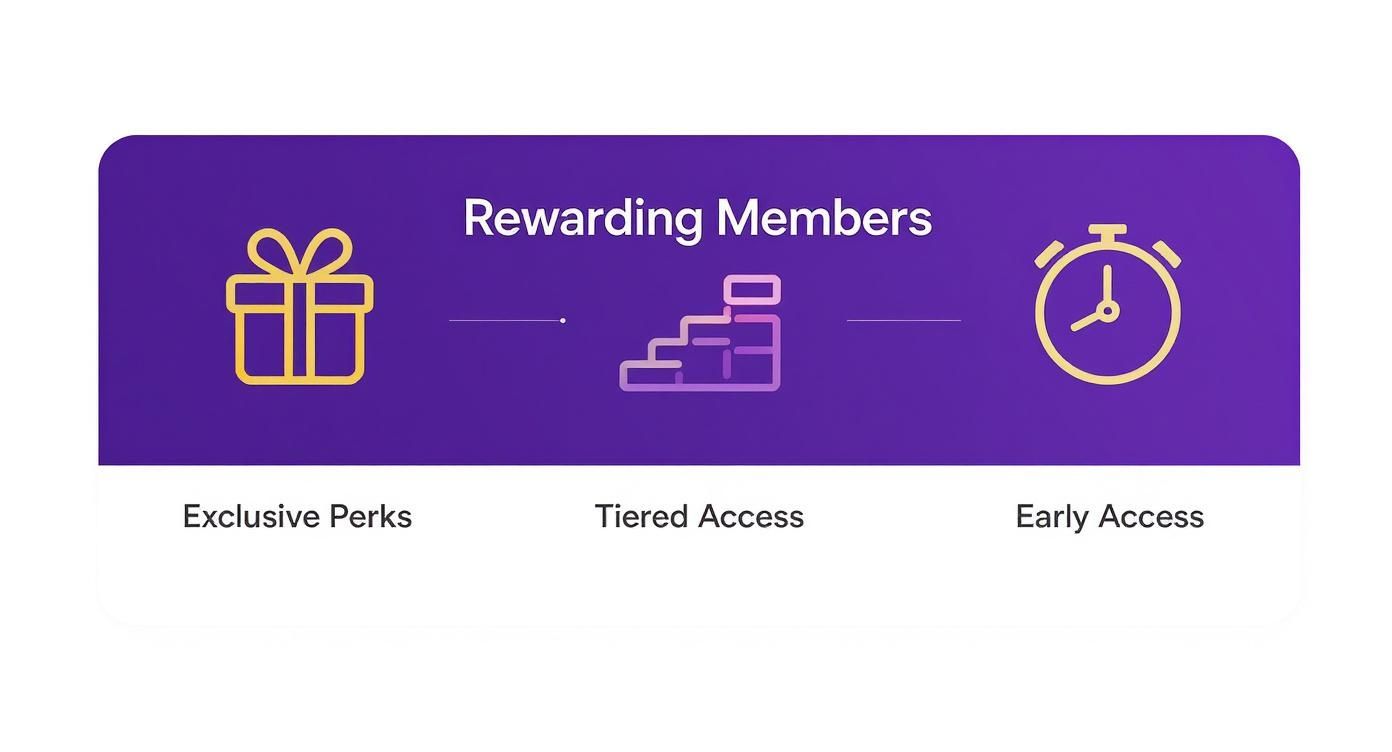
This visual breakdown shows how a smart mix of exclusive perks, tiered access, and early product releases creates a compelling reason for members to stick around and stay active.
Modernizing Perks with Digital Wallet Passes
To make your community feel modern and high-tech, it’s time to look beyond traditional email coupons. Digital wallet passes—like the ones for Apple Wallet and Google Wallet—offer a sophisticated way to deliver exclusive benefits directly to your members' phones. You can use them to grant access to a members-only virtual event, deliver a surprise birthday reward, or provide a scannable in-store discount.
Digital passes create a tangible connection between your online community and real-world experiences. They make your members feel like true insiders, carrying a piece of the brand with them wherever they go.
This kind of integration reinforces a key idea: branding a community is all about creating a cohesive, omni-channel experience. Maintaining this consistency is absolutely crucial for growth. In fact, companies with strong brand consistency grow 24% faster than their competitors, and branded posts on social media see 23% more engagement.
A unified presence also encourages the 83% of consumers who are happy to share positive brand experiences online. When your tech works in harmony, your brand feels stronger everywhere. You can dive into more insights on why brand consistency is so powerful by reading the full research on branding statistics.
Community Engagement Tactic Comparison
To help you decide which engagement tactics are right for your brand, here's a quick comparison of some popular options, their goals, and how to measure their success.
| Tactic | Primary Goal | Example Platforms | Key Metric |
|---|---|---|---|
| User-Generated Content (UGC) Contests | Boost content creation & social proof | Instagram, TikTok, Community Forum | Number of submissions, reach, engagement rate |
| Q&A Forums / Help Center | Reduce support tickets, build knowledge base | Discourse, Slack, Circle | Number of solved questions, search volume |
| Exclusive Product Feedback Groups | Improve products, increase member value | Private Discord channel, Closed Facebook Group | Number of active participants, quality of feedback |
| Virtual Events & AMAs | Build relationships, provide direct access | Zoom, YouTube Live, Twitch | Live attendance, post-event survey scores |
Choosing the right mix of these tactics depends entirely on your community's brand identity and your members' preferences. The key is to start with one or two, measure their impact, and then expand based on what resonates.
Keeping Your Community Hooked with Smart Gamification

So, you’ve got members in the door. How do you keep them coming back day after day? The secret is making participation feel genuinely fun and rewarding. This is where a little bit of smart gamification can work wonders, turning passive members into your most active contributors.
We’re not talking about building a full-blown video game. It’s much simpler than that. The idea is to weave in subtle, motivating mechanics that tap into our natural desire for progress and achievement. When done right, it gives members a real sense of ownership and makes them feel personally invested in the community's success.
Getting the Core Mechanics Right
The most effective gamification strategies are often the most straightforward. You want to start with a foundation that’s easy for everyone to grasp and for you to manage. These core elements create a clear path for engagement and offer that instant gratification that keeps people involved.
Here are a few classic mechanics that just plain work:
- Points: This is your bread and butter. Award points for the actions you want to encourage—posting a helpful tip, leaving a comment, or answering another member's question. It provides a simple, tangible way to measure contribution.
- Badges: People love to collect things. Use badges to recognize specific milestones or achievements. Think a "Trailblazer" badge for your first 100 members or a "Top Contributor" badge for the most helpful person each month.
- Leaderboards: A little friendly competition never hurts. Showcasing your top members on a weekly or monthly leaderboard can be a huge motivator for those who enjoy seeing their name at the top.
Getting these features right from the start is key. If you're looking for a deeper dive into how these elements play together, check out our guide on applying gamification in loyalty programs.
Building Powerful Engagement Loops
Once you have the basics down, the real magic begins when you engineer self-sustaining engagement loops. Think of it as a cycle: a member takes an action, gets a reward, and that reward immediately prompts them to take the next action.
An engagement loop is what turns participation from a one-off action into a habit. By rewarding valuable contributions, you create a positive feedback cycle that encourages members to give more, which in turn strengthens the entire community.
Here’s a practical example: launch a contest for the best user-generated content (UGC). The winner gets a special "Creator" badge and a stash of bonus loyalty points. This is a brilliant move because brand communities are a core retention strategy for 62% of businesses, and UGC has been shown to be 10 times more influential on buying decisions than traditional marketing.
This single initiative does three things at once: it encourages content creation, rewards quality, and gives members a new status symbol to aim for. For more smart ways to foster this kind of active participation, take a look at these 10 Community Engagement Best Practices. By thoughtfully weaving these interactive elements into your community's DNA, you build a space that people genuinely want to return to every single day.
How to Measure Community Health and ROI
https://www.youtube.com/embed/02xXNHqrr9k
A buzzing, active community is a fantastic feeling, but good vibes don't show up on a balance sheet. To prove your community's worth, you have to move beyond vanity metrics like the total member count and dig into the data that really matters to the business. Measuring community health and its return on investment (ROI) is how you'll justify the budget and make smarter decisions to keep it growing.
Think of it less as just tracking numbers and more as understanding the stories those numbers tell. A healthy community actively shapes customer behavior. It creates a powerful feedback loop that drives up retention, encourages more spending, and builds the kind of brand loyalty that competitors can't touch.
Key Metrics for Tracking Community Health
To get a real sense of your community's pulse, you need to look at a few different kinds of metrics. I like to split them into two buckets: engagement indicators that show what's happening inside the community, and business impact metrics that connect that activity to your bottom line.
For a quick health check, start with these fundamentals:
- Active Member Rate: Forget total sign-ups. What percentage of your members have actually posted, commented, or even just reacted in the last 30 days? That’s your true user base.
- Engagement Rate: Look at the average number of interactions (likes, comments, replies) your posts get. This tells you if your content and discussions are actually hitting the mark.
- User-Generated Content (UGC) Volume: How many original posts, product reviews, or photos are members sharing on their own? High-quality UGC is pure gold for social proof and marketing.
Watching these numbers gives you a snapshot of the day-to-day energy. If they're trending up, you know your branding a community strategy is working and connecting with people.
Connecting Community Activity to Business ROI
Okay, now for the part that gets everyone's attention: tying all that engagement to real business results. This is how you prove your community is a revenue-driver, not just a "nice-to-have" expense. The goal is to draw a clear line from community participation to increased customer value.
Here’s how to start measuring the financial impact:
- Customer Lifetime Value (CLV): This is a big one. Segment your customers and compare the average CLV of community members to non-members. I'm willing to bet you'll find members spend more and stick around longer.
- Purchase Frequency: Are community members buying more often? Your customer data holds the answer. A simple segmentation can reveal a significant lift here.
- Reduced Support Costs: Keep an eye on how many questions get answered by other members before your support team has to jump in. A self-sufficient community can seriously cut down on operational costs.
A well-branded community builds a deep sense of trust, which is an incredibly valuable currency in today's market. When members feel seen and heard, they become your most passionate advocates, willing to defend your brand and recommend it to anyone who will listen.
This trust directly influences buying habits. We know that 71% of global consumers say that trusting a business impacts their purchase decisions. Even more telling, 84% of Gen Z consumers now trust product recommendations from niche online communities more than they trust traditional ads. If you want to dive deeper into this trend, you can explore the state of brand trust in 2025.
To really get a handle on your community's brand impact, you need solid measurement strategies in place. This might even include using sophisticated AI brand tracking tools for SaaS companies to help quantify sentiment and brand perception, giving you the full picture of your community’s influence.
Common Questions About Community Branding
Diving into community building for the first time? It's natural to have a ton of questions. Getting some clear answers upfront can make the whole process feel a lot less intimidating. Let's tackle some of the most common questions we hear from merchants just starting to think about their community's brand.
What Is the First Step in Branding a Community?
Before you even dream up a name or sketch a logo, you need to nail down your community's core purpose. The very first step is getting crystal clear on why this group needs to exist. What unique value are you offering that members can't get anywhere else?
Is the goal to offer incredible product support? Maybe it's about connecting people with a shared passion, giving them exclusive content, or even inviting them to help shape your next product. This "why" is the foundation for every single branding decision you'll make, from the tone of voice you use to the types of events you host.
Think of your community's purpose as its North Star. Without it, your branding will feel random, and people won't have a compelling reason to stick around. Once you have a clear "why," everything else clicks into place.
How Do I Choose the Right Platform?
Honestly, the "best" platform really depends on where your people already are and what you're trying to achieve. If your customers are constantly on Discord or active in certain Facebook Groups, it just makes sense to meet them there. Going where they already hang out massively lowers the barrier to entry.
But, if you're looking for more control, deeper analytics, and a tight integration with your store, a dedicated platform is almost always the way to go. As you weigh your options, keep these things in mind:
- Moderation tools: You'll need them to keep the space positive and safe.
- Gamification features: Things like badges and leaderboards can really boost engagement.
- Integration capabilities: How well does it play with your loyalty program and other tech?
How Can I Measure the ROI of My Branding Efforts?
Measuring the return on your community branding isn't just about one number; it’s a mix of different metrics. For the hard data, you can directly compare the customer lifetime value (CLV) of community members against non-members. You should also be tracking how often community-exclusive coupons are used and how much referral traffic your members are driving.
On the softer side, you need to pay attention to qualitative feedback. Keep an eye on member sentiment, the amount of amazing user-generated content (UGC) being created, and what people are telling you in surveys. The true ROI is a blend of direct sales impact and the long-term wins, like fierce customer loyalty and even a drop in your support ticket volume.
Ready to build a community that drives loyalty and repeat sales? Toki provides all the tools you need, from tiered memberships and gamification to seamless e-commerce integration. Start building your brand community today.