Shopify Referral Programs That Drive Growth
Discover how to build Shopify referral programs that boost sales and customer loyalty. Get actionable strategies and real-world tips to grow your store.
Shopify referral programs are a smart, cost-effective way to get high-value customers by giving your existing buyers a reason to spread the word about your store. Brands that lean into this word-of-mouth channel often find they can lower their acquisition costs and build a much more loyal community, sometimes seeing a far better return than they ever did with traditional paid ads.
Why Your Store Needs a Referral Program
Let's get straight to it: a referral program isn't just another shiny object to add to your marketing checklist. It’s one of the most powerful and reliable growth engines you can build for your Shopify store. This isn't about theory; it's about turning your happiest customers into your most authentic and effective sales team.
The Tangible Impact of Word-of-Mouth
The real magic of a referral program comes down to one thing: trust. A recommendation from a friend or family member simply carries more weight than any ad you could ever buy. When a customer you've already won over vouches for your products, they're essentially lending their social credibility to you, which instantly creates a trusted connection with a potential new buyer.
That trust isn't just a fuzzy feeling—it translates directly into hard business metrics. Customers who come to you through a referral aren't just cold traffic; they show up pre-qualified and with a much stronger intention to buy, making them incredibly valuable from the get-go.
The real power of referral marketing is that it generates customers who already trust you. This initial trust leads to higher conversion rates, better retention, and a greater lifetime value compared to customers acquired through other channels.
Need proof? Just look at a brand like Galen Leather Co. After rolling out their program, they generated over $350,000 in sales and brought in more than 2,000 new customers from referral codes alone. It’s a perfect example of how tapping into your existing customer base can fuel massive growth.
A Smarter Way to Acquire Customers
To really grasp the value here, it helps to put referral marketing side-by-side with the traditional paid advertising playbook. When you look at the broader landscape of e-commerce growth strategies, you start to see why referrals are so uniquely effective.
This quick comparison table breaks down the key differences between paying for referrals versus paying for clicks.
Referral Marketing vs Paid Advertising: A Quick Comparison
| Metric | Referral Programs | Paid Advertising |
|---|---|---|
| Customer Acquisition Cost (CAC) | Lower; based on performance-based incentives, not bids. | Higher; driven by competitive ad auctions and rising CPMs. |
| Conversion Rate | Significantly higher due to the built-in trust factor. | Lower; you're working with cold traffic that needs convincing. |
| Customer Lifetime Value (LTV) | Higher; these customers start out with more loyalty. | Variable; often lower without strong post-purchase retention. |
| Trust Factor | High; it’s built on genuine personal recommendations. | Low; modern shoppers are often skeptical of ads. |
At the end of the day, a well-designed referral program isn't just a nice-to-have; it's a strategic imperative. It creates a sustainable growth loop where every new, happy customer has the potential to bring in the next one. You're building a predictable and scalable acquisition channel powered by your biggest fans.
Designing a Program Customers Love
A truly great referral program isn't about slapping a discount code on your site and hoping for the best. It’s an experience, one that’s built on understanding what actually motivates your customers to share. The bedrock of any successful Shopify referral program is a crystal-clear set of goals. Before you even think about rewards, you have to define what a "win" looks like for your brand.
Are you just trying to get as many new customers through the door as possible? Maybe you're more focused on bumping up the average order value (AOV) from those new shoppers. Or perhaps the main goal is simply to generate buzz and get people talking. Each of these objectives demands a completely different approach.
Defining Your Core Objectives
My advice? Start by picking one primary goal. A laser-focused objective will be your North Star for every decision, from how you structure rewards to the language you use in your emails. When you try to do everything at once, you usually end up with a program that's mediocre at everything.
For instance, a new skincare brand might be all-in on customer acquisition to build that crucial initial user base. On the other hand, an established coffee subscription service might focus on increasing customer lifetime value (LTV) by using referrals to foster long-term loyalty.
"The most successful referral programs feel like a natural extension of the brand's core values. When the reward aligns perfectly with what your customers already love about you, sharing becomes an effortless and authentic action."
This alignment is everything. Your program should feel less like a transaction and more like a genuine thank-you for being part of the community. It's about giving your biggest fans the tools to share a brand they already believe in.
The Psychology of Rewarding Your Customers
With your goals locked in, it’s time for the fun part: designing a reward structure that’s both irresistible to customers and sustainable for your business. It's so easy to just default to a simple percentage discount, but that's often not the smartest play. The right incentive completely depends on your product, your brand, and how your customers behave. Understanding the different reward models is key to building compelling rewards for referrals.
Let's break down some of the most effective structures I've seen work in the wild:
- Two-Sided Incentives: This is the crowd favorite for a reason. It rewards both the person sharing (your advocate) and their friend. Think "Give $20, Get $20." This simple structure makes the advocate feel like they're giving a gift, not just chasing a reward, which removes a lot of the awkwardness from sharing.
- Tiered Rewards: Perfect for gamifying the experience and discovering who your true superfans are. A tiered system encourages repeat referrals by sweetening the deal as they go. Maybe the first referral gets them a 10% discount, the fifth earns a free product, and the tenth unlocks a major store credit.
- Exclusive Perks: Sometimes, money isn't the best motivator. Think about offering exclusive access to a new product drop, a free deluxe sample with their next order, or an invite to a private VIP community. These kinds of perks create a sense of status and belonging that a simple discount just can't replicate.
Crafting the Perfect Offer
The best reward always feels authentic to your brand. A luxury fashion label, for example, would likely steer clear of deep discounts to protect its premium image, maybe offering a gift card or an exclusive accessory instead. A supplement company, however, might offer a free month's supply—a reward that reinforces the habit of using their product.
Let’s look at a couple of real-world scenarios:
- A Skincare Brand: Offering a deluxe travel-sized version of their best-selling serum is a brilliant move. It costs the brand very little, gets the advocate excited to use the product again, and feels like a tangible, high-value gift.
- A Coffee Subscription: Instead of a generic discount, they could offer a free bag of a rare, limited-edition single-origin coffee. This kind of reward is exciting, exclusive, and speaks directly to the passions of their core audience.
Never underestimate the power of a well-designed incentive. As of 2025, data shows 44% of consumers join referral programs specifically to earn rewards, and a massive 86% of consumers say recommendations are a major factor in their purchasing decisions. This just goes to show how much more trust people put in their friends than in traditional ads. You can find more data on how referral rewards impact consumer behavior in recent industry reports.
Choosing the Right Referral App
Walking into the Shopify App Store to find a referral solution can feel a little overwhelming. You're hit with dozens of options, and they all seem to promise the moon. So, how do you sort through the noise and find the one that's actually right for your business?
The secret isn’t finding the app with the longest feature list. It’s about finding the one with the right features for where your brand is right now. The perfect tool for a brand new store is completely different from what a massive enterprise merchant needs. Choosing the wrong one is a fast track to a headache—wasted money, a clunky setup, and a program that never really takes off.
Core Features Every Good Referral App Needs
Before we start comparing the different types of apps out there, let's cover the basics. No matter your store's size, there are a few non-negotiable features you should always look for. Think of these as the foundation for any solid referral program.
- Seamless Shopify Integration: This is table stakes. The app has to plug directly into Shopify to track sales, create unique referral codes, and sync customer data automatically. If you have to do manual workarounds, it’s a deal-breaker.
- Brand Customization: Your referral program needs to feel like your brand. You’ll want a tool that lets you easily change the logos, colors, and fonts on referral widgets, landing pages, and emails.
- Robust Fraud Detection: You have to protect your profit margins. A good app will have built-in checks to block self-referrals and other common scams. Look for things like IP address tracking and the ability to flag suspicious activity for manual review.
- Actionable Analytics: You can't improve what you don't measure. The app's dashboard should give you a clear, instant snapshot of your most important numbers: referral rate, conversion rate, and total revenue.
These are the core pieces that make a program easy for your customers to use and even easier for you to manage.
I see this all the time: a store owner picks an overly complex app, thinking they'll "grow into it." The reality? They end up paying for features they never touch and get bogged down by a system that’s too complicated to run well. Start with what you need today. You can always upgrade later.
Comparing Different Tiers of Referral Apps
To make this decision a bit easier, I like to break the options down into three main categories based on a store's size and complexity. This way, you can quickly figure out where you fit and what kind of solution will give you the most bang for your buck.
Shopify Referral App Feature Comparison
Here’s a look at what you can generally expect from each type of app. This table should help you narrow down your search based on what you’re trying to achieve.
| Feature | Beginner-Friendly App | Integrated Loyalty Platform | Enterprise Solution |
|---|---|---|---|
| Primary Focus | Simple, straightforward referral tracking. | Unifying referrals with points, VIP tiers, and more. | Advanced segmentation and omnichannel campaigns. |
| Pricing Model | Low monthly fee or free tier, often based on order volume. | Mid-range monthly subscription, tiered by features. | High-tier subscription or custom enterprise pricing. |
| Customization | Basic branding (logos, colors). | Extensive design control over widgets and pages. | Fully white-labeled, API access for custom development. |
| Key Advantage | Quick setup and affordability for new stores. | Creates a holistic customer retention strategy. | Unmatched power, scalability, and integration depth. |
So, what does this all mean for you?
If you’re just starting out, a beginner-friendly app like Referral Candy is a fantastic way to test the waters without a big financial commitment. They get the job done simply and effectively.
As your brand grows, you might find you want to do more than just referrals. That’s where an integrated loyalty platform like Yotpo or LoyaltyLion comes in. These tools let you bundle referrals with a points program, VIP tiers, and other retention-focused features, creating a much stickier customer experience.
Finally, for the big players doing serious volume, enterprise solutions like Mention Me offer unparalleled power. We're talking deep API access for custom integrations, connections to your physical stores (POS), and incredibly granular control over every single campaign detail.
By figuring out which category your business falls into, you can choose a tool that will truly help you grow instead of holding you back.
Launching Your Referral Program
You've designed your rewards and picked your app—now it’s time for the fun part. This is where your strategy moves from a spreadsheet to a real, customer-facing experience. A great launch isn't just about flipping a switch; it's about building genuine excitement and making it dead simple for your customers to start sharing from day one.
The first stop is the backend of your chosen Shopify app. This is where you’ll plug in your reward rules, sync your store data, and customize the basic look and feel. Get granular here. Make sure referral codes are a breeze to copy and that any conditions, like a minimum spend for the new customer, are crystal clear in the system.
Creating a Frictionless Referral Experience
Your mission is to make sharing so easy it’s an impulse, not a task. Think about it: every extra click or form field is a chance for someone to give up. A smooth, intuitive flow isn’t a "nice-to-have"; it's the foundation for getting your program off the ground.
Start by building a dedicated referral landing page. This page is your program's headquarters and needs to answer three key questions in about ten seconds:
- What do I get? (The reward for the person sharing)
- What does my friend get? (The deal for the new customer)
- How do I share? (The actual sharing buttons or link)
Use a punchy, benefit-first headline like "Share the Love, Get $20"—it’s much more effective than a generic "Refer a Friend." This page must also feel like your store, not some random third-party plugin. Use your brand’s fonts, colors, and voice to create a seamless experience that builds trust with your best customers.
As you build, it helps to see where you're starting and where you can grow. Referral programs aren't static; they evolve as your business scales.
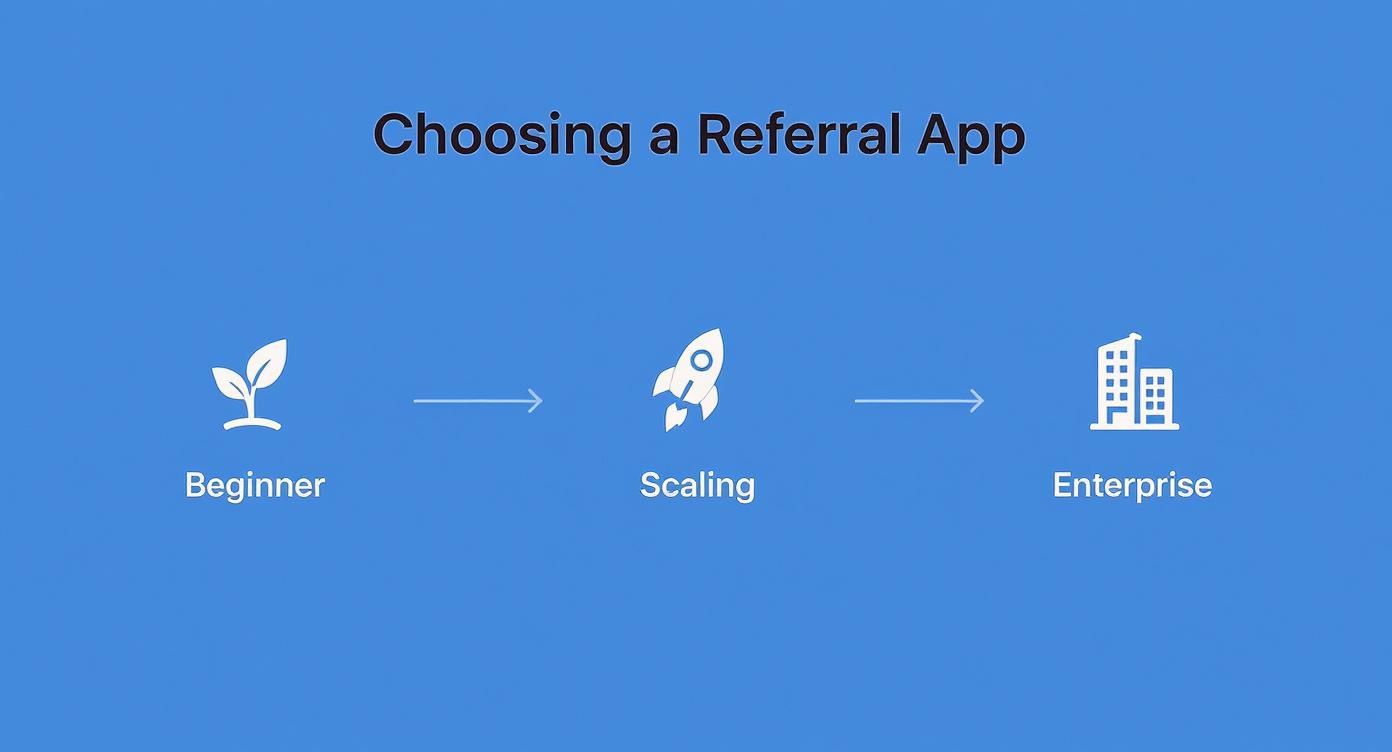
This visual shows how you can move from a simple, out-of-the-box solution to a deeply integrated, sophisticated system as your needs change.
Crafting Compelling Launch Communications
The words you use will turn a happy customer into an active advocate. Your messaging needs to be persuasive, clear, and sound like it came from a human, not a robot. This holds true for every email, social post, and on-site prompt.
When you draft that big launch email, go for a subject line that screams value, like "Give $15, Get $15 When You Share [Your Brand]." Keep the email body short and sweet. Hit them with the two-sided benefit, a big, obvious call-to-action (CTA) button linking to the referral page, and maybe even a personal note from the founder to make it feel special. If you're looking for a starting point, these referral email templates can be a huge help.
Another fantastic tactic is to use pre-populated sharing messages. Most apps let you write the default text that appears when someone clicks to share on social media or via email.
Pro Tip: Write your pre-populated message like a real person talking to a friend. "I'm loving the products from [Your Brand] and thought you would too! Here's $15 off your first order to try them out" is infinitely better than a stuffy, corporate-sounding pitch.
Executing a Multi-Channel Launch Blitz
On launch day, you have to make some noise. Tucking a link in your website footer and hoping for the best is a recipe for a quiet launch. You need a coordinated promotional push across a few key channels to get that initial wave of sign-ups.
Here's a simple game plan for a powerful launch:
- The Big Email Blast: Send a dedicated email to your entire list announcing the program. Make the rewards and the sharing link impossible to miss.
- Prime Website Real Estate: For the first week, stick an eye-catching banner on your homepage. This guarantees every visitor sees it.
- The Post-Purchase Nudge: This is your golden opportunity. Hit new buyers with a pop-up or a clear message on the order confirmation page. Their excitement is at its peak, making it the perfect time to ask for a referral.
- Social Media Shout-Out: Announce the program on all your active channels (Instagram, Facebook, etc.). Use strong visuals or even a short video to explain how it works and what's in it for them.
By planning your setup, copy, and promotion around the customer's point of view, you'll create a launch that feels like an exciting new perk, not a marketing campaign. This early momentum is what sets the stage for a successful Shopify referral program that grows with you.
Measuring Success and Optimizing Performance
https://www.youtube.com/embed/OoJe4Ao34y4
Getting your Shopify referral program live is a huge step—congratulations. But the real work is just beginning. A launch is a starting line, not a finish line. The most successful referral programs I've ever seen are the ones that are constantly evolving. Now, your focus shifts from building to optimizing, turning this new channel into a predictable growth engine for your store.
Think of your referral program as a living, breathing marketing campaign, not just a static feature you set and forget. It needs your attention. You have to get into the weeds, look at the numbers, and figure out what’s actually working—and more importantly, what isn’t.
Defining Your Key Performance Indicators
Before you can improve anything, you have to know what you're measuring. Your referral app’s dashboard is probably overflowing with data, but you can get a clear picture of your program's health by focusing on a few core metrics. These are your vital signs.
Your primary KPIs should be:
- Referral Rate: What percentage of your total orders are coming directly from referrals? This is the ultimate high-level indicator of your program's impact.
- Share Rate: How many of your customers are actually sharing their referral links? A low share rate is often the first red flag, pointing to problems with awareness or motivation.
- Referral Conversion Rate: Of the people who click a referral link, how many actually complete a purchase? This tells you how compelling your offer is to new customers.
- Customer Lifetime Value (LTV) of Referred Customers: This is the big one. Are the customers you get through referrals more valuable over time? Comparing their LTV to customers from other channels is how you prove the long-term ROI.
Don't just launch your program and hope for the best. Consistent tracking is what separates a program that fizzles out from one that becomes a core part of your growth strategy. Data gives you the power to make smart, informed decisions instead of just guessing.
Knowing some industry benchmarks helps put your numbers in context. A solid, healthy program usually sees 2% to 5% of total orders coming from referrals. The global average referral rate hovers around 2.35%, and the median conversion rate for e-commerce brands is typically between 3% and 5%. The truly killer programs can push that conversion rate to 8% or even higher.
Actionable Optimization Tactics
Once you've got a handle on your numbers, you can start making targeted improvements. Optimization is really just a game of "what if?" followed by testing your ideas. Don't be afraid to experiment here; I've seen small tweaks lead to huge gains. You can get more details on setting up a solid system for referral program tracking to make this process easier.
Here are a few high-impact tactics I always recommend trying:
- A/B Test Your Reward Structure: This is one of the most powerful levers you have. Is a $20 discount more motivating than a 20% off coupon? Set up a test and let your customers tell you what works. The results often surprise you.
- Run Limited-Time Campaigns: Create a little urgency by boosting your rewards for a short period. A "Double Rewards Weekend" can be a fantastic way to re-engage advocates who might have forgotten about the program. Just be sure to promote it heavily through email and your social channels.
- Optimize Your Messaging: Test different headlines on your referral landing page. Try out different email subject lines. Even a simple copy change, like focusing on the friend's benefit ("Give your friends $25 off!") instead of the advocate's, can completely change your performance.
To really understand the impact and get the most out of your Shopify referral program, it's crucial to diligently measure the overall marketing ROI and connect the dots between referrals and real financial gains. Every tweak you make should be aimed at improving those key metrics. By continuously measuring and optimizing, you'll transform your referral program from a simple tactic into a powerful, scalable customer acquisition machine.
Common Questions About Shopify Referrals
Even the most well-thought-out plan can hit a few snags. When you're setting up a referral program on Shopify for the first time, it's natural for questions to pop up. Getting these details right is often what separates a program that sputters out from one that becomes a genuine growth engine for your store.
Let's walk through some of the most common hurdles I see merchants face and get you some clear, practical answers.
How Much Should I Offer as a Referral Reward?
This is the big one, and while there isn't a single magic number, there’s a solid rule of thumb to get you in the right ballpark. A great starting point is to offer a reward that’s about 10-20% of your average order value (AOV). So, if your typical cart is around $100, a $15 reward for both the advocate and their friend feels genuinely motivating.
You also need to think about your customer lifetime value (LTV). We know from experience that referred customers almost always have a higher LTV, which can easily justify a more generous reward upfront. I always recommend a two-sided incentive (like "Give $15, Get $15") because it reframes the action. The advocate feels like they're giving a gift to their friend, not just trying to earn a kickback. This simple psychological shift makes a huge difference in sharing rates.
Don't just set it and forget it. What works for one brand might not land with yours. Test a fixed dollar amount against a percentage-based discount and see what your customers actually respond to.
How Do I Prevent Referral Fraud?
Fraud is a real concern, but it's totally manageable with the right setup. The most common scheme is self-referral, where a customer just uses a different email to refer themselves and double-dip on discounts. It sounds minor, but it can quietly eat away at your margins.
Thankfully, most modern referral apps have built-in protections. When you're picking a tool, make sure it has these features:
- IP Address Tracking: Flags referrals coming from the same internet connection—a dead giveaway for self-referrals.
- Cookie Monitoring: Uses browser cookies to see if the advocate and the new customer are using the same device.
- Manual Review Triggers: Lets you set rules to automatically flag suspicious activity, like one person suddenly referring dozens of "friends," so you can review it before any rewards go out.
You can also build some smart, simple rules into your program. For instance, make it a firm rule that the referred friend must be a new customer who has never bought from you before. Another effective tactic is adding a payout delay on rewards, making sure they aren't issued until the order is fulfilled and past the return window.
When Is the Best Time to Ask for a Referral?
Timing is everything. You have to ask when your customer's happiness and excitement are at their peak. These "moments of delight" are golden opportunities to turn a satisfied buyer into a vocal brand advocate.
The best time to prompt a referral is right after a positive moment with your brand. Think about triggering the ask at these key points:
- On the Order Confirmation Page: They just made a purchase and are feeling good about their decision.
- In the Shipping Confirmation Email: Anticipation is building as they wait for their package.
- A Few Days After the Product Arrives: Give them just enough time to unbox, use, and fall in love with what they bought.
- Immediately After Leaving a 5-Star Review: This is the perfect moment. They've literally just told you how happy they are, so asking them to share the love feels like a natural next step.
Whatever you do, don't ask too early. A pop-up asking for a referral before they've even received their order is just going to feel pushy and will likely be ignored.
Can a Referral Program Work for a New Store?
Absolutely. In fact, for a new Shopify store, a referral program can be one of the most powerful and cost-effective ways to grow. You might not have a huge customer base to start with, but that’s okay. A referral program empowers your very first customers to become your most passionate marketers.
For a new store, the game is all about delivering an unforgettable product and customer experience. When you nail that for your first handful of buyers, the program gives them a simple, rewarding way to tell everyone they know. It's a fantastic way to build early momentum and get that crucial social proof when you don't have a big marketing budget to play with.
Ready to turn your happy customers into your most powerful growth engine? Toki makes it easy to launch a fully customized referral program on Shopify, complete with loyalty points, VIP tiers, and fraud protection. Start building a community of brand advocates today. Get started with Toki