10 Powerful Segmenting Customers Examples to Boost Loyalty in 2025
Discover 10 powerful segmenting customers examples and learn how to apply them to your e-commerce loyalty strategy. Boost retention and CLV today.
In the crowded e-commerce landscape, treating all your customers the same is a recipe for failure. The one-size-fits-all approach leads to low engagement, wasted ad spend, and missed revenue opportunities. The solution is smart customer segmentation. By dividing your audience into distinct groups based on shared characteristics, you can deliver hyper-relevant messages, personalized offers, and loyalty rewards that truly resonate. This deep dive explores 10 powerful segmenting customers examples, moving beyond basic theory to provide actionable strategies you can implement immediately.
This isn't just about theory; it's a practical playbook. We’ll break down how each segmentation model works, why it matters for e-commerce and loyalty, and how a platform like Toki can help you turn these insights into automated, revenue-driving campaigns. To truly unlock growth and move beyond generic outreach, understanding methods like how to segment email lists effectively is crucial for personalized communication. The goal is to equip you with the tools to speak directly to individual customer needs, transforming your marketing from a broadcast into a meaningful conversation.
Get ready to transform your customer relationships from transactional to personal. This list will show you how to identify your most valuable shoppers, re-engage at-risk customers, and reward your most loyal advocates. By the end, you will have a clear roadmap for creating brand champions who not only buy more but also stay with your brand longer.
1. Demographic Segmentation: The Foundational Layer of Personalization
Demographic segmentation involves grouping customers based on quantifiable personal characteristics like age, gender, income, and location. While it’s one of the oldest methods, it remains a crucial starting point for understanding your audience. For e-commerce brands, it helps tailor product recommendations, marketing imagery, and messaging to specific life stages and purchasing power. Think of it as the 'who' in your customer base, providing the essential context needed for more advanced segmenting customers examples.
Why It Matters
This foundational approach prevents major marketing mismatches. By understanding basic demographics, you can avoid promoting high-end luxury items to students or retirement products to Gen Z, ensuring your budget is spent efficiently and your messaging resonates.
Use Case: Gender-Based Welcome Series for an Apparel Brand
An online apparel store uses gender data collected at sign-up to create two distinct welcome email flows. The male-focused series highlights durable fabrics and new arrivals in menswear, while the female-focused series showcases best-selling dresses and seasonal accessories.
Strategic Insight: This simple segmentation immediately increases relevance. The brand saw a 25% higher click-through rate in its segmented welcome emails compared to its previous generic version. The key was aligning imagery, product links, and even the email subject line with the primary interests of each demographic group.
Actionable Takeaway & Toki Implementation
Actionable Takeaway: Use the demographic data you collect during account creation or through optional surveys to personalize initial customer interactions. This builds an immediate sense of relevance and understanding from the very first touchpoint.
Toki Implementation Tip:
- Targeted Rewards: Create specific reward campaigns in Toki, such as "20% off all menswear" and target the campaign only to your 'male' segment.
- Points Campaigns: Offer bonus points for customers who complete their profile by adding demographic information like their birthday, which can then be used for age-based segmentation.
2. Psychographic Segmentation: Understanding the 'Why' Behind the Buy
Psychographic segmentation moves beyond the 'who' of demographics to uncover the 'why' behind customer actions. This method groups customers based on their lifestyle, values, interests, and personality traits. For e-commerce brands, understanding these intrinsic motivators is the key to building a brand that customers don't just buy from, but truly connect with, making it one of the most powerful segmenting customers examples.
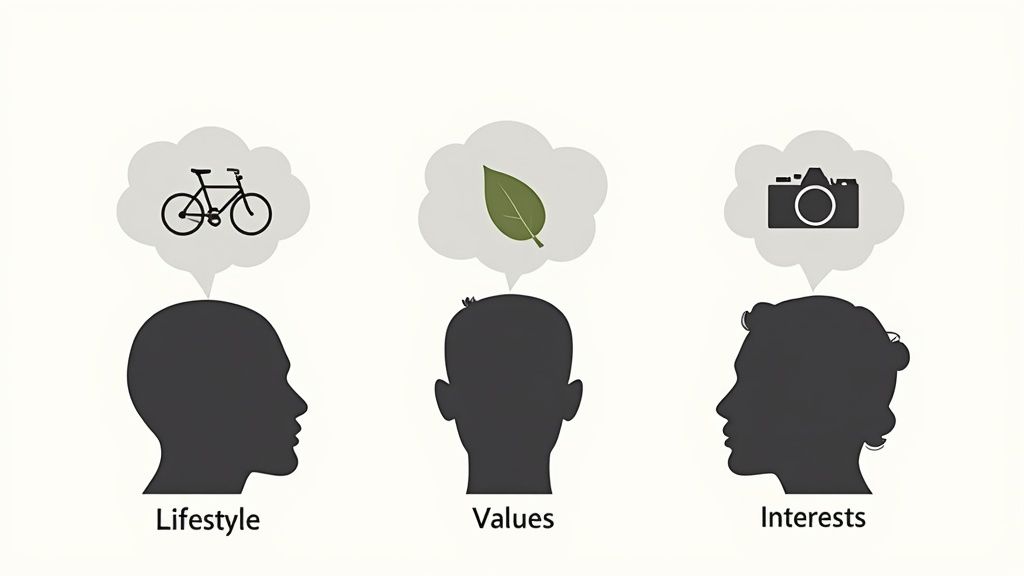
Why It Matters
Psychographics allow you to align your brand’s core message with your customers' deepest beliefs and aspirations. This creates powerful emotional connections that foster loyalty far more effectively than transactional benefits alone. When you market to a value system, like sustainability or adventure, you attract customers who are more likely to become brand advocates.
Use Case: Lifestyle-Based Content for a Health & Wellness Brand
A health and wellness brand uses a post-purchase survey to ask customers about their primary wellness goals: are they focused on "high-intensity training," "mindful relaxation," or "holistic nutrition"? Based on these responses, the brand segments its content marketing. The "high-intensity" group receives workout tips and performance product ads, while the "mindful relaxation" segment gets articles on meditation and is shown calming teas.
Strategic Insight: By tailoring content to the customer's self-identified lifestyle, the brand validates their choices and becomes a trusted resource, not just a seller. This approach led to a 40% increase in email engagement and a 15% lift in repeat purchases from segmented customers who felt the brand truly understood their personal wellness journey.
Actionable Takeaway & Toki Implementation
Actionable Takeaway: Use quizzes, surveys, and on-site polls to gather psychographic data directly from your audience. This zero-party data is invaluable for creating messaging that resonates with specific values and lifestyles, making customers feel seen and understood.
Toki Implementation Tip:
- Targeted Rewards: Create a reward for "15% off sustainable products" and use Toki's segmentation engine to target it exclusively to your 'eco-conscious' customer segment.
- Points Campaigns: Run a campaign offering bonus loyalty points for customers who complete a "What's Your Wellness Style?" quiz, allowing you to automatically tag and segment them based on their answers.
3. Behavioral Segmentation: Aligning with Customer Actions
Behavioral segmentation groups customers based on their direct actions and interactions with your brand. This includes purchase history, product usage rates, website browsing patterns, and engagement with marketing campaigns. Unlike demographics, which explain who your customers are, behavioral data reveals how they act, making it one of the most powerful segmenting customers examples for predicting future intent and driving retention.
Why It Matters
This approach moves beyond assumptions and relies on concrete data. By understanding customer actions, you can identify your most loyal advocates, spot customers at risk of churning, and tailor promotions to specific buying habits. It allows for highly relevant, timely marketing that feels less like an advertisement and more like a helpful suggestion. You can learn more about this powerful method in our deep dive on what behavioral segmentation is.
Use Case: Re-Engagement Campaign for "At-Risk" Customers
A subscription box service uses RFM (Recency, Frequency, Monetary) analysis to identify a segment of customers who haven't made a purchase in 90 days but were previously frequent buyers. This "at-risk" segment receives a targeted email campaign with an exclusive "We Miss You" offer for 25% off their next box, coupled with a sneak peek of upcoming products to reignite interest.
Strategic Insight: This proactive re-engagement is far more cost-effective than acquiring a new customer. The brand saw a 15% reactivation rate from this single campaign, preventing significant churn by addressing the behavioral cue (a lapse in purchasing) with a direct, value-driven incentive.
Actionable Takeaway & Toki Implementation
Actionable Takeaway: Use purchase data to create dynamic segments based on recency and frequency. This allows you to automate campaigns that either reward your best customers for their loyalty or strategically re-engage those who are drifting away before they are lost for good.
Toki Implementation Tip:
- Automated Segment Triggers: In Toki, create a segment for customers with a 'last purchase date' older than 90 days.
- Targeted Wallet Pass Offer: Automate a push notification to this segment's digital wallet pass with a unique discount code, creating an immediate and hard-to-miss call to action.
4. Geographic Segmentation: Connecting with Customers Where They Live
Geographic segmentation divides customers based on their physical location, such as country, city, climate, or whether they live in an urban or rural area. This approach acknowledges that a customer's needs, preferences, and purchasing habits are often shaped by where they are. For e-commerce brands, it's essential for localizing marketing, adjusting shipping offers, and tailoring product selections to regional climates and cultures. This is the 'where' in your customer data, a critical piece of context in segmenting customers examples.
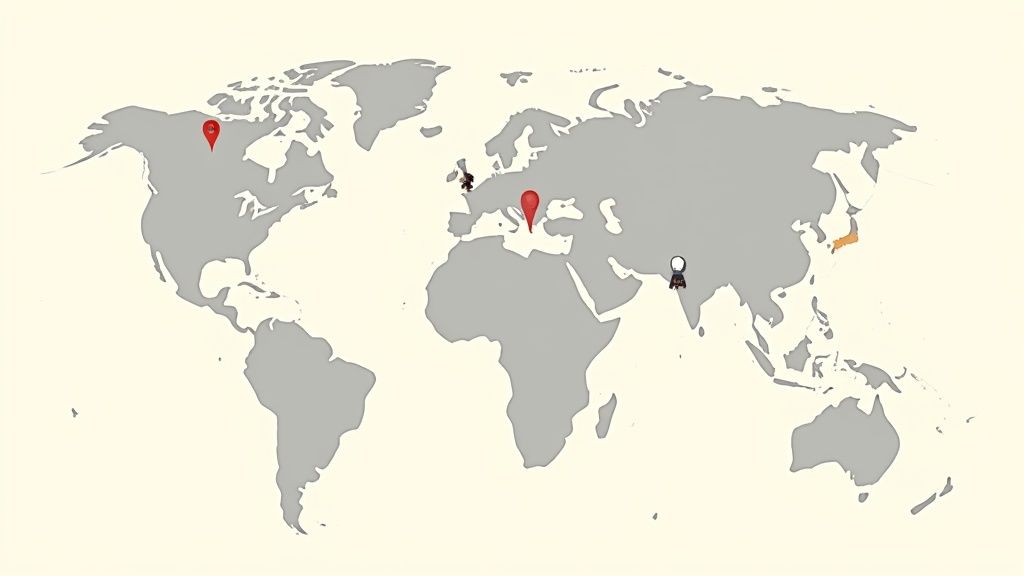
Why It Matters
This segmentation method is key to avoiding logistical headaches and cultural missteps. It ensures you don't promote winter coats to customers in tropical climates or offer next-day shipping in regions where it's not feasible. By localizing your approach, you can create a more relevant and seamless experience that acknowledges the customer's real-world environment, improving conversion rates and operational efficiency.
Use Case: Climate-Based Promotions for an Outdoor Gear Retailer
An outdoor and sporting goods company uses customer shipping addresses to segment its audience by climate zone. In the fall, customers in colder northern regions receive targeted campaigns for insulated jackets and snow gear. At the same time, customers in warmer southern regions see promotions for lightweight hiking apparel and hydration packs.
Strategic Insight: By aligning promotions with local weather patterns, the brand makes its marketing feel timely and incredibly useful. This strategy led to a 40% increase in seasonal category sales and a significant reduction in cart abandonment for weather-inappropriate items. The key was moving beyond a one-size-fits-all seasonal calendar to a dynamic, location-aware marketing engine.
Actionable Takeaway & Toki Implementation
Actionable Takeaway: Use location data from shipping details or IP addresses to tailor marketing messages and product recommendations. Simple adjustments for seasons, local holidays, or regional shipping offers can make your brand feel more local and considerate.
Toki Implementation Tip:
- Targeted Rewards: Create a "Free Shipping for California" or "25% Off Winter Wear for New York" reward in Toki. Use customer location data to create segments and make these rewards visible only to the relevant audience.
- Wallet Passes: Use Toki’s wallet pass feature to send push notifications about in-store events or promotions to customers located near a physical retail outlet, bridging the online-offline gap.
5. Firmographic Segmentation: The B2B Targeting Blueprint
Firmographic segmentation is the B2B equivalent of demographics, grouping business customers based on company attributes like industry, company size, annual revenue, and location. This method is essential for businesses selling to other companies, as it allows them to tailor solutions, pricing, and outreach to the specific needs and operational scales of their clients. It moves beyond individual buyers to understand the entire organizational context, providing a macro view for effective B2B marketing.
Why It Matters
In the B2B world, a one-size-fits-all approach is a recipe for failure. Firmographics ensure that a SaaS provider doesn't pitch an enterprise-level solution to a five-person startup or offer small-business pricing to a Fortune 500 company. This precise targeting maximizes sales efficiency and helps build account-based marketing (ABM) strategies that treat each business account as a market of one.
Use Case: Tiered Onboarding for a SaaS Platform
A B2B SaaS company that provides project management software uses firmographic data to segment new sign-ups by company size. "Startup" clients (under 50 employees) are funneled into an automated, self-service onboarding flow. "Enterprise" clients (over 1,000 employees) are immediately assigned a dedicated account manager who provides a personalized demo and implementation plan.
Strategic Insight: This segmentation drastically improved user activation and reduced churn. The company saw a 40% increase in feature adoption among enterprise clients who received high-touch support, while simultaneously reducing support costs for smaller clients who preferred a self-guided experience. The key was matching the onboarding investment to the customer's potential lifetime value.
Actionable Takeaway & Toki Implementation
Actionable Takeaway: Use data from sign-up forms (e.g., asking for company size) or data enrichment tools like ZoomInfo or Apollo to create distinct customer journeys. This allows you to allocate high-value resources to high-value accounts while efficiently serving smaller clients at scale.
Toki Implementation Tip:
- Tiered Memberships: Create B2B membership tiers in Toki, such as "Business," "Pro," and "Enterprise." Use firmographic data to automatically assign companies to the appropriate tier, each with its own set of perks like wholesale pricing, dedicated support access, or early access to new features.
- Targeted Rewards: Offer a reward like "Free Implementation Consulting" and target it exclusively to your 'Enterprise' segment to incentivize high-value conversions.
6. Technographic Segmentation: Speaking Your Customer’s Tech Language
Technographic segmentation groups customers based on the technology they use, from their preferred devices and software to their overall digital savviness. For e-commerce brands, especially those selling software, electronics, or digital services, this approach is critical. It helps tailor marketing, product features, and support to the specific tech stacks and comfort levels of different users, making it a powerful tool in a growing list of segmenting customers examples.
Why It Matters
Understanding a customer's technology profile prevents friction and builds confidence. You can avoid marketing a complex API integration to a non-technical small business owner or promoting a desktop-only software to a mobile-first user. This ensures your solutions are presented as a perfect fit for their existing technological ecosystem.
Use Case: Onboarding Flow for a SaaS Productivity Tool
A SaaS company offering a project management tool uses technographic data to segment new sign-ups. By detecting whether a user signed up via a corporate email server (like Microsoft Exchange) versus a personal one (like Gmail), and analyzing their browser type, it customizes the onboarding experience. Corporate users are shown integrations for Slack and Microsoft Teams first, while individual users are shown integrations for Google Calendar and Trello.
Strategic Insight: This tech-based segmentation significantly reduced user drop-off during the critical first week. The company saw a 30% increase in feature adoption within the first 7 days by immediately showcasing relevant integrations instead of overwhelming users with a full list of options. The key was to make the tool feel instantly native to the customer's existing workflow.
Actionable Takeaway & Toki Implementation
Actionable Takeaway: Use surveys or data from initial interactions (like device type used for sign-up) to understand your customers' tech environments. Use this insight to personalize onboarding, highlight relevant product features, and provide targeted technical support content.
Toki Implementation Tip:
- Segmented Educational Content: Create a 'Power User' customer segment in Toki for users identified as technologically advanced. Target this segment with exclusive access to beta features or bonus points for completing tutorials on advanced functionalities.
- Targeted Rewards: If you sell accessories, you can create a reward like "15% off all iPhone 15 cases" and target it specifically to customers who have visited your site or made purchases using an iPhone 15 device.
7. Value-Based Segmentation: Prioritizing Your Most Important Customers
Value-based segmentation categorizes customers based on their economic worth to your business, primarily using metrics like Customer Lifetime Value (CLV), average order value, and purchase frequency. This strategic approach shifts the focus from treating all customers equally to investing more resources in those who drive the most profit. It’s a core principle behind many of the most successful segmenting customers examples, allowing brands to identify and nurture their VIPs.
Why It Matters
Not all customers contribute equally to your bottom line. By identifying your high-value segments, you can allocate marketing spend, customer service resources, and exclusive perks more effectively. This ensures your most profitable customers feel appreciated, which is crucial for long-term retention and preventing them from churning. It’s about working smarter, not harder, to maximize revenue.
Use Case: VIP Tiers for a Beauty Subscription Box
A popular beauty subscription service segments its customers into three value-based tiers: Bronze (1-3 boxes purchased), Silver (4-11 boxes), and Gold (12+ boxes). Gold members, representing the top 15% of customers by CLV, receive exclusive benefits like early access to new products, a dedicated customer support line, and a complimentary full-sized product in every third box.
Strategic Insight: This tiered system creates a powerful incentive for customers to remain loyal. The brand found that once a customer reached the Gold tier, their churn rate dropped by 60%. The key was making the rewards feel truly exclusive and valuable, directly rewarding the behavior (long-term commitment) the company wanted to encourage. For a deeper dive, explore these strategies for improving customer lifetime value.
Actionable Takeaway & Toki Implementation
Actionable Takeaway: Calculate the CLV for your customer base and create distinct tiers. Design exclusive benefits that are genuinely desirable to your high-value segment to foster loyalty and create a clear path for lower-tier customers to ascend.
Toki Implementation Tip:
- Tiered Memberships: Use Toki's tier system to automatically segment customers based on their spend or points accumulated. You can create 'Gold', 'Silver', and 'Bronze' tiers with unique earning rules and rewards for each.
- Targeted Rewards: Create high-value rewards, like "Free Express Shipping for a Year," and restrict them so they are only visible and claimable by customers in your top 'Gold' tier.
8. Needs-Based Segmentation: Solving the Customer's Core Problem
Needs-based segmentation shifts the focus from who the customer is to what they are trying to accomplish. This method groups customers based on their specific goals, pain points, and the "job" they are hiring your product to do. For e-commerce brands, it means understanding the distinct problems customers face, allowing for hyper-relevant product positioning and solution-oriented marketing. This is one of the most powerful segmenting customers examples for building true product-market fit.
Why It Matters
This approach goes deeper than demographics or behavior to uncover the fundamental motivations driving a purchase. By understanding and addressing a specific need, you can position your brand as an indispensable solution rather than just another option, fostering intense loyalty and reducing price sensitivity.
Use Case: Feature-Based Onboarding for a Productivity App
A productivity software company segments new users based on their answer to one crucial onboarding question: "What is your main goal with our tool?" Options might include "Managing team projects," "Organizing personal tasks," or "Tracking client work." Each answer triggers a tailored onboarding flow that highlights the most relevant features for that specific need.
Strategic Insight: Instead of a generic tour, users immediately see how the tool solves their primary problem. This needs-first approach led to a 40% increase in feature adoption within the first week and a significant drop in early-stage churn. The key was connecting user intent directly to product value from the very first interaction.
Actionable Takeaway & Toki Implementation
Actionable Takeaway: Use quizzes, onboarding surveys, or even purchase history data to infer customer needs. Map your products or services as solutions to these needs and create marketing content, educational guides, and product recommendations that speak directly to solving those specific pain points.
Toki Implementation Tip:
- Tiered Memberships: Create paid membership tiers in Toki that align with specific needs. A "Pro" tier could offer advanced features for business users, while a "Basic" tier caters to individual hobbyists, ensuring each segment only pays for the value they require.
- Targeted Rewards: If a customer frequently buys products related to a specific need (e.g., "sensitive skin" in a beauty store), use Toki to send them targeted rewards for new products that solve the same problem.
9. Channel/Distribution Segmentation: Unifying the Customer Journey
Channel/distribution segmentation involves grouping customers based on where and how they interact with your brand. This could be in-store, on your website, via a mobile app, or through a third-party marketplace. By understanding these preferences, you can create a seamless, unified experience that meets customers where they are, a crucial factor in building a robust omnichannel strategy and another powerful tool in your toolkit of segmenting customers examples.
Why It Matters
In today's retail landscape, the customer journey is rarely linear. A customer might discover a product on Instagram, research it on your website, and purchase it in-store. Failing to connect these touchpoints creates a disjointed experience. Channel segmentation ensures consistency in messaging, pricing, and service, which builds trust and reduces friction for the buyer.
Use Case: Omnichannel Loyalty for a Cosmetics Brand
A cosmetics brand with both a strong e-commerce presence and physical retail stores noticed a segment of customers who browsed online but only purchased in-store ("webroomers"). To bridge this gap, they created a unified loyalty program where points could be earned and redeemed seamlessly across all channels. Online shoppers could add items to a "store wishlist" in their app, which a store associate could then access to provide a personalized in-person experience.
Strategic Insight: By unifying the experience, the brand removed the barrier between online and offline shopping. This strategy led to a 30% increase in in-store purchase value from customers who had previously interacted with the brand online. The key was making the transition between channels feel like a single, continuous conversation.
Actionable Takeaway & Toki Implementation
Actionable Takeaway: Map your customer journey to identify the most common paths and channel preferences. Use this data to create a unified experience where loyalty, promotions, and customer history are accessible regardless of the touchpoint, turning disparate channels into one cohesive brand ecosystem.
Toki Implementation Tip:
- Wallet Passes: Use Toki's Wallet Passes to create a digital loyalty card that customers can use both online at checkout and in-store by having staff scan the pass. This unifies points collection across channels.
- Targeted Rewards: Create a reward campaign offering bonus points for a customer's first in-store purchase and target it specifically to your "online-only" segment to encourage channel crossover.
10. Attitudinal Segmentation: Capturing How Customers Feel
Attitudinal segmentation categorizes customers based on their feelings, opinions, satisfaction levels, and brand perceptions. It moves beyond what customers do to understand why they do it. This powerful approach helps e-commerce brands identify their biggest advocates, those who are on the fence, and those who are at risk of churning, making it one of the most insightful segmenting customers examples.
Why It Matters
Understanding attitude allows you to respond proactively to customer sentiment. You can nurture brand advocates to amplify their positive voice, re-engage neutral customers before they drift away, and intervene with at-risk customers to resolve their issues and prevent negative word-of-mouth. This turns customer feedback into a direct growth and retention strategy.
Use Case: NPS-Based Intervention for a Subscription Box Service
A monthly subscription box service uses Net Promoter Score (NPS) surveys to segment customers into Promoters (9-10), Passives (7-8), and Detractors (0-6). Detractors automatically trigger a high-priority customer service ticket and receive a personalized "We're Listening" email offering a 1-on-1 call with a customer success manager and a credit for their next box.
Strategic Insight: This proactive intervention directly addresses the source of dissatisfaction. The brand found that by immediately contacting Detractors, they could resolve over 40% of the issues raised, and a quarter of those customers subsequently upgraded their NPS score within 90 days. The key was separating feedback from action and systemizing the response.
Actionable Takeaway & Toki Implementation
Actionable Takeaway: Implement regular NPS or customer satisfaction (CSAT) surveys at key post-purchase milestones. Use the scores to trigger automated workflows that either celebrate positive feedback or provide immediate support for negative experiences, turning detractors into loyal customers.
Toki Implementation Tip:
- Targeted Rewards for Promoters: Create an exclusive reward in Toki, like "Free Premium Product Sample," and target it only to your 'Promoter' segment as a thank you for their loyalty and positive feedback.
- Points for Feedback: Set up a Toki points campaign that rewards all customers for completing an NPS survey, ensuring you get a steady stream of data to fuel your attitudinal segmentation efforts.
10 Customer Segmentation Types Comparison
| Segmentation Type | 🔄 Implementation Complexity | ⚡ Resource Requirements | ⭐ Expected Outcomes / Quality | 📊 Key Advantages / Impact | 💡 Ideal Use Cases |
|---|---|---|---|---|---|
| Demographic Segmentation | Low — straightforward grouping by age, gender, income | Low — census, surveys, CRM fields | Moderate — good for broad targeting | Broad reach, easy to implement, correlates with purchasing power | Mass-market campaigns, media planning, basic personas |
| Psychographic Segmentation | High — qualitative research and modelling required | High — surveys, focus groups, social analysis | High — deep motivational insights and stronger engagement | Drives emotional connection and personalized messaging | Brand positioning, lifestyle products, premium brands |
| Behavioral Segmentation | Medium — needs tracking and analytics pipelines | Medium–High — transaction logs, event tracking, analytics | High — predictive and revenue-linked | Enables personalization, churn prediction, revenue optimization | E‑commerce, SaaS, recommendation engines, retention programs |
| Geographic Segmentation | Low — map-based grouping by location or climate | Low — geolocation data, market reports | Moderate — improves local relevance | Localized campaigns, logistics planning, regulatory alignment | Retail rollouts, regional promotions, localized content |
| Firmographic Segmentation | Medium — B2B data enrichment and account mapping | Medium — business databases, CRM integration | High (B2B) — targets accounts with highest potential | Supports ABM, prioritizes sales effort, industry-specific messaging | Enterprise software, B2B sales, vertical marketing |
| Technographic Segmentation | Medium–High — requires technical assessment | High — tech scans, integrations, expert analysis | High (tech fit) — identifies receptive audiences for tech solutions | Improves product-market fit, targets early adopters | SaaS, cybersecurity, integration services, digital transformation |
| Value-Based Segmentation (CLV) | High — modeling and lifetime calculations needed | High — historical data, analytics, finance inputs | High — aligns actions with profitability (ROI-focused) | Optimizes resource allocation, retention of high-value customers | Loyalty programs, subscription businesses, revenue optimization |
| Needs-Based Segmentation | High — deep qualitative customer research | High — interviews, surveys, product usage analysis | High — strong product-market fit and relevance | Focuses product development, improves messaging relevance | Product strategy, solution selling, feature prioritization |
| Channel / Distribution Segmentation | Medium — requires cross-channel coordination | Medium — platform integrations, tracking across channels | Moderate–High — improves experience and conversion | Enables omnichannel consistency, reduces friction | Retail omnichannel, banking channels, marketplace strategies |
| Attitudinal Segmentation | Medium — regular sentiment and survey measurement | Medium — NPS, CSAT tools, social listening | Moderate — informs reputation and loyalty programs | Identifies promoters/detractors, guides CX improvements | Customer experience initiatives, loyalty and win‑back campaigns |
From Theory to Action: Building Your Segmentation Strategy
Throughout this guide, we've dissected ten powerful segmenting customers examples, moving from foundational methods like demographic and geographic analysis to more sophisticated strategies such as value-based and attitudinal segmentation. The journey from data points to dynamic customer relationships is not about picking one perfect method; it's about the artful combination of several.
The most potent loyalty strategies emerge when you stop viewing customers as single-data-point entities. A customer isn't just their age (demographic) or their last purchase date (behavioral). They are a complex blend of motivations, habits, values, and potential. Your segmentation must reflect this complexity to be truly effective.
The Power of Layered Insights
The core takeaway is that a multi-dimensional approach yields the most profitable results. True customer understanding lies at the intersection of different data types. By layering various segmentation models, you transform flat data into a rich, three-dimensional view of your audience.
Consider the synergy between these layers:
- Behavioral + Psychographic: This combination is the cornerstone of personalization. You know what customers do (e.g., abandon carts with high-value items) and can infer why they do it (e.g., they are discerning, price-conscious shoppers). This insight allows you to target them not with a generic discount, but with an exclusive offer on a premium product or a 'buy now, pay later' option.
- Value-Based (CLV) + Behavioral: This pairing helps you strategically invest your resources. By identifying your high-CLV customers who are showing signs of lapsing (e.g., decreased purchase frequency), you can preemptively launch a high-touch retention campaign, like offering bonus points or a surprise upgrade to a higher membership tier, ensuring your most valuable assets remain loyal.
- Geographic + Needs-Based: This allows for hyper-relevant local marketing. A customer in a coastal, sunny region has different needs than one in a cold, landlocked area. Combining this geographic data with needs-based segments (e.g., "seeking sun protection" vs. "seeking warm outerwear") enables you to create targeted campaigns that resonate on a practical, personal level.
Your Actionable Segmentation Roadmap
Moving from understanding these segmenting customers examples to implementing them requires a clear, step-by-step plan. Don't try to boil the ocean. Start small, validate your approach, and scale what works.
- Start with Your Core Data: Begin by combining your most accessible and impactful data sets, typically behavioral (purchase history, site activity) and demographic (age, location). Use this foundation to identify 3-5 initial, high-level customer groups.
- Develop Richer Profiles: Enhance these basic segments by digging deeper. This is where you translate data into human stories. A fundamental component of translating segmentation theory into action involves learning how to create buyer personas that yield results, which thoroughly explores the demographic and behavioral data essential for understanding your ideal customer. This process will give your segments names, faces, and motivations.
- Activate with a Loyalty Platform: This is the critical step where theory becomes action. Use a flexible tool like Toki to build out your loyalty program based on these defined segments. Assign different customer groups to specific Membership Tiers, launch targeted Points Campaigns for at-risk segments, or create exclusive Targeted Rewards for your VIPs.
- Test, Measure, and Iterate: Your segments are not static. Customer behavior changes, and your strategy must adapt. Continuously monitor the performance of your segmented campaigns. Are your VIPs engaging more? Are you successfully reactivating dormant customers? Use these insights to refine your segments and offers over time.
Mastering customer segmentation is no longer a "nice-to-have" marketing tactic; it's a fundamental requirement for sustainable e-commerce growth. It is the engine that powers personalization, enhances customer lifetime value, and transforms one-time buyers into lifelong brand advocates. By implementing these strategies, you move beyond generic marketing blasts and begin building genuine, profitable relationships, one well-defined segment at a time.
Ready to turn your customer segments into automated, revenue-driving loyalty campaigns? With Toki, you can easily create tiered memberships, targeted rewards, and personalized point systems that bring your segmentation strategy to life. Stop guessing and start building relationships that last with Toki.