Unlocking Growth with POS Loyalty Programs
Discover how POS loyalty programs build lasting customer relationships and drive revenue. Learn proven strategies for implementation, measurement, and success.
A POS loyalty program is a rewards system that lives right inside your point-of-sale (POS) terminal. Instead of fumbling with a separate app or a paper punch card, customers can earn and cash in on rewards automatically as they pay. It’s a simple concept, but this direct integration is a total game-changer for any modern retail shop or restaurant.
How POS Loyalty Programs Turn Transactions into Relationships
Think of every sale as a quick conversation. A normal transaction is just a passing "hello." But a transaction flowing through a POS loyalty program? That’s the start of a real dialogue. These systems turn your checkout counter from a simple payment spot into a hub for building genuine customer connections.
The magic of POS loyalty programs is their native integration. Because the program operates within the same system that handles payments, it removes almost all the friction for both your customers and your team. No more juggling different apps, scanning stubborn QR codes, or trying to manually track purchases. A customer just gives their name or phone number, and the system handles the rest.
The Power of Seamless Integration
This built-in design is what makes these programs so much better than older, clunkier methods. For the customer, joining and participating feels like a natural part of their shopping routine. For your business, it funnels valuable data into one unified stream.
Here's what that deep integration looks like in practice:
- Effortless Enrollment: Staff can sign up new members in a few seconds, right at the register. This makes a huge difference in how many people actually join.
- Automated Rewards: Points are tallied and rewards are applied on the spot, which means fewer mistakes and faster checkout lines.
- Unified Customer Profiles: Every purchase—whether it happens online or in your store—adds to a single customer profile, paving the way for real personalization.
- Instant Gratification: Customers can see their points balance update immediately on their receipt or a screen, which instantly reinforces the value of their loyalty.
This kind of smooth experience is exactly why modern shoppers not only expect but actively look for these programs. And the numbers back it up. Around 90% of consumers worldwide are part of at least one loyalty program, and a massive 84% say they’re more likely to shop with brands that offer one. Better yet, program members tend to spend 12% to 18% more than non-members, proving the direct hit to your bottom line.
POS Integrated vs Standalone Loyalty Programs
Choosing between a system that's built into your POS and one that runs separately is a critical decision. The table below breaks down the key differences in how they impact your customers and your daily operations.
| Feature | POS-Integrated Loyalty Program | Standalone Loyalty Program |
|---|---|---|
| Customer Experience | Effortless—just an email or phone number needed at checkout. | Often requires a separate app, card, or manual lookup by staff. |
| Staff Workflow | Seamless. Rewards and points are handled automatically in one system. | Adds extra steps and training; staff must manage two separate systems. |
| Data Accuracy | High. Transaction data is captured directly and without error. | Prone to manual errors, missed transactions, and syncing issues. |
| Enrollment Rate | Higher, as signup is quick and happens organically at the counter. | Lower, as customers face more friction to join (e.g., downloading an app). |
| Omnichannel Ability | Excellent. Easily links online and in-store profiles for one account. | Difficult to sync. Often results in separate profiles and a disjointed feel. |
As you can see, the integrated approach wins out by making the entire process invisible and automatic, which is what truly drives adoption and long-term engagement.
From Data Points to Customer Connections
At the end of the day, a POS loyalty program is much more than a marketing gimmick; it's an engine for sustainable growth. The data you gather at the point of sale tells you who your best customers are, what they love to buy, and how often they come back. This kind of insight lets you graduate from generic discounts to creating personalized offers that make your customers feel recognized and valued. To really cement those relationships, you can explore other proven strategies for retail customer engagement that work hand-in-hand with your program.
By tying rewards directly to transactions, you’re doing more than just encouraging another sale. You are methodically building a community of loyal advocates who feel a real connection to your brand—turning one-time buyers into lifelong fans.
Getting a handle on the fundamental benefits of a customer loyalty program is the first step toward putting this powerful tool to work for your business.
Designing a Loyalty Program Customers Actually Love
The best POS loyalty programs don't feel like a marketing gimmick; they feel like a genuine thank you. A simple points-per-dollar system is a decent starting point, but earning real customer devotion requires a much more thoughtful approach. You need to blend real value, smart personalization, and an experience that’s completely seamless. The goal is to build a program that people are actually excited to join.
This is about looking past the transaction. It's about building a system that recognizes and rewards your customers in ways that truly matter to them. When you get this right, your program becomes a natural part of your brand—something that feels both effortless and a little bit exclusive.
Building a Foundation with Compelling Rewards
Let's start with the basics: a loyalty program has to offer rewards people actually want. A classic mistake is creating rewards that are nearly impossible to earn or just aren't valuable enough to get someone to come back. The trick is to find that perfect balance between being generous and making good business sense.
Think of it like a game. If the grand prize isn't exciting, no one plays. And if the rules are too confusing, people just give up. Your reward structure needs to be crystal clear, compelling, and perfectly aligned with what your customers value most.
Here are a few popular structures that just plain work:
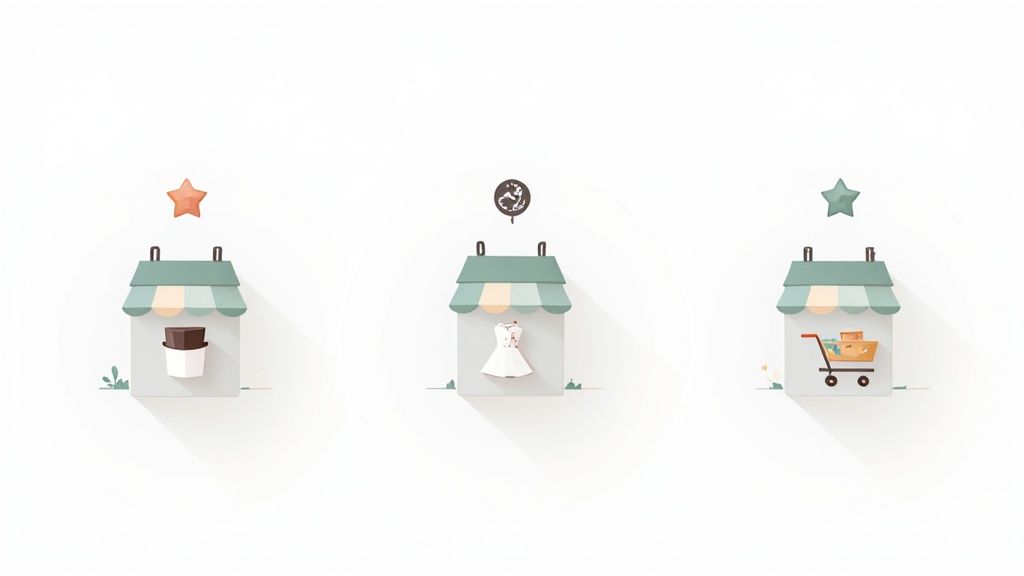
- Points-Based Programs: This is the old faithful. Customers earn points for every dollar they spend. It’s incredibly straightforward and works wonders for encouraging frequent, smaller purchases. A local coffee shop, for instance, might offer a free latte after someone racks up 100 points.
- Tiered Programs: These programs tap into our desire for status and exclusivity. As customers spend more, they unlock new levels (think Bronze, Silver, Gold), gaining access to better perks along the way. A fashion boutique could offer Silver members early access to sales and treat Gold members to a personal styling session.
- Cash-Back or Store Credit: This model offers immediate, tangible value by giving customers a cut of their purchase back as credit. It’s a home run for businesses where customers appreciate a direct financial kickback.
The most successful programs often blend these elements. A tiered system might offer a better point-earning rate at higher levels, giving customers both a long-term goal and immediate gratification with each purchase.
Creating a Unified Omnichannel Experience
In today’s retail environment, the line between shopping online and in-store has basically vanished. Customers expect—and deserve—a consistent experience no matter where they are, and that absolutely includes your loyalty program. An omnichannel approach isn't a "nice-to-have" anymore; it's table stakes.
This means that a customer who earns points buying a shirt on your website should be able to redeem them without a hitch at your physical checkout counter. Their profile, points balance, and available rewards have to be perfectly synced across every single channel. If they aren't, you create a clunky, frustrating experience that completely undermines the loyalty you're trying to build.
Adding Value with Modern Features
Once your core rewards are set, modern features can take your program from good to unforgettable. These are the additions that cut down on friction and add layers of convenience and fun, making the program itself feel like a perk.
Consider weaving in these high-impact features:
- Digital Wallet Integration: Let members add their loyalty card to their Apple or Google Wallet. This kills the need to carry a physical card or even remember a phone number. Redemption becomes as easy as tapping their phone.
- Referral Bonuses: Turn your happiest customers into your best marketers. Offering points or discounts when they refer a friend is a powerful, low-cost way to bring in new customers who are already primed to love your brand.
- Personalized Offers: Use the purchase data from your POS to send targeted rewards that feel special. If a customer frequently buys a certain type of coffee, a surprise "25% off" coupon for that exact blend makes them feel seen and valued.
Ultimately, designing a program that sticks requires a deep understanding of what motivates your customers. For more insights on this, exploring strategies for designing and launching community rewards and loyalty programs can offer some fantastic perspectives on building real engagement. By combining a compelling reward structure with a seamless omnichannel experience and modern conveniences, you can create a loyalty program that doesn't just retain customers—it turns them into genuine advocates for your brand.
Your Step-by-Step Implementation Playbook
Rolling out a POS loyalty program isn't as daunting as it might seem. Think of it less like a massive tech project and more like following a good recipe—get the steps right, and the result is fantastic. The key is to be methodical, starting with the big picture before diving into the nitty-gritty.
It all begins by asking a straightforward but essential question: what does a "win" look like for our business? Without knowing where you're going, you can't possibly draw a map to get there. Once you have that clarity, you can confidently design the program, nail the technical setup, and launch it to your customers.
Define Your Primary Business Goals
Before you even think about points, tiers, or special offers, you have to get crystal clear on your objectives. A loyalty program is a tool, and you need to know exactly what job you want it to do. Are you trying to encourage more frequent visits? Or are you focused on getting customers to spend a little more each time they stop by?
This single decision is the bedrock of your entire strategy. It will shape every choice you make, from the rewards you offer to the way you talk about the program.
Consider which of these common goals feels most urgent for your business right now:
- Increase Customer Visit Frequency: Perfect for coffee shops, bakeries, or quick-service spots where building a daily or weekly habit is everything.
- Boost Average Order Value (AOV): A smart goal for retail stores where getting a customer to add just one more item to their cart can make a huge difference.
- Drive Customer Acquisition: If growth is your top priority, a program with a killer referral bonus can turn your best customers into your most effective sales team.
- Gather Valuable Customer Data: A well-designed program gives you incredible insight into what your customers love, helping you make smarter, more personal marketing decisions down the road.
Choose the Right Reward Structure
Okay, you’ve figured out your "why." Now it's time for the "what." The reward structure is the engine of your loyalty program, so it has to be perfectly aligned with both your business goals and what your customers actually want. What works for a high-end clothing boutique probably won't fly at the local pizza joint.
For example, if you want to see customers more often, a simple "earn points per purchase" or a digital punch card model works wonders. These frequent, smaller rewards are great for encouraging repeat visits. But if your goal is to bump up AOV, a tiered program is a better bet—unlocking bigger and better perks at higher spending levels gives people a real incentive to spend more.
Pro Tip: Don't overthink it. The best loyalty programs are dead simple to understand and offer rewards people genuinely care about. Simplicity is your secret weapon for getting people to sign up and stay engaged.
Integrate With Your POS System
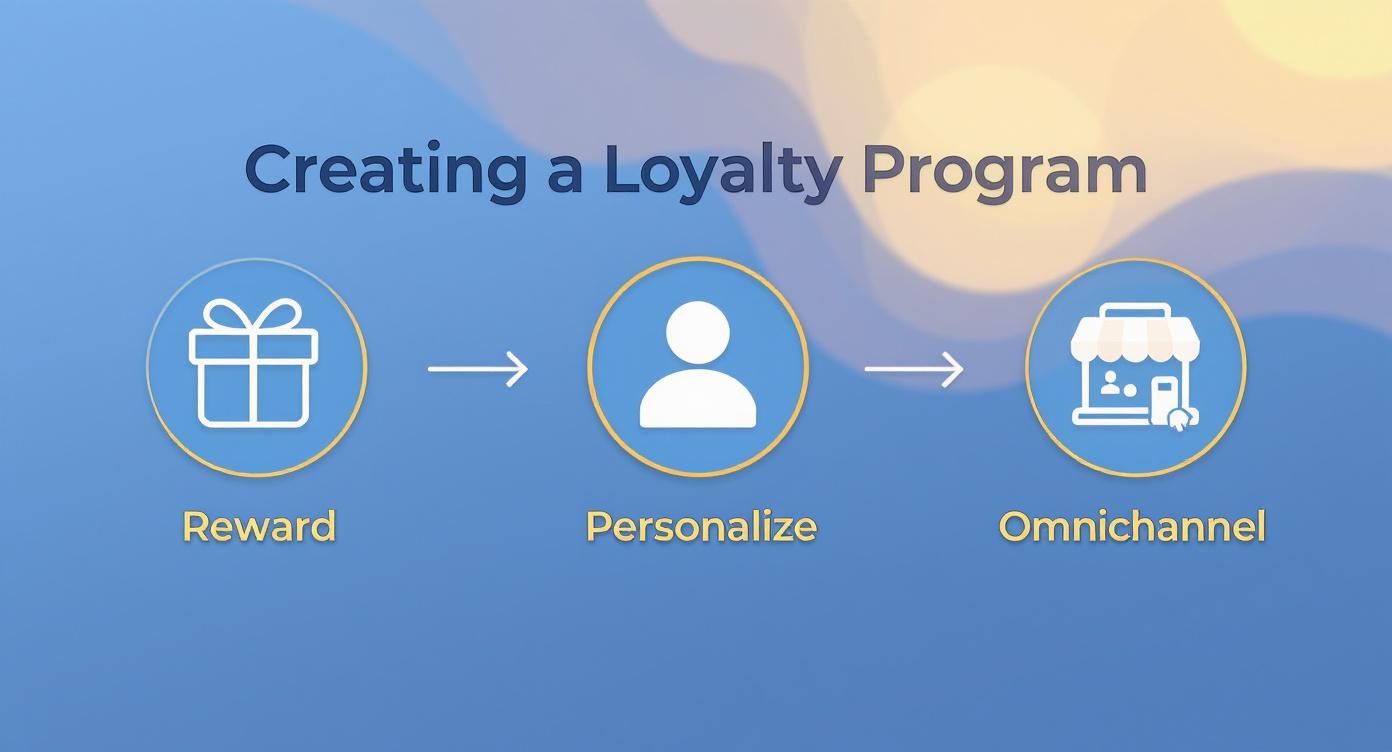
This is the part that puts the "POS" in POS loyalty programs. The technical integration is what connects your loyalty software to your checkout system, creating that smooth, effortless experience everyone expects. For retailers using modern systems like Shopify POS or Square, this is often as simple as installing an app.
Typically, the process involves adding the loyalty program's app or plugin to your POS and tweaking a few settings. This connection allows your system to automatically recognize members, track what they buy, and apply rewards without any clunky manual work from your staff. For a deeper dive, our guide on how to integrate a loyalty program with your POS system breaks down the steps for a painless setup.
This integration is what makes a truly modern loyalty experience possible—one that’s personal, rewarding, and consistent whether a customer is online or in your store.
Train Your Team and Launch Your Campaign
Never forget: your staff are the ambassadors for your loyalty program. They’re on the front lines every day, and their excitement (or confusion) will make or break your sign-up numbers. A solid training session is absolutely non-negotiable.
Make sure your team is ready to:
- Explain the benefits simply: They need a quick, compelling one-liner to explain why a customer should join.
- Make sign-up a breeze: The process should take just a few seconds, right at the point of sale. No friction.
- Answer common questions: Get them comfortable with the basics, like how points are earned and redeemed.
Finally, it's time to launch! Make some noise. Announce the new program in your email newsletter, post about it on social media, and use in-store signs to grab attention. A great way to kick things off is with a special launch offer, like bonus points for signing up or an instant discount. That initial buzz can build the momentum you need for lasting success.
Measuring What Matters for Program Success
Getting your loyalty program up and running is a huge milestone, but the real work has just begun. A well-designed program churns out a ton of data, but just having the data isn't the point. To really see what's working, you need to focus on the numbers that tell the story of your customer behavior and, ultimately, your bottom line.
Think of it like flying a plane. The pilot isn't looking at every single gauge and dial at once. They’re focused on the critical instruments—altitude, speed, heading—that tell them if they're on course. Your POS loyalty program is no different. You need to zero in on the right Key Performance Indicators (KPIs) to steer your strategy toward real growth.
Customer Lifetime Value (CLV)
This is the north star for any loyalty program. Customer Lifetime Value (CLV) is a projection of the total amount of money a customer will spend with your business over their entire relationship with you. It’s the ultimate measure of long-term customer health.
When you start comparing the CLV of loyalty members to non-members, the impact of your program becomes undeniable. If the CLV for members is climbing, it's a clear sign that you're successfully encouraging them to shop more often and spend more over time. Your POS system has all the raw data you need to calculate this, primarily by looking at their average purchase value and how frequently they buy.
The data backs this up. Nearly 70% of brands report better customer engagement thanks to their loyalty initiatives, and 58% see more repeat purchases. With 60% of companies now using CLV as a core metric, the focus has clearly shifted from one-off sales to building lasting, profitable relationships. You can find more data on how brands are doing this at OpenLoyalty.io.
Repeat Purchase Rate
Your Repeat Purchase Rate shows you what percentage of your customers have come back to make a second purchase. This KPI is a fantastic, no-nonsense indicator of customer satisfaction and how "sticky" your brand is. A high rate means you made a great first impression.
A POS loyalty program is built to boost this number. By dangling a small reward or some bonus points after that first purchase, you give new customers a solid reason to come back much sooner than they might have otherwise.
Calculating it is simple: divide the number of customers who bought more than once during a period by the total number of unique customers from that same period. Watch this metric before and after you launch your program; you'll see the difference it makes.
By tracking this metric, you can answer a critical question: "Is our program turning one-time visitors into regulars?" If the answer is yes, you're on the right track.
Redemption Rate
The Redemption Rate tells you how many of your issued rewards are actually being used. This is your direct feedback on how desirable your rewards really are. If this number is low, it’s a major red flag.
A low redemption rate could mean a few things: your rewards are too difficult to earn, they don't feel valuable enough, or they're just not what your customers want. Think of it as a conversation. If customers aren't "cashing in," they're telling you it's time to rethink your offers.
Here's the quick formula:
- (Number of Rewards Redeemed / Number of Rewards Issued) x 100
A healthy rate usually falls somewhere between 15-25%. When you're in that range, it shows your rewards are hitting the mark and actively encouraging customers to engage. This KPI helps you make sure your program isn't just sitting there collecting digital dust. For a deeper dive, check out our guide on essential loyalty program KPIs to track.
Proven Strategies from Successful Retailers
Knowing the features of a POS loyalty program is one thing, but seeing how they work in the real world is where the real learning happens. The best retailers don't just hand out points; they build experiences that feel like a natural extension of their brand and what their customers actually want.
By looking at a couple of different business models, we can pull out some universal truths about what makes these programs click. These examples show how the right strategy can turn a simple rewards system into a serious growth engine.
The Neighborhood Coffee Shop
For a local coffee shop with a line out the door, the main goal is simple: increase visit frequency. They need to become an essential part of their customers' daily routine. A complicated, multi-level program would just slow everything down and annoy someone trying to grab their morning latte.
What they really need is a straightforward, fast-paced points program tied directly into their POS.
- Reward Structure: "Earn 10 points for every dollar spent. 500 points gets you any drink, on us." It's simple, the goal is achievable, and the reward is exactly what their customers are there for.
- POS Integration: When a customer pays, the barista just asks for a phone number. The system instantly finds their account, adds the new points, and lets them know if a free drink is waiting. No cards to fumble with, no hassle.
- The Outcome: This frictionless approach encourages people to come back every day. Customers watch their points add up with each purchase, creating a satisfying little feedback loop that makes them choose this shop over the one down the street.
The High-End Fashion Boutique
A luxury boutique plays a completely different game. They aren't worried about daily visits. Instead, they want to drive up the average order value (AOV) and forge strong, lasting relationships with their biggest spenders. The goal is to make their best customers feel like genuine insiders.
For them, a tiered loyalty program is a perfect match, creating an air of exclusivity and something to strive for.
- Reward Structure: The boutique might create three tiers: Insider, Stylist, and Icon. Insiders get early access to sales. Stylists receive a personal shopping appointment each season. And Icons? They get an invitation to an exclusive annual brand event.
- POS Integration: The POS software keeps a running tally of customer spending. The moment a customer crosses a spending threshold, the system can fire off an automated email welcoming them to the next tier and explaining their new perks.
- The Outcome: Suddenly, spending becomes a status symbol. The program gives shoppers a powerful reason to consolidate their purchases at the boutique, all to unlock that next level of benefits. This directly boosts AOV and builds a real sense of belonging.
The lesson here is that one size never fits all. The most effective programs are those that are thoughtfully tailored to the natural rhythm and goals of the business.
Universal Best Practices for Any Retailer
While the specific tactics might change, a few core principles are behind almost every successful loyalty initiative. And getting these details right pays off. Research shows that 83% of owners who measured the ROI of their loyalty programs saw positive returns. On average, these programs generated 5.2 times more revenue than they cost to run. You can dig into more of these powerful customer loyalty findings on Antavo.com.
To get that kind of result, try focusing on these proven strategies:
- Embrace Surprise and Delight: Scheduled rewards are expected. Unexpected perks are remembered. Use your POS data to spot a loyal customer and empower your staff to give them a surprise discount or a small freebie "just because." These little gestures build powerful emotional bonds.
- Communicate with Clarity: Your program's entire value should be crystal clear in five seconds. Use simple, direct language on in-store signs, receipts, and emails. If your customers have to struggle to understand the benefits, they’ll tune out.
- Make It Feel Exclusive: Even a basic points program can create a sense of community. Call your members part of a "club" or an "insiders" group. This subtle shift in wording makes participation feel special and strengthens their connection to your brand.
Got Questions About POS Loyalty Programs?
When you're thinking about adding a loyalty program to your point-of-sale system, a few practical questions always come up. It's smart to get these sorted out before you dive in. Here are some of the most common things business owners ask, along with some straight-to-the-point answers.
How Much Does This Actually Cost?
The price tag for a POS loyalty program really depends on your needs and how big your business is. Most modern platforms run on a monthly subscription. For small shops, you can often find plans starting under $100 per month, with costs scaling up as you add more customers or locations.
But the real way to think about it isn't the cost—it's the return. A good program should easily pay for itself by bringing customers back more often and encouraging them to spend more.
Is This Going to Slow Down My Checkout Line?
Nope, quite the opposite. A loyalty program that’s properly integrated with your POS is designed to speed things up. Because it's baked right into your sales system, your staff can look up a customer in a heartbeat with just a name or phone number.
Applying rewards or adding points is usually just a single tap on the screen. It gets rid of the fumbling for punch cards or dealing with clunky external apps.
A seamless loyalty system doesn't add a step to your checkout; it improves the one you already have, making life easier for your team and your customers.
What's the Difference Between a Points Program and a Tiered One?
This is a great question because it gets right to the strategy behind your program.
- A points program is all about transactions. Customers earn points for what they buy, and then they can cash those points in for rewards, like a $5 discount for every 100 points. It’s fantastic for encouraging that next purchase.
- A tiered program is more about building a relationship. Customers "level up" through different statuses (think Bronze, Silver, Gold) as they spend more over time. Each new tier unlocks better, ongoing perks, which is incredibly powerful for keeping your best customers hooked.
How Can I Get My Current Customers to Sign Up?
The key to a great launch is making it ridiculously easy to join and offering a little something to sweeten the deal. Train your staff to mention it at the checkout, maybe with an immediate incentive like 10% off their current purchase just for signing up.
Then, shout it from the rooftops on your email list and social media. The best programs make joining effortless—often just a name and phone number is all it takes. Make the value crystal clear from the very beginning, and people will be happy to join.
Ready to turn casual shoppers into your biggest fans? Toki is an all-in-one loyalty platform that plugs right into your POS. You can easily launch points, tiers, and referral programs that actually grow your business. See how it works at https://buildwithtoki.com.