Build a POS Loyalty Program That Customers Actually Love
Learn how to build a POS loyalty program that drives repeat business. Our guide covers Shopify integration, key features, and proven strategies for success.
Picture this: a customer is at your checkout counter. They pay, take their bag, and walk out the door. That could be the last time you ever see them.
Now, imagine that same moment sparking a genuine, long-term relationship. That’s the real magic of a POS loyalty program. It’s not just a digital punch card; it's the heartbeat of your entire customer retention strategy.
What Is a POS Loyalty Program Really Worth?
A point-of-sale (POS) loyalty program is a rewards system built directly into your checkout process. It turns a simple transaction into a chance to connect by linking every single interaction a customer has with your brand, whether they're shopping in-store or online. Think of it as the bridge connecting your physical storefront to your digital world, making sure no customer action goes unnoticed or unrewarded.
This integration is so much more than a convenience—it's a massive strategic advantage. By capturing valuable first-party data right at the point of purchase, you get a clear picture of who your customers are, what they love to buy, and how often they come back. This is the kind of insight that lets you ditch generic discounts and start creating personalized experiences that actually mean something to individual shoppers.
The Strategic Value Beyond Points
While points and rewards are what customers see, the true value for your business runs much deeper. A properly integrated system is a cornerstone of modern retail, essential for increasing customer lifetime value (CLV) and building real brand affinity.
A well-executed POS loyalty program does more than just offer discounts; it builds an emotional connection with your brand, making customers feel recognized and valued every time they shop.
This connection helps protect your business from market shifts and fierce competition. When customers feel like they're part of your community, they aren't as easily tempted by a competitor's sale. They stick with you for the experience. For a closer look at what makes these programs tick, it's worth understanding top small business customer loyalty programs.
Unifying The Customer Journey
For merchants running both a physical store and an e-commerce site, the benefits are even more powerful. A POS loyalty program erases the boundaries between your website and your brick-and-mortar locations, creating a single, unified view of each customer.
This integrated approach delivers a powerful combination of benefits for omnichannel merchants, directly impacting both the customer experience and your bottom line.
Key Benefits of an Integrated POS Loyalty Program
| Benefit | Impact on Your Business |
|---|---|
| Seamless Experience | Customers can earn points online and redeem them in-store (or vice versa) without any hassle or confusion. |
| Comprehensive Data | You get a complete 360-degree view of customer behavior, seeing their entire purchase history across all channels. |
| Increased Engagement | Consistent interactions, whether at the checkout or on your website, keep your brand top-of-mind and build loyalty. |
Creating this unified journey is quickly becoming the standard. While customers can join loyalty programs online (48%) and through mobile apps (37%), the in-store POS system remains a critical channel, accounting for 31% of interactions. People are signing up everywhere—35% on websites, 30% via apps, and 16% right at the checkout counter. This proves you need a system that connects every single one of these touchpoints.
Exploring the broader benefits of a loyalty program can offer more context on why this strategy is so powerful.
Designing a Loyalty Program Customers Can’t Resist
A truly great loyalty program feels less like a marketing tactic and more like an exclusive club that customers are excited to be a part of. It’s not just about tossing out discounts; it's about creating an experience that makes your best customers feel seen, valued, and genuinely special.
The goal is to weave the program so seamlessly into the shopping journey that it becomes a natural reason why people choose you over the competition. Let’s break down the essential pieces that transform a standard POS loyalty program into something customers actually love.
Create Exclusivity with Tiered Memberships
One of the most powerful motivators is the simple human desire for status and recognition. Tiered memberships tap directly into this. Think of it like a frequent flyer program—sure, anyone can join, but only the most dedicated travelers get to kick back in the first-class lounge.
This structure gives customers a clear ladder to climb, motivating them to consolidate their spending with you to unlock the next level of perks.
- Bronze Tier (Entry-Level): This is your welcome mat. Offer a simple reward for signing up, like earning points on every dollar spent. The goal here is to get as many people in the door as possible.
- Silver Tier (Engaged Customers): As customers spend more, they unlock better rewards—maybe bonus point events, an annual birthday gift, or early access to sales. This is where they start to feel truly appreciated.
- Gold Tier (VIPs): Keep your absolute best perks for your top spenders. We're talking free shipping on all orders, exclusive access to new products before anyone else, or invitations to special events.
By setting up tiers, you’re not just rewarding transactions. You're building a community and giving your most loyal customers a reason to feel proud they shop with you.
Build Flexibility with A Smart Point System
Points are the bread and butter of most loyalty programs, but their real power lies in their flexibility. A rigid, one-size-fits-all system gets boring, fast. Your point system should be a dynamic tool you can adjust to hit specific business goals.
For instance, a clothing boutique could offer double points on accessories during a slow month to move that inventory. A coffee shop might award bonus points for visiting during off-peak hours to spread out the morning rush. This adaptability turns your loyalty program into a strategic lever you can pull to manage sales and customer flow.
A well-designed point system does more than reward spending; it subtly guides customer behavior. By making certain actions more rewarding, you can encourage product discovery, increase visit frequency, and drive sales exactly where you need them most.
When you’re mapping out your program, always keep the end-to-end customer experience in mind. For more on that, this practical guide on how to improve e-commerce customer experience offers some invaluable insights.
Reduce Friction with Digital Wallet Passes
Even the most amazing rewards are worthless if they're a pain to redeem. Today’s shoppers expect convenience. Fumbling for a plastic card or trying to remember a member ID at the checkout counter is pure friction. This is where digital wallet passes for Apple and Google Wallet are a game-changer.
Letting customers add their loyalty card directly to their phone makes the whole process effortless. The pass can pop up on their lock screen when they're near your store, and the cashier can scan it in a second. This small touch dramatically improves the in-store experience, making participation second nature and boosting your redemption rates.
Turn Customers into Marketers with Referrals
Your happiest customers are your best salespeople, hands down. A referral program baked into your POS loyalty system turns their natural enthusiasm into a powerful customer acquisition engine. The setup is simple but wildly effective: reward your current customer for bringing in a new one, and give that new person a compelling reason to make their first purchase.
- Advocate Reward: Give your loyal customer a meaningful thank-you (like $10 in points) once their friend makes a purchase.
- Friend Offer: Give the new customer a sweet introductory deal (like 15% off their first order) to get them over the line.
This creates a win-win-win. Your loyal customer feels valued, the new customer gets a great deal, and you just landed a high-value shopper for a fraction of what traditional ads cost. After all, Nielsen reports that 92% of consumers trust recommendations from people they know above all other marketing.
Connecting Your Loyalty Program to Shopify POS
Okay, so you’ve designed a brilliant loyalty program. Now for the most important part: making it actually work seamlessly with your Shopify POS. This is where the magic happens, connecting your online store with your brick-and-mortar locations.
Getting this connection right is what allows every single customer interaction—whether they're buying online or tapping their card at your counter—to feed into one unified loyalty profile. It’s the technical backbone that makes the whole experience feel effortless for both your staff and your customers.
Let's break down the two main ways merchants get this done.
Choosing Your Integration Path
When you're ready to link your loyalty program to Shopify POS, you're essentially looking at two options: using a native Shopify app or building a custom solution from scratch using an API.
Think of it like this: you can either buy a fantastic, ready-to-build home kit (a native app) or hire an architect and a construction crew to build a completely unique house from the ground up (a custom API integration).
-
Native Shopify Apps: These are plug-and-play solutions you'll find right in the Shopify App Store. They’re built for a quick setup and straightforward management, usually with clean dashboards that don't require a computer science degree to figure out. This is the best route for most merchants who want a powerful, reliable system without the massive time and expense of a custom project.
-
Custom API Integrations: This path gives you total creative control but demands serious developer resources. An API (Application Programming Interface) is like a translator that helps different software programs communicate. A custom build is really only necessary for massive enterprises with highly specific operational needs that an off-the-shelf app just can't handle.
For the vast majority of businesses on Shopify, a well-made native app strikes the perfect balance between powerful features and ease of use.
Once you’re connected, you can start building out the fun stuff. The chart below shows how the core elements of a great program—tiers, points, and referrals—all work together, managed right from your POS.
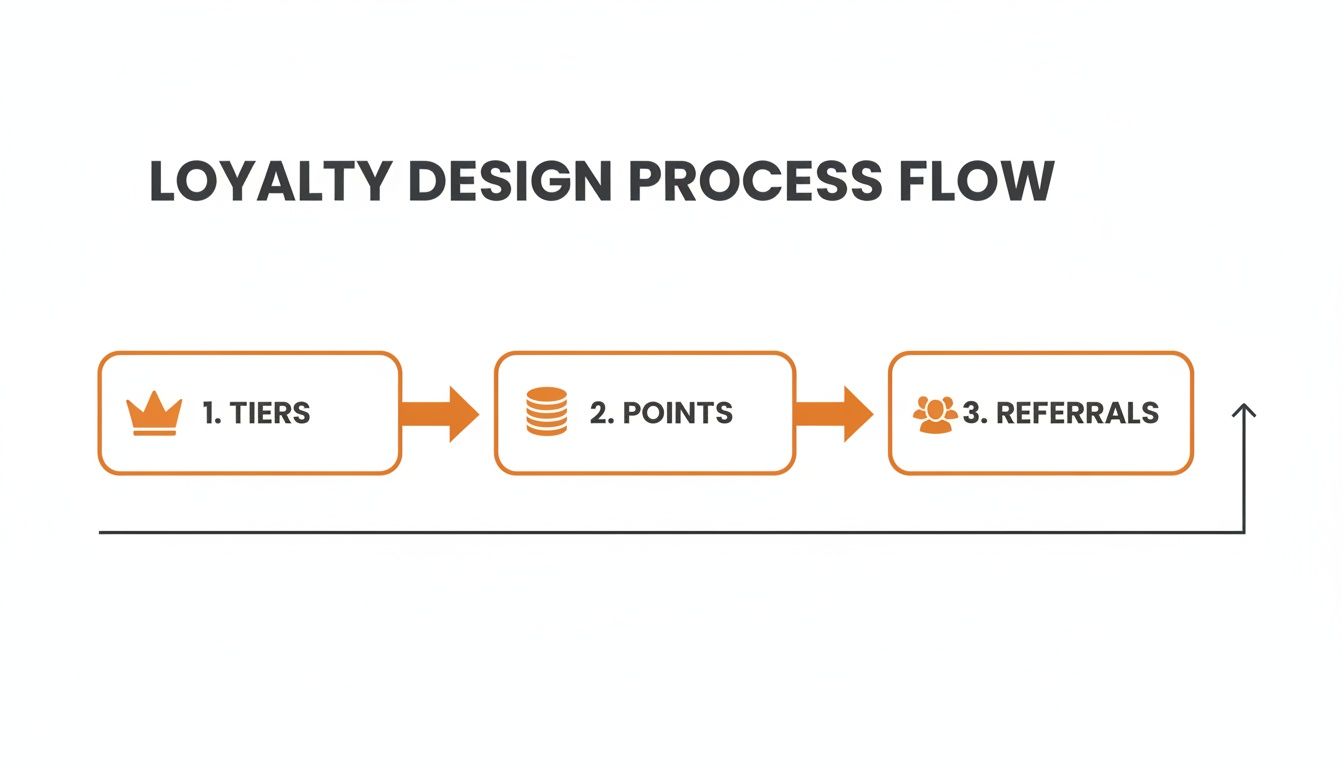
This flow isn't just a diagram; it's a strategy. It shows how you can layer different incentives to keep customers engaged, all powered by the data flowing through your central POS hub.
Your Implementation Checklist
A successful launch is about more than just flipping a switch. It takes a bit of planning to make sure the transition is smooth for your team and, most importantly, your customers. Following a clear plan helps you sidestep the common pitfalls.
The real goal of a POS loyalty integration isn't just getting the tech to work. It's about making the entire loyalty experience feel completely natural for everyone—from the cashier processing a sale to the customer redeeming points they've been saving up.
Here’s a simple, step-by-step checklist to get you there:
- Define Your Program Rules: Before you even log in, map out the basics. How many points do customers get per dollar? What are the spending thresholds for each tier? What are the actual rewards? Getting this clear on paper first makes the setup process a breeze.
- Migrate Existing Customer Data: If you’re moving from an old system, this is a non-negotiable step. Most platforms let you import a CSV file with customer names and their current point balances. This ensures your most loyal fans don’t feel like they're starting over.
- Configure and Test Everything: Follow the app’s instructions to connect it to your Shopify POS and your online storefront. Run a few test purchases to make sure points are awarded correctly, both in-store and online. This is where you iron out any kinks in the data sync.
- Train Your Staff: Your team is the face of your loyalty program. They need to know how to sign people up, look up accounts, and apply rewards at the register without fumbling. A quick training session and a simple one-page cheat sheet can work wonders.
- Promote the Launch: A great program is useless if nobody knows it exists. Announce your new and improved POS loyalty program everywhere—email, social media, and with some simple signs at the checkout counter. Make the benefits obvious and the sign-up process even simpler.
Getting your systems properly connected is the foundation of a successful omnichannel loyalty strategy. For a more detailed breakdown of the technical side, you can learn more about how to integrate a loyalty program with your POS system in our in-depth guide.
How to Measure What Truly Matters
So, you've launched your POS loyalty program. That’s a great first step, but how do you know if it's actually working? If you're not tracking the right data, you’re flying blind. To see the real impact, you have to look past simple sign-up numbers and dig into the Key Performance Indicators (KPIs) that prove your program is delivering a solid return on investment.

These numbers tell the true story of your customer relationships. They show whether you’re building genuine, lasting loyalty or just handing out discounts. Keeping a close eye on them is the only way to fine-tune your strategy and make sure your investment is paying off.
Tracking Core Retention Metrics
First things first: is your program actually keeping customers around? A huge member list doesn't mean much if those people never come back. The real test of loyalty is repeat business, plain and simple.
Start with these foundational metrics:
- Customer Retention Rate (CRR): This is your gold standard. It’s the percentage of customers who stick with you over a set period. If your CRR is climbing, your program is working to build those crucial long-term relationships.
- Repeat Purchase Rate: This one’s straightforward—it tracks the percentage of your customers who have made more than one purchase. It’s a direct measure of how well you're turning first-time buyers into loyal regulars.
- Time Between Purchases: How long does it take for a customer to shop with you again? A good loyalty program should shorten this gap, making your brand a more frequent part of their routine.
These numbers give you a clear, honest look at your program's health. Improving them is the first domino to fall in creating a more profitable and sustainable business.
Analyzing Member Spending Habits
Okay, so your members are coming back. But are they spending more? A well-designed POS loyalty program should actively encourage better buying habits, inspiring members to increase their cart size and choose you over the competition.
This is where you need to compare the behavior of your loyalty members to non-members. The difference between the two is where you’ll find the financial lift.
The most effective loyalty programs don't just reward existing behavior—they actively shape it. By analyzing member spending, you can see if your incentives are driving incremental revenue or simply rewarding transactions that would have happened anyway.
Here are the key spending habits to watch:
- Average Order Value (AOV): Is the AOV for loyalty members higher than for everyone else? If it is, that's proof your perks are successfully nudging them to spend a little extra each time they check out.
- Purchase Frequency: Are your members buying from you more often in a given month or quarter? This tells you if your program is keeping your brand top-of-mind.
When you start comparing these groups, the value becomes crystal clear. On average, members of loyalty programs generate 12-18% more incremental revenue growth each year than non-members. This isn't just a feel-good stat; it’s hard proof that investing in your customers pays off.
Essential KPIs for Your POS Loyalty Program
To make sense of all this data, it helps to have a clear framework. The table below breaks down the most critical KPIs, what they measure, and why they are so important for understanding your program's performance.
| KPI (Key Performance Indicator) | What It Measures | Why It Matters |
|---|---|---|
| Customer Retention Rate (CRR) | The percentage of customers who continue to buy from you over time. | It's the ultimate measure of loyalty and shows if your program is building lasting relationships. |
| Repeat Purchase Rate | The percentage of customers who have made more than one purchase. | This tells you if you're successfully converting one-time buyers into returning customers. |
| Average Order Value (AOV) | The average amount spent per order by a customer. | Comparing member vs. non-member AOV shows if your program encourages larger purchases. |
| Purchase Frequency | How often a customer makes a purchase within a specific timeframe. | This indicates whether your program is keeping your brand top-of-mind and driving more frequent visits. |
| Customer Lifetime Value (CLV) | The total projected revenue a customer will generate throughout their relationship with your business. | CLV combines retention and spending into a single metric, revealing the long-term financial impact of your loyalty efforts. |
By consistently monitoring these five indicators, you can get a holistic view of your program's health and make data-driven decisions to improve it.
Calculating Customer Lifetime Value
When it comes all down to it, the one metric that reigns supreme is Customer Lifetime Value (CLV). This KPI isn't just about a single sale; it predicts the total profit you can expect from a customer over their entire relationship with your brand. Think of it as your North Star for measuring long-term success.
By calculating and comparing the CLV of loyalty members versus non-members, you can put a hard dollar amount on the value your program is creating. This makes it incredibly easy to justify the investment to yourself and your team. To get really good at this, check out our complete guide to the most important loyalty program KPIs to track.
Avoiding the Common Loyalty Program Traps
Launching a new loyalty program is an exciting step, but it's easy to get tripped up by a few common mistakes. Most programs don't fail because the idea was bad; they fail because of small, completely avoidable errors in how they're rolled out. Getting these details right is what separates a program that costs you money from one that actually drives serious revenue.
Think of this as your pre-flight checklist. By understanding where other businesses have stumbled, you can build a program that clicks with customers and delivers real results right out of the gate.
Let's break down the most common pitfalls and, more importantly, how you can sidestep them.
The Overly Complex Rewards Structure
Want to kill customer engagement before it even starts? Make your program confusing. If a customer needs a spreadsheet and a calculator to figure out your points system or tier benefits, you've already lost them. Simplicity is your best friend here.
Your rewards should be so simple they can be understood in a single glance. Think about the classic "buy 10 coffees, get one free" model or a straightforward "earn 1 point for every dollar you spend." That kind of clarity removes all the friction and makes joining feel like a no-brainer, which is exactly the vibe you're going for.
The goal isn't to build the most elaborate system; it's to build the most motivating one. A customer should grasp the value of your program in the few seconds they have at the checkout counter.
If you find yourself needing to write a multi-page FAQ just to explain the rules, it's a huge red flag. Your customers are busy. A transparent, easy-to-understand system will win every time.
Forgetting to Train Your Team
Your in-store staff are the face of your loyalty program. They’re the ones getting people excited to sign up, explaining the perks, and helping them cash in their hard-earned rewards. If they don't seem confident or can't answer basic questions, the whole experience crumbles.
When training is an afterthought, you end up with inconsistent messaging, flustered cashiers, and confused customers. It can make a beautifully designed digital program feel clunky and awkward at the physical point of sale, undermining all your hard work.
Here’s how to set your team up for success:
- Hold a Real Kick-Off Session: Before you go live, get everyone together. Don't just show them how it works—explain why it matters for the business and what's in it for them (like happier, more frequent customers).
- Create a Simple Cheat Sheet: A one-page guide taped next to the register can be a lifesaver. It should cover the basics: how to sign someone up, how to look up a customer, and how to redeem points.
- Practice Makes Perfect: Run through a few role-playing scenarios. Let your team practice the pitch during a quiet moment, not when there's a line out the door. This builds muscle memory and confidence.
A little bit of time spent on training goes a long way, paying you back tenfold in smooth transactions and happy customers.
The "Build It and They Will Come" Fallacy
This might be the single biggest mistake of all: assuming customers will magically discover your amazing new program. You could design the most generous and exciting POS loyalty program on the planet, but if no one knows it exists, it’s guaranteed to fall flat. A great program needs a great launch plan.
You have to tell people about it, then tell them again, and then tell them one more time. Use every communication channel you have to shout it from the rooftops.
- In-Store Signage: Put up clean, eye-catching signs right at the checkout counter and near the entrance.
- Email and SMS Blasts: Let your existing subscribers know about the new program. A "sign up and get 10% off today" offer works wonders.
- Social Media Campaign: Create a few simple, visual posts that clearly explain the perks and how to join.
- The Personal Ask: This is the most powerful tool. Train your staff to mention the program to every single customer during checkout. A simple, "Hey, are you part of our rewards program yet?" is incredibly effective.
By actively promoting your program from day one, you build the momentum it needs to become a long-term success.
Choosing the Right POS Loyalty Partner
Picking a technology partner is probably the biggest decision you'll make when launching your POS loyalty program. Think of it this way: the right partner becomes an extension of your team, giving you the tools and backup you need to succeed. The wrong one? Well, that's a one-way ticket to technical headaches, frustrated staff, and a loyalty program that sputters out before it even has a chance.
This isn't just about ticking boxes on a feature list. It’s about finding a solution that truly gets your business goals, plays nicely with the tech you already use, and is ready to grow with you.
Evaluating Technical Integration and Scalability
First things first, your loyalty platform has to communicate perfectly with your Shopify POS system. A clunky, unreliable connection is a nightmare for everyone—your cashiers get flustered, and your customers get annoyed. When you're talking to potential partners, get specific. Ask them if customer data syncs in real-time between your website and your brick-and-mortar stores.
But don't just think about today. A platform that seems fine now might buckle under pressure a year from now as you grow. Look for a partner with a track record of supporting businesses that are scaling up. Can their system handle a surge in transactions? Can it manage a much larger customer base without grinding to a halt? A scalable solution saves you from a painful migration down the road.
Choosing a loyalty partner is like hiring a key employee. You need someone reliable, supportive, and capable of growing with you. The right choice sets the foundation for years of successful customer relationships.
Assessing Support and Transparent Pricing
When something inevitably goes wrong—and it will—you need to know that real help is just a call or a click away. Don't underestimate the value of great customer support. Look for partners that offer solid onboarding, easy-to-reach live support, and a library of clear, helpful guides. Good support keeps small hiccups from turning into full-blown crises.
Finally, take a hard look at the price tag. Steer clear of partners who bury costs in confusing contracts. The best providers have simple, transparent pricing so you know exactly what you're paying for. That clarity lets you budget properly for your POS loyalty program and actually measure its ROI from the very beginning.
Frequently Asked Questions
Thinking about a POS loyalty program is one thing, but getting into the nitty-gritty details is another. Let's tackle some of the most common questions merchants have when they're on the verge of making this move.
How Quickly Can I Get a Program Up and Running?
You might be surprised. With a modern loyalty app that integrates directly with Shopify, you can go from zero to a fully functional program in just a few hours. Forget about waiting weeks or months; the whole process, from installation and setup to a quick training session for your team, is designed to be fast. You can start rewarding your customers by the end of the day.
What Happens to My Existing Members if I Switch Programs?
You won’t lose them. Any loyalty platform worth its salt makes it easy to bring your members and their hard-earned points over. Typically, this is done with a simple CSV file import. This means your best customers have a smooth transition and don't lose any of the value they've built up with your brand.
A seamless migration is key. It sends a clear message to your loyal customers that you respect their history with your brand, which is exactly the kind of trust you want to build.
What Are the Best Rewards to Offer?
There’s no magic bullet here, and that's actually a good thing. The best rewards are the ones your customers want, which is why a flexible program is so important. A great strategy usually mixes things up to appeal to everyone.
- Points for discounts: This is the bread and butter of loyalty—simple, direct, and always appreciated.
- Exclusive product access: Let your members be the first to know about new drops or get early access to sales.
- Free stuff: A tangible perk, like a free coffee or a small product, feels like a genuine gift and creates a memorable experience.
Ultimately, the most powerful programs are built on understanding what your customers truly value. When you get that right, your rewards won't just be discounts; they'll be compelling reasons for people to come back again and again.
Ready to turn casual shoppers into lifelong fans? Toki gives you all the tools you need—from tiered memberships and digital wallet passes to a flawless Shopify POS integration. Start building a loyalty program your customers will love.