Point Rewards System: How to Build a point rewards system that Drives Loyalty
Learn how to build a point rewards system that boosts loyalty, drives repeat purchases, and increases customer lifetime value for your ecommerce store.
At its core, a point rewards system is a simple concept: customers take actions you want to encourage—like making a purchase or leaving a review—and in return, they earn points. They can then cash in those points for discounts, freebies, or other special perks.
But it's more than just a marketing tactic. It's one of the most effective ways to build customer habits, drive repeat business, and turn first-time buyers into genuine fans of your brand.
Why a Point Rewards System Is Your Growth Engine
Let's get past the textbook definition. A well-executed point rewards system isn't just a "nice to have" feature; it's a powerful engine for predictable growth. It directly nudges customer behavior by giving them a real, tangible reason to shop with you instead of the competition.
Think about it from the customer's perspective. They need a new pair of shoes. They could go anywhere, but they remember they're just a few points away from a $10 discount at your store. Suddenly, the choice is easy. That’s the kind of influence you can create.
This simple exchange sets off a positive feedback loop. Customers spend, they earn points, they redeem rewards, and they feel good about it—so they come back to do it all over again. You're shifting the dynamic from a one-off transaction to a long-term relationship, making them feel like a valued part of your brand's world.
The Core Components of Engagement
To make this work, you need to nail three things. They all work together to create an experience that feels motivating, not like a chore.
- Earning: This is how customers rack up points. The key here is simplicity and transparency. And don't just stop at purchases. Rewarding actions like writing a review or following you on social media gets customers more invested in your brand.
- Redeeming: Here's the payoff. The rewards have to be something people actually want, and they need to feel achievable. If the prize is unappealing or feels a million miles away, people will just tune out.
- Engaging: This is all about communication. You need to keep your customers in the loop about their points balance, new ways to earn, and special offers. Consistent, helpful reminders keep your program top of mind.
To really get why this structure is so effective, it helps to understand what makes customers stick around in the first place. It's worth taking a moment to explore the most direct causes of customer loyalty.
When you focus on these three pillars—earning, redeeming, and engaging—you stop running a simple rewards program and start building a thriving community. Your customers feel seen, recognized, and consistently incentivized to come back. That's how you boost lifetime value and create real brand advocates.
The proof is in the numbers. As of 2025, more than 90% of companies have some kind of loyalty program, and point-based systems are by far the most popular. The brands running them report an average ROI of 4.8x—a clear sign that these systems are no longer optional for serious merchants.
We’ll dig into the broader benefits of a loyalty program later, but for now, this guide will give you the foundation you need to build a system that gets your customers truly invested in your success.
Designing Your Point Economy for Maximum Impact
This is where your rewards program really comes to life. A successful system hinges on a well-designed point economy—the financial engine that dictates how customers earn and spend points. If you get this right, you create something that feels generous and exciting to your customers while staying profitable and sustainable for your business.
First things first, you need to assign a clear monetary value to your points. A common benchmark, and one I highly recommend for its simplicity, is 100 points = $1. This straightforward ratio makes it incredibly easy for customers to see the value of their rewards at a glance. Avoid complicated math at all costs; it’s a known conversion killer.
The whole idea is to create a self-sustaining loop: customers earn points, redeem them for rewards, and that positive experience encourages them to engage and spend more.
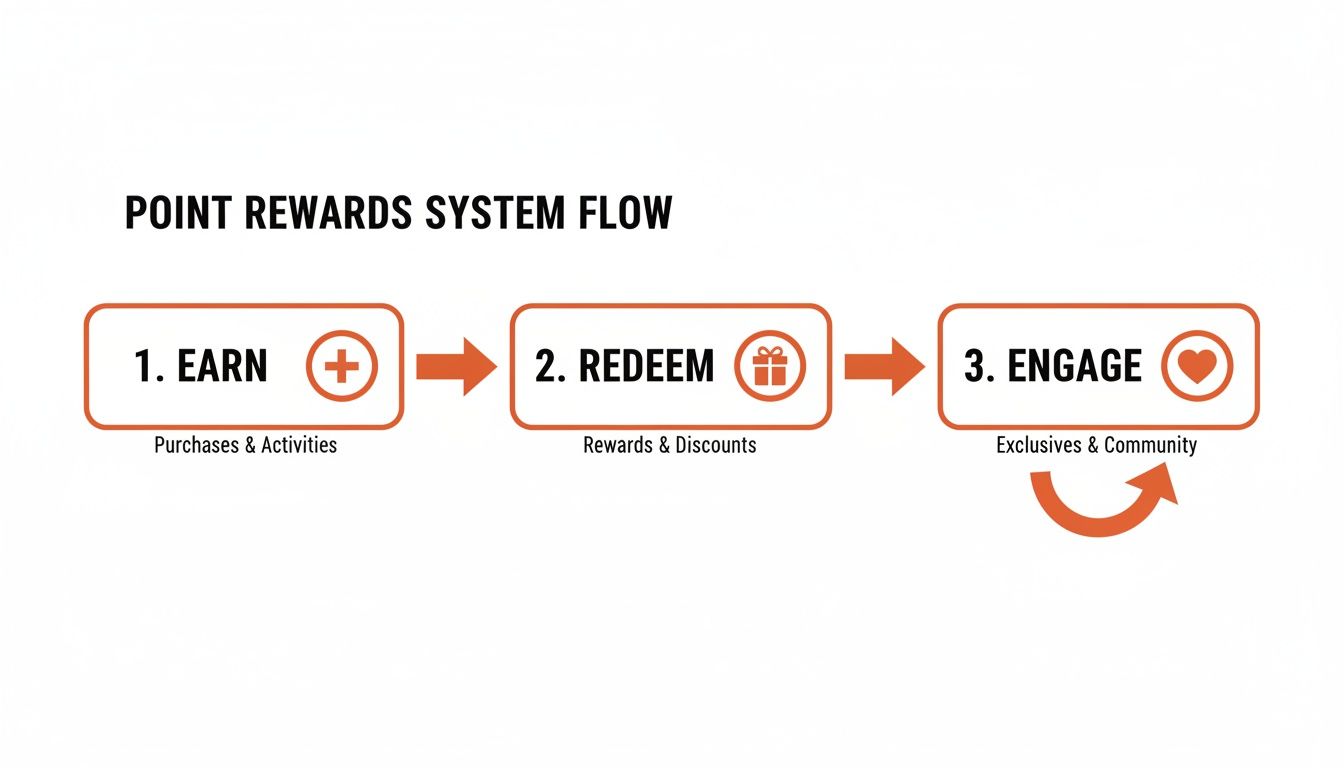
As you can see, the goal is to reward more than just spending. It's about building a continuous cycle of interaction that deepens the customer relationship over time.
Shaping How Customers Earn Points
With a point value set, you can now define how customers will earn them. The most obvious way is through purchases, like offering 1 point for every $1 spent. This directly incentivizes spending. But the real magic of a modern rewards program is encouraging behaviors that build your brand community and drive long-term value.
Think beyond the transaction. What actions would truly help your business grow? You can offer bonus points for these high-value activities that boost your marketing without a direct purchase.
Here are a few ideas I’ve seen work wonders:
- Social Engagement: Offer 50 points when a customer follows you on Instagram or shares a post. This is a low-cost way to expand your reach organically.
- User-Generated Content: A beauty brand could offer 200 points for a customer who leaves a review with a photo. This provides powerful social proof that influences other shoppers.
- Account Creation: Give new customers an instant win with 100 points just for creating an account. This simple gesture gets them invested from day one.
The goal here is to create a system that rewards customers for being genuine advocates, not just spenders. By incentivizing actions like reviews and social shares, you're building a community around your brand that generates authentic marketing content for you.
Of course, the most impactful programs are tailored. Digging into user segmentation strategies can help you offer different rewards to different customer groups for an even bigger impact.
Crafting Redemption Options People Actually Want
Earning points is only half the equation. Redeeming them is the payoff that keeps people coming back. Your redemption options must feel both valuable and, crucially, attainable. If rewards are too expensive or just plain uninspiring, you’ll see engagement drop off a cliff.
So, how can customers cash in their points?
- Fixed-Value Discounts: This is the bread and butter of many programs. A customer redeems a set number of points for a specific dollar amount off (e.g., 500 points = $5 off). It’s simple and effective.
- Percentage-Based Discounts: You could offer something like 10% off for 1,000 points. This is a great way to encourage larger purchases, since the value of the discount scales with the cart size.
- Free Products: This can be a high-perceived-value reward that costs you relatively little. A coffee shop might offer a free pastry for 750 points, turning a simple reward into a special treat.
- Exclusive Perks: Think beyond discounts. Non-monetary rewards like free shipping or early access to a new product launch can make your most loyal customers feel like true VIPs.
To help you visualize how this all fits together, here's a table outlining a balanced point economy. It gives you a practical starting point for setting your own earn and redemption rules.
Balancing Point Earning and Redemption Rules
| Customer Action (Earning) | Suggested Point Value | Reward (Redemption) | Suggested Point Cost |
|---|---|---|---|
| Sign up for an account | 100 Points | $5 off coupon | 500 Points |
| Spend $1 | 1 Point | $10 off coupon | 1,000 Points |
| Follow on Instagram | 50 Points | 15% off coupon | 1,500 Points |
| Leave a product review | 150 Points | Free Shipping | 800 Points |
| Post a photo (UGC) | 200 Points | Free Product (e.g., T-shirt) | 2,500 Points |
Remember, these are just suggestions. The key is to find the right balance for your specific profit margins and customer base. The cost of the rewards you give out should always be less than the value of the customer behaviors you're encouraging.
This isn’t just theory; the data backs it up. For Shopify merchants, 74% of consumers say they feel more loyal to brands with good rewards programs. An incredible 86% actively recommend those brands to others. This emotional connection is why 43% of shoppers admit these programs directly cause them to spend more.
If you're curious about the mental triggers behind what makes a reward feel truly compelling, our guide on reward psychology is a great next read. By carefully structuring both sides of your point economy, you’ll build a system that drives sales, fosters genuine loyalty, and ultimately strengthens your bottom line.
Moving Beyond Points with Tiers and Gamification
A solid point rewards system is a fantastic starting point, but it's really just the foundation. If you want to build something that creates a genuine emotional connection with your customers, you have to create an experience. This is where you bring in the advanced stuff—tiered memberships and gamification—to turn a simple program into a compelling brand journey.
These strategies tap into powerful human motivators: status, achievement, and a little friendly competition. When customers feel like they're climbing a ladder and progressing toward something exclusive, they’re far more likely to stick with your brand to reach that next level. This is how you stop being just a discount tool and start being a powerful retention machine.
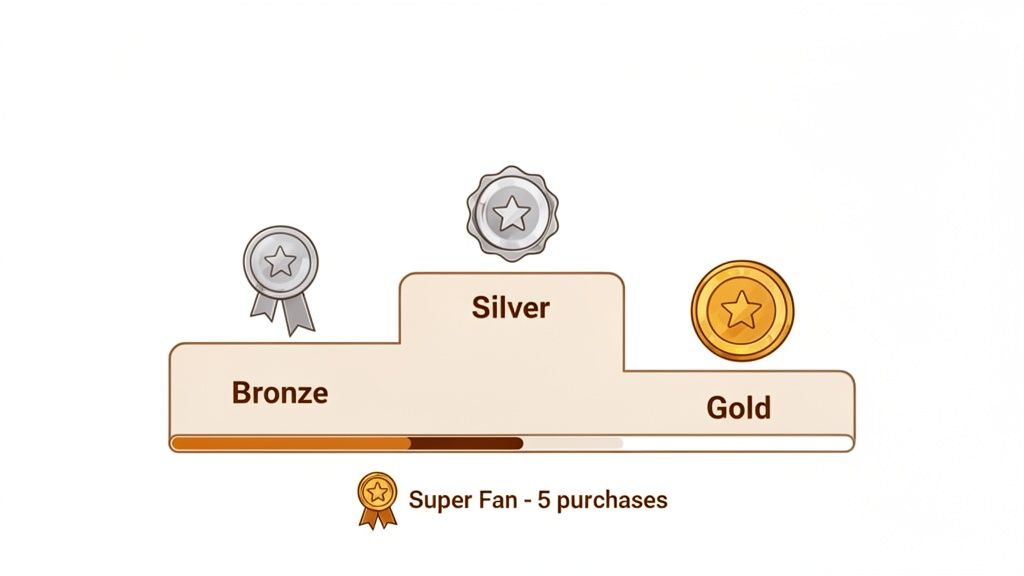
A basic points system is good, but layering on these elements creates an unforgettable experience that keeps customers engaged for the long haul.
Structuring Compelling Tiers
The most effective way to encourage higher spending and more frequent purchases is with a tiered loyalty program. The model is simple: you group customers into levels (think Bronze, Silver, Gold) based on their spending or engagement over a set period, like a calendar year. Each tier unlocks better and better perks, creating a clear incentive to climb the ladder.
But here’s the key: the benefits in the higher tiers have to be genuinely desirable. A 5% discount for your top-tier members just won't cut it. You need to offer perks that feel exclusive and provide real, tangible value.
Consider these kinds of high-impact tier rewards:
- Early Access: Give your Gold members a 24-hour head start on new product drops or major sales. This costs you virtually nothing but creates immense perceived value and a feeling of being an insider.
- Exclusive Products: A subscription box company could offer a members-only item to its top-tier subscribers. It’s a brilliant way to make them feel special.
- Free Shipping Upgrades: Offer complimentary expedited shipping for your highest tier. This is a practical, high-value perk that frequent shoppers will absolutely love.
- Bonus Point Multipliers: Accelerate the earning potential for your best customers. For instance, Silver members could earn 1.25x points on every dollar, while Gold members get 1.5x.
When you're designing your tiers, the goal is to make the next level feel both aspirational and achievable. If the jump from Silver to Gold requires a customer to spend ten times more, they'll just give up. The sweet spot is a challenge that encourages just a few extra purchases per year.
For a much deeper look into the nuts and bolts of building these levels, our detailed guide on tiered loyalty programs offers a step-by-step approach to creating a structure that truly motivates customers.
Injecting Fun with Gamification
While tiers appeal to our desire for status, gamification taps into our love of fun, challenge, and achievement. It's all about adding game-like elements to your program to turn routine actions into rewarding little experiences. This is an incredibly effective way to keep your points system from feeling stale or purely transactional.
Gamification doesn't mean you need to build a complex video game. It’s about adding small, delightful interactions that encourage specific behaviors and celebrate milestones along the way. These small moments of recognition can seriously boost engagement and make your brand more memorable.
Gamification Tactics to Implement
Here are a few practical ways you can bring gamification into your loyalty program:
- Earning Badges: Award digital badges for completing specific actions. A "Super Fan" badge for making five purchases or a "Social Butterfly" badge for sharing three products on social media provides a fun, visual acknowledgment of a customer's loyalty.
- Double-Point Weekends: Create a sense of urgency and excitement by running limited-time events. Announcing a double-point weekend for a specific product category can drive a huge spike in sales for those items.
- Surprise & Delight Points: I love this one. Randomly deposit a small number of bonus points (say, 50 points) into a loyal customer's account with a message like, "Just because we appreciate you!" This unexpected reward creates a powerful positive feeling about your brand.
- Progress Bars: Visually show customers how close they are to their next reward or tier. Seeing a progress bar at 80% full is a powerful psychological nudge to make another purchase just to close that gap.
Imagine a local coffee shop creating a "Coffee Connoisseur" challenge. After a customer tries five different specialty blends, they could unlock a badge and get 200 bonus points. This encourages product discovery and makes the routine act of buying coffee feel more like an accomplishment.
By combining a well-structured tier system with these kinds of engaging gamification elements, your points program evolves. It becomes more than just a way to save money; it transforms into an interactive experience that builds a stronger, more emotional connection with your customers and drives the kind of repeat business that fuels real growth.
Integrating Your Rewards Program Across Every Channel
Your point rewards system is only as good as it is convenient. If customers have to jump through hoops on one specific platform to earn or redeem points, you can bet engagement will tank. The real magic happens when your program meets customers wherever they are, creating a seamless experience that connects your online store with your brick-and-mortar locations.
A truly unified system means someone can buy a product on your Shopify store, watch their points balance update instantly, and then walk into your physical shop to use those points on their very next purchase. This kind of fluidity removes all the friction. Customers shouldn't have to think about how to use their rewards; it should just work.

Connecting Your Online Store
For most brands today, the e-commerce store is the mothership. Integrating your loyalty program here is non-negotiable and, luckily, it's usually the most straightforward part of the puzzle.
Modern loyalty platforms like Toki offer powerful, plug-and-play integrations for major e-commerce solutions, especially Shopify. This connection syncs data in real-time, so when a customer earns points—whether from a purchase or by leaving a review—their account updates automatically. You don't have to lift a finger. This automation is what builds a reliable and trustworthy program from the ground up.
Unifying the In-Store Experience with POS Systems
This is where so many programs fall flat, creating a jarring disconnect between the online and offline worlds. For your points program to be effective, it has to work just as smoothly at a physical cash register as it does in a digital shopping cart. That means you need a direct integration with your Point of Sale (POS) system.
When a customer is checking out, your staff needs to be able to:
- Look up a customer by name, email, or phone number to pull up their loyalty profile.
- See their current points balance and any available rewards right there in the POS.
- Apply rewards, like a $10 discount, to the transaction with a single tap.
- Credit points for their new purchase to their account on the spot.
This seamless flow makes the rewards program feel like a natural part of the checkout process, not some clunky, awkward add-on. It gives your team the power to actively promote the program and surprise customers with the rewards they've already earned.
Think about a local boutique. A customer brings a dress to the counter, the associate asks for her phone number, and her account pops up. "Great news!" the associate says. "You have enough points for $15 off today. Want to use that?" That simple interaction can completely elevate the customer's entire experience.
Leveraging the Power of Digital Wallets
One of the slickest ways to bridge the online-offline gap is through digital wallet integration. This lets customers add a branded loyalty pass directly to their Apple Wallet or Google Wallet.
This isn't just some static digital card; it's a dynamic tool. The pass can show the customer's name, their real-time points balance, and even their current loyalty tier. Better yet, these passes can be location-aware. When a customer walks near one of your physical stores, the pass can trigger a push notification, reminding them of their points and nudging them to stop by.
At the register, the process becomes incredibly easy. The customer just holds their phone up to the scanner, the same way they would with a credit card. The POS reads their unique ID from the pass, instantly pulling up their account. It's the definition of a low-friction experience.
This interconnected ecosystem—linking your e-commerce site, POS system, and digital wallets—is what turns a simple points system into a core part of your brand experience. It delivers consistency, makes things incredibly convenient for your customers, and ultimately drives the repeat business that builds real, lasting loyalty.
Measuring Success and Optimizing for Growth
Launching your point rewards system is a huge step, but the real work starts now. The best loyalty programs aren't set in stone; they’re a living, breathing part of your marketing strategy. You have to constantly watch, test, and tweak things to get it right. To do that, you need to look past the flashy "vanity metrics" and dig into the Key Performance Indicators (KPIs) that actually tell you what's happening with your bottom line.
A well-oiled program doesn't just hand out discounts—it actively shapes how your customers shop and drives real, sustainable growth. Tracking the right data is the only way to know what's working and, just as importantly, where you can do better.
Key Metrics That Actually Matter
Your analytics dashboard is probably overflowing with numbers, but only a handful truly tell the story of your program's health. Let's cut through the noise and focus on the KPIs that give you a real sense of your return on investment.
- Repeat Purchase Rate (RPR): This is the big one. It’s simply the percentage of customers who come back to buy from you again. This metric is a direct reflection of loyalty, making it the most critical number for judging if your program is actually working. If your RPR is climbing, your rewards are doing their job.
- Customer Lifetime Value (CLV): This number predicts how much revenue a single customer will bring in over their entire relationship with your brand. A solid rewards program should create a noticeable gap between the CLV of members and non-members. Loyal members just shop more often and spend more over time.
- Redemption Rate: What percentage of the points you hand out are actually being used? A low redemption rate—think anything below 20%—is a serious red flag. It usually means your rewards aren't very exciting, are too hard to earn, or you simply aren't telling people about them effectively.
- Program ROI: This is the ultimate proof of success. The math is straightforward: (Additional Profit from Members - Program Costs) / Program Costs. This calculation tells you exactly how much you're getting back for every dollar you put in.
These metrics don’t live in a vacuum; they work together. For instance, seeing a high repeat purchase rate and a healthy redemption rate is the dream. It shows customers are not only returning but are genuinely excited and engaged with the rewards you're offering.
Using Data to Make Smart Optimizations
Once you start tracking these KPIs, you can stop guessing and start making data-driven decisions to fine-tune your program. Your analytics will show you patterns and sticking points, giving you a clear roadmap for what to change.
Don't be afraid to experiment. The goal isn't to launch the perfect system on day one, but to build a framework that allows for continuous optimization. A simple A/B test on a reward value can yield powerful insights that boost engagement across your entire customer base.
Let's say you notice your Redemption Rate is lagging. Time to play detective. Are your rewards boring? Is the points goal too far out of reach?
This is the perfect scenario for some A/B testing. You could try offering a new, easier-to-get reward to a small segment of your customers to see if it moves the needle. It could be as simple as testing a $5 coupon for 500 points against your current $10 coupon for 1,000 points. You might find that smaller, more frequent wins are way more motivating for your audience.
What if your Repeat Purchase Rate isn't where you want it? Try a limited-time promotion like a "Double Points Weekend." This creates urgency and can be the exact push someone needs to make another purchase. By tracking sales from program members during that specific period, you can directly measure the campaign's impact.
To give you a clearer picture, I've pulled together the most important KPIs and some healthy benchmarks to aim for.
Key KPIs for Your Point Rewards System
This table summarizes the core metrics you should have on your dashboard. Monitoring these will give you a clear, ongoing picture of your program's health and its impact on your business.
| KPI (Key Performance Indicator) | What It Measures | Why It Matters | Healthy Benchmark |
|---|---|---|---|
| Repeat Purchase Rate | % of customers making 2+ purchases | Directly shows if your program is building loyalty and driving return business. | 20-40% for e-commerce |
| Customer Lifetime Value (CLV) | Total net profit from a single customer | Indicates the long-term financial health and value of your customer relationships. | Should be 3x higher than Customer Acquisition Cost (CAC) |
| Redemption Rate | % of earned points that are spent | Reveals how engaged customers are and how appealing your rewards are. | 20% or higher |
| Program ROI | Financial return on your program investment | Proves the program's value and justifies continued investment in it. | 4x or higher |
By keeping a close eye on these numbers and using the insights to test new ideas, your point rewards system evolves from a simple feature into a powerful engine for growth. This proactive approach is what keeps a program relevant, engaging, and profitable for years to come.
Common Questions About Point Rewards Systems
Even with the best strategy in place, launching a point rewards system inevitably brings up some tricky questions. You want to feel confident you're making the right calls for your business and, just as importantly, for your customers. Let's walk through some of the most common hurdles we see brands tackle.
Think of this as your go-to guide for navigating those "what if" moments. We'll reinforce the core ideas we've covered with practical advice you can put to use immediately.
How Much Should My Points Be Worth?
This is, without a doubt, the question I hear most often. And the answer is simpler than you might think. A fantastic starting point for almost any business is the 100 points = $1 model. It’s clean, customers get it instantly, and it’s a breeze for you to manage.
The real goal here is clarity. The last thing you want is for a customer to have to pull out a calculator to figure out what their points are worth. When the value is straightforward, they can immediately see the benefit of shopping with you again, which is exactly what you want.
What if Customers Just Hoard Their Points?
Point hoarding is a legitimate concern. It can inflate the liability on your balance sheet and, more critically, it signals that customers aren't actually using the program. If your redemption rate is tanking, that’s a red flag telling you it's time for an adjustment.
The most effective tool against hoarding is a clear and well-communicated points expiration policy. For instance, setting points to expire after 12 months of account inactivity is a common and fair approach. It nudges customers to use their rewards without being overly aggressive.
A point expiration policy isn't about punishing customers—it's about encouraging them to enjoy the rewards they've earned. Frame it positively. A simple, automated email reminder a month before their points expire can work wonders.
This single strategy keeps your program fresh, your engagement up, and your financial liability under control.
Is My Program Too Generous? Or Not Generous Enough?
Ah, the classic balancing act. Go too generous, and you risk eating into your margins. Be too stingy, and customers won't see the point in participating.
To find that sweet spot, begin by calculating your cost per point. Using our 100 points = $1 example, each point costs you exactly one cent. If a customer earns 100 points on a $100 purchase, you’re giving them a 1% reward. For most e-commerce businesses, this is a very sustainable and common baseline.
Not sure if you've hit the mark? Keep an eye on these metrics:
- Redemption Rates: A healthy program usually sees a redemption rate of 20% or higher. If you're well below that, your rewards might not be exciting enough.
- Repeat Purchase Rate: Are your loyalty members coming back to buy more often than your non-members? If the answer is yes, your program is adding real value.
- Program ROI: At the end of the day, the numbers tell the full story. The lift in customer lifetime value and purchase frequency needs to outweigh the cost of the rewards you’re giving out.
Can a Small Business Really Afford a Rewards Program?
Absolutely. This isn't a tool reserved for massive corporations with bottomless budgets. In fact, for a small business, a loyalty program is one of the most cost-effective marketing investments you can make. It’s almost always cheaper to keep a customer than to find a new one.
Modern loyalty platforms make it incredibly affordable and easy to get started. You don’t need a dedicated team or a complicated, custom-built system. The trick is to start simple. Launch with basic earn-and-redeem rules, then as you grow and learn what your customers love, you can layer in more sophisticated features like tiers or gamification.
Ready to build a point rewards system that turns one-time shoppers into lifelong fans? Toki provides all the tools you need to launch, manage, and optimize a powerful loyalty program that integrates seamlessly with Shopify.