Point Based Loyalty Program: point based loyalty program blueprint for ROI
Discover a point based loyalty program that boosts retention and ROI. Learn design, launch, and measurement with expert tips and real examples.
At its core, a point-based loyalty program is a straightforward deal between you and your customers. They take actions you value—like making a purchase, leaving a review, or even just following you on social media—and in return, you give them points.
These points act like a special currency for your brand. Customers can save them up and cash them in for real rewards, like discounts, free shipping, or exclusive products. It’s one of the oldest and most effective tricks in the book for encouraging people to come back again and again.
The Foundation of Customer Retention
Think of a point-based program as a structured way of saying "thank you" for being a customer. It's like a digital punch card, but way more flexible. Every time a shopper does something that helps your business, they get a little kickback in the form of points.
This simple mechanic fundamentally changes the customer relationship. It shifts it from a one-off transaction to an ongoing connection. It gives people a concrete reason to choose your store over a competitor's, slowly turning first-time buyers into loyal regulars who feel appreciated. The goal is to create a positive feedback loop: they engage, you reward them, and they're excited to engage again.
Why This Model Is So Effective
The real magic of a point-based system is how it taps into basic human psychology. We're all wired to enjoy making progress, hitting goals, and feeling recognized for our efforts. Watching a point balance grow feels like an accomplishment, creating a small but satisfying sense of achievement.
This is a classic example of the goal-gradient effect: the closer we get to a reward, the harder we work to close that final gap. It’s the same reason you’re more likely to finish the last chapter of a book or run that final lap. By showing customers they're just a few points away from their next reward, you create a powerful, built-in nudge to make another purchase.
A well-designed loyalty program doesn't just give away discounts; it creates a compelling game that customers want to keep playing. It shifts their focus from "what I'm spending" to "what I'm earning."
More Than Just Transactions
Beyond just driving the next sale, these programs help build a much deeper, more emotional connection with your brand. They make customers feel like they're part of a community—like they're insiders with special perks.
Here are a few of the key benefits that come from building that feeling:
- Increased Customer Lifetime Value (CLV): Loyal members simply spend more over time. Research from Bain & Company shows that improving customer retention by just 5% can increase profits anywhere from 25% to 95%.
- Higher Engagement: You can reward more than just purchases. Giving points for social shares, reviews, or newsletter sign-ups encourages customers to interact with your brand in new ways.
- Valuable Data Collection: Loyalty programs are a goldmine of information. They give you clear insights into what your best customers are buying and what motivates them, helping you personalize your marketing and improve the entire shopping experience.
In the end, a point-based system gives you a clear, easy-to-understand framework for rewarding loyalty. It's a versatile starting point that you can build on with tiers, limited-time promotions, and unique rewards, making it a true cornerstone of any modern retention strategy.
Designing a Program Customers Actually Use
A great loyalty program shouldn't feel like a marketing chore. It should feel like an exclusive club that your customers are genuinely excited to be a part of. The design is everything—it's what separates a program people forget from one they actively use. It all comes down to creating real value and an experience that makes them feel connected to your brand.
Just handing out points for purchases is table stakes. To get people buzzing, you have to think bigger. This means weaving in layers of exclusivity, fun, and personalization that make being a member rewarding in itself.
This diagram shows how a well-built program connects customer actions to real, tangible rewards.
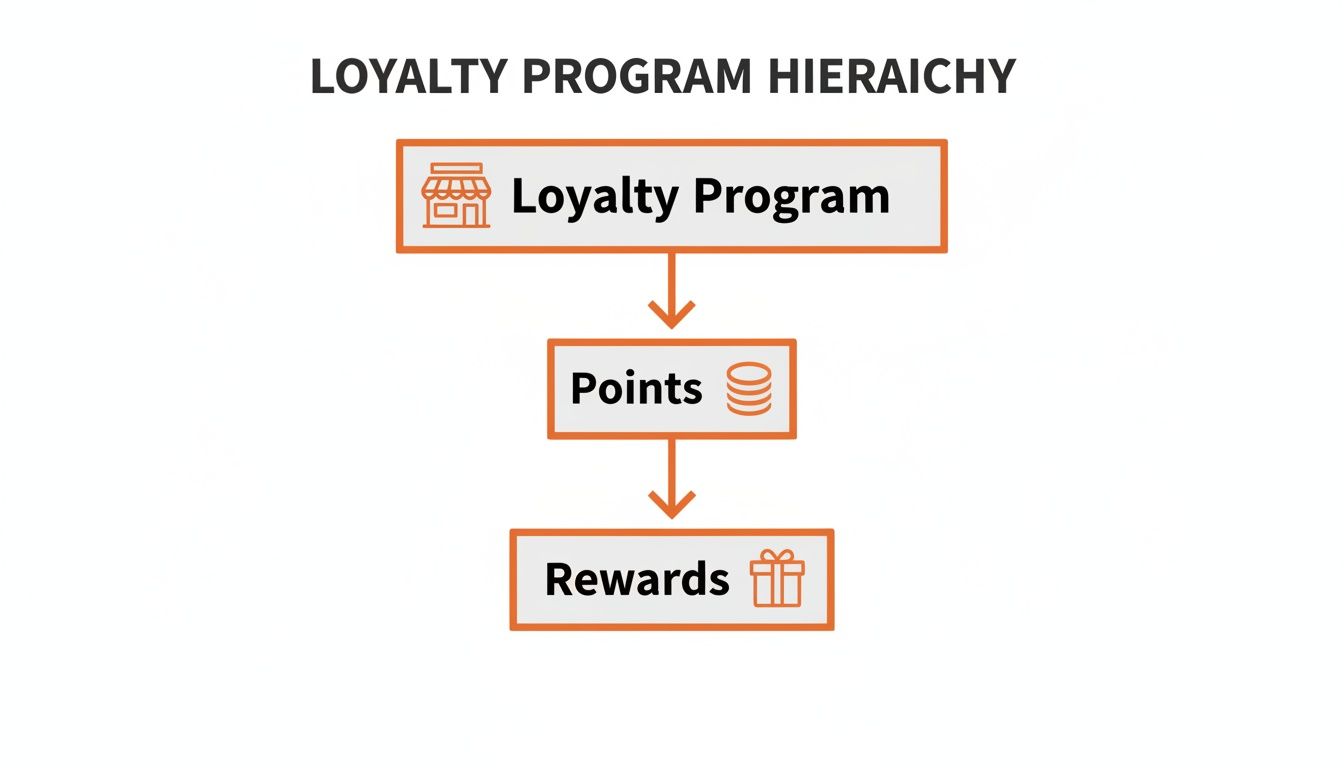
As you can see, the structure is simple but powerful. Points act as the currency that unlocks value, giving customers a clear path from their engagement to a well-earned benefit.
Before we dive into the specific tactics, it's helpful to understand the core elements that make a program tick. The table below breaks down the essential features and why they matter for your business.
Key Components of a High-Impact Loyalty Program
| Feature | Description | Primary Business Benefit |
|---|---|---|
| Tiered Membership | Creates levels of status (e.g., Bronze, Silver, Gold) with increasing perks. | Motivates higher spending to unlock VIP status and rewards your most valuable customers. |
| Gamification | Incorporates challenges, badges, and point streaks for completing actions. | Increases engagement beyond purchases and makes interacting with your brand more fun. |
| Personalized Rewards | Uses customer data to offer rewards tailored to individual purchase history. | Deepens customer connection by showing you understand their preferences, boosting redemption rates. |
| Omnichannel Access | Ensures the program works seamlessly online, in-store, and on mobile. | Provides a frictionless experience, making it easy for customers to earn and redeem anywhere. |
Each of these components plays a crucial role in transforming a basic points system into a powerful customer retention engine. Now, let's look at how to bring them to life.
Introduce Tiers for Exclusivity
One of the best ways to make customers feel truly valued is with a tiered system. Tiers create a natural sense of progression and achievement. Shoppers are motivated to spend more to unlock the next level of perks, turning a simple program into a status symbol. It’s a direct way to reward your best customers and make them feel like insiders.
A simple tiered structure might look something like this:
- Bronze Tier (Entry-Level): Everyone starts here, earning points at a base rate. They might get access to member-only sales or a small birthday gift.
- Silver Tier (Mid-Level): Customers reach this tier after hitting a certain spending goal. Here, they could earn points 1.25x faster and get perks like free shipping on all orders.
- Gold Tier (Top-Level): This is for your absolute best customers. They might get a 2x points multiplier, early access to new products, or even invitations to exclusive events.
This structure gamifies spending by creating clear, attainable goals. When customers can see the next level of benefits just within reach, they’re more likely to consolidate their purchases with your brand to climb the ladder.
Turn Earning into a Game
Gamification breathes life and fun into the loyalty experience, turning ordinary actions into engaging challenges. Instead of just passively racking up points from buying things, customers can actively participate in brand activities to earn rewards.
By making the process of earning points interactive and enjoyable, you create more touchpoints for positive brand engagement. This deepens the customer relationship beyond simple transactions.
Consider adding a few of these gamified elements:
- Badges and Achievements: Award digital badges for milestones like making five purchases, leaving three product reviews, or successfully referring a friend.
- Point-Boosting Challenges: Create timely missions like "Spend $100 this month to unlock 500 bonus points." This creates urgency and drives specific behaviors you want to encourage.
- Engagement Streaks: Reward customers for consistent interaction, like visiting your site once a week for a month. This helps build a loyal, habitual relationship with your brand.
Personalize Rewards for a Deeper Connection
In a world full of generic marketing blasts, personalization is what makes a customer feel seen and valued. A truly effective loyalty program uses customer data to offer rewards that are genuinely relevant to each individual.
Forget the one-size-fits-all rewards catalog. Dig into purchase history and browsing behavior to tailor your offers. For instance, if a customer constantly buys running shoes, offer them exclusive early access to a new sneaker drop or bonus points on athletic apparel. It shows you’re paying attention. Any good loyalty program follows proven concepts; looking at general design principles for effective incentive programs can provide a solid foundation.
Create a Seamless Omnichannel Experience
Finally, your loyalty program has to live wherever your customers are. An omnichannel approach ensures a consistent and easy experience, whether someone is shopping on your website, in a physical store, or through your mobile app. This unified journey is no longer a "nice-to-have"—it's a must for modern retail.
A customer should be able to earn points from an in-store purchase and see them pop up instantly in their app. They should also be able to redeem a reward on your website that they earned from sharing on social media. When you remove the friction between channels, you make it effortless for customers to stay engaged, reinforcing your program's value and keeping your brand top-of-mind.
The Mechanics of Earning and Redeeming Points
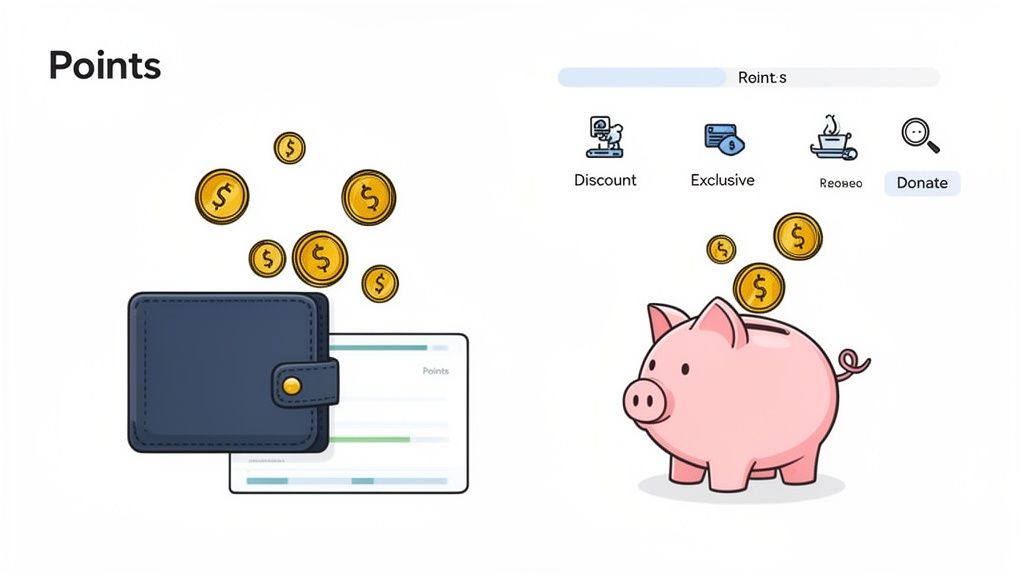
The success of any point-based loyalty program really comes down to its core mechanics—the rules for earning and spending points. Think of it as the engine of your program. A well-tuned engine is easy to understand, runs smoothly, and keeps customers coming back for their next reward.
The foundation is almost always a simple points-per-dollar system. It’s the most common model for a reason: it’s direct, intuitive, and gives customers that little hit of positive reinforcement with every purchase they make.
But if you stop there, you’re leaving a ton of value on the table. Your program can be so much more than a transactional tool. By rewarding a wider range of behaviors, you can turn it into a powerful way to build a real community around your brand.
Expanding How Customers Earn Points
To build a thriving loyalty economy, you have to think beyond the checkout page. The real goal is to encourage a deeper, more meaningful relationship with your brand.
Here are a few creative ways to let customers rack up points:
- Initial Engagement: Hand out a welcome bonus of 200 points just for creating an account. It’s a simple gesture that gives new members instant value and gets them invested from day one.
- Social Amplification: Offer points for following your brand on social media or sharing a product page. This turns your best customers into your best marketers.
- User-Generated Content: Reward customers for leaving a product review or uploading a photo. This not only boosts engagement but creates priceless social proof for other shoppers.
- Personal Milestones: Celebrate a customer's birthday with bonus points. It’s a small, personal touch that goes a long way in building an emotional connection.
Mixing up the earning rules like this makes interacting with your brand feel rewarding all the time, not just when a customer is ready to buy.
Defining What Your Points Are Worth
Once customers start collecting points, they need a clear picture of what they’re good for. This is where point valuation comes in, and it's a delicate balancing act. You need rewards that feel valuable and within reach, but the math has to work for your business.
A great starting point is the 1% back model. For example, if a customer earns 10 points for every $1 spent, and 1,000 points gets them a $10 discount, your reward rate is 1%. This is a sustainable and easy-to-understand structure for most e-commerce brands.
Your point value sends a clear message about how much you value your customers' loyalty. Make it transparent and consistent to build trust and ensure the perceived value of your rewards drives repeat business.
After you've set a baseline, you can get creative with a whole catalog of rewards that appeal to different types of customers. Discounts are great, but they're not the only game in town.
Consider offering things like:
- Exclusive Products: Let members use points to buy merchandise that isn't available to anyone else.
- Early Access: Give loyal customers a head start on new collections or major sales.
- Experiential Rewards: Offer access to special events, workshops, or even one-on-one consultations.
- Charitable Donations: Let customers turn their points into a donation to a partner charity, connecting your brand with a cause they care about.
Creating Urgency with Point Expiration
Finally, you need a smart policy for when points expire. It might sound a bit counterintuitive to take points away, but a well-designed expiration rule creates a sense of urgency that actually nudges customers to cash in their rewards. This is also critical for your accounting, as it prevents a massive, inactive liability from building up on your books.
The key is to be fair and totally transparent about it. A "rolling" expiration policy, where points expire after a period of inactivity (say, 12 months), is much more customer-friendly than a hard cutoff date. It encourages ongoing engagement without penalizing your active members. To really nail this down, you can check out our guide on how to set up an expiration policy for earned rewards or points.
Getting these mechanics right is absolutely essential. While plenty of customers sign up for loyalty programs, the global reward redemption rate was a shockingly low 28% in 2023. That huge gap between earning and redeeming often comes down to confusing rules or rewards that just don't inspire anyone. By making your program simple, valuable, and transparent, you build a system that customers will actually want to use.
How to Measure Success and Calculate ROI
So, you've launched a point-based loyalty program. That's a great start, but it's more than just a feel-good customer perk—it’s a serious business investment. And like any investment, you need to know if it's actually paying off. To do that, we need to ditch the guesswork and get comfortable with a little data.
Think of it like this: you wouldn't drive a car without a dashboard. Gauges for speed, fuel, and engine temperature tell you how things are running. The same principle applies here. You need a dashboard of key performance indicators (KPIs) to monitor your program's health and prove its value.
Core Metrics That Tell the Full Story
To really understand your program's impact, you have to look beyond surface-level numbers like how many points you've given out. The real magic is in tracking how your program is changing customer behavior for the better.
Here are the essential metrics you should have on your radar:
- Repeat Purchase Rate: This is your bread and butter. It's the percentage of customers who come back for a second, third, or fourth purchase. If this number is climbing for your loyalty members, your program is doing its job.
- Customer Lifetime Value (CLV): This is the total amount of money you can expect to make from a single customer over their entire relationship with you. The goal is simple: your loyalty members should have a significantly higher CLV than your non-members. That gap is pure profit driven by your program.
- Redemption Rate: This tells you what percentage of earned points are actually being used for rewards. A low rate can be a red flag. It might mean your rewards aren't exciting enough or that cashing in points is too much of a hassle.
A loyalty program isn't just about giving away discounts; it’s a data-driven tool for building more profitable customer relationships. When you track the right metrics, you can prove that every point issued is an investment in long-term growth.
This focus on data is exactly why the global loyalty management market, valued at $8.6 billion, is expected to hit $18.2 billion by 2026. Businesses are waking up to the power of using points to drive measurable results. For Shopify merchants, platforms like Toki are designed to make this happen, with some brands seeing up to 4.9X ROI on average. In fact, 80% of companies that actually measure their loyalty impact report a positive return, according to Yotpo's 2023 report on customer loyalty.
Calculating Your Loyalty Program ROI
While the metrics above show you how customer behavior is shifting, the Return on Investment (ROI) calculation ties everything directly to your finances. The formula itself is pretty simple, but it does require you to be diligent about tracking your program's costs and the revenue it generates.
Here’s a straightforward way to break it down:
- Calculate Total Program Revenue: Add up all the sales that came from your loyalty program members over a set period (like a quarter or a year).
- Subtract Program Costs: This includes the cost of the rewards people redeemed, your loyalty software fees, and any money you spent on marketing to promote the program.
- Divide by Program Costs: Take your net profit (Revenue - Costs) and divide it by the total program costs.
- Multiply by 100: This converts the number into a percentage, giving you your ROI.
Let's say your members spent $50,000 and the program cost you $10,000 to run. Your net gain is $40,000. That means your ROI is a whopping 400%! (($40,000 / $10,000) * 100). For a more detailed walkthrough, check out our guide on how to calculate your loyalty program ROI.
Using Data for Continuous Improvement
Your analytics dashboard isn't just a report card—it's a roadmap. By digging into the data, you can see who your most valuable customers are and what keeps them coming back. You can spot which rewards are flying off the shelves and which ones are collecting dust.
Use these insights to constantly refine your program. If a particular reward is a smash hit, make it a hero offer. If customers aren't bothering with a specific earning rule, it’s probably too confusing or not worth their time. This ongoing cycle of measuring, analyzing, and optimizing is what ensures your program stays relevant and continues to deliver a powerful return.
Common Pitfalls and How to Avoid Them
Even with the best intentions, a point based loyalty program can fall flat. It’s a classic story: a program launches with a lot of hype, only to see engagement drop off a cliff, turning it into a cost sink instead of a revenue booster. Knowing where others have stumbled is the key to designing a program that sidesteps these expensive mistakes from the get-go.
Honestly, the biggest killer is complexity. If your customers need a PhD to figure out how to earn points or what those points are even worth, they’re just going to check out. Simplicity is your best friend here; build something people will actually use.
The Pitfall of Confusing Rules
Think of your loyalty program like a board game. If the rules are a convoluted mess, nobody's going to stick around to play. When your earning rules are too tricky or the value of a point is a mystery, customers get frustrated and just give up.
The fix? Make clarity and transparency your guiding principles. A customer should be able to grasp the basic idea in about five seconds.
- Actionable Solution: Keep the earning model dead simple, like "10 points for every $1 spent." Then, make the value crystal clear everywhere, such as "1,000 points = $10 off." This straightforward approach cuts through the noise and builds trust right away.
The Problem of Uninspiring Rewards
Here's another frequent misstep: offering rewards that nobody actually wants. That generic 5% discount probably isn't going to convince someone to change their shopping habits, especially if they have to spend a small fortune just to earn it. The reward has to feel worth more than the effort.
Your rewards catalog should feel like a treasure chest of awesome perks, not a dusty old clearance rack.
A loyalty program is an emotional contract with your customer. If you promise value but deliver lackluster rewards, you risk eroding the very loyalty you're trying to build. The perceived value of the reward is everything.
To solve this, think beyond basic discounts. What would truly wow your best customers? Maybe it's exclusive products, early access to a big sale, or unique experiences that money can't buy. A quick survey asking customers what they’d love to see is an incredibly effective way to make sure your rewards actually land.
The Trap of Poor Communication
You could have the most amazing program in the world, but if nobody knows it exists or how to use it, it's destined to fail. A "set it and forget it" mindset is a surefire way to kill your program's momentum. You have to be proactive and consistently remind customers about the benefits.
Promoting your program isn't a one-and-done launch party; it's a continuous conversation.
- Actionable Solution: Weave your program into every customer touchpoint. Feature it on your homepage, mention it in order confirmation emails, and talk about it on social media. Sending out regular, personalized emails that show members their point balance and how close they are to their next reward is a great way to keep it top-of-mind and drive engagement.
Launching Your Program with Toki on Shopify
Alright, let's turn all this theory into action. If you're running on Shopify, launching a sophisticated point-based loyalty program is far less daunting than it sounds. You don't need a team of developers or weeks of setup—with a tool like Toki, the whole process is built to be straightforward.
The journey begins with a simple, guided setup. Once you install the app, the Toki dashboard becomes your command center. From here, you’ll lay down the core rules of your program: creating earning actions, setting point values, and designing rewards that actually make sense for your brand.
Effortless Setup and Customization
Toki's interface is designed for merchants who need to move quickly. You can get the basics—like points per dollar spent—configured in just a few clicks. But it’s the non-transactional behaviors where things get interesting. You can easily add rules to reward customers for things like creating an account, following you on social media, or even celebrating a birthday.
This screenshot gives you a peek inside the clear, step-by-step process in the Toki dashboard.
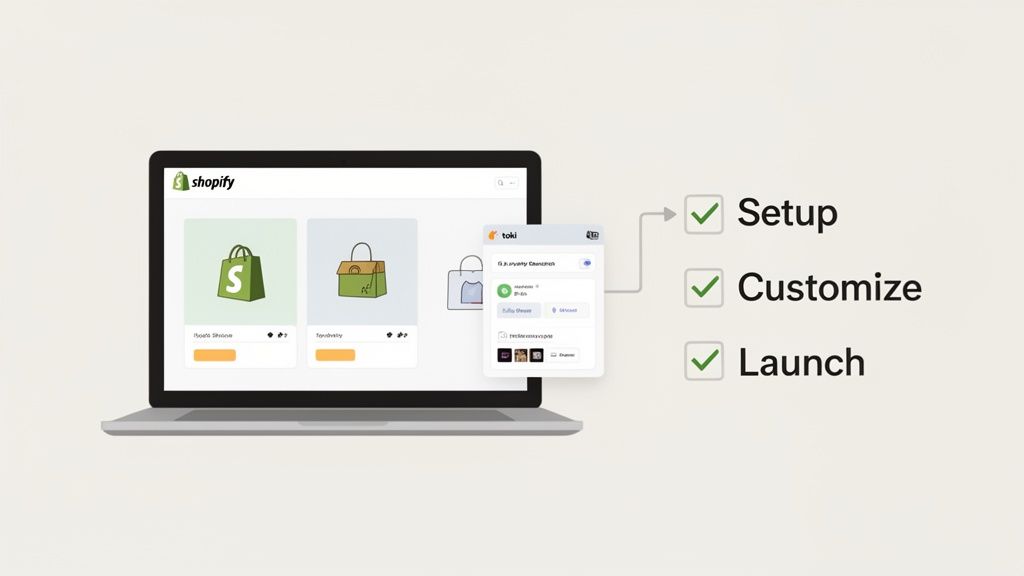
The platform turns what would normally be complex features into simple toggles and settings, letting you build a program that feels completely custom.
This is where you can start layering in more advanced strategies without the usual headache. Toki makes it easy to add features that drive deeper engagement and make your program feel special.
- Tiered Memberships: Build out VIP levels to give your best customers exclusive perks and better earning rates. It’s a great way to make them feel valued while motivating everyone else to climb the ladder.
- Gamification Elements: Incorporate challenges, badges, and milestones to make earning points feel more like a fun game than a transaction.
- Digital Wallet Integration: Let members add their loyalty card right to their Apple and Google Wallet. This creates a seamless experience, bridging the gap between online and in-person shopping.
Toki simplifies the technical side of loyalty so you can focus on the creative strategy. You get the power of an enterprise-level system with the user-friendliness that modern e-commerce brands need to move fast.
Getting started is genuinely painless. In fact, you can install Toki from the Shopify App Store and have a foundational program up and running in minutes. This means you can start gathering data and seeing a return almost immediately, turning your loyalty program from an idea into a real, revenue-generating asset.
Frequently Asked Questions
Even with the best planning, a few common questions always pop up before launching a point based loyalty program. Let's tackle these head-on. Getting these details right will help you sidestep common pitfalls and launch your program with confidence.
Think of this as a quick-start guide to the nitty-gritty decisions that can make or break your program's success right out of the gate.
How Do I Decide What My Points Are Worth?
Figuring out your points' value is one of the most critical first steps, and it's easy to overcomplicate. A great, safe place for most brands to start is the 1% back model. It’s easy for customers to grasp and financially sustainable for you.
Here’s the simple math behind it:
- A customer spends $100 and earns 1,000 points.
- Those 1,000 points are worth a $1 discount on a future purchase.
This gives your customers a clear 1% return on what they spend. You can always tweak this based on your margins and goals, but this formula provides a competitive value proposition without eating into your profits.
Should My Loyalty Points Expire?
Yes, they should—but thoughtfully. Point expiration is a fantastic way to create a little urgency and get customers to actually use the rewards they’ve earned. It also keeps a growing liability of unredeemed points off your books. The trick is to do it without making customers feel punished.
An expiration policy isn't about taking points away; it's about giving customers a gentle nudge to come back and treat themselves. A fair policy encourages action while respecting the loyalty they've shown.
The gold standard here is a "rolling" expiration. This means points only expire after a period of inactivity, usually 12 months. So, as long as a customer keeps earning or spending points, their balance is safe. This approach rewards your truly active fans while cleaning up dormant accounts.
What Are the Best Ways to Promote My New Program?
A loyalty program can't succeed if nobody knows it exists. A "build it and they will come" approach just doesn't work. You have to shout about it from the rooftops across every channel you have.
Here are three promotion tactics that always deliver:
- Welcome Email Campaign: Blast an announcement to your entire email list. Make sure to spell out the benefits and maybe even toss in a small point bonus for signing up right away.
- Website Banners and Pop-Ups: Place a can't-miss-it banner on your homepage. Use well-timed pop-ups to catch visitors’ attention and make joining the program a one-click affair.
- Post-Purchase Messaging: Right after a customer buys something, their engagement is sky-high. Use the order confirmation email to show them the points they just earned. It immediately reinforces the program's value.
Ready to put these answers into action? Toki gives you all the tools to build, launch, and grow a point-based loyalty program that turns first-time shoppers into loyal fans. Discover how Toki can transform your customer retention strategy today.