Your Guide to an Omnichannel Commerce Solution
Discover how an omnichannel commerce solution unifies customer experiences to boost loyalty and sales. Learn key features, benefits, and implementation steps.
At its core, an omnichannel commerce solution is the engine that powers a truly unified customer experience. It’s the technology and the strategy that connect every way a customer can interact with your brand—from your website and mobile app to your physical stores—into one seamless conversation. The goal is to make a customer's journey feel continuous, recognizing them and their history no matter where they are.
Why a Unified Customer View Is a Game-Changer
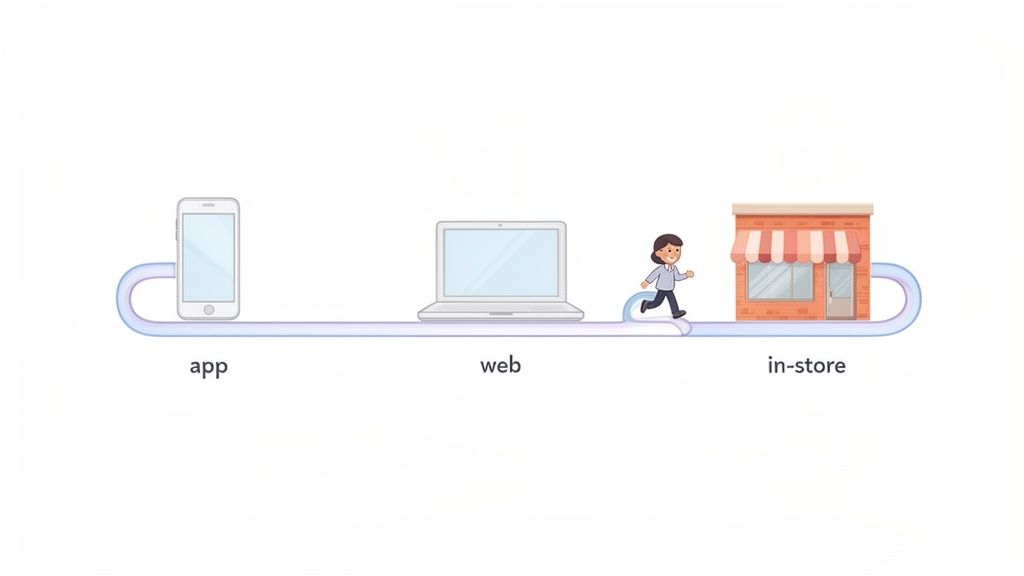
We've all been there: explaining an issue to a customer service agent, only to be transferred to another department and forced to start all over again. That's the frustrating reality of a disjointed, multichannel experience. The channels exist, but they operate in their own little worlds, completely unaware of each other.
An omnichannel commerce solution shatters these silos. It's not just about having a website, an app, and a brick-and-mortar store. It's about making them work together as a single, intelligent system that revolves around the customer.
From Disconnected Channels to a Single Conversation
In a typical multichannel setup, your online store and physical shop might as well be on different planets. A customer who spends an hour browsing products online is a complete stranger the moment they walk through your front door. Their shopping cart, browsing history, and loyalty points are trapped in a digital vault.
Omnichannel tears down these walls. It creates a central hub for all customer data, inventory levels, and order history, making it accessible across every touchpoint. This is what makes modern, fluid retail experiences possible.
- A shopper adds a pair of shoes to their cart on a laptop and gets a friendly reminder on their phone a few hours later.
- They walk into a store, and a sales associate can instantly pull up their online wishlist to offer tailored recommendations.
- They decide to buy the shoes in-store but have them shipped directly to their home, all handled in a single, smooth transaction.
This level of integration isn't a futuristic concept; it's rapidly becoming the standard. The global omnichannel retail market is expected to jump from USD 10.13 billion in 2025 to a staggering USD 25.35 billion by 2032. This explosive growth shows just how much consumer expectations and business priorities have shifted.
The Real Impact on Your Business
Adopting an omnichannel strategy isn't just a tech upgrade—it's a fundamental change in how you think about your customers. It’s about building a foundation for real loyalty by removing friction from their journey. At the heart of it all, a great omnichannel system depends on reliable digital payment solutions for businesses to make sure paying is as effortless as browsing.
An omnichannel approach isn't about giving customers more channels; it's about giving them one unified brand experience, empowering them to shop how, when, and where they want without interruption.
This unified view leads directly to happier customers and a higher lifetime value. When every interaction feels connected, personal, and easy, people are far more likely to stick around and become advocates for your brand. By exploring the different omnichannel retail solutions available, you can begin building a more resilient and customer-obsessed business.
The Core Capabilities of a Modern Omnichannel Platform
Think of a true omnichannel commerce solution as your business's central nervous system. It connects every single customer touchpoint—your website, physical stores, mobile app, you name it—into one intelligent, cohesive network. Instead of having separate, siloed systems that don't talk to each other, a modern platform unifies them all. This allows data to flow freely, creating a consistent and context-aware experience for every shopper, no matter how they decide to engage with your brand.
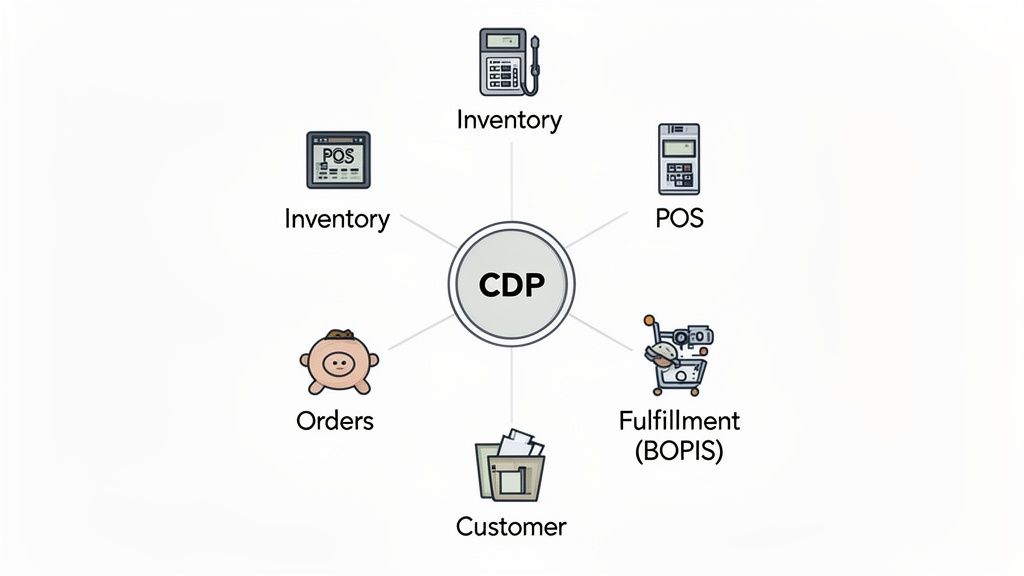
This interconnectedness isn’t just a nice-to-have; it's about making your customer feel seen and valued at every step of their journey. A powerful platform makes this a reality by delivering a specific set of core capabilities that work together seamlessly. Without these foundational pieces, you’re just running a multichannel business, not a truly unified omnichannel one.
Centralized Customer Data Platform
At the very heart of any effective omnichannel solution is a Centralized Customer Data Platform (CDP). You can think of a CDP as your brand's memory. It diligently collects and organizes every piece of customer information—from their online browsing history and abandoned carts to their in-store purchases and loyalty points—into a single, easy-to-understand profile.
This 360-degree view is a game-changer. Imagine a customer browses for a specific jacket on your website, then walks into one of your stores. Your sales associate can pull up that history on their POS terminal and offer personalized help. That simple interaction elevates a routine shopping trip into a high-touch, consultative experience, building a much stronger relationship.
Ultimately, a modern platform is crucial for effective customer experience management, making sure every single interaction is smooth and meaningful across all your channels.
Unified Inventory Management
One of the most frustrating experiences for a customer is seeing an item listed as "in stock" online, only to drive to the store and find an empty shelf. A unified inventory management system eliminates this classic retail pain point. It provides a real-time, single source of truth for your stock levels across every location, including all your warehouses and brick-and-mortar stores.
This capability is the engine behind modern fulfillment. When an item sells online, the inventory is instantly updated across the entire network, which prevents overselling and disappointment. It also gives your team the power to find any product for a customer, whether it needs to be shipped from another store or set aside for local pickup.
By breaking down inventory silos, you not only improve operational efficiency but also build customer trust. Accurate stock information prevents disappointment and sets clear expectations, which is vital for customer retention.
Flexible Order Fulfillment and Management
Today’s shoppers demand convenience and choice, especially when it comes to getting their hands on their purchases. A genuine omnichannel platform has to support flexible fulfillment models that expertly blend your digital and physical operations.
Key fulfillment options you need to offer include:
- Buy Online, Pick-up In-Store (BOPIS): Lets customers buy online and grab their order from a local store, often in just a few hours. This is no longer a novelty; over 50% of adult shoppers now use BOPIS.
- Ship-from-Store: This model turns your retail locations into mini-distribution hubs. You can fulfill online orders from the store closest to the customer, drastically cutting down delivery times and helping you move inventory that might be sitting on a shelf.
- Seamless Returns: Allowing customers to return an online purchase to any of your physical stores is a must. This simple convenience removes a huge barrier to buying online and gives shoppers the confidence to click "purchase."
Seamless POS Integration
Last but not least, your Point of Sale (POS) system can't be an isolated island of technology. In a proper omnichannel setup, the POS transforms into a powerful command center, connecting the in-store experience to your entire digital ecosystem. A modern, integrated POS gives your team the ability to:
- Access Customer Profiles: Associates can instantly look up a customer’s purchase history, loyalty status, and even their online wishlists.
- Process Cross-Channel Transactions: They can handle in-store returns for online orders or place an online order for an out-of-stock item right on the spot.
- Apply Unified Promotions: This ensures that all your discounts and loyalty rewards are consistent, whether a customer is checking out on your website or in your store.
This deep integration changes the role of a store associate from a simple cashier into a knowledgeable brand expert, armed with the tools to provide a genuinely personal and helpful experience.
How Omnichannel Strategies Drive Real Business Growth
An omnichannel commerce solution isn't just a tech upgrade; it’s a direct line to serious business growth. When you tear down the walls between your sales channels, you start having one continuous conversation with your customers. This is what turns a one-off purchase into a lifelong, profitable relationship.
Think about it from the customer's perspective. When every interaction feels connected, they feel understood and valued. That seamless experience encourages them to spend more, come back more often, and become genuine fans of your brand. They no longer see your app, website, and physical store as separate islands—it's all just one convenient way to shop with a company they trust.
Connecting Actions to Outcomes
The real magic of an omnichannel strategy is how it directly improves the numbers that matter. A single view of your customer lets you move beyond generic marketing to create highly relevant experiences that drive specific, profitable actions. It’s about building genuine loyalty that you can see in your revenue.
The data backs this up. Campaigns that run across three or more channels see a 287% higher purchase rate than single-channel efforts. That’s because repeated, consistent messaging across social ads, emails, and in-app notifications builds trust and a sense of urgency. You can dig into more eye-opening numbers by checking out these omnichannel marketing statistics on AmraandElma.com.
Let’s make this real. Imagine a customer, Sarah, browsing for a new handbag on your website. She likes one but gets distracted and doesn't buy it. Later that week, she walks into one of your physical stores.
- The Old Way (Multichannel): Sarah is a complete stranger. The store associate has no clue she’s a warm lead who has already done her homework. The opportunity evaporates.
- The New Way (Omnichannel): The moment Sarah connects to the store's Wi-Fi or scans her loyalty app, your system knows she's there. A store associate gets a quiet alert on their tablet, sees her browsing history, and says, "Hi Sarah, I see you were looking at the leather tote online. We have it right over here if you'd like to see it in person."
That single, context-aware interaction doesn't just close the sale. It makes Sarah feel like a VIP, dramatically increasing the odds she'll be back.
Key Performance Indicators to Measure Success
To really know if your investment is paying off, you have to track the right metrics. These Key Performance Indicators (KPIs) tell you exactly how well your omnichannel commerce solution is performing and where you can make it even better.
An effective omnichannel strategy isn't measured by how many channels you use. It's measured by how seamlessly they work together to increase customer value. The real goal is to make every touchpoint feel like part of a single, effortless journey.
Focus on these essential KPIs to get a clear picture of your growth:
- Customer Lifetime Value (CLV): This is the ultimate report card. Compare the CLV of customers who shop across multiple channels versus those who only use one. You’ll almost certainly find that your omnichannel shoppers are far more valuable over the long haul.
- Average Order Value (AOV): Are your omnichannel customers spending more per transaction? Track AOV by channel and for customers who use a mix of them. Features like Buy Online, Pick-up In-Store (BOPIS) are famous for inspiring additional in-store purchases, pushing that total transaction value higher.
- Customer Retention Rate: A smooth, connected experience is a sticky one. Keep an eye on your retention rate before and after you roll out unified features like a universal loyalty program or cross-channel returns.
- Channel Conversion Rates: Dig into how different touchpoints work together to secure a purchase. For instance, how many in-store sales started with online research? This data helps you map the complete customer journey and fine-tune every step.
Powering Your Omnichannel Loyalty Strategy
An omnichannel commerce solution truly shines when it moves beyond simple transactions and starts building genuine relationships. This is where a modern loyalty platform becomes your secret weapon, acting as the glue that connects your digital and physical worlds. It’s how you take the idea of a unified customer experience and turn it into a rewarding reality for every single shopper.
A loyalty program designed for an omnichannel world doesn't just sit on your website; it travels with your customer. Every interaction, whether it happens on your app or at your cash register, feeds into one single, shared journey. This consistency is what elevates a basic rewards system into a powerful engine for building real brand affinity and driving repeat business.
From Siloed Points to a Unified Journey
Think about the classic, disconnected setup: a customer earns points online that they can’t use in your store, or vice versa. It’s clunky and frustrating, completely defeating the purpose of a loyalty program. An integrated solution, on the other hand, makes sure every point earned and every reward redeemed is recognized instantly, everywhere.
Here’s a look at how a platform like Toki makes this connection feel so effortless:
- Digital Wallet Integration: Customers can add their loyalty pass right to their Apple or Google Wallet. At checkout, a quick scan of their phone at the POS identifies them and applies their points or rewards on the spot. No friction, no fuss.
- Cross-Channel Redemptions: A customer unlocks a discount online for hitting a new loyalty tier. They can then walk into a physical store and redeem it just as easily. The POS system already knows who they are and applies the benefit automatically.
- Unified Membership Perks: Someone who buys a VIP membership on your website can stroll into a store and immediately get exclusive perks, like early access to a new collection, just by giving their name or email.
This level of seamlessness shows customers you see them as one person, not as a separate “online shopper” and “in-store shopper.” It’s a subtle but incredibly powerful way to build trust and make them feel like they truly belong to your brand’s community.
Making Omnichannel Loyalty Actionable
Seeing how this works in practice makes it all click. Customers need to be able to check their loyalty status, see available rewards, and track their points balance from anywhere, on any device, without any hassle.
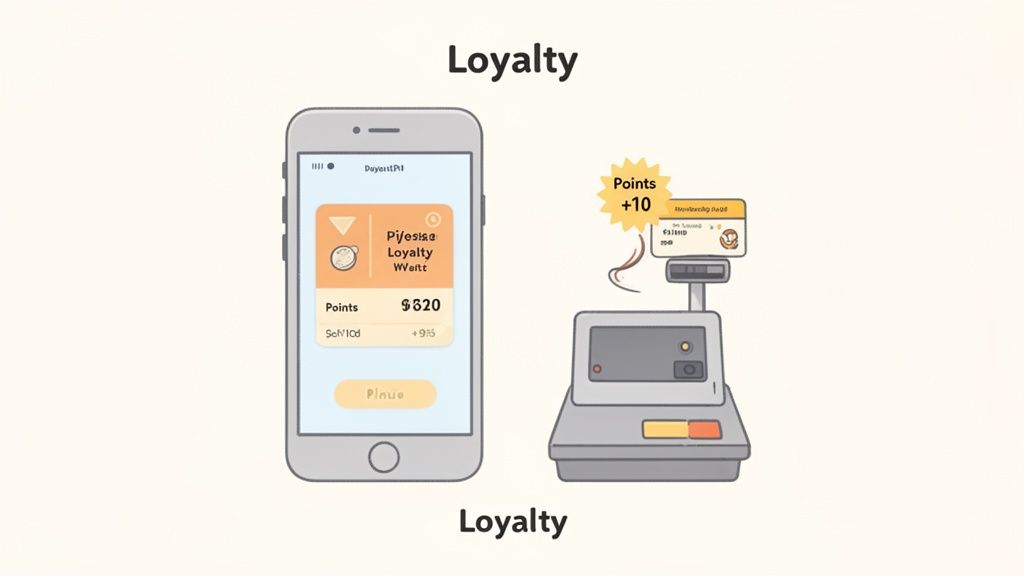
As you can see, a modern loyalty platform gives customers a single, clear view of their standing. This simple, unified interface empowers them to actively engage with your program, whether they’re browsing on their couch or standing in the checkout line.
This unified approach should touch every part of your loyalty strategy, from referrals to rewards.
A truly great omnichannel loyalty program makes the customer forget where they are. The experience is so consistent that the channel fades into the background, and all that's left is the relationship with your brand.
For instance, a customer can share a referral code with a friend from your app. That friend can use the code to make their first purchase in one of your brick-and-mortar stores, and the original customer instantly gets their reward points. This closes the loop between digital advocacy and physical sales, turning your best customers into powerful, channel-agnostic brand ambassadors. If you want to dive deeper into this, you can explore the fundamentals of designing an omnichannel loyalty program and see how these strategies fuel retention.
Ultimately, integrating your loyalty program isn’t just an optional add-on; it’s a non-negotiable part of a successful omnichannel commerce solution. It's the final piece of the puzzle that ensures every interaction, no matter where it happens, strengthens the customer's connection to your brand and drives real, long-term growth.
Your Roadmap to Implementing an Omnichannel Solution
Shifting to a true omnichannel model isn't like flipping a switch; it’s more like building a bridge. You need a solid plan to connect all your existing systems and processes into one seamless structure. This roadmap breaks that complex journey down into manageable phases, taking you from your first assessment all the way to ongoing optimization.
Jumping in without a clear, step-by-step plan is a recipe for common (and costly) mistakes, like creating new data silos or launching features before your team is even ready. A structured implementation makes sure your omnichannel commerce solution is built on a foundation that can actually support long-term growth.
Phase 1: Audit Your Current Tech Stack
Before you can build anything new, you need a detailed blueprint of what you already have. This first step involves mapping out every single piece of technology that touches the customer journey. Think of it as a thorough inventory check for both your digital and physical operations.
Your goal here is to get brutally honest about your strengths and weaknesses. Which systems are modern and easy to connect to? Which ones are old, clunky, and operating in a vacuum? This assessment will quickly show you where the gaps are and which core systems you can reliably build on.
- E-commerce Platform: How flexible is it, really? Can it integrate smoothly with other tools?
- Point of Sale (POS) System: Is it capable of connecting to a central customer database and inventory system?
- Customer Relationship Management (CRM): Where does all your customer data live, and how easy is it to access and use?
- Inventory Management Software: Does it give you a single, real-time view of stock across every single location?
Understanding how these pieces fit together is crucial. For a deeper look at this, our guide on customer data integration best practices is a great resource for unifying all those disparate data sources.
Phase 2: Define Your Core Business Goals
Once you have a clear picture of your technology, it's time to define what success actually looks like. An omnichannel strategy needs to be tied directly to real-world business outcomes. Are you trying to boost customer lifetime value? Cut down shipping times with ship-from-store? Or maybe drive more foot traffic with options like Buy Online, Pick-up In-Store (BOPIS)?
Setting specific, measurable goals gives your project a clear direction and makes prioritization so much easier. Instead of a vague goal like "improve the customer experience," get specific. Aim for something like, "increase the average order value of BOPIS orders by 15% within six months." That kind of clarity ensures every decision you make serves a real purpose.
Phase 3: Select the Right Technology Partners
Choosing the right partners is easily one of the most critical steps you'll take. The technology you pick has to do more than just fill your current gaps—it has to be able to scale as your ambitions grow. Look for platforms that have robust APIs, a proven history of successful integrations, and a clear focus on creating a unified data environment.
A vendor shouldn't just sell you software; they should provide a partnership. Evaluate their support, onboarding process, and their roadmap for future innovation to ensure they align with your long-term vision.
Retailers are making this decision with increasing urgency. While only 17% of US specialty retailers currently feel their unified commerce capabilities are mature, a whopping 38% are planning to make major advancements in 2025. This rapid shift shows just how important it is to pick partners who can deliver a sophisticated omnichannel commerce solution. You can dig into this trend and what it means for the industry by reading the full report on 2025 omnichannel trends on Manh.com.
Choosing the right technology partner is a decision that will shape your omnichannel future. To help you make a more informed choice, here is a practical checklist you can use during your evaluation process.
Vendor Selection Checklist for Omnichannel Technology
This checklist is designed to help you evaluate and choose the right technology partners for your omnichannel strategy, ensuring seamless integration and scalability.
| Evaluation Criteria | Key Questions to Ask | Importance (High/Medium/Low) |
|---|---|---|
| Integration Capabilities | Does the platform have pre-built integrations with our existing systems (POS, ERP, e-commerce)? How robust and well-documented is their API? | High |
| Unified Data Model | Can the system create a single, unified profile for each customer across all channels? Does it support real-time data synchronization? | High |
| Scalability & Performance | Can the platform handle our peak season traffic and transaction volumes without performance degradation? What is their architecture built on? | High |
| Core Omnichannel Features | Does it natively support key use cases like BOPIS, ship-from-store, and endless aisle? How configurable are these features? | Medium |
| Partner Support & Onboarding | What does the implementation process look like? What level of technical support is included? Do they offer a dedicated success manager? | Medium |
| Future Roadmap | What new features or integrations are on their product roadmap for the next 12-18 months? How do they incorporate customer feedback? | Low |
Using a structured framework like this helps ensure you're not just buying a piece of software, but investing in a long-term partnership that aligns with your business goals.
Phase 4: Execute a Phased Rollout
A "big bang" launch, where everything goes live at once, is incredibly risky. A much smarter approach is a phased rollout, which lets you implement, test, and refine your new capabilities in a controlled environment. This minimizes disruption to your business and gives your team time to adapt to new workflows.
Start with something that offers high impact but has low complexity. For many retailers, rolling out BOPIS is the perfect first step. It provides immediate, tangible value to customers and serves as a real-world test for your newly unified inventory and order management systems. Once that's running smoothly, you can move on to more complex initiatives like ship-from-store or a unified loyalty program.
Phase 5: Measure and Optimize Continuously
Launching your new omnichannel features isn't the finish line—it's the starting line for continuous improvement. As soon as your new systems are live, you need to be diligently tracking the KPIs you set back in phase two. Keep a close eye on metrics like cross-channel conversion rates, customer retention, and fulfillment efficiency.
Use this data to find friction points and uncover opportunities for improvement. Is the in-store pickup process taking too long? Are customers having trouble redeeming loyalty points online versus in-store? This data-driven feedback loop is what turns your omnichannel platform from a static system into a dynamic engine for growth, constantly adapting to better serve your customers.
Common Questions About Omnichannel Commerce
Thinking about moving to an omnichannel model naturally brings up a lot of questions. It’s a big shift, so it's smart to think through the cost, the complexity, and what the real-world impact will be. Let’s walk through some of the most common concerns to help clear the path forward.
First, here’s a high-level look at what the journey entails, from the initial planning stages all the way to a full rollout.

As you can see, a structured approach is everything. You have to know where you are now, pick the right tools for the job, and then execute your plan thoughtfully.
Answering Key Omnichannel Questions
What is the biggest challenge when implementing an omnichannel commerce solution? Hands down, the single biggest hurdle is almost always data integration. Think about it: to create that coveted single view of the customer, you have to pull together information from all your separate systems—your Shopify store, your POS, your marketing platforms. These systems usually don't talk to each other. Breaking down those data silos is the critical first step to delivering the consistent experience that omnichannel is all about.
Can a small business implement an omnichannel strategy? Absolutely. You don't need a massive budget or a huge team. The trick for small businesses is to start smart, not big. Instead of a massive, disruptive overhaul, take a phased approach.
Begin by integrating your online store with just one physical location. A modern POS system and a compatible loyalty platform can bridge that gap. From there, you can introduce high-impact features like click-and-collect or a unified rewards program that works both online and in-store. These are perfect starting points.
The key for any business, regardless of size, is to select scalable, user-friendly tools that can grow alongside your brand. An omnichannel commerce solution should adapt to your needs, not the other way around.
How do I measure the ROI of my omnichannel investment? Measuring your return on investment comes down to tracking the right KPIs—the ones that truly reflect a connected customer journey. The most telling metrics include:
- Customer Lifetime Value (CLV): Are your omnichannel shoppers more valuable over time than your single-channel customers? The data will tell you.
- Retention Rates: Keep an eye on how many customers keep coming back after you roll out new unified features.
- Average Order Value (AOV): Do customers who engage with you across multiple channels actually spend more per purchase?
Tracking these numbers gives you concrete proof of how a seamless experience directly impacts your bottom line and builds a foundation for long-term growth.
Ready to bridge the gap between your online and in-store experiences? With Toki, you can launch a powerful loyalty program that unifies every customer touchpoint, from digital wallets to your physical POS.
Start building a seamless omnichannel loyalty strategy today.