How to Create Affiliate Program That Drives Real Growth
Learn how to create affiliate program that attracts top partners and boosts revenue with practical steps on strategy, setup, commissions, tech, and optimization.
Before you even think about software, tracking links, or sending your first recruitment email, you have to get the foundation right. The success of any affiliate program is built on the strategic groundwork you do upfront.
Building the Foundation for a Profitable Program
Jumping straight into the technical setup without a clear plan is a classic mistake. It's like building a house on sand—it might look okay for a little while, but it's destined to crumble. A solid foundation ensures every decision you make, from commission rates to the partners you choose, actually supports your business goals.
Too many brands launch an affiliate program just because their competitors did. That’s a recipe for disaster. It often leads to recruiting the wrong partners, tracking meaningless metrics, and ultimately, a disappointing return on your effort. A proactive approach starts with looking inward. What does a "successful" program actually look like for your business?
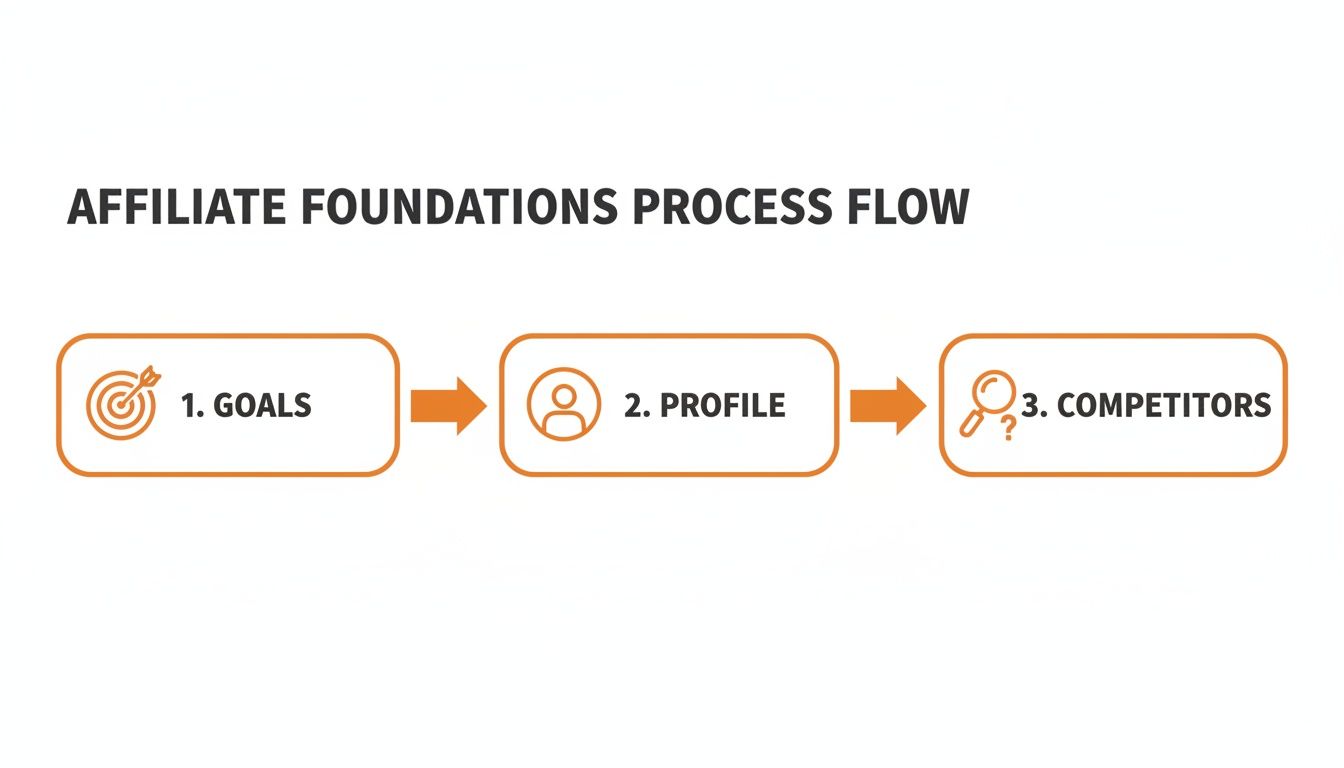
This process flow hits the nail on the head. You start with your internal strategy—goals, ideal partners, and competitor analysis—long before you start reaching out to anyone.
Define Your Primary Business Goals
First things first: what are you trying to achieve? Your program's objectives need to be specific, measurable, and tied directly to your company's bigger picture. Are you after raw sales numbers, or is getting your brand noticed in a new market the top priority? Maybe you just need more qualified leads for your sales team to close.
Here are a few of the most common goals I see:
- Boost Sales Revenue: The most straightforward goal, focused on driving direct conversions.
- Generate Qualified Leads: Perfect for B2B companies or businesses with a longer sales cycle.
- Drive Relevant Website Traffic: Using partners to introduce your brand to new, highly-targeted audiences.
- Increase Brand Awareness: Collaborating with influential creators to build trust and market credibility.
Getting this clear from the start saves you from what I call "metric chaos"—tracking everything but measuring nothing that matters. If your goal is lead generation, then sales volume is a nice bonus, not your main success metric. This clarity helps you design a program that rewards the right actions. If you're looking for a bird's-eye view of the whole process, this guide on how to start an affiliate program is a great resource.
To help you get started, here’s a quick breakdown of common goals and the KPIs you should be watching.
Core Affiliate Program Goals and Key Metrics
This table maps out some typical business objectives and the specific metrics that will tell you if you're on the right track.
| Business Goal | Primary KPI | Secondary Metric |
|---|---|---|
| Increase Sales Revenue | Total Affiliate-Driven Revenue | Average Order Value (AOV) |
| Generate Qualified Leads | Number of Qualified Leads | Lead-to-Customer Conversion Rate |
| Boost Website Traffic | Clicks, New Users from Affiliates | Bounce Rate, Pages per Session |
| Improve Brand Awareness | Impressions, Social Media Mentions | Branded Search Volume Lift |
Focusing on the right KPIs keeps your program aligned and makes it much easier to prove its value down the road.
Profile Your Ideal Affiliate Partner
Let’s be clear: not all affiliates are created equal. A creator with a million followers might sound incredible, but if their audience isn’t your target customer, the partnership is going to be a dud. That’s why creating a detailed profile of your "ideal affiliate" is a step you just can't skip.
Go deeper than just follower counts and website traffic. Ask yourself these questions:
- Audience Alignment: Does their audience's demographic and psychographic profile line up with your best customers?
- Content Quality: Is their content authentic, well-produced, and trustworthy? Shoddy content can do more harm than good to your brand.
- Real Engagement: Forget vanity metrics. Look for active communities with real conversations, shares, and discussions.
- Shared Brand Values: Do they operate with a similar ethos? A partnership with someone whose values clash with yours is a ticking time bomb.
A top-tier affiliate is more than just a source of traffic—they are an extension of your marketing team. Choose partners who can genuinely stand behind your brand because they believe in what you offer and respect their audience.
Analyze the Competitive Landscape
Finally, you need to know what you’re up against. A little sleuthing into your competitors' affiliate programs gives you a crucial baseline for what potential partners expect. Simply searching for "[Competitor Name] affiliate program" will usually take you right where you need to go.
As you dig in, pay close attention to:
- Commission Rates: What percentage or flat fee are they paying out?
- Cookie Duration: How long does a referral cookie last after a click? 30, 60, or 90 days are the industry standards.
- Partner Support: Are they offering high-quality banners, email copy, and a dedicated manager?
The goal here isn't to copy your competitors. It's to position your program competitively. If your main rival offers a 20% commission and you launch with a 5% offer, you'll have a tough time attracting any serious talent. This homework ensures your program is attractive right out of the gate.
Designing a Commission Structure That Attracts Top Talent
Let’s be honest: your commission structure is the heart of your affiliate program. It’s what gets potential partners excited to work with you, but it also has to make sense for your bottom line. Nailing this balance between a compelling offer and a sustainable business model is everything.
A great structure isn't just about throwing the highest percentage at the wall and hoping it sticks. It's about creating a system that’s fair, transparent, and perfectly aligned with your business. Get it wrong, and you’ll either struggle to attract anyone worthwhile or, worse, watch your profits evaporate.
Choosing the Right Commission Model
First things first, you need to pick the right type of commission. The best fit depends entirely on what you’re selling. An ecommerce brand with a physical product will think about this differently than a SaaS company with a monthly subscription.
Here are the most common models I see work in the wild:
- Percentage of Sale (PPS): This is the classic model. Affiliates get a fixed percentage of every sale they drive. It’s perfect for ecommerce, digital downloads, and pretty much any one-time purchase. Think of a Shopify store selling apparel—offering a 10-15% commission is a great starting point.
- Recurring Commission: If you run a subscription business (like a SaaS platform or a membership), this is the gold standard. Your partners earn a commission not just on the initial sign-up, but for as long as that customer sticks around. A SaaS company might offer a 30% recurring commission for the first 12 months of a customer's subscription.
- Tiered Commission: This is how you really motivate your top performers. The idea is simple: the more they sell, the higher their commission rate gets. It gamifies the process and keeps your best partners pushing for more. You could offer 15% for up to 10 sales a month, bump it to 20% for 11-25 sales, and hit 25% for anything beyond that.
The key is to match the commission model to your revenue model. Recurring commissions build long-term partnerships for subscription services, while tiered structures gamify performance and incentivize growth for any business type.
To help you decide, let's lay out the options side-by-side.
Comparing Affiliate Commission Models
This table breaks down the most common affiliate commission structures to help you find the perfect fit for your business and your goals.
| Commission Model | Best For | Typical Rate/Structure | Pros | Cons |
|---|---|---|---|---|
| Percentage of Sale | Ecommerce, digital products, one-time purchases | 5-30% of the sale price | Simple to understand and implement. Directly ties rewards to revenue. | May not incentivize promotion of lower-priced items. |
| Recurring Commission | SaaS, subscription boxes, memberships | 10-40% of the recurring payment (often for a limited time, e.g., first 12 months) | Highly attractive to affiliates; encourages long-term partnerships and quality referrals. | Can become costly if customer churn is low. Requires robust tracking. |
| Tiered Commission | Any business aiming to motivate high-performers | Starts at a base rate (e.g., 15%) and increases with volume (e.g., 20% at 10 sales, 25% at 25 sales) | Motivates top affiliates to sell more. Rewards loyalty and performance. | Can be complex to manage. May demotivate smaller affiliates. |
Choosing the right model is a strategic decision that signals to affiliates what kind of partnership you're looking to build.
Setting Competitive Yet Sustainable Rates
Okay, you've picked a model. Now for the numbers. This is where you have to get real about your own finances—specifically your Customer Acquisition Cost (CAC) and Customer Lifetime Value (LTV).
A huge mistake I see brands make is just copying a competitor’s rate. That’s a dangerous game. If their cost of goods is way lower than yours, their "generous" 25% commission could sink your business.
Instead, work backward from your profit margin. If your margin on a sale is 40%, offering a 30% commission is probably unsustainable. It leaves you almost nothing for marketing, operations, or just plain profit. A 15-20% rate might be a much smarter, more sustainable choice. For a deeper dive into structuring various incentives, you might be interested in our guide on designing effective referral program rewards.
It also pays to know the industry benchmarks. You don't have to look further than the giant in the room: Amazon Associates, which holds a massive 46.62% of the global affiliate market share. While their rates vary wildly, their scale—involving nearly 95,000 companies—sets a baseline for what affiliates expect in terms of reliability. With the global affiliate market projected to jump from $18.5 billion to $31.7 billion by 2031, getting your rates right is a massive opportunity.
Don't Forget the Cookie Duration
The cookie duration, also called the referral window, is a critical piece of the puzzle that many merchants overlook. It’s the length of time after someone clicks an affiliate’s link that the affiliate is still eligible for a commission on a sale.
A short cookie duration can feel like a slap in the face to an affiliate, especially if you have a longer sales cycle. It just feels unfair.
Think about it this way:
- Low-Cost, Impulse Buys: Selling a $20 t-shirt? A 30-day cookie is pretty standard. The decision to buy is made quickly.
- High-Consideration Purchases: Selling a $2,000 online course or a B2B software subscription? The customer might research for weeks or even months. Here, a 60, 90, or even 120-day cookie is far more appropriate.
Matching your cookie duration to your customer’s buying cycle shows you respect the work your partners do. It builds trust and proves you understand their value, making your program infinitely more attractive to the seasoned affiliates you want on your team.
Choosing Your Tech Stack and Nailing the Setup

Your commission structure is the engine of your affiliate program, but your tech is the chassis holding it all together. Without reliable software, even the most generous offer will sputter out from missed clicks, inaccurate payouts, and frustrated partners. This is where you build the operational backbone of your entire affiliate marketing effort.
The biggest decision you'll face is whether to join a large, established affiliate network or manage your program in-house with self-hosted software. There’s no single right answer here. The best choice really depends on your budget, technical know-how, and how fast you want to scale.
Affiliate Networks vs. Self-Hosted Software
Think of an affiliate network like a bustling marketplace. Platforms like ShareASale, CJ Affiliate, or Rakuten give you a ready-made ecosystem packed with thousands of vetted affiliates who are actively hunting for new products to promote. You get instant access to a massive talent pool and can lean on their established trust and robust tracking infrastructure.
The catch? Networks come with some serious costs. You’re often looking at setup fees, monthly charges, and a network override—a percentage of every single commission you pay. For example, a network might skim an additional 20-30% on top of the affiliate’s cut.
On the other hand, self-hosted software like Tapfiliate or dedicated Shopify apps puts you in the driver’s seat. You build your program on your own terms, dodge those network fees, and own the relationship with your affiliates from day one. This route gives you far more customization and is usually much more cost-effective in the long run.
The challenge, of course, is recruitment. Without the network's built-in discovery engine, you're on the hook for finding, vetting, and onboarding every single partner yourself. It requires a dedicated effort, especially in the early days when you're trying to build momentum from scratch.
Your choice boils down to a classic trade-off: Pay for reach or invest the time to build it yourself. Networks fast-track recruitment but take a slice of the pie, while self-hosted software saves money but demands a hands-on approach to growth.
Key Factors for Your Decision
Before you pull the trigger on a platform, run your options through this checklist:
- Integration Ease: How smoothly does it actually connect with your e-commerce store (like Shopify or BigCommerce)? A clunky or manual integration process is a huge red flag that will create endless headaches.
- Cost Structure: Look beyond the sticker price. Are there setup costs, hidden transaction fees, or commission overrides? Model out the total cost at your projected sales volume to see the real financial impact.
- Tracking Reliability: This is completely non-negotiable. The software has to offer accurate, real-time tracking that your affiliates can trust. If partners even suspect they're not getting credited for sales, your program is dead in the water.
- Payout Capabilities: Can the platform handle automated mass payouts in different currencies? Trust me, managing manual payments to dozens (or hundreds) of affiliates is an administrative nightmare you want to avoid at all costs.
Setting Up a System That Earns Trust
Once you've picked your tech, the setup is all about building a foundation of trust. The first, most critical step is ensuring your conversion tracking is absolutely flawless. That link between a partner's click and a customer's purchase must be unbreakable. For merchants on platforms like Shopify, Toki has some excellent guidance on implementing a solid referral program tracking system that prevents errors and builds confidence from the start.
With tracking locked in, turn your focus to the affiliate dashboard. This is your partners' home base, so it needs to be intuitive and empowering.
A great dashboard should provide:
- Easy Link Generation: Affiliates must be able to create and customize tracking links for different campaigns in just a few clicks.
- Access to Creatives: A centralized library with your approved banners, logos, email copy, and social media templates makes it easy for partners to grab what they need and promote you effectively.
- Clear Performance Reports: Real-time data on clicks, conversions, earned commissions, and payout history is essential for affiliates to monitor their success and fine-tune their strategy.
By getting the technical setup right, you're not just launching a program—you're creating a professional, reliable, and transparent ecosystem where your partners can actually thrive. This initial investment in good tech and a great user experience pays dividends in affiliate loyalty and long-term growth.
Finding and Onboarding Your First High-Impact Affiliates

So, you've built out a killer program. The commission structure is competitive, and the tech is solid. But an affiliate program without partners is just a pretty dashboard. Now for the part that really matters: getting the right people on board.
This is where so many programs falter. They add a "Join Our Affiliate Program" link to their website footer and just… wait. That’s not a strategy; it’s a hope. To get real momentum, you have to actively recruit the partners who can become true evangelists for your brand.
Where to Find Your Future Top Earners
The best affiliates aren't usually scrolling through program directories. They're too busy creating great content and connecting with their audience. It's on you to find them and make a compelling case for why your brand is a perfect match.
Here are a few of the most effective, field-tested ways to unearth those gems:
- Poach from the Competition: This one is my favorite. Use an SEO tool to see who is linking to your competitors. These creators and publishers are already bought into your niche and have an audience that's ready to hear about your products. They're the warmest leads you'll ever find.
- Spot Your Existing Champions: Who is already giving you free press? Scour social media, blogs, and YouTube for people already talking about your brand. These are genuine fans, and their endorsements will be incredibly authentic. They're just waiting for you to give them a way to get paid for it.
- Recruit Your Superfans: Your own customer list is a goldmine. Your most loyal buyers already understand your product's value inside and out. They can speak from a place of genuine experience and passion. Fire off a targeted email campaign to your top spenders and turn them into your best salespeople.
Treating this process with the same focus you would for sales is key. Thinking about it in terms of applying proven strategies to find B2B leads will help you build a much stronger network by focusing on quality over sheer numbers.
Writing an Outreach Email That Actually Gets a Reply
Once you have a list of potential partners, your first email is everything. Everyone can spot a generic, copy-pasted template from a mile away, and it's a one-way ticket to the trash folder. The only way to cut through the noise is with genuine personalization.
A great outreach email needs to do three things, and do them quickly:
- Give a Real Compliment: Don’t just say "I like your content." Get specific. "I loved your recent video on sustainable skincare—your review of the bamboo moisturizer was incredibly detailed." This proves you’ve actually paid attention.
- Explain the "Why": Connect the dots for them. Why would a partnership make sense for their audience? Briefly explain how your product solves a problem their followers have.
- Make a Clear Offer: State your commission rate and cookie duration upfront. Be transparent and show them the direct financial benefit of partnering with you.
Pro Tip: Keep it short. Your goal is to start a conversation, not to close a deal in the first email. End with a soft call to action, like "Would you be open to learning more?" instead of dropping a sign-up link on them right away.
Don't Fumble the Onboarding
Getting a "yes" is just the start. A clunky, confusing onboarding process is where partner enthusiasm goes to die. If an affiliate has to struggle to figure things out, they'll simply move on. Your job is to make it ridiculously easy for them to start promoting and earning from day one.
A well-planned welcome sequence is your secret weapon. This is an automated email flow that kicks off the moment you approve a new partner, acting as a mini-bootcamp for your program.
Here's what that sequence should cover:
- The Welcome and Keys to the Dashboard: Your first email needs to be a warm welcome that includes their login details and a direct link to their affiliate dashboard. No hunting around.
- Your Brand Toolkit: Give them everything they need. This means logos, banners, high-quality product photos, and even some pre-written copy. Make sure you also include clear brand guidelines so they represent you correctly.
- Product Cheat Sheet: Never assume they know your product as well as you do. Send them a concise guide covering the key features, benefits, and what makes you different from everyone else. For a great deep dive on this kind of strategic thinking, see this guide on referral marketing strategy.
- Their First Mission: Give them a simple, actionable first step. "Share your unique link in your Instagram bio today" is a lot better than a vague "start promoting." Showcasing what your top affiliates are doing can also provide a great jolt of inspiration.
By being proactive in your search for partners and then setting them up for success, you're not just building a program—you're building a powerful engine for growth.
Keeping Your Program Thriving for the Long Haul
Getting your affiliate program off the ground is a fantastic first step, but it’s just that—a first step. The real growth, the kind that moves the needle for your business, starts right now. Too many merchants fall into the "set it and forget it" trap, thinking the initial commission offer is enough to keep partners engaged forever. It isn't.
A successful affiliate program is a living, breathing thing. It needs constant attention, strategic nurturing, and real relationship-building to transform it from a line item into a major revenue channel.
Build Real Relationships with Your Affiliates
Think of your affiliates as an extension of your marketing team, not just a list of links. When you treat them like genuine partners, they become far more invested in your brand’s success. It all comes down to consistent, personal communication.
You can't let your partners feel like they're shouting into the void. Keeping your brand top-of-mind is crucial, and that means showing up for them regularly.
- Valuable Newsletters: Ditch the fluff. Send out monthly or bi-weekly updates packed with genuinely useful info: new product drops, insider promotional tips, sneak peeks of upcoming sales, and shout-outs to top performers.
- Personal Check-ins: Your top 10-20% of affiliates drive the lion's share of sales. For them, automation just won't cut it. A quick, personal email to see how things are going, offer tailored support, or just ask for feedback goes a long, long way.
- Be Easy to Reach: Nothing is more frustrating for an affiliate than needing help and not knowing where to turn. A dedicated email address or a clear support channel shows you’re committed to helping them win.
An engaged affiliate is a productive affiliate. Simple acts of recognition—like a shout-out in a newsletter or a personal email celebrating a milestone—can significantly boost motivation and loyalty.
Keep Things Exciting with Smart Incentives
Your base commission rate gets people in the door, but creative incentives are what keep them motivated and prevent your program from going stale. These are the catalysts that encourage both your veterans and your newest recruits to find that extra gear.
Look beyond the standard payout. A little gamification can inject a ton of energy and healthy competition into your program.
Creative Rewards to Motivate Your Roster
A tiered commission structure is a solid foundation, but layering on more immediate, tangible rewards can really fire people up.
- Launch Contests: Kick things off with a bang. Run a 30-day sales contest for new affiliates, with a cash bonus or a product bundle for the winner. It gets them in the habit of promoting you from day one.
- Performance Bonuses: Set clear, achievable milestones. For instance, you could offer a $100 bonus for their first 10 sales or an extra reward for hitting $1,000 in total commissions.
- Tiered Perks: As affiliates level up, make the rewards about more than just a percentage bump. Offer them real perks, like early access to new products, a dedicated account manager, or co-branded swag.
These incentives do more than just drive sales. They create a dynamic atmosphere where affiliates feel seen and appreciated, which strengthens their bond with your brand.
Use Your Data to Make Smarter Decisions
You can't grow what you don't measure. Gut feelings are great, but data is what allows you to strategically scale your program's profitability. Your affiliate dashboard is loaded with insights—you just have to know where to look.
By regularly tracking a few Key Performance Indicators (KPIs), you can spot what’s working, fix what isn't, and uncover hidden opportunities.
Focus on these essential metrics:
| KPI | Why It Matters |
|---|---|
| Affiliate-Generated Revenue | This is your bottom line. How much money is the program actually making? Track it monthly and quarterly to spot trends. |
| Conversion Rate | Are the clicks your affiliates send actually turning into sales? A low number could point to a problem with your landing page or a disconnect with the affiliate's audience. |
| Top Performer Growth | Keep a close eye on your stars. Are their sales growing, flatlining, or dropping off? Their success (or struggles) holds clues you can apply to the rest of your program. |
| Active Affiliate Rate | How many of your signed-up partners are actually doing anything? If only a small fraction are active, you likely need to improve your onboarding and engagement efforts. |
By actively managing relationships, offering compelling incentives, and letting data guide your decisions, you’ll turn your affiliate program into a powerful, scalable growth engine for your business.
Got Questions? Let's Talk Affiliate Program FAQs
Even the best-laid plans hit a few bumps. When you're building an affiliate program from scratch, a lot of "what if" questions are bound to pop up. Let's get ahead of them and tackle some of the most common hurdles I see merchants face. Getting these answers straight now will save you a world of headaches later.
What's the Real Cost to Get an Affiliate Program Running?
This is the big one, and the answer is always "it depends." Your budget will be shaped by the tech you choose, but it's never just about the commissions.
If you go with a traditional affiliate network, brace yourself for a few different fees. There's often a one-time setup cost, a recurring monthly platform fee, and then the network override—which is basically their cut, usually an extra 20-30% skimmed right off the top of your affiliate payouts.
The alternative is self-hosted software. This route usually gives you a more predictable, flat monthly subscription. But the biggest cost, and the one most people forget, isn't software—it's time. Especially at the beginning, you or your team will be pouring hours into finding the right partners, getting them set up, and keeping the relationship strong.
Expert Tip: When you're budgeting, look beyond the commission rates. Add up the platform fees, any potential network charges, and the real cost of your team's time. That’s your true investment.
How Do I Stop People from Gaming the System?
Affiliate fraud is a real risk. It can quietly drain your profits and completely throw off your performance data. The most common schemes I see are things like cookie stuffing (force-dropping affiliate cookies on a user's browser without them knowing) or sending you a ton of bogus leads.
Your best defense is being proactive. First, make sure your affiliate platform has solid, built-in fraud detection. These tools are great at flagging weird patterns, like a sudden spike in clicks from one affiliate that never seems to result in a single sale.
But don't rely on tech alone. I always recommend doing manual spot-checks on your top earners. Just take a look at where their traffic is coming from and how they're promoting you. Does it all look legit and on-brand? Finally, your affiliate agreement is your legal backstop. Make sure it has a crystal-clear clause that explicitly outlaws any funny business.
What Kind of Marketing Assets Should I Give My Affiliates?
You want your affiliates to succeed, right? Then you have to set them up for it. Don’t expect them to create everything from the ground up. Giving them a complete toolkit of creative assets makes it incredibly easy for them to start promoting you effectively and, just as importantly, consistently.
Here’s a look at the absolute must-haves for your asset library:
- A Solid Banner Collection: Offer a variety of standard sizes that fit most blogs and websites.
- Top-Notch Visuals: Provide high-resolution product photos and lifestyle shots. Videos are even better.
- Plug-and-Play Email Copy: Give them templates they can drop into their newsletters.
- Social Media Starters: Create ready-to-go posts, stories, and graphics for platforms like Instagram and X.
By providing these materials, you're not just making their life easier—you're also ensuring your brand's voice and look stay consistent, no matter where it's being shared.
Ready to build a loyal community and drive more sales? Toki offers an all-in-one platform to launch, manage, and scale your affiliate program with ease. Convert your best customers into powerful brand advocates today. Get started with Toki.