How to Create a Membership Program That Drives Real Loyalty
Discover how to create a membership program that retains customers and builds recurring revenue. Our guide offers actionable advice for modern ecommerce brands.
Building a membership program isn't just a project; it's a fundamental shift in how you do business. It boils down to four critical stages: nailing your value proposition, designing compelling membership tiers, picking the right tech stack, and then, of course, planning a launch that makes a splash. Done right, this process turns one-time shoppers into a reliable, recurring revenue stream built on real community and fierce brand loyalty. This is the new playbook for growing an e-commerce brand that lasts.
Why Your Brand Needs a Membership Program
In the crowded e-commerce space, living sale-to-sale is like trying to fill a leaky bucket. You're constantly pouring resources into acquiring new customers, only to watch many of them slip away. A membership program plugs those leaks. It completely changes the dynamic, moving you from chasing one-off transactions to building long-term, predictable value for both you and your customers.
This is more than just a fancy loyalty scheme; it's a strategic move to build a more resilient business. A huge reason brands go this route is to build genuine, lasting relationships and stop customer churn in its tracks. To see the bigger picture, you can explore other powerful customer retention strategies and understand how a membership model fits perfectly within that ecosystem.
Go Beyond Discounts and Build a Real Community
The best membership programs out there get it: they aren’t just selling perks. They’re building a community. This creates a deep, emotional connection that a simple 10% off coupon could never achieve. When members feel like they're part of an exclusive club, their loyalty skyrockets, and they naturally become your most passionate brand advocates.
A membership program transforms your business from transactional to relational. It’s the ultimate tool for creating predictable revenue, capturing priceless customer data, and building a moat around your brand that competitors can't easily cross.
This community also becomes your secret weapon for feedback. You get a direct line to your most dedicated customers, giving you the kind of first-party data that reveals what they really want from your brand.
Meeting Modern Consumer Expectations
People are hungry for these programs, but they're also getting picky. The average U.S. consumer is signed up for over nine different loyalty programs, but they only actively engage with a handful. This tells us that while customers are ready to join, only the programs that deliver real, tangible value will keep their attention—and their business.
With the global loyalty market expected to hit an incredible $41.2 billion by 2032, the investment in technology and personalization is making it easier than ever to create an experience that truly stands out.
Designing Your Membership Value and Tiers
The real heart of a killer membership program isn't the tech stack or the marketing budget; it’s the value you promise—and consistently deliver. Before you even start thinking about pricing, you have to nail the answer to one simple question: "Why would someone actually pay to be part of my brand's world?" The answer is all about crafting a mix of perks that feels both valuable and just a little bit exclusive.
A solid value proposition is a strategic blend of tangible deals and genuine connection. I like to think of them as transactional and emotional benefits. One gets them in the door, the other makes them want to stay for good.
Balancing Transactional and Emotional Benefits
Transactional perks are your hook. They're straightforward, easy to grasp, and help a customer immediately justify the cost of joining. These are the no-brainers:
- Exclusive Discounts: A flat, member-only percentage off every purchase.
- Free Shipping: This is so simple but so powerful. It removes one of the biggest points of friction in online shopping.
- Early Access: The chance to snag new products before anyone else. Scarcity and exclusivity are huge drivers.
Emotional benefits, on the other hand, are the glue that creates long-term loyalty. These are the perks that make members feel seen, special, and part of an inner circle. Think about access to a private community space, behind-the-scenes content, or even the chance to vote on future product designs. This is how you transform a simple subscription into a true community.
I’ve seen so many brands lean too heavily on discounts. It’s a classic mistake. While deals are great, a program built only on transactional value just trains customers to wait for a sale. The real magic happens when you pair those savings with emotional draws that connect people to your brand’s mission.
This simple infographic really nails the process of turning a customer list into a community that actually drives revenue.
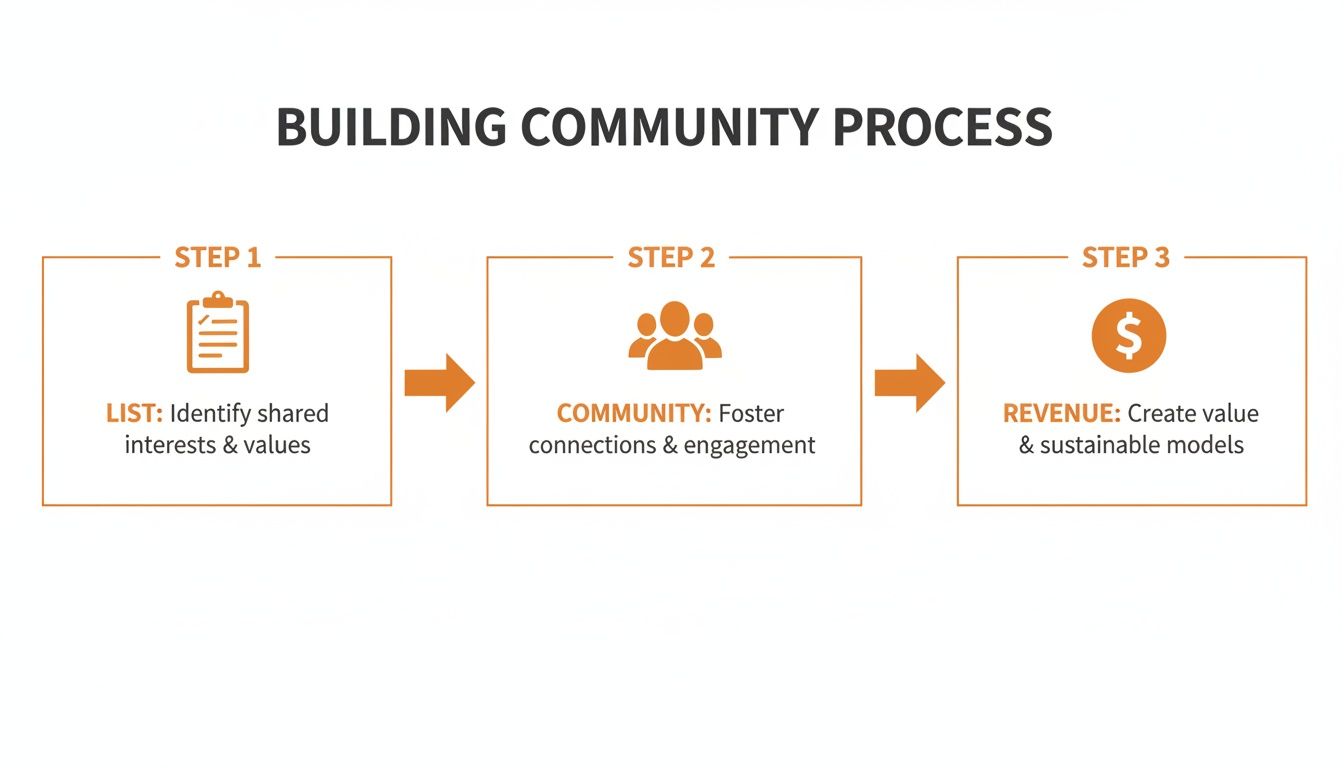
It’s a clear journey: start with your audience, build a real community, and then generate sustainable revenue. It all comes back to connection.
Structuring Your Membership Tiers
Once you’ve got a solid list of potential benefits, it's time to package them into tiers. A tiered structure works beautifully because it lets customers self-select their level of engagement and investment. For most e-commerce brands, a three-tier system is a fantastic starting point: Free, Standard (Paid), and Premium (Paid).
The whole point is to create a clear "value ladder." Each step up should offer obviously more value than the one below it, making the decision to upgrade feel natural and worthwhile. We dive deep into this framework in our guide on the different levels of membership.
Here's a quick look at how you might structure this for your own brand.
Sample Membership Tier Structures
| Benefit | Free Tier | Standard Tier (Paid) | Premium Tier (Paid) |
|---|---|---|---|
| Welcome Points | ✅ 50 points | ✅ 100 points | ✅ 200 points |
| Exclusive Content | ✅ Newsletter access | ✅ All Free benefits | ✅ All Standard benefits |
| Standard Discount | ❌ | ✅ 10% off all orders | ✅ 15% off all orders |
| Free Shipping | ❌ | ✅ On all orders | ✅ On all orders |
| Early Product Access | ❌ | ✅ | ✅ |
| Private Community | ❌ | ✅ | ✅ |
| Quarterly Gift Box | ❌ | ❌ | ✅ |
| Dedicated Support | ❌ | ❌ | ✅ |
As you can see, the value clearly stacks as you move up the tiers, giving customers a compelling reason to upgrade their membership level.
The Free Tier (Your Lead Magnet)
Don't think of your free tier as giving things away. It's a strategic tool for lead generation. The goal here is simple: capture an email address and give potential members a small taste of the value you offer, enticing them to stick around.
- Real-world example: A skincare brand could offer a free tier that gives members access to a weekly newsletter with expert skincare tips and automatic entry into monthly product giveaways. It costs the brand next to nothing but builds a highly engaged audience for future marketing.
The Standard Tier (Your Workhorse)
This is your core paid offering. It's where the majority of your paying members will likely end up. It needs a solid mix of your best transactional and emotional perks—enough to make the monthly or annual fee feel like a complete steal.
- Real-world example: A coffee subscription company's standard tier might offer a 10% discount on all beans, free shipping on every single order, and early access to limited-edition roasts before they sell out.
The Premium Tier (The VIP Experience)
This tier is for your super-fans—the people who love what you do and want more. The price point is higher, but the perks need to be exponentially better. This level should include everything from the standard tier, plus your most exclusive benefits that create a true VIP feeling.
- Real-world example: A fashion brand’s premium tier could include all standard benefits plus a quarterly "style box" curated by an in-house stylist, a dedicated VIP customer service line, and an invitation to an annual virtual summit with the brand's founder.
Choosing the Right Tech for Your Program
Once you’ve nailed down your value proposition and sketched out your membership tiers, it’s time to talk tech. This is the engine that will run your entire program, and getting it right is crucial for a smooth member experience. A great tech stack works so seamlessly in the background that your members never even think about it.
Honestly, this is where a lot of founders get stuck. The options feel endless.
But the goal is simple: automate everything you possibly can. From the moment someone signs up and their recurring payment is processed, to how they access their exclusive content, the tech should handle it. This frees you up to focus on creating value, not getting bogged down in spreadsheets and manually granting access.
For anyone on Shopify, you're in a good spot. The Shopify App Store is filled with powerful apps built specifically for this.
This healthy competition means developers are constantly one-upping each other with features designed to help you succeed, from basic content gating to full-blown community platforms.
Core Features Your Membership Platform Must Have
With so many apps to choose from, it's easy to get distracted by fancy features you'll never use. To cut through the noise, just focus on the non-negotiables—the foundational pillars of any solid membership program.
Make sure your chosen platform nails these three things:
- Automated Recurring Billing: This is the absolute heart of your membership model. The system has to process monthly and annual payments without you ever touching it. It also needs a smart way to handle failed payments—think automated retries and dunning emails—to fight that dreaded involuntary churn.
- Tiered Membership Levels: Your tech has to understand the different tiers you’ve designed. That means letting you set unique prices, billing cycles (like monthly vs. annual), and, most importantly, different access rules for each level.
- Content and Product Gating: This is how you deliver on the promise of exclusivity. The app must let you easily lock down specific pages, blog posts, product collections, or even individual products based on a member’s tier. Someone in your VIP tier should automatically see things a free member can't.
The right tech isn’t just a payment processor; it’s the backbone of your member experience. If people have to jump through hoops to get their perks, they won’t stick around, no matter how good the benefits are.
Critical Integrations for a Seamless Operation
Your membership app can't live on an island. It has to talk to the other tools you use to run your store. Solid integrations are what separate a professional operation from a clunky, manual mess.
Here are the key connections you absolutely need to look for:
- Email Marketing Platform (e.g., Klaviyo, Mailchimp): This is a big one. The integration needs to automatically sync member data and tag subscribers based on their membership tier. This unlocks powerful segmentation for targeted welcome flows, exclusive content drops, and renewal reminders.
- Customer Relationship Management (CRM): Pushing member data into your CRM gives you that elusive 360-degree view of your best customers. You can see their entire journey, from their first purchase to their current membership status, all in one dashboard.
- Other Shopify Apps: Think about your whole ecosystem. Does the membership app play nice with your reviews app, your personalization engine, or your help desk software? Smooth integrations here prevent a lot of future headaches.
If you want to go deeper and compare specific solutions, our guide to loyalty program platforms breaks down the top players and what makes each one unique.
All-in-One Platform vs. a Custom Stack of Apps
You really have two main paths you can take here. You can go with an all-in-one platform that tries to do everything—payments, content gating, community, email, etc.—under one roof. Or, you can assemble your own best-in-class stack by integrating several specialized apps that are amazing at one specific thing.
| Approach | Pros | Cons |
|---|---|---|
| All-in-One Platform | - Way simpler to set up and manage. - One company to call for support. - Usually more affordable upfront. | - Can be a "jack of all trades, master of none." - Less flexibility if one feature is weak. |
| Individual Apps | - Get the absolute best tool for each job. - Huge flexibility and customization. - Can scale parts of your stack independently. | - More complex to connect and maintain. - Integration gremlins can pop up. - Costs can add up quickly. |
My advice? For most brands just launching a program, an all-in-one solution is the fastest and simplest path forward. It gets you to market quickly and minimizes the technical wrangling, letting you focus on your members. You can always re-evaluate and add more specialized tools later as your program grows and your needs evolve.
Crafting an Unforgettable Member Welcome Experience
The moment a customer clicks "join" isn't the most important part of their journey with you. The real magic—or the moment you lose them—happens in the 24 hours that follow. This is your one shot to prove their decision was a good one, kill any potential buyer's remorse, and lay the groundwork for a long, happy relationship.
I've seen it time and time again: a weak or non-existent onboarding flow is the fastest way to an early cancellation. Your goal here is to make new members feel welcomed, seen, and immediately able to tap into the value you promised. It's much more than a simple "thank you" email; it's a strategic welcome mat that guides them straight to the good stuff.
The Essential Welcome Email Sequence
A single welcome email is fine, but a thoughtfully planned sequence is what truly sets you apart. The trick is to drip these messages out over the first 3-5 days so you don't overwhelm them. Each email should have a single, clear purpose. To really nail this, you'll want to learn how to write a compelling welcome email that turns fresh sign-ups into loyal fans from day one.
Here’s a flow that works wonders:
- The Instant Welcome & Login: This needs to hit their inbox within seconds. It should include a warm, personal note from the founder, crystal-clear login details, and a direct link to their new member dashboard. No friction, just immediate access.
- The Quick Win: The next day, send an email laser-focused on helping them achieve a small victory. Guide them to use their exclusive member discount on a bestseller or show them exactly how to access a popular piece of members-only content.
- Community & Connection: Your third email is all about bringing them into the fold. Link directly to your private community (like a Discord server or Facebook group) and prompt them to post a quick intro. Sparking that first interaction is how you make someone feel like they belong.
A strong onboarding flow doesn't just reduce churn; it trains your members on how to be successful. You're showing them exactly where the value is and making it effortless for them to find it, which dramatically increases their perceived value of the membership from day one.
A great member onboarding plan is a blend of clear communication and smart automation. For a deeper dive, our post on the best customer onboarding practices lays out a detailed roadmap.
Your Members-Only Hub
Dumping members onto your standard homepage after they log in is a huge missed opportunity. They should land in a dedicated, members-only hub—a central dashboard that acts as their home base. This immediately reinforces the feeling of exclusivity and puts their perks front and center.
Your member hub needs to feature:
- A Personal Greeting: Something simple like, "Welcome back, Sarah!"
- Quick Links to Benefits: Obvious buttons for exclusive products, the community forum, and special content.
- Benefit Status: Clearly show their current points balance, available discounts, or recent activity.
- Latest Updates: A small section announcing new perks, upcoming events, or fresh content.
Imagine a coffee subscription brand. Their member hub could immediately showcase the "Member Exclusive Roast of the Month," a button to "Join the Brew Crew Forum," and a clear display of their 15% off member discount code. It’s all right there, no digging required.
Sparking That First Engagement
The final piece of the welcome puzzle is nudging them to take that crucial first action. The sooner a member actually uses a benefit, the more likely they are to stick around. Don't just list their perks; actively prompt them to use one.
- Prompt an Introduction: In your community, ask a simple, low-effort question like, "Introduce yourself and tell us your favorite product!"
- Highlight a "Starter" Perk: Call out an easy-to-use benefit. "Your free shipping is now active! Why not start by browsing our new arrivals?"
- Create a Welcome Challenge: Gamify the first few days. Offer a small reward, like 50 bonus points, for completing simple onboarding tasks like filling out their profile or making their first comment.
Think of this initial experience as your handshake. Make it firm, welcoming, and memorable, and you’ll lay the foundation for a relationship that lasts.
It's Time to Launch and Market Your Membership
So, you’ve put in the work. You’ve designed incredible benefits, dialed in your pricing, and wired up all the tech. Now comes the moment of truth: the launch.
A powerful launch isn’t just about flipping a switch and hoping for the best. It’s a carefully orchestrated event designed to build a groundswell of hype and drive a flood of initial sign-ups. Without a rock-solid marketing plan, even the most valuable membership program can launch to the sound of crickets.
The goal is to create a sense of inevitability and excitement. You want your audience counting down the days, not just stumbling upon your new offering by chance. This process has to start weeks before your official launch day.
Build Buzz with a Pre-Launch Strategy
Your pre-launch phase is where you turn your existing audience into your first wave of paying members. These are your warmest leads—the people who already know, like, and trust your brand. This period is all about teasing value and creating a powerful fear of missing out (FOMO).
A fantastic way to do this is by creating a dedicated waitlist. This isn't just another email list; it's a VIP club for those who are most interested. Promote this waitlist everywhere you can think of—your email newsletter, social media bios, and even a banner at the top of your website.
Give them a compelling reason for getting on that list, such as:
- An exclusive "founder's rate" that will never be offered again.
- A bonus gift or resource that only waitlist members receive when they join.
- Early access to sign up a day or two before the general public.
Once you have people on the waitlist, your job is to nurture them. Send them weekly emails with behind-the-scenes content, sneak peeks of member benefits, and maybe a few testimonials from a small group of beta testers. This builds a narrative and makes them feel like insiders who are part of the journey.
Execute a Coordinated Multi-Channel Launch
When launch day finally arrives, it’s time for an all-out, coordinated push. This isn't the time for a single, timid social media post. You need to create a "surround sound" effect where your audience sees the announcement everywhere they turn.
Your launch-day toolkit should absolutely include:
- A High-Converting Sales Page: This is your program's home base. It needs to clearly articulate the value, detail the perks of each tier, feature testimonials, and have an unmissable call-to-action button.
- An Email Marketing Blitz: Your email list is your most valuable asset here. Plan a multi-day email sequence that announces the launch, highlights key benefits, tackles common questions (FAQs), and uses urgency-driven reminders as the launch window closes.
- A Social Media Takeover: Go all in. Update your profile bios with the link. Use countdown timers in your stories. Post engaging videos explaining the benefits. Go live to answer questions in real time. Encourage your followers to share what they're most excited about.
The success of your launch often comes down to the clarity and persuasion of your messaging. It's not just about what members get; it's about the transformation they'll experience. Frame your membership as the solution to their problems, not just a list of features.
How you position your program matters immensely for the long haul. Consumers who see a paid plan as a membership renew at a much higher rate (69%) than those who see it as just another subscription (58%). This mindset shift toward belonging and community directly impacts spending and engagement; for example, Sephora's loyalty members are responsible for about 80% of the company's total sales. You can discover more insights about loyalty program statistics on Queue-it.com.
Keep the Momentum Going Post-Launch
The initial launch is just the beginning. The real challenge is building an evergreen promotion engine that brings in a steady stream of new members long after the initial excitement has faded. Don't let your marketing efforts fall off a cliff after week one.
Your first move should be to leverage social proof. Immediately start collecting testimonials and success stories from your founding members. Feature them prominently on your sales page, in emails, and across social media. Nothing sells a membership better than seeing other people find success with it.
Next, you need to weave your membership offer into your existing marketing funnels:
- Add a call-to-action at the end of your most popular blog posts.
- Mention the membership in your welcome email sequence for new subscribers.
- Create a dedicated "exit-intent" pop-up on your site offering a free trial or a peek inside the program.
By building these promotional touchpoints into your everyday operations, you turn your membership from a one-time event into a core part of your business, ensuring consistent and sustainable growth for months and years to come.
Common Questions (and Straight Answers) About Membership Programs
As you start mapping out your membership program, you’re bound to have questions. That's a good thing. It means you’re thinking through the details and anticipating the hurdles before they trip you up.
Let's walk through some of the most common questions I hear from merchants who are exactly where you are now. These aren't just generic answers; they're practical insights pulled from real-world experience to help you make the right calls.
How Do I Actually Price My Membership Tiers?
Pricing is always a tricky blend of art and science. You can't just pick a number that feels right.
First, get a handle on the actual costs of delivering your perks. What's it costing you in time, software, or products? Once you have that baseline, shift your thinking to value-based pricing. This is key. You're not pricing based on your costs; you're pricing based on the outcome, the exclusivity, and the experience your members get. What is that access and value worth to them?
Of course, it’s smart to see what competitors are doing, but don’t just copy them. Your unique value should be your north star.
And here’s a pro tip: always offer both monthly and annual plans. Give a solid 15-20% discount for paying annually. This is a huge win-win. It gives your cash flow a nice boost and locks members in for a longer period, which is fantastic for slashing your churn rate.
A killer move for a brand-new program is launching with a special, limited-time "founder's rate." It's the perfect way to reward your earliest, most loyal supporters. Plus, it creates a natural sense of urgency and gives you a direct line to your most engaged members for priceless feedback.
What Are the Most Important Metrics to Watch?
Just counting your total members is a vanity metric. It doesn't tell you the real story of your program's health. To see if you're actually building something sustainable, you need to look a bit deeper.
Think of these as the vital signs for your membership program. Keeping an eye on them is the difference between guessing and making smart, strategic decisions.
Here's what you should have on your dashboard:
- Monthly Recurring Revenue (MRR): This is the pulse of your program. It’s the predictable income you can count on every month.
- Customer Churn Rate: This is your early warning system. It's the percentage of members you lose each month. If it starts creeping up, you know you have a problem to solve.
- Member Lifetime Value (LTV): This metric proves the whole concept. It shows you the total revenue you can expect from an average member over their entire subscription, highlighting the long-term ROI.
- Engagement Rate: This isn't just one number. It's a collection of behaviors. Are members logging in? Are they using their perks? Are they active in the community? Low engagement is often a leading indicator of future churn.
What Are the Big Mistakes I Should Avoid?
One of the best shortcuts to success is learning from other people's failures. I've seen three major mistakes that can absolutely sink a membership program before it even gets going.
The first is offering weak or generic benefits. If your perks don't feel special or genuinely valuable, people won't pay for them. It's that simple. The second is a clunky or confusing sign-up process. If it's hard to join, people will just give up. You’ve lost them before they’ve even started.
But the biggest killer of them all is the "set it and forget it" mindset. A membership isn't a product you launch once; it's a living, breathing community you have to nurture. If you neglect your members by not adding new value or engaging with them, they will leave. I guarantee it.
How Much Content Do I Really Need to Launch?
This question paralyzes so many entrepreneurs, but the answer is probably less than you think. Don't fall into the trap of believing you need a massive library of content to go live.
Focus on quality over quantity.
Your goal for launch day is to have a core set of "pillar" benefits that deliver a powerful, immediate punch of value. Think three to five killer offerings—maybe a key discount, a couple of exclusive guides, and access to your community space.
You just need enough to make someone feel like they got their money's worth the moment they sign up. Then, put a simple "What's Coming Next" calendar or roadmap somewhere visible. This builds anticipation and shows members that you're committed to the long haul, giving them a compelling reason to stick around.
Ready to turn these insights into action? Toki provides an all-in-one platform to launch, manage, and grow a thriving membership program on Shopify. From tiered plans and point systems to community tools and powerful analytics, we give you everything you need to build lasting customer loyalty. Start creating your membership program today at https://buildwithtoki.com.