How to Collect Customer Feedback A Guide for E-Commerce
Learn how to collect customer feedback that builds loyalty and drives growth. Discover proven strategies and actionable tips for your e-commerce store.
Collecting customer feedback isn't just another box to check on your to-do list—it's the very core of a smart growth strategy. To do it right, you have to meet your customers where they are. This means weaving feedback requests into the natural flow of their journey, like right after a purchase, following a chat with your support team, or even while they're browsing your site.
By using a smart mix of channels—think email surveys, subtle on-site pop-ups, and in-app prompts—you start to gather the kind of genuine insights that tell you what customers really think about your brand.
Why Customer Feedback Is Your Growth Engine
Let's be real. Running an e-commerce store is a constant hunt for a competitive edge. But that edge isn't buried in some complex analytics dashboard or a flashy, expensive marketing campaign. It’s hiding in plain sight, offered up freely by the people who matter most: your customers.
The first big step is moving past the idea that feedback is just "nice to have." When you stop listening, you start paying for it in other ways—higher churn rates, missed chances to create the next best-selling product, and a brand that feels more and more out of touch.
On the flip side, when you actively listen, you kickstart a powerful, positive cycle that fuels itself.
The Metrics That Actually Matter
To turn a flood of opinions into something you can actually use, you need to focus on the metrics that give you a real-time pulse on your business. Three key scores will tell you most of what you need to know.
-
Net Promoter Score (NPS): This is all about loyalty. It boils down to one simple question: "How likely are you to recommend our brand to a friend?" The answers split your customers into Promoters, Passives, and Detractors, giving you a crystal-clear picture of brand advocacy.
-
Customer Satisfaction (CSAT): Think of CSAT as a snapshot of short-term happiness. It measures how a customer feels about a single, specific interaction, like completing a purchase or getting help from support. A quick "How satisfied were you?" gives you immediate, valuable data on that touchpoint.
-
Customer Effort Score (CES): This one is pure gold. CES tells you how easy it was for a customer to get something done, whether it was finding a product or resolving a problem. A low-effort experience is one of the strongest predictors of whether a customer will come back.
By consistently tracking these core KPIs, you're not just collecting random data points. You're building a diagnostic toolkit for your entire customer experience. You can spot friction, double down on what’s working, and make smarter decisions that directly boost retention and sales.
Ultimately, knowing how to collect customer feedback is about starting a conversation, not just sending a survey. It’s about showing your customers you value their voice enough to act on what they tell you. This doesn’t just put out fires—it builds the kind of loyalty that lasts.
Designing Your Feedback Collection Strategy
A powerful feedback program doesn't happen by accident. It’s built with intention, asking the right people the right questions at exactly the right moments. The real goal isn't just to hoard data; it's to start a genuine conversation that shows you how to build a better customer experience. Before you even think about launching a survey, you have to be crystal clear on what you’re trying to achieve.
Are you trying to figure out why shoppers are abandoning their carts? Or maybe you want to know what they really think about a new product line? Perhaps you're trying to measure how well your support team is actually doing. Your specific goal will dictate every other decision you make, from the questions you ask to the channels you use to ask them.
In the cutthroat world of e-commerce, actively asking for feedback is one of the most powerful things you can do to build loyalty. Think about this: a whopping 77% of customers view brands more favorably if they proactively ask for and accept feedback. It shows you care.
Defining Your Goals and Metrics
First things first, you need to connect your business goals to specific feedback metrics. A fuzzy goal like "improve customer satisfaction" is impossible to measure. Instead, you need concrete objectives tied to clear key performance indicators (KPIs). This clarity is what makes your efforts focused and your results measurable.
For example, if your big-picture goal is to boost brand loyalty and get more word-of-mouth referrals, then the Net Promoter Score (NPS) should be your go-to metric. But if you just want to know how a customer felt about their most recent support chat, Customer Satisfaction (CSAT) is the perfect tool for that immediate snapshot.
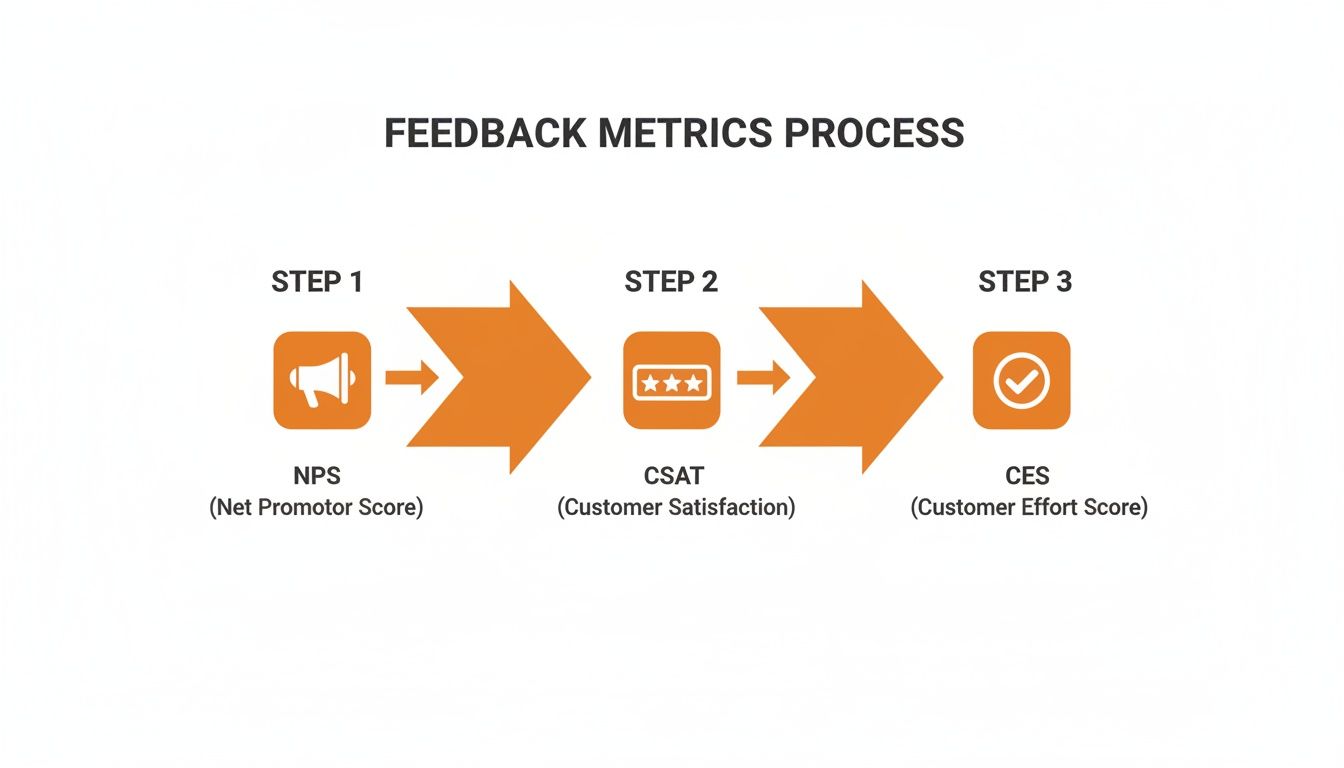
This simple flow shows how each metric provides a different lens: NPS looks at long-term loyalty, CSAT captures in-the-moment happiness, and the Customer Effort Score (CES) tells you how easy it was for a customer to get something done.
By aligning your goals with the right metrics, you're not just collecting scores; you're creating a diagnostic tool that gives you truly actionable insights. Understanding these differences is the foundation of any successful feedback program. To get it right from the start, it helps to lean on proven customer feedback best practices.
Here's a quick way to think about which metric to use for your specific business goals.
Matching Your Goals to the Right Feedback Metric
This table connects common business objectives to the best metric for the job and gives you some simple, effective questions you can use right away.
| Your Business Goal | Recommended Metric | A Sample Question to Ask |
|---|---|---|
| Measure overall brand loyalty and predict future growth. | Net Promoter Score (NPS) | "On a scale of 0-10, how likely are you to recommend our brand to a friend or colleague?" |
| Gauge immediate satisfaction with a specific interaction. | Customer Satisfaction (CSAT) | "How satisfied were you with your recent checkout experience?" |
| Understand how easy it is for customers to interact with you. | Customer Effort Score (CES) | "How easy was it to get your issue resolved today?" |
Choosing the right tool for the job makes all the difference. It ensures the data you collect directly informs the business decisions you're trying to make.
Mapping the Customer Journey for Feedback Opportunities
Once your goals are set, it’s time to walk in your customer’s shoes. Map out every single touchpoint they have with your brand—from the moment they first land on your website to weeks after their package arrives. Each of these interactions is a golden opportunity to ask for their thoughts.
Don't just focus on the obvious moments like post-purchase. Consider the subtle interactions: when a customer uses your site's search bar, when they contact support, or even when they join your loyalty program. These are prime moments to capture authentic, in-context feedback.
Mapping this journey helps you pinpoint the most natural and least intrusive times to make your ask. Here are a few key moments I've seen work incredibly well:
- Post-Discovery: After someone has browsed your site for a few minutes, a small pop-up can ask about their first impression.
- Post-Purchase: An email sent right after checkout is the perfect spot for a CSAT survey on the buying experience.
- Post-Delivery: A week after the product is delivered is the ideal time to ask for a product review or get an NPS score.
- Post-Support: The moment a support ticket is closed, a CES survey can measure how easy it was to get help.
This kind of feedback is gold because the customer gives it to you willingly. It’s what we call zero-party data, and you can learn more about how to use it ethically in our guide: https://www.buildwithtoki.com/blog-post/what-is-zero-party-data.
The secret is to match your question to the moment. Asking about product quality before the item has even shipped will just confuse people and sink your response rates. A smart, strategic approach ensures your requests are always relevant and timely, which makes customers far more likely to give you the honest feedback you need.
Choosing Your Channels and Tools
So, you’ve mapped out your customer journey. The next logical question is: where and how are you going to ask for feedback? The channels you pick and the tools you use will make or break your response rates. The real goal here is to make giving feedback feel so natural and effortless that it’s just part of the experience, not some annoying chore.
A smart feedback strategy meets customers on their own turf. Think about it—the person who just wrapped up a support chat is in a completely different headspace than the one who got their package a week ago. This means you need a mix of channels, each playing to its strengths, to catch those crucial insights at just the right moment.
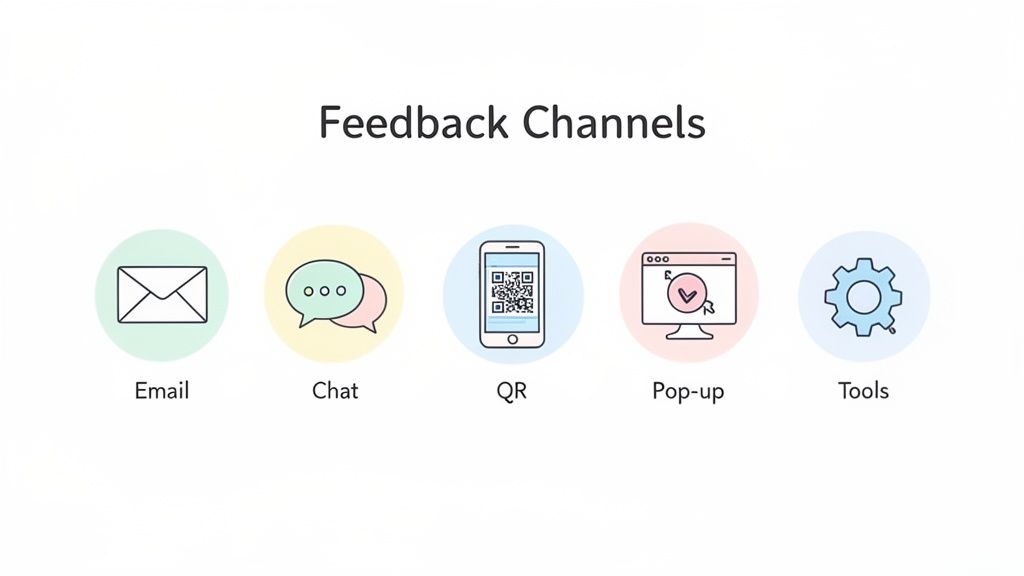
Blending Classic and Modern Feedback Channels
There’s a reason the old-school methods are still around—they work. But you can’t ignore the newer tools that capture raw, in-the-moment sentiment. I've found the most successful brands blend both.
Here are a few of the most reliable channels for any e-commerce store:
- Post-Purchase Emails: These are the bread and butter of feedback collection. Sending a quick email a few days after delivery is the perfect time to ask for a product review or an NPS score while the experience is still fresh in their mind.
- On-Site Surveys & Pop-Ups: When used strategically (and sparingly!), pop-ups are fantastic for real-time feedback. You can ask about the shopping experience, figure out why someone might be leaving their cart, or even find people for more detailed user interviews.
- QR Codes on Packaging: Don't forget the unboxing experience! A simple QR code on the box or an insert is a brilliant way to bridge the physical and digital worlds. It can link straight to a review page or a quick survey about their first impressions.
While these channels form a solid foundation, there's one that has become an absolute powerhouse for immediate, unfiltered insights.
The Power of Live Chat for Instant Feedback
Live chat isn't just for support anymore; it's a feedback goldmine. It gives you a direct line to your customers at the exact moment they’re engaged, letting you capture insights at the peak of their emotional response—good or bad.
In fact, when it comes to feedback channels, live chat is a clear favorite, preferred by 79% of customers because it’s so immediate. The data also shows that live chat interactions have an impressive 85% CSAT benchmark, making it one of the most effective ways to check the pulse on satisfaction right after an interaction.
Let me paint a picture for you: A customer chats with an agent to fix an order issue. The second the agent resolves the ticket, a chatbot can instantly pop up a one-question CSAT survey right there in the chat window. It’s seamless. The customer doesn’t have to open an email or click another link, and you get their honest feelings in that exact moment.
This immediacy is what makes live chat so valuable. The feedback is contextual, raw, and incredibly actionable.
Selecting the Right Tools for the Job
Trying to manage feedback from all these different channels by hand is a fast track to chaos. The right software doesn't just automate the asking; it helps you organize, analyze, and actually do something with the answers. A good tool should plug right into your e-commerce platform, help desk, and email marketing software.
When you're shopping for a feedback tool, make sure it has these non-negotiables:
- Multi-Channel Support: You need to be able to build and send surveys via email, on-site pop-ups, chat, and more, all from one dashboard.
- Automation and Triggers: The ability to automatically send a feedback request based on a specific action—like a completed purchase or a support ticket being closed—is essential.
- Segmentation and Routing: Look for features that let you slice and dice feedback by customer segments and automatically send urgent issues to the right person on your team.
- Analytics and Reporting: You need clear, intuitive dashboards to track your core metrics (NPS, CSAT, CES) over time and spot the trends that really matter.
Your objective is to build a unified system where all feedback flows into one central place. This gives you a holistic, 360-degree view of the customer experience. For a deeper dive, check out our guide on the top e-commerce analytics tools that can help pull all this data together.
Ultimately, picking your channels and tools is about creating a feedback ecosystem that just works. By making it easy for customers to share and even easier for your team to act, you turn feedback from a line on a spreadsheet into your most powerful engine for growth.
How to Write Surveys People Actually Answer
An unanswered survey is a missed opportunity. It's a customer story you'll never get to hear. If you really want to get inside your customers' heads, you have to master the art of the ask.
The line between a survey that gets ignored and one that delivers game-changing insights is thinner than you think. It all boils down to respecting your customer's time and intelligence. Your goal? Make giving feedback feel easy, quick, and genuinely appreciated. The second it feels like a chore, you've lost them.
This means we need to ditch the long, multi-page questionnaires. It's time to focus on short, sharp questions that get right to the heart of the matter.
Keep It Short and Focused
What's the number one reason people bail on a survey? Length. No one wants to face a 20-question interrogation after buying a t-shirt.
Your survey needs to be laser-focused on one single objective. Are you trying to gauge post-purchase satisfaction? Or are you digging for feedback on a new feature? Pick one lane and stay in it.
A great benchmark is the one-minute rule: a customer should be able to fly through your survey in 60 seconds or less.
Here’s how to make that happen:
- Stick to single-question formats. For metrics like NPS or CSAT, the initial rating is often all you need. A simple, optional follow-up like, "Care to share why you chose that score?" is perfect for adding context without feeling mandatory.
- Limit the open-ended questions. Typing is work. These questions are incredibly valuable, but use them sparingly. Save them for the insights you absolutely can't get from a multiple-choice or rating scale. One, maybe two, is plenty.
- Show a progress bar. If your survey has a few steps, a progress bar is a simple psychological trick that works wonders. It manages expectations and shows the customer the finish line is in sight, making them far less likely to drop off.
Writing Copy That Connects
The words you use are just as important as the questions you ask. Ditch the dry, corporate jargon and write like a real person. Your subject line and intro should be warm, personal, and get straight to the point about what's in it for them.
Instead of a snooze-fest subject line like "Customer Feedback Survey," try something that sounds like it came from a human:
- "Got a minute, [Customer Name]? Tell us about your recent order."
- "How'd we do? Your feedback makes us better."
- "A quick question about your new [Product Name]."
Frame the request around how their feedback helps them. Explain that their thoughts will lead to better products or a smoother experience. This flips the script from a self-serving request into a collaborative effort to make things better for everyone.
When you show people their opinions are actively shaping your brand's future, they feel invested. It’s no longer a survey; it’s a conversation. For more inspiration, you can find a ton of examples in our guide to customer feedback survey templates.
Transform Feedback Into a Rewarding Interaction
Let’s be honest, even the most beautifully designed survey can use a little nudge to get customers over the finish line. This is where incentives come in, but there’s a right way and a wrong way to do it.
A generic 10% discount can feel transactional and often attracts feedback only from bargain hunters. A much smarter approach is to tie your incentives directly to your loyalty program. This strategy turns a simple survey into a meaningful brand interaction that actually strengthens the customer relationship.
By offering loyalty points or exclusive perks, you reward genuine engagement, not just a click.
Here’s a quick guide to help you pair the right timing with a compelling, loyalty-focused incentive to optimize your response rates.
A Guide to Feedback Timing and Incentives
This guide shows you how to optimize response rates by pairing the right timing with a compelling, loyalty-focused incentive.
| Feedback Scenario | Optimal Timing | Example Incentive (Loyalty Program) |
|---|---|---|
| Post-Purchase Experience | 2-3 days after delivery | "Get 50 bonus points for telling us about your order!" |
| Product-Specific Feedback | 14-21 days after delivery | "Review your new item and get 100 points toward your next reward." |
| Customer Service Interaction | Within 24 hours of ticket resolution | "Rate your support experience and earn 25 points instantly." |
| Website/App Experience | Immediately after session (via pop-up) | "How was your visit? Share a thought and get 10 points." |
| Abandoned Cart Follow-Up | 24 hours after abandonment | "Tell us why you left and we'll add 20 points to your account." |
Offering 50 bonus loyalty points for a post-purchase survey does more than just get a response. It reinforces the value of your loyalty program and nudges that customer closer to their next reward, creating a powerful cycle of engagement. This is how you build a community of brand advocates, not just a database of survey answers.
From Insight to Impact: Turning Feedback into Revenue
Gathering feedback is just the starting line. The real race is won when you dig into that data, get it to the right people, and act on what you’ve learned. This is how you transform customer opinions into real, measurable growth for your business.
A well-oiled feedback loop does more than just fix problems—it builds a foundation of trust. It shows customers you're not just listening, but that you actually hear them.
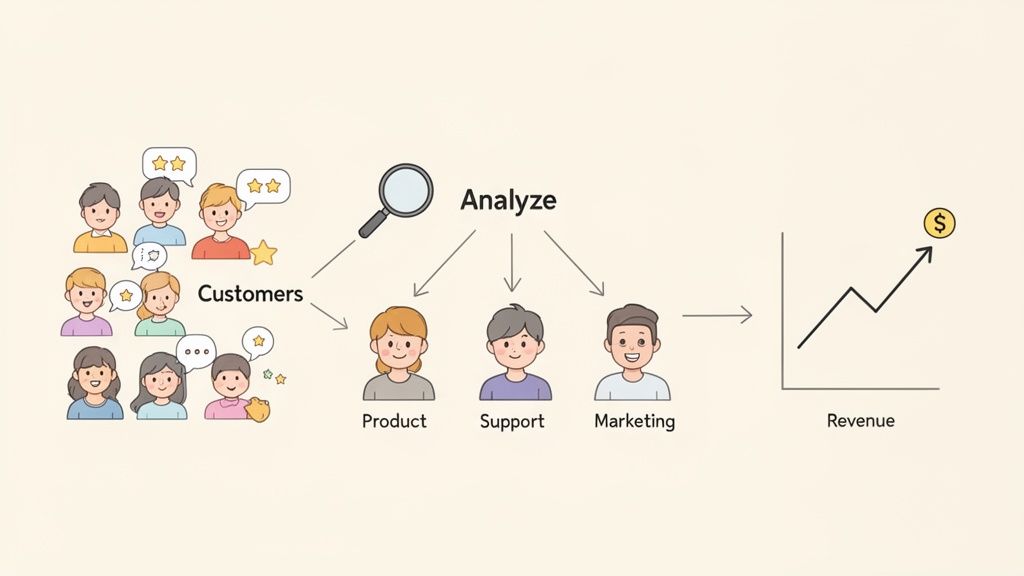
The final, and most critical, part of this process is building a system where every comment has a home and a purpose. Feedback shouldn’t die in a spreadsheet. It needs to kick off automated workflows that get the right information to the right teams, instantly.
Set Up Automated Feedback Workflows
Think about building a system that does the heavy lifting for you. When a glowing 5-star review comes in praising your lightning-fast shipping, why not have it automatically ping your marketing team? Boom—instant social proof they can splash on product pages or use in their next ad campaign.
On the flip side, a survey response with a low CSAT score and keywords like "broken" or "defective" should immediately trigger an alert for your support and product teams. This lets you jump on the problem, reach out to the customer, and investigate a potential quality issue before it snowballs.
Here are a few simple routing rules you can put in place:
- Negative Product Comments: Automatically create a support ticket and assign it to the product development team for their next sprint review.
- Positive Service Reviews: Send a Slack notification to a manager’s channel so they can give a well-deserved shout-out to the agent involved.
- Feature Requests: Pipe these suggestions directly into a dedicated backlog or idea board for the product team to explore.
This kind of smart segmentation makes sure nothing gets missed and your team can react with genuine agility.
Always Close the Loop with Your Customers
If there’s one thing you take away from this guide, let it be this: close the loop. It's the simple act of following up with customers to acknowledge their input and, most importantly, show them how you’re using it. This one move builds incredible trust and makes customers 80% more likely to give you feedback again.
You can close the loop in a couple of different ways:
- The Personal Touch: A customer points out an issue. You fix it. A week later, you send them a personal email: "Hi Sarah, you mentioned our checkout process was a bit confusing. We took your feedback to heart and just rolled out a simplified payment step. Thanks for helping us get better."
- The Public Announcement: A bunch of customers request a new feature. You build it. Don't just quietly release it—shout it from the rooftops! Announce it in your newsletter or on social media, giving full credit to the customer feedback that sparked the idea. This shows your entire community you’re listening.
Responding to feedback validates the effort your customers took to share their thoughts. It turns them from passive buyers into active partners who are invested in your brand's success. It’s a simple gesture with a massive ROI.
Once you have all this input, you need to know how to interpret it effectively. For more ideas on how to turn raw comments into concrete improvements, check out these actionable peer review feedback examples.
Connect Feedback Directly to Business Outcomes
So what's the real payoff here? It's huge. Remember, research shows that 73% of consumers will jump ship to a competitor after just a few bad experiences. Even more telling, 56% of unhappy customers won't even complain; they just vanish. You can find more of these eye-opening customer experience stats from Coveo.com.
A strong feedback program directly shores up your bottom line. When you systematically find and fix friction points, you slash churn and boost customer lifetime value (LTV). When you listen to what people want, you innovate smarter and build products that fly off the shelves. This is exactly how you turn one-time shoppers into lifelong fans.
Got Questions? We've Got Answers
Getting a handle on customer feedback can feel like a big undertaking, so it's natural to have questions. Here are some straightforward answers to the things e-commerce merchants ask us most often.
How Often Should I Actually Ask for Feedback?
The real key is to ask at the right moment, not just all the time. You want fresh, relevant feedback, but you never want to annoy your customers. A good rule of thumb is to tie your requests to specific milestones in their journey.
Here’s a timeline that works well for most brands:
- Post-Purchase: Within 24 hours, ask about the checkout and buying experience.
- Post-Delivery: Give them a week or two (7-14 days) to actually use the product before you ask for a review.
- Post-Support: Send a feedback request the moment a support ticket is closed. The experience is fresh in their mind.
For those bigger-picture questions about brand loyalty, like an NPS survey, checking in with your best customers every quarter or so is plenty. The goal is to get a pulse without causing "survey fatigue."
What's the Real Difference Between NPS, CSAT, and CES?
They all measure how customers feel, but they each tell a completely different part of the story. Nailing down the difference is crucial to understanding what to ask, and when.
-
Net Promoter Score (NPS) is your long-game metric. It asks, "How likely are you to recommend us?" This gives you a bird's-eye view of brand loyalty and overall health.
-
Customer Satisfaction (CSAT) is all about the "right now." It measures happiness with a single, specific interaction, like how a support chat went or what they thought of a new product they just received.
-
Customer Effort Score (CES) gets to the heart of friction. It asks how easy it was for a customer to do something, like get an issue resolved or find a product on your site.
A simple way to think about it: NPS tells you if they love you enough to come back. CSAT tells you how they felt about a specific moment. And CES tells you how much work you made them do.
How Do I Get More Responses Without Giving Away Discounts?
Discounts are an easy go-to, but they aren't your only option—and often, they aren't the best one for building genuine loyalty. Instead of training customers to expect a coupon, focus on making them feel like they're a part of something.
Try offering loyalty points that they can bank for a future reward, or grant them early access to a new product line. A special badge on their customer profile can also go a long way.
Honestly, the most powerful incentive is simply showing them you're listening. When you follow up, acknowledge their input, and publicly share the changes you’ve made based on their ideas, you create a powerful reason for them to keep sharing. They feel heard, and that’s more valuable than 10% off.
Ready to turn customer insights into your most powerful growth engine? Toki provides all the tools you need to build a world-class loyalty and feedback program. Start building lasting customer relationships today.