Boost Revenue with customer retention loyalty programs
Explore how customer retention loyalty programs boost revenue with proven tactics, case studies, and practical steps for e-commerce success.
At its core, a customer retention loyalty program is all about rewarding your best customers to keep them coming back. By offering real incentives—think points, discounts, and exclusive perks—you can turn casual shoppers into dedicated brand fans who choose you every time.
Why Loyalty Programs Are Your E-commerce Growth Engine
Let's be honest: acquiring new customers is an expensive grind. You've probably heard that "retention is cheaper than acquisition," but that’s a massive understatement. A smart loyalty program isn't just a gimmick; it's a foundational strategy for building a predictable, sustainable business.
Think about it this way. Every new customer is a bit of a gamble. You pour money into ads and marketing, crossing your fingers they'll return. But every time a loyal customer interacts with your brand, it’s a solid investment with a guaranteed return. These repeat buyers are the bedrock of your brand’s growth, not just another sale.
The Financial Power of Repeat Business
The numbers don't lie. Your loyal customers don't just buy more often; they consistently spend more per order. They trust your brand, so they’re more willing to try new products and are far less likely to be swayed by a competitor's discount. This creates a powerful cycle where your best customers just keep getting better. For a deeper dive, you can explore the many benefits of a loyalty program in our detailed guide.
This isn't just theory; it's backed by hard data. The link between retention and profitability is one of the tightest in e-commerce. A small 5% bump in customer retention can boost your profits by 25% to 100%. That's because these customers cost less to serve, and 57% of consumers admit to spending more with brands they feel loyal to. You can discover more insights on how loyalty drives revenue growth on Queue-it.com.
The real win with a loyalty program isn't just the next sale. It's creating a customer who costs you less to keep, spends more over their lifetime, and brings you new customers for free through word-of-mouth.
More Than Just Transactions
Beyond the bottom line, a well-run customer retention loyalty program delivers some incredible, game-changing benefits.
- Priceless Feedback: Your most loyal members are your best source of truth. They'll give you the honest, constructive feedback you need to make your products and services even better.
- Brand Advocacy: Happy, rewarded customers become your most powerful marketing asset. They rave about your brand to friends and family, creating an organic growth engine that money can't buy.
- Predictable Revenue: A solid base of repeat buyers helps smooth out the natural ups and downs of e-commerce, giving you a more stable and predictable cash flow to plan your growth.
Ultimately, a loyalty program is a mindset shift. It moves you from constantly chasing one-off sales to building meaningful, long-term relationships. For a complete look at how these programs fit into the bigger picture, check out this excellent strategic guide to Shopify loyalty programs.
Designing a Loyalty Program Your Customers Will Love
Let's start with a simple question that gets to the heart of any great loyalty program: what will make your customers feel truly valued? The truth is, the most successful programs aren't copy-pasted. They're thoughtfully chosen to fit a brand’s products, sales cycle, and, most importantly, how its customers actually behave.
The whole design process is a balancing act. You need to create a program that feels generous and exciting for your customers while still being sustainable for your bottom line. It’s all about finding that sweet spot between rewarding loyalty and protecting your margins.
To help you find the right fit, let's walk through the most popular and effective models I've seen work for e-commerce stores.
Choosing the Right E-commerce Loyalty Program Model
Deciding on the foundation of your program is the most critical step. Each model serves a different purpose and appeals to different customer motivations. This table breaks down the four main types to help you figure out which one aligns best with your business goals and customer base.
| Program Type | Best For | Key Benefit | Potential Drawback |
|---|---|---|---|
| Points-Based | Brands with frequent, smaller purchases (e.g., coffee, cosmetics). | Simple for customers to understand and see immediate value. | Can feel transactional if not paired with other perks. |
| Tiered Program | Aspirational brands or those with a wide range of customer value. | Motivates customers to spend more to unlock exclusive status/perks. | Can be complex to set up and manage the different levels. |
| Paid Membership | Businesses with a strong community and high-value, recurring needs. | Creates a predictable revenue stream and highly committed customers. | The value proposition must be incredibly strong to justify the cost. |
| Referral Program | Any brand with happy customers and a focus on acquisition. | Low-cost marketing that leverages social proof for high conversion. | Relies on existing customer satisfaction to be effective. |
Ultimately, the best choice—or even a hybrid of two—comes down to knowing your brand and what makes your customers tick. Now, let's dive a little deeper into how each one works in the real world.
The Classic Points-Based System
This is the bread and butter of loyalty programs for a reason: it’s incredibly easy to understand. Customers earn points for actions—making a purchase, leaving a review, a social media follow—and then "burn" those points for rewards. It’s a straightforward system that works wonders for brands where customers come back often for smaller purchases.
Think about a cosmetics brand or your local coffee shop. They thrive on repeat business. A points system keeps them coming back because they always feel like they're just a few dollars away from their next free lipstick or latte. The trick is to keep it dead simple.
I’ve seen it time and again: a study found that 75% of customers would switch brands just for a better loyalty program. A clear, simple points system is often the fastest way to get their attention.
If you go this route, make sure the value is crystal clear. "Earn 5 points for every $1 spent" is so much better than some complicated, vague system. You want customers to feel that instant gratification and see a clear path to their next reward.
Creating Aspiration with Tiered Programs
Tiers are all about making your best customers feel like the VIPs they are. As customers spend more or engage more often, they unlock new levels with better perks, creating a powerful sense of status and achievement. This model is an absolute beast for fostering long-term, sticky loyalty.
Instead of just offering discounts, tiers let you provide experiences that forge a much deeper connection.
- Bronze Tier: The starting line. Think basic rewards like earning points and maybe a little something for their birthday.
- Silver Tier: Things get more interesting. You could unlock free shipping or give them early access to sales.
- Gold/Platinum Tier: This is the inner circle. We're talking exclusive access to limited-edition products, a dedicated support agent, or even invites to special brand events.
The psychology here is incredibly effective. Customers in the lower tiers are motivated to climb the ladder, while those at the top will work to protect their hard-earned status. For a more detailed breakdown on building out these levels, check out our complete guide on loyalty program design.
Building an Exclusive Community with Paid Memberships
If you have a strong brand community and high-value products, a paid VIP or membership program can be a total game-changer. Customers pay a recurring fee—monthly or annually—and in return, they get instant, always-on premium benefits. Amazon Prime is the most famous example, and for good reason.
This only works if the value you provide is a no-brainer. The benefits have to feel like a steal compared to the cost of the membership.
Here are a few VIP perks that really work:
- Guaranteed Free Shipping: This is a huge one. It removes one of the biggest points of friction at checkout.
- Exclusive Content: Give them access to special tutorials, behind-the-scenes content, or a members-only community forum.
- Members-Only Products: Create limited-run items that only subscribers can buy.
- A Constant Discount: A permanent 10-15% discount on everything is a simple but powerful incentive.
A paid program not only generates a predictable, recurring revenue stream but also transforms your customer relationships from purely transactional to something much more meaningful.
Turning Customers into a Sales Force with Referrals
Why sink a massive budget into ads when your happiest customers can be your most authentic and effective sales team? Referral programs work by incentivizing your current customers to spread the word, rewarding both them and the new customer they bring in.
The "give-get" model is where the magic happens. For example, give your existing customer a $20 store credit when their friend makes a purchase, and give that friend 20% off their first order. It’s a win-win that feels genuine and builds trust. After all, a recommendation from a friend carries so much more weight than any ad you could ever run.
As this infographic shows, putting in the work to design the right program is a direct investment in your growth.
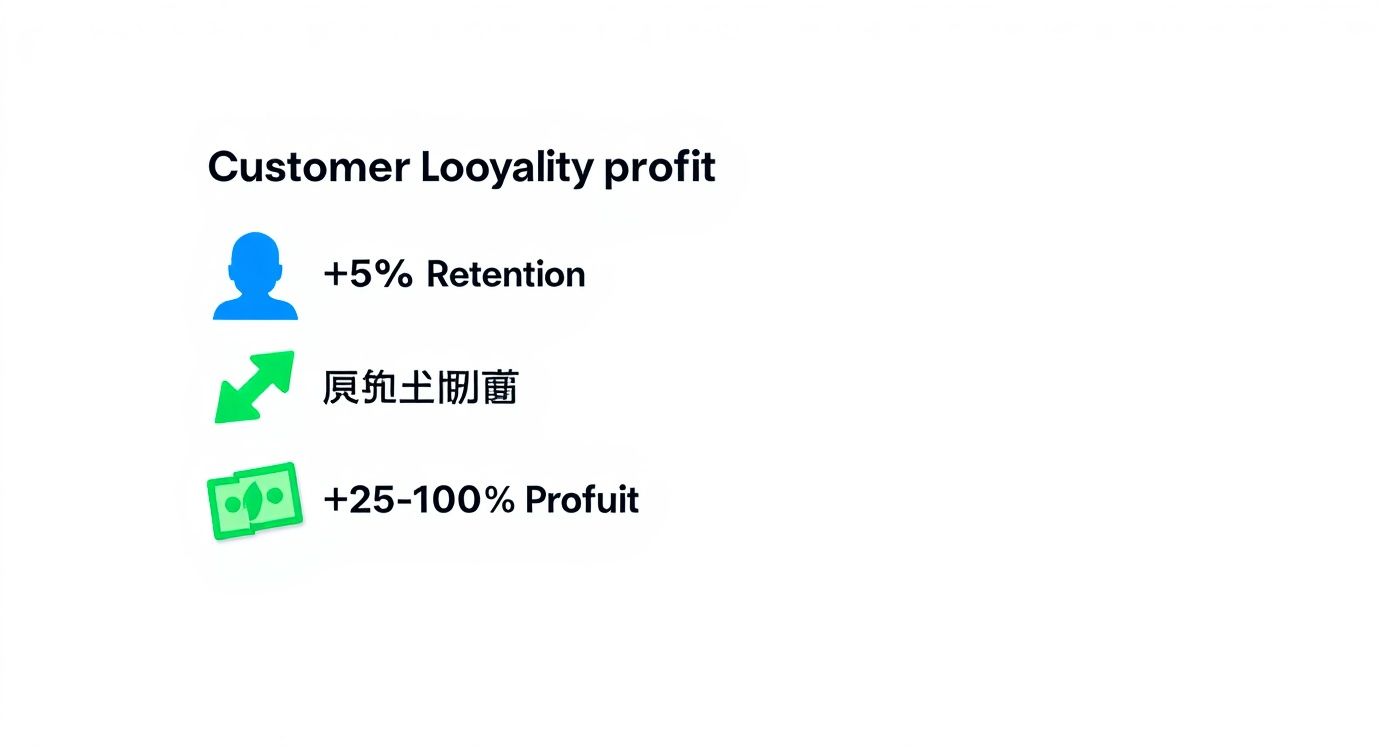
The numbers don't lie. Even a small 5% increase in customer retention can boost profits by anywhere from 25% to 100%. That’s a powerful reminder that keeping the customers you have is one of the smartest things you can do for your business.
Launching Your Loyalty Program Without the Headaches
You've designed a brilliant loyalty program. That's the first big win. But a great idea is only half the battle—a smooth, professional launch is what turns that concept into a real business asset.
This is where the operational details make or break you. A good launch delights your customers. A bad one creates a tidal wave of frustration and support tickets. The goal is to make the entire experience feel effortless from day one.
Executing a flawless launch really comes down to choosing the right technology. For anyone on Shopify or other major e-commerce platforms, this usually means picking a dedicated loyalty app. These tools do the heavy lifting—tracking points, managing rewards, you name it—freeing you up to focus on strategy instead of getting buried in code. When you're looking at different platforms, put a premium on those with solid, pre-built integrations.
Unifying the Customer Experience with Key Integrations
A modern loyalty program has to live where your customers are. To create a truly connected experience that drives real engagement, two integrations are absolutely crucial.
First up, digital wallet integration isn't a "nice-to-have" anymore. It’s essential. Giving members the ability to add their loyalty card to Apple Wallet or Google Pay is a game-changer. It means they don't have to remember another password or carry a physical card. Your brand is right there, in the ecosystem they use every single day. This simple convenience makes a massive difference in how often they'll engage with your program in-person.
Second, if you have any kind of physical footprint, Point of Sale (POS) integration is non-negotiable. It's the bridge between your online store and your brick-and-mortar shop. A customer needs to be able to earn points online and redeem them at your register without a hitch, and vice-versa. This kind of consistency is fundamental to building a cohesive brand and getting the most value out of your customer retention loyalty programs.
Your Pre-Launch Success Checklist
A successful launch is all about meticulous prep work. Rushing this stage is a recipe for technical glitches and customer confusion that can tarnish your program's reputation right out of the gate. For a deeper dive into the initial setup, our guide on how to start a rewards program is a great resource.
Before you flip the switch, run through this practical checklist:
- Internal Testing: Get in there and try to break things. Create test accounts and run through every possible customer action—earn points, redeem every reward, move up and down tiers, test referral links. Your goal is to find and squash bugs before your customers do.
- Customer Support Training: Your support team is your front line. Arm them with a detailed FAQ that covers how the program works, how to fix common problems (like "my points are missing"), and what the key benefits are. They need to be the biggest experts on your program.
- Marketing Asset Creation: You can't just launch a program and hope people find it. Get your promotional materials ready in advance. Think dedicated landing pages, email announcements, social media graphics, and website banners. Have it all ready to go.
- Set Up Your Analytics: Make sure your tracking is ready from day one. You need to be monitoring key metrics like enrollment rate, redemption rate, and the impact on repeat purchase frequency from the very start.
Pro Tip: A soft launch can be your secret weapon. Before the big public announcement, invite a small group of your most loyal customers to join first. They'll give you incredible feedback and help you iron out any last-minute kinks in a much lower-stakes environment.
By methodically nailing the technical integrations and your operational readiness, you turn your launch from a stressful event into a strategic advantage. This careful planning ensures that when you finally unveil your loyalty program, the customer experience is polished, professional, and perfectly on-brand.
Keeping Customers Engaged with Gamification and Personalization
So, you've launched your loyalty program. That's a huge first step, but the real work starts now. A "set it and forget it" approach is a recipe for a program that quickly loses steam and fades into the background. To turn your program into a true retention powerhouse, you have to keep members actively involved and feeling seen long after that initial signup.
This is where you move beyond simple point collection. It's time to transform your program into an exciting, dynamic experience that feels like it was made just for them. The two most powerful tools in your toolbox for this are gamification and personalization.
Making Loyalty Fun with Gamification
Think of gamification as applying the fun parts of games—like earning points, unlocking achievements, and completing challenges—to your loyalty program. It taps into our natural drive for competition, achievement, and rewards, which makes routine actions feel way more compelling.
When you apply this to your customer retention loyalty program, you're no longer just rewarding transactions. You start rewarding behaviors that build a stronger connection to your brand, giving customers more reasons to interact with you between purchases.
The results speak for themselves. Studies have found that loyalty programs using gamification can retain 87% more customers than traditional, non-gamified models. And when you consider the average consumer is a member of 9.3 different loyalty programs, making yours stand out is non-negotiable. You can dig into more of this data in these loyalty program statistics from CapitalOneShopping.com.
Here are a few practical ways to inject some fun into your program:
- Introduce Badges for Milestones: Award digital badges when a customer hits a specific goal—their fifth purchase, leaving three product reviews, or reaching a new VIP tier. Badges act as a visual pat on the back and give them a sense of accomplishment.
- Create Action-Based Challenges: Run limited-time challenges that encourage specific actions. A skincare brand might create a "Complete Your Routine" challenge, rewarding customers who buy a cleanser, moisturizer, and serum within 30 days. It's a great way to guide product discovery.
- Implement Surprise and Delight Rewards: Not every reward needs to be predictable. Randomly dropping bonus points into a loyal customer's account "just because" or slipping a surprise freebie into their next order creates those unforgettable moments that build a real emotional connection.
The Power of Smart Personalization
If gamification makes your program fun, personalization is what makes it feel special. We're all bombarded with generic marketing. A personalized offer cuts through that noise and shows your customers you see them as individuals, not just order numbers.
It’s all about using the data you have to get the right reward to the right person at just the right moment.
True personalization is so much more than just plugging {{first_name}} into an email. It’s about understanding their purchase history, what they browse on your site, and their preferences to create offers that are genuinely valuable to them. This is what separates a good loyalty program from a truly great one.
Actionable Ways to Personalize Your Program
You don't need a massive data science team to get started. You can make a huge impact with a few smart strategies using the customer data you’re already collecting.
- Tailor Rewards to Purchase History: If a customer only buys your vegan products, don't send them offers for leather goods. It shows you aren't paying attention. Instead, give them double points on their favorite plant-based protein or early access to a new vegan snack.
- Celebrate Personal Milestones: The birthday reward is a classic for a reason—it works! But you can take it a step further. Celebrate the anniversary of their first purchase with your brand. Acknowledging their long-term loyalty in a personal way goes a long way.
- Use Segmentation for Targeted Campaigns: Group your customers into segments. You could have a "VIPs" segment for top spenders, an "At-Risk" group for customers who haven't shopped in a while, and a "New Members" segment. Then, create specific campaigns for each. Send an exclusive perk to your VIPs, a "we miss you" point bonus to your at-risk customers, and a special welcome challenge for the newbies.
By weaving together the excitement of gamification with the thoughtful touch of personalization, you build a loyalty experience that's incredibly difficult for your competitors to copy. It builds a powerful moat around your brand, ensuring your best customers feel consistently engaged, appreciated, and excited to see what you'll offer them next.
So, you've launched your loyalty program. That's a huge win, but it's really just the starting line. A great program isn't something you just set and forget; it’s a living part of your business that needs regular check-ups and fine-tuning to really shine.
To make sure your program is actually driving growth, you have to get comfortable with the data. This isn't about guesswork. It's about looking at the numbers to understand what your customers are really doing. Are they spending more? Are they cashing in their rewards? Are they sticking around longer? The right metrics will answer these questions and give you a clear roadmap for what to do next.
Key Metrics to Monitor Your Program's Health
Getting lost in a sea of data is easy. Instead, focus on a handful of key performance indicators (KPIs) that give you a real, honest look at how your program is performing and what kind of return you're getting on your investment.
- Customer Retention Rate (CRR): This is the big one. It tells you exactly what percentage of customers you've held onto over time. If your CRR is climbing, you know your loyalty efforts are hitting the mark.
- Repeat Purchase Rate: This one’s straightforward—it tracks the portion of your customers who come back to buy again. A healthy repeat purchase rate is a clear sign that your program is successfully encouraging those crucial second and third sales.
- Redemption Rate: This shows how many of the rewards you’ve issued are actually being used. If this number is low, it could mean your rewards aren't exciting enough or the redemption process is a headache. A few years ago, redemption rates often hovered around 50%, but today's shoppers are much more engaged, making this an even more vital metric to watch.
- Average Order Value (AOV): You should be comparing the AOV of your loyalty members against non-members. A well-designed program will almost always result in members spending more per order, often to hit that next reward threshold.
Of course, the ultimate proof of a program's value lies in its long-term impact. For that, you need to be mastering Customer Lifetime Value (CLV) calculation. This metric shows you the total revenue you can expect from a customer over their entire relationship with your brand, proving that keeping them around is far more profitable than constantly acquiring new ones.
Actionable Strategies for Program Optimization
Once you know what the data is telling you, it's time to take action. Optimization is all about making smart, targeted adjustments based on performance. It's a continuous cycle: measure, learn, and refine.
Don't be afraid to experiment a little. The best loyalty programs are the ones that evolve right alongside customer expectations. What worked six months ago might feel stale today, so staying proactive is key to long-term success.
A loyalty program isn't just about giving away discounts. It's about changing customer behavior. Small, data-driven tweaks can lead to significant increases in purchase frequency and lifetime value without eroding your margins.
Here are a few common scenarios I see all the time, along with some proven tactics to turn things around.
If your Redemption Rate is low...
- Run a Points Promotion: Nothing creates urgency like a limited-time offer. Try a "Double Points Weekend" to get members excited about earning and spending.
- Simplify the Rewards: Are your rewards too complicated or feel impossible to reach? Give members an easy first win by lowering the points needed for an entry-level reward.
- Increase Reward Visibility: Sometimes people just forget. Use emails, on-site banners, and notifications to remind customers about their points balance and what they can get with it.
If your Repeat Purchase Rate is stagnant...
- Introduce Tier-Exclusive Perks: Give customers a real reason to make that next purchase by dangling a compelling benefit in the next tier up, like free shipping or early access to new products.
- Create Time-Sensitive Offers: Target your one-time buyers with a special, expiring offer. This gives them a clear and compelling reason to come back and shop again now.
By consistently tracking these KPIs and making these kinds of targeted adjustments, you’ll transform your loyalty program from a simple marketing tactic into a powerful, data-driven engine for sustainable growth.
Answering Your Top Loyalty Program Questions
When you get down to the brass tacks of setting up a loyalty program, the practical questions always start to surface. I've heard them all. How much is this really going to cost? When should I even start? What if it doesn't work?
Let's cut through the noise and tackle the common questions and hurdles I see e-commerce owners face all the time.
What Does It Really Cost to Launch a Program?
This is the big one, and the honest answer is: it depends. The investment can range from next to nothing to a serious line item on your budget. A local coffee shop can get away with a simple punch card for the cost of printing. For a growing e-commerce brand, you'll need something more sophisticated.
An app or integrated software solution can run anywhere from a small monthly fee to tens of thousands of dollars for a custom-built, enterprise-level system. The right choice comes down to the features you actually need.
- For Startups: A simple points and referral app is a great starting point. You can get the ball rolling without a massive financial commitment.
- For Growing Brands: As you scale, you’ll want to invest in a platform that can handle tiers, deeper analytics, and maybe even a POS integration to create a seamless experience for your customers, wherever they shop.
The trick is to stop thinking of it as a cost and start seeing it as an investment in customer lifetime value (CLV). A good program will more than pay for itself by driving repeat purchases and increasing your average order value.
Don't let the potential cost paralyze you. The real question isn't "how much does it cost?" but rather "how much revenue am I losing by not having a program that encourages repeat business?"
Are There Alternatives to a Full Loyalty Program?
Absolutely. If you’re not quite ready to pull the trigger on a full-blown system, you can still build loyalty and keep customers coming back. Think of these as stepping stones—they can work on their own or pave the way for a more formal program down the road.
Here are a few ideas to get you started:
- Run Semi-Frequent Sales: Creating predictable sales events, like a quarterly friends-and-family discount, builds anticipation and gives people a reason to come back without the overhead of tracking points.
- Send Exclusive Offers: Every so often, surprise a few of your best customers with a personal discount code or a small gift card. That unexpected "thank you" can be incredibly powerful for building a real connection.
- Feature Customers on Social Media: A little recognition goes a long way. Highlighting loyal customers on your social media or in your newsletters is a free way to show you appreciate them and helps build a community around your brand.
These alternatives work because they tap into the core principle of any successful customer retention loyalty program: making your best customers feel seen and valued.
Ultimately, you need a strategy that fits your brand, your budget, and what you can realistically manage. Whether that’s a simple system of surprise rewards or a multi-tiered VIP club, the most important thing is to start building those deeper, more profitable relationships with the customers who truly matter.
Ready to build a loyalty program that turns casual shoppers into lifelong fans? With Toki, you can launch points, tiers, referrals, and even paid memberships with an all-in-one platform designed for e-commerce growth. See how Toki can boost your retention.