Master customer experience in ecommerce for stronger brands
Discover how customer experience in ecommerce drives loyalty and conversions with tips on journey mapping, personalization, and optimization.
When we talk about customer experience in ecommerce, we're talking about the entire feeling a shopper gets from your brand. It’s every single digital interaction, from the moment they land on your site to the follow-up email they receive after their package arrives.
It’s no longer enough to have a simple, working checkout. The goal is to build a journey that’s genuinely memorable, effortless, and feels like it was designed just for them.
Why Ecommerce CX Is Your Unbeatable Advantage
In a marketplace this crowded, competing on price or product features alone is a losing battle. A truly exceptional customer experience (CX) in ecommerce is what sets the winning brands apart. You can thank giants like Amazon for that—they’ve trained us all to expect incredibly smooth navigation, smart recommendations, and support that anticipates our needs.
This shift has massive implications. Prioritizing CX isn't just a nice idea; it's a direct line to more revenue and customers who stick around. A great experience gets a visitor to click "buy," while a frustrating one sends them running to your competitor in seconds.
The Modern Customer Demands More
Let's be honest: today's online shoppers have zero patience for friction. The data on this is impossible to ignore. A staggering 89% of ecommerce consumers say that bad customer service sours their entire experience with a brand. That’s a near-universal dealbreaker.
Speed and responsiveness aren't optional anymore, either. Think about these numbers:
- Roughly 64% of shoppers expect a reply to their questions within an hour.
- If you offer live chat, the expectation is a response in minutes, not hours.
Falling short here is a guaranteed way to lose sales. It’s worth looking at how leading customer support companies operate to see what best-in-class service really looks like.
Here’s the bottom line: Customer experience isn't one person's job or one department's responsibility. It's the sum of everything—from your site's load speed and mobile design to the tone of your support emails and the care you put into your packaging.
From Transaction to Relationship
Ultimately, great CX is what turns a one-off sale into a long-term relationship. It’s the engine that drives real customer loyalty, converting first-time buyers into repeat shoppers and, if you do it right, into vocal brand advocates.
This isn’t just about making people feel good; it’s a hard-nosed strategy for building a more resilient, profitable business. By systematically improving the customer journey, you create a powerful growth loop fueled by word-of-mouth and a higher customer lifetime value. If you're ready to get more structured, our guide on what is customer experience management breaks down the entire process.
To give you a clearer picture, let's break down the essential components that make up a modern, winning CX strategy.
Core Pillars of Modern Ecommerce Customer Experience
This table provides a quick summary of the key areas that define a winning customer experience strategy for online retailers.
| Pillar | What It Means for Your Business | Example Action |
|---|---|---|
| Personalization | Making customers feel seen and understood, not just like another order number. | Using purchase history to recommend relevant new products via email. |
| Frictionless Journey | Removing any and all roadblocks that could cause a shopper to abandon their cart. | Implementing a one-click checkout option for returning customers. |
| Omnichannel Cohesion | Ensuring a consistent and seamless brand experience across all channels (web, mobile, social, email). | Allowing customers to start a cart on mobile and finish it on their desktop. |
| Proactive Support | Answering questions before they're even asked and solving problems before they escalate. | Sending an automated shipping update if a delivery is unexpectedly delayed. |
| Post-Purchase Care | Continuing to engage and add value after the sale is complete to encourage loyalty. | Including a handwritten thank you note and a discount for a future purchase in the box. |
Focusing on these five pillars is the foundation for moving beyond simple transactions and toward building genuine, lasting customer relationships.
See Your Store Through Your Customers’ Eyes by Mapping Their Journey
Before you can even think about improving your customer experience, you have to get inside your shoppers' heads. That's what customer journey mapping is all about. It’s less of a corporate exercise and more of a practical tool for seeing your business exactly as your customers do, transforming a vague concept into a clear, strategic roadmap.
A journey map charts out the entire relationship a customer has with your brand—from the first time they stumble upon your ad on Instagram all the way to becoming a loyal fan who tells all their friends about you. When you break it down like this, you can pinpoint precisely where the experience is working and, more importantly, where friction is quietly killing your sales.
This isn't just a "nice-to-have" in today's market; it's critical. With around 2.77 billion people shopping online—that's nearly a third of the world's population—customers are spoiled for choice. Online purchases now make up 21% of all retail sales globally, and that number is only going up. If you want to stand out, you have to obsess over the journey you're providing.
Breaking Down the Ecommerce Customer Journey
To make this really stick, let's look at the journey in four key stages. Each phase has its own set of touchpoints, customer emotions, and potential roadblocks you need to get ahead of. A truly great customer experience is built by nailing every single one of them.
-
Awareness: This is the first "hello." How do people even find out you exist? It could be a targeted ad, a blog post, a friend's recommendation, or a lucky search result. The goal here is to make a strong first impression that instantly connects with what they’re looking for.
-
Consideration: Okay, you've got their attention. Now they're weighing their options, comparing your products to your competitors, scrolling through reviews, and digging into your site. Your product pages, detailed descriptions, and customer photos are doing the heavy lifting at this stage.
-
Purchase: This is the moment of truth. They've added an item to their cart and are ready to buy. Any hiccup here—a clunky form, surprise shipping fees, or not enough payment options—and they're gone in a flash.
-
Retention & Advocacy: The sale isn't the end of the road. Post-purchase emails, the unboxing experience, and how you handle a support ticket all decide whether a one-time buyer becomes a repeat customer and, ultimately, a vocal supporter of your brand.
This flow diagram boils it down to three core pillars that drive a winning customer experience: navigation, support, and personalization.
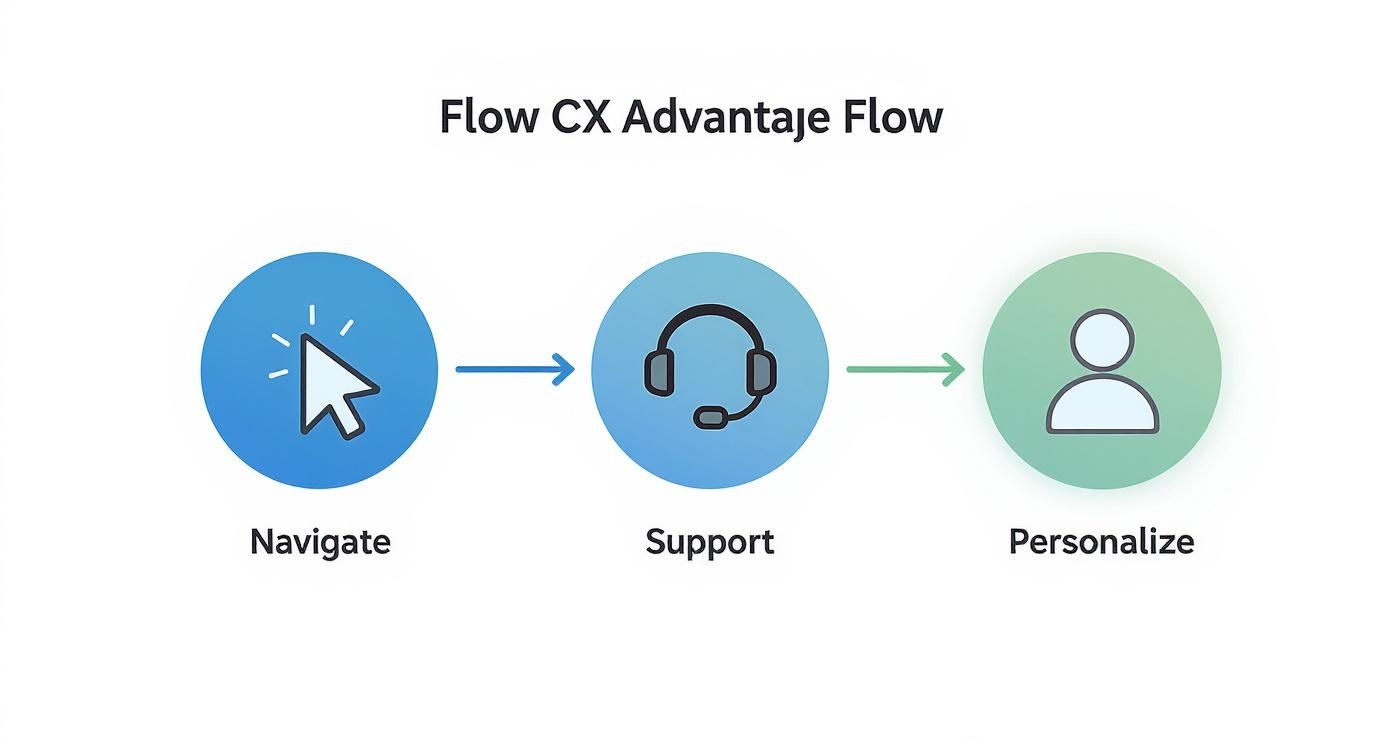
As you can see, a successful journey is one where customers can easily find what they need, get help when they're stuck, and feel like the experience was built just for them.
Finding the Real Data to Build Your Map
A journey map based on guesswork is a waste of time. You need to put on your detective hat and dig into real data, using a mix of tools to uncover how customers actually behave in your store.
For example, a major friction point in the consideration stage for apparel brands is fit uncertainty. Integrating a virtual try-on feature can directly tackle this, giving shoppers the confidence to click "buy." You can dive deeper into this with this ultimate guide to the virtual dressing room.
Start gathering your own insights with these methods:
-
Google Analytics: Go straight to the user behavior flows. This will show you the exact paths people take through your site. Where do they land first? What pages do they look at before they buy? And, critically, where are they bailing?
-
Heatmaps & Session Recordings: Tools like Hotjar are a game-changer. Heatmaps show you where people are clicking and scrolling, but session recordings are pure gold—it’s like watching over a customer's shoulder as they browse, giving you context that numbers alone never will.
-
Customer Surveys: Just ask! A simple post-purchase survey with a question like, "What almost stopped you from buying today?" can reveal huge roadblocks you never knew existed. For a more structured approach, learn more about https://www.buildwithtoki.com/blog-post/customer-journey-management.
When you start layering these data sources, you'll move from assumptions to real, evidence-based insights. You’ll have those "aha!" moments—like realizing your shipping policy page is so confusing it's scaring people away, or that everyone is looking for more product photos. That’s the stuff that fuels real improvements.
Drive Engagement with Smart Personalization
When we talk about personalization in ecommerce, we're going way beyond just dropping a first name into an email subject line. Real personalization is about using customer data to create interactions that feel genuinely one-on-one. It’s about showing shoppers you get them, sometimes before they even know what they want.
Done right, it's the magic that turns a generic, forgettable visit into an experience that makes a customer feel seen and valued. This is how you start turning raw transaction data into a real relationship.
Move Beyond Basic Demographics
The real power isn't in knowing a customer's age or location; it's in understanding their behavior. You need to segment your audience into dynamic groups based on how they actually interact with your store.
This lets you tailor your messaging with surgical precision. Think about it: the message you send a first-time visitor should be worlds apart from what you send a VIP who's bought from you ten times.
Get started by creating segments like these:
- High-Value Shoppers: Your best customers, the ones with the highest lifetime value who deserve exclusive perks.
- Cart Abandoners: Folks who got so close to buying but left before checking out.
- Recent First-Time Buyers: New customers who need a warm welcome and a gentle nudge to come back.
- Lapsed Customers: Previous buyers who haven't made a purchase in a while, say, 90 days.
This kind of segmentation is the bedrock. It lets you build targeted campaigns that resonate because they're directly tied to where that customer is in their journey with your brand.
Automate Your Personalized Outreach
With your segments defined, you can build automated email and SMS flows that do the heavy lifting. These aren't just generic blasts; they're triggered responses to specific actions, ensuring your message always lands at the perfect moment.
The classic example is a cart abandonment flow. But don't just send one "You left something behind!" email. Create a three-part series. The first can be a gentle reminder. The second could showcase customer reviews for the items they abandoned. The third might offer a small, time-sensitive discount to seal the deal.
Another killer tactic is dynamic website content. Imagine a returning customer lands on your homepage and immediately sees a banner with new arrivals in the exact category they bought from last time. It’s a simple touch that makes the whole experience feel curated and frictionless, seriously boosting the odds of another purchase.
The Critical Balance of Personalization and Privacy
Here's the tricky part. While personalization is incredibly powerful, it walks a fine line with privacy. Shoppers are savvier than ever about how their data is used, and a clumsy approach can feel more creepy than helpful. The key is to build trust through total transparency.
This is one of the biggest challenges in ecommerce today. An incredible 88% of shoppers say they're more likely to buy from brands that offer personalization. But in the same breath, 40% of shoppers have ditched a purchase because they were worried about their data security. As you can see from recent customer experience research, people want relevance, but not at the expense of their privacy.
Getting this right means being upfront and putting the customer in the driver's seat.
Pro Tip: Your privacy policy shouldn't be a link buried in your website's footer. Make it easy to find and write it in plain English. Clearly explain what you collect and how it helps you make their experience better.
Here’s how to build that trust, step by step:
- Implement Clear Consent Management: Use a cookie banner that gives people real control over what they share. Don't default to "accept all" and hope for the best.
- Offer a Preference Center: Let customers easily manage their communication settings in their account. Give them the choice to opt into emails about new arrivals, sales, or blog updates.
- Personalize Based on Explicit Signals: Focus your energy on data customers have willingly given you. This includes items they've wishlisted, categories they browse often, or brands they've explicitly "followed" on your site.
Ultimately, your personalization should feel like a helpful concierge, not a watchful observer. When customers feel respected and in control, they’re far more likely to engage with you and become true brand advocates. That’s what separates the good from the great.
Turn Buyers Into Brand Advocates with Loyalty Programs
The moment a customer clicks "buy" isn't the end of the road. In many ways, it's just the beginning. The real magic, the kind that builds a lasting brand, happens after the first sale. This post-purchase phase is your single biggest opportunity to turn a one-time buyer into a loyal fan—and maybe even a vocal advocate.
A well-crafted loyalty program is your best tool for making that happen. It’s more than just a marketing tactic; it's a structured way to say "thank you" and give customers a compelling reason to stick with you over the competition.
Choosing the Right Loyalty Model
Let's be clear: not all loyalty programs are created equal. The best ones feel like a natural extension of your brand and tap directly into what your customers actually value. You have to find the right fit.
Points-Based Systems This is the classic for a reason: it's simple. Customers earn points for actions like making a purchase, and then they can cash those points in for discounts or freebies. For brands that sell consumables—think coffee, skincare, or supplements—this model is a workhorse because it encourages those frequent, repeat buys.
Tiered VIP Programs This model plays on aspiration and exclusivity. Customers unlock new perks and status as they spend more, creating a game-like incentive to climb the ladder. Think about Sephora's iconic Beauty Insider program. Moving from "Insider" to "VIB" to "Rouge" comes with increasingly valuable benefits, making top customers feel genuinely seen and appreciated. It’s fantastic for building a real community.
Paid Memberships Amazon Prime basically wrote the book on this one. Customers pay a recurring fee for immediate access to a bundle of premium benefits, like unlimited free shipping or exclusive content. This is a power move for securing long-term commitment and creating a steady stream of predictable revenue.
A paid membership fundamentally changes the customer relationship. It shifts the focus from individual transactions to a long-term partnership, creating an incredibly high barrier for competitors to overcome.
Designing Rewards People Actually Want
The entire program lives or dies based on one question: are the rewards good? Generic, low-value perks just won't cut it. Your rewards need to feel genuinely desirable and reinforce what makes your brand special.
Here are a few categories to consider:
-
Transactional Rewards: These are the nuts and bolts. Things like discounts, free shipping, and "buy 10, get one free" offers. They provide clear, tangible value and are always a solid motivator.
-
Experiential Rewards: This is where you can get creative and build an emotional connection. Offer early access to new products, invite members to an exclusive online event, or provide a one-on-one consultation with an expert. Experiences are memorable in a way a 10% discount rarely is.
-
Community-Based Rewards: Make your top members feel like insiders. This could mean access to a private Discord channel, the ability to vote on new T-shirt designs, or a special shout-out on your Instagram. It gives them a real stake in the brand.
Mixing and matching these types keeps things interesting. For a deeper look at building out your rewards structure, our guide on how to create a loyalty program is the perfect next step.
Nailing the Launch
A brilliant program that nobody knows about is, well, useless. You need a coordinated launch plan to build hype and make signing up an absolute no-brainer.
Your Pre-Launch Checklist Before you flip the switch, make sure you’ve covered these bases:
- Give It a Name: "Rewards Program" is boring. "The Adventure Club" or "The Inner Circle" feels special. Give it an on-brand name that sparks curiosity.
- Build a Landing Page: Create a single, clear page that explains how the program works, shows off the rewards, and has a massive sign-up button. Keep the language simple and the visuals strong.
- Integrate It Everywhere: Don't hide it! Add prompts to join on your homepage, product pages, and especially the order confirmation page. Make it impossible for customers to miss.
- Plan Your Promotional Blitz: Get ready to announce it across all your channels—email, social media, homepage banners. You could even offer bonus points for anyone who signs up in the first week.
- Train Your Team: Your customer service reps need to be experts. They should be able to answer any question and actively promote the program during support chats and calls.
Investing in a thoughtful loyalty program isn't just about giving away discounts. It's about building an ecosystem that keeps customers coming back, boosts their lifetime value, and turns your biggest fans into your most effective marketing channel.
Unify Your Brand with an Omnichannel Strategy
https://www.youtube.com/embed/V0X8ssKui3c
Think about how your customers actually shop. Their journey is almost never a straight line from A to B.
They might see a product on Instagram during their lunch break, check out reviews on their laptop that evening, add it to their cart from your mobile app while watching TV, and then pop onto live chat with a final question before hitting "buy." If each of those touchpoints feels like a completely separate conversation, you’re creating friction. Worse, you're chipping away at their trust in your brand.
This is exactly why a true omnichannel strategy is no longer a "nice-to-have" for ecommerce. It's about more than just showing up on different platforms; it’s about orchestrating them to work in perfect harmony. The whole point is to create one single, seamless experience for your customer, no matter how or where they connect with you.
What's the Real Difference? Multichannel vs. Omnichannel
A lot of brands think they're doing omnichannel when they’re really just multichannel. It’s an easy mistake to make.
A multichannel approach simply means you have a presence in different places. Your website, social media, and physical store all exist, but they operate in their own little bubbles. They don’t share data or context, and for the customer, jumping between them can feel clunky and disconnected.
An omnichannel strategy, on the other hand, weaves all those channels together. The customer is placed firmly at the center of the experience, and every channel works together to support their journey. This is where the magic happens, turning awkward handoffs into a smooth, intuitive flow.
An omnichannel approach recognizes that the customer, not the channel, is the single point of sale. It ensures that every touchpoint—from an in-app notification to an in-store return—feels like part of the same thoughtful, unified brand experience.
This shift in mindset—from being channel-focused to customer-obsessed—is what really separates the great from the good in today's retail world.
Practical Ways to Create a Unified Experience
So, how do you actually make this happen? It comes down to implementing features that remove friction and offer genuine convenience. One of the most powerful examples is "buy online, pick up in-store" (BOPIS).
BOPIS is the perfect blend of digital ease and brick-and-mortar immediacy. A customer can browse your entire inventory online, buy without waiting for shipping, and then swing by their local store to grab their order—sometimes on the very same day. It’s a simple concept that perfectly bridges the online-offline divide and puts the customer in control.
Another non-negotiable is unifying your customer support. Your team needs a single, 360-degree view of every customer's history, no matter where those interactions happened.
- Previous Purchases: Did they buy this item online or in-store?
- Past Conversations: Have they already reached out via email or a social media DM?
- Wishlist Items: What products have they saved on your website or app?
When an agent has this information at their fingertips, they can resolve issues in minutes, not hours. The customer doesn't have to repeat their life story every time they switch from a chatbot to a live agent. That alone transforms a potentially frustrating experience into a surprisingly positive one.
Multichannel vs Omnichannel Customer Experience
To put it plainly, these two strategies deliver vastly different experiences for the customer. Thinking about it from their perspective makes the right choice obvious.
| Feature | Multichannel Approach | Omnichannel Approach |
|---|---|---|
| Customer Data | Data is siloed by channel (e.g., website data is separate from in-store data). | Customer data is centralized, providing a single, unified view of their history. |
| Inventory | Online and in-store inventory are managed separately, often leading to discrepancies. | Inventory is unified, allowing for features like BOPIS and ship-from-store. |
| Brand Experience | The brand voice and promotions may be inconsistent across different channels. | A consistent brand message, pricing, and experience is maintained everywhere. |
| Customer Journey | The customer must start a new journey on each channel. | The customer can seamlessly switch channels (e.g., start a cart on mobile, finish on desktop). |
Ultimately, focusing on an integrated, omnichannel strategy is how you show customers you value their time and their business. You meet them where they are and build a stronger, more resilient brand in the process.
Your Top Ecommerce CX Questions, Answered
As you start dialing in your store's customer experience, a few key questions always seem to surface. We hear them all the time from merchants just like you. Let's break down some of the most common ones with practical, no-fluff answers to help guide your strategy.
How Can Small Businesses Improve CX on a Tight Budget?
You don't need a massive budget to create a fantastic customer experience. It’s not about expensive tech; it’s about nailing the fundamentals that really matter to people.
Start with your site's performance. A fast, easy-to-use mobile experience is table stakes today—it's not even a question. If your site is slow or clunky on a phone, you're losing customers before you even have a chance.
Next, get obsessive about your product pages. Write incredibly detailed and helpful descriptions. Use high-quality photos and maybe even a short video to show the product in action. The goal is to answer every possible question a shopper might have, building confidence and trust. This costs you nothing but time, but it pays off by reducing hesitation and support tickets.
Finally, lean into personal, human support. A quick, thoughtful email or a response from a free live chat tool will always beat an expensive, clumsy chatbot. Simple things like a personal thank-you email after a purchase or a quick check-in to make sure their order arrived okay show you genuinely care. These low-cost moves are the absolute bedrock of a great customer experience in ecommerce.
What Are the Most Important KPIs for Ecommerce CX?
Don't get lost in a sea of data. To truly understand your CX performance, you only need to track a handful of key performance indicators (KPIs) that give you the full picture—from immediate happiness to long-term loyalty.
- Customer Satisfaction (CSAT): This is your real-time feedback loop. CSAT scores give you a direct pulse on how happy a customer is right after a specific interaction, like a purchase or a support chat.
- Net Promoter Score (NPS): This one is all about long-term loyalty. NPS measures how likely your customers are to recommend your brand to friends and family, making it a powerful predictor of organic growth.
- Customer Lifetime Value (CLV): CLV is the ultimate financial scorecard for your CX efforts. It calculates the total revenue a single customer is expected to bring to your business over their entire relationship with you.
- Customer Churn Rate: This is a critical health metric. It tells you the percentage of customers who stop buying from you over a certain period, directly showing whether your retention strategies are working.
Together, these four metrics create a powerful dashboard for understanding and improving your customer experience.
What Is the Real Role of AI in Ecommerce CX?
Let's clear this up: AI is here to scale your human touch, not to replace it. The smartest way to use it is to handle the repetitive, predictable stuff so your team can focus on creating genuine human connections.
For instance, an AI-powered chatbot is brilliant for answering simple, round-the-clock questions like "Where's my order?" or "What's your return policy?" This frees up your support agents to handle the complex, emotional issues where a human's empathy and problem-solving skills are irreplaceable.
AI should augment, not automate, the human touch. Let it crunch browsing data to serve up spot-on product recommendations, but always make sure a real person can step in the moment a customer needs nuanced help.
How Do I Turn Negative Feedback Into a Positive?
First, you have to change your mindset. Negative feedback isn't an attack—it's a gift. It’s a customer taking their time to show you exactly where the friction is in your business, for free.
The secret is in the response. Always reply quickly and, if the feedback is public, respond publicly. Acknowledge their frustration and genuinely thank them for bringing it to your attention. This shows everyone else reading that you're listening and that you take ownership.
Then, immediately take the conversation to a private channel—email, DMs, a phone call—to resolve the actual problem. Apologize sincerely and offer a clear, fair solution. This could be a refund, a replacement, or a discount on their next order. You'll often find that a customer whose problem is solved with speed and respect becomes even more loyal than one who never had an issue in the first place.
Ready to turn your buyers into brand advocates? Toki provides all the tools you need to build a world-class loyalty and rewards program that drives repeat sales and deepens customer relationships. Learn more and get started at https://buildwithtoki.com.