8 ideas for a sample referral program on Shopify
Explore 8 practical ideas for a sample referral program to boost Shopify sales. Real-world examples, templates, and tips to drive referrals today.
Struggling to design a referral program that actually drives growth? You're not alone. Many Shopify merchants and direct-to-consumer brands understand that referrals are a powerful customer acquisition channel but get stuck on the details: What rewards truly motivate sharing? What should the email and landing page copy say? How do you create a seamless launch plan?
Instead of starting from a blank page, this comprehensive guide provides a deep dive into proven, real-world sample referral program models. We’re moving beyond surface-level descriptions to give you the strategic blueprints used by successful brands. For each example, we will dissect the specific tactics, reward structures, target audience, and key performance indicators (KPIs) you need to track.
This article is your ultimate toolkit. We will break down everything from viral loops and B2B enterprise referrals to community-driven initiatives. To further expand your referral strategies and explore various approaches, consider delving into different Affiliate Program models as they often share similar psychological drivers and reward structures.
More importantly, we will provide actionable takeaways showing you how to implement these powerful blueprints using an all-in-one loyalty and referrals platform like Toki. This will help you turn these proven concepts into a tangible, automated revenue stream for your store. Get ready to copy, customize, and conquer customer acquisition with a referral program that works.
1. The Classic 'Friend-Get-Friend' Discount Program
This is the quintessential e-commerce referral model, and for good reason: its simplicity makes it powerful. The premise is straightforward and easy for customers to grasp instantly. A current customer (the Advocate) shares a unique link or code with a friend (the Friend). When the Friend makes their first purchase using that referral, both parties receive a reward.
This creates a self-sustaining loop. You acquire a new customer at a potentially lower cost than traditional advertising, and you simultaneously reward an existing customer, encouraging them to make a repeat purchase. This model is foundational and serves as a perfect starting point for any e-commerce brand venturing into referral marketing.
Strategic Breakdown
- Target Audience: Ideal for brands with a broad customer base and products that have a clear, immediate value proposition (e.g., apparel, cosmetics, food and beverage).
- Core Psychology: It leverages reciprocity and social proof. The Friend trusts the recommendation, and the Advocate is motivated by both the reward and the desire to share a good find.
- Business Goal: Primarily focused on new customer acquisition while secondarily boosting existing customer loyalty and lifetime value.
Key Insight: The beauty of this sample referral program is its low barrier to entry. Customers don't need to be super-fans or ambassadors; they just need to like your product enough to share it for a tangible, immediate benefit.
Sample Structure & Copy
- Advocate's Reward: $15 off their next order.
- Friend's Reward: $15 off their first order.
- Landing Page Headline: "Give $15, Get $15! Share the love and save."
- Social Share Copy: "I love [Your Brand]! Here’s $15 off your first order to try them out for yourself. You won't regret it! #YourBrand"
- Email Invite Subject: "A gift for you from [Advocate's Name]"
Implementation with Toki
Setting up a classic friend-get-friend program in Toki is streamlined.
- Program Setup: Navigate to the Referrals section and select the "Refer a Friend" campaign type.
- Reward Configuration: Define the rewards. Set the Friend's reward as a fixed-amount coupon for new customers. Set the Advocate's reward to be issued after the Friend's purchase is completed.
- Sharing Options: Enable multiple sharing options like email, social media, and a simple copy-paste link to maximize reach.
- Track KPIs: Monitor your Invitation Conversion Rate and Share Rate directly within the Toki dashboard to gauge the program's effectiveness and identify your most influential advocates.
2. Two-Sided Marketplace Referral Program
This model is the lifeblood of platforms that need to grow two distinct user groups simultaneously: the supply side (e.g., drivers, hosts, service providers) and the demand side (e.g., riders, guests, clients). A two-sided marketplace is only valuable when there's a healthy balance of both, and this referral program is engineered to build that critical mass by incentivizing referrals for each side of the platform.

Unlike a standard e-commerce model, success here depends on creating powerful network effects. When a user successfully refers a new customer, the platform becomes more valuable for all providers. Conversely, when a user refers a new service provider, the platform becomes more attractive to all customers. This dual-focus approach accelerates growth where it's needed most, as seen with pioneers like Airbnb and Uber.
Strategic Breakdown
- Target Audience: Marketplaces, gig economy platforms, and service-based businesses that connect two different user groups (e.g., TaskRabbit, DoorDash).
- Core Psychology: It taps into the user's desire to enhance their own experience. Referring a new driver means shorter wait times; referring a new host means more travel options. The reward is both financial and functional.
- Business Goal: To achieve liquidity and balance between supply and demand, fueling network effects that create a defensible market position.
Key Insight: The most effective sample referral program for a marketplace separates its incentives. The value of a new service provider is often much higher than a new customer, and the rewards should reflect this economic reality to motivate the right kind of growth.
Sample Structure & Copy
- Advocate's Reward (Referring a Customer): $20 in platform credit.
- Friend's Reward (New Customer): $20 in platform credit.
- Advocate's Reward (Referring a Provider): $100 cash bonus after the provider completes 5 jobs.
- New Provider's Reward: $50 cash bonus after completing their first 5 jobs.
- Landing Page Headline: "Help Us Grow! Get Paid to Refer New Clients & Service Pros."
- Social Share Copy (Customer): "Need a ride? Here's $20 in free credit to try [Your Platform]. It's a lifesaver!"
- Email Invite Subject (Provider): "[Advocate's Name] thinks you'd be a great [Provider Role]!"
Implementation with Toki
While Toki is primarily built for e-commerce, its flexible architecture can be adapted for a service marketplace.
- Program Setup: Create two separate "Refer a Friend" campaigns within Toki. One will be for referring new customers (demand side) and the other for new service providers (supply side).
- Reward Configuration: For the customer referral campaign, use store credit or a gift card reward issued through Toki's system. For the provider referral campaign, you may need to configure a custom reward (like a cash bonus) that is tracked in Toki but fulfilled manually or via another system once the new provider meets their requirements.
- Customization: Use Toki's API and webhooks to connect with your main platform. This allows you to trigger the Advocate's reward for a provider referral only after your system confirms the new provider has completed their first five tasks.
- Track KPIs: Monitor the Referral Rate for both campaigns separately. This will show you whether you need to adjust incentives to better balance supply-side versus demand-side growth.
3. The B2B Enterprise Referral Program
This model shifts from high-volume, low-value e-commerce transactions to a high-touch, high-value B2B environment. Designed for enterprise software and services where sales cycles are long and deal values are substantial, these programs incentivize existing clients and partners to refer other enterprises. The rewards are typically commissions or significant service credits rather than simple discounts.
The core difference is the emphasis on relationships and trust. A referral in the B2B space is a significant endorsement, and the program must be structured to honor that trust. It’s less about a quick share on social media and more about a strategic introduction, often involving dedicated partner managers and co-marketing efforts.
Strategic Breakdown
- Target Audience: Ideal for SaaS companies, professional services firms, and enterprise software providers with long sales cycles and high customer lifetime value (e.g., Salesforce, HubSpot).
- Core Psychology: It capitalizes on professional credibility and financial incentive. The referrer leverages their industry reputation, and the high-value commission makes the effort worthwhile. The referred company trusts the peer recommendation over a cold sales pitch.
- Business Goal: Focused on acquiring highly qualified, large-contract leads that are difficult to reach through traditional marketing. It also strengthens relationships with existing customers and partners, turning them into a dedicated sales channel.
Key Insight: This sample referral program succeeds by treating referrers as true partners, not just customers. Providing them with dedicated support, co-marketing materials, and transparent tracking is non-negotiable for building the trust required for high-stakes referrals.
Sample Structure & Copy
- Advocate's Reward: 15% commission on the first year's contract value, paid after the new client's first invoice is settled.
- Friend's Reward: An extended 90-day free trial or complimentary onboarding services (a value-add, not a discount).
- Landing Page Headline: "Partner with [Your Company] and Grow Together. Refer a client and earn 15% commission."
- Social Share Copy (LinkedIn): "Working with [Your Company] has transformed our [specific business function]. Happy to make a direct introduction for any of my connections looking to achieve similar results. #B2B #Partnership"
- Email Invite Subject: "Introduction: [Friend's Company] <> [Your Company]"
Implementation with Toki
While Toki is often focused on D2C, its robust system can be adapted for a B2B lead-generation program.
- Program Setup: Use the "Refer a Friend" campaign type but frame it as a "Partner Referral Program" on your front-end.
- Reward Configuration: Set the Advocate's reward to be a manual "cash" reward. This creates a notification for your team to process the commission payment externally once the deal is closed and verified. The Friend's "reward" can be a custom event that triggers an internal notification for your sales team to apply the special offer.
- Sharing Options: Focus on the "copy link" and "email" sharing options, as professional introductions are more common than broad social media blasts.
- Track KPIs: Use Toki's dashboard to monitor the Share Rate and initial Invitation Conversion Rate (leads generated). You will need to integrate with your CRM (like Salesforce or HubSpot) to track the lead's progression from referral to a closed-won deal, which is the ultimate success metric.
4. Affiliate Marketing Referral Program
Shifting from customer-to-customer referrals, this model formalizes the process by partnering with external promoters. This performance-based program empowers affiliates - such as bloggers, content creators, or influencers - to market your products using unique tracking links. In return, they earn a commission on every sale or lead they generate.
This approach transforms referrals into a scalable sales channel. Instead of relying solely on your existing customers, you tap into established audiences that trust the affiliate's recommendations. It’s a powerful way to reach new, highly-relevant customer segments and build brand credibility through trusted third-party endorsements.
Strategic Breakdown
- Target Audience: Best for brands in competitive niches or those with higher-priced products where a considered purchase is common (e.g., electronics, SaaS, high-end fashion, specialized equipment).
- Core Psychology: It leverages authority and trust. A recommendation from a respected creator or expert in a specific field carries significant weight, effectively warming up potential leads before they even visit your site.
- Business Goal: Primarily focused on scalable, performance-based customer acquisition and expanding brand reach into new, targeted markets.
Key Insight: Unlike typical customer referrals, this sample referral program is a true marketing partnership. Success hinges on recruiting the right affiliates and equipping them with the tools they need to effectively represent your brand and drive sales.
Sample Structure & Copy
- Affiliate's Reward: 20% commission on all sales generated through their link.
- Friend's Reward: Often none, but a 10% discount code exclusive to the affiliate's audience can boost conversions.
- Affiliate Portal Headline: "Partner with [Your Brand] & Earn 20% on Every Sale."
- Recruitment Email Subject: "Collaboration Inquiry: Join the [Your Brand] Affiliate Program"
- Affiliate Bio Copy (for their site): "I’m proud to partner with [Your Brand]! Use my exclusive code PARTNER10 at checkout to get 10% off your order and support my content."
Implementation with Toki
Toki provides the robust tracking and management tools needed to run a professional affiliate program.
- Program Setup: Create a new "Affiliate" program in Toki. This will generate a unique registration page for potential partners to sign up.
- Commission Structure: In the reward settings, define the commission rules. You can set a percentage-based commission for sales, which is the most common structure.
- Creative Assets: Use Toki's platform to upload and share marketing materials like banners, logos, and product images that your affiliates can easily access and use.
- Track KPIs: Focus on your Affiliate Conversion Rate and Top Performers report in the Toki dashboard. This data is crucial for optimizing your affiliate marketing sales funnel and identifying which partnerships deliver the highest ROI. Learn more about building a successful affiliate funnel.
5. The Viral Loop/Incentivized Sharing Program
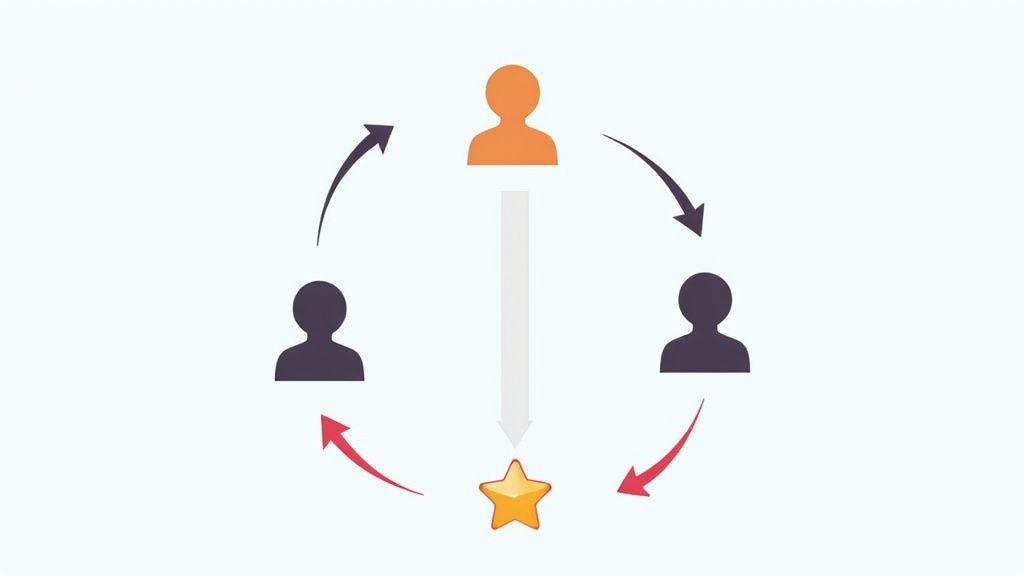
This referral model is less of a standalone campaign and more of a growth mechanism built directly into the core user experience. It incentivizes sharing and invitations as a way for users to unlock features, gain in-app currency, or progress faster. Instead of a one-off transaction, the referral becomes part of the product's natural usage loop, turning users into active promoters to enhance their own experience.
Popularized by mobile games like Candy Crush Saga and fintech apps like Robinhood, this model thrives on creating a symbiotic relationship between user engagement and user acquisition. The more a user engages with the product, the more opportunities they have to share, which in turn brings in new users who repeat the cycle.
Strategic Breakdown
- Target Audience: Ideal for brands with a digital product, app, or service that has high engagement and a natural social component (e.g., gaming, finance apps, subscription media, educational platforms).
- Core Psychology: It taps into game mechanics, such as achievement and competition. It also leverages the fear of missing out (FOMO) and the desire for social collaboration to drive sharing.
- Business Goal: Primarily focused on explosive, low-cost user acquisition and achieving a viral coefficient greater than one (where each user brings in more than one new user).
Key Insight: The success of this sample referral program hinges on making the act of sharing feel like a necessary and beneficial part of using the product, rather than a forced marketing action. The incentive must directly improve the user's immediate experience.
Sample Structure & Copy
- Advocate's Reward: Unlock a premium feature for 7 days.
- Friend's Reward: Get instant access to the same premium feature upon signup.
- In-App Prompt Headline: "Don't Go It Alone! Invite friends to unlock Pro access."
- Social Share Copy: "Loving this [App Name]! Use my link to sign up and we'll both get Pro features for free. Let's try it out together."
- Email Invite Subject: "[Advocate's Name] invited you to get free Pro access on [App Name]!"
Implementation with Toki
While Toki is e-commerce focused, you can adapt this model using points and rewards to create a viral loop.
- Program Setup: Use the Points program in Toki. Create a custom action called "Invite a Friend" that triggers when a new user signs up using a referral link.
- Reward Configuration: Set the Advocate's reward to be a significant number of points, enough to redeem a high-value reward like a free product or a major discount. Give the Friend an immediate point bonus upon signup.
- Gamification: Use Toki's gamification features to create tiers. For example, "Invite 5 friends to become a VIP" or "Unlock exclusive access after 3 successful referrals." This builds the loop into your loyalty program.
- Track KPIs: The most critical metric here is your Viral Coefficient. You can also track Referred User Retention Rate and the Time to First Referral in your analytics to understand how quickly new users become advocates.
6. Customer Success/Account-Based Referral Program
Moving beyond automated, mass-market approaches, this model embeds referrals directly into high-touch client relationships. Instead of a passive link on a website, referrals are actively facilitated by customer success managers (CSMs) or account managers. This is a strategic, relationship-driven play common in B2B SaaS and high-value service industries, but it can be adapted for premium e-commerce brands with dedicated clienteling.
The process involves CSMs identifying happy, successful customers and personally asking for introductions to peers who could also benefit from the product. The focus is on quality over quantity, leveraging the deep trust built between the account manager and the client to generate highly qualified, warm leads. It transforms referrals from a simple transaction into a strategic partnership activity.
Strategic Breakdown
- Target Audience: Ideal for B2B brands, enterprise software, professional services, or high-end e-commerce stores with significant customer lifetime value and a dedicated account management or customer success function.
- Core Psychology: It relies on established trust and professional rapport. The Advocate is motivated by a desire to help a professional peer and strengthen their relationship with their account manager, not just by a monetary reward.
- Business Goal: To acquire high-value, ideal-fit customers with a higher-than-average close rate and lifetime value, leveraging the credibility of your best existing clients.
Key Insight: This sample referral program is not about blasting out links. It's about integrating the "ask" into the natural cadence of a strong customer relationship, like during a quarterly business review or after a major success milestone.
Sample Structure & Copy
- Advocate's Reward: A choice of high-value rewards like a $500 service credit, a premium gift (e.g., Apple AirPods), or a donation to a charity of their choice.
- Friend's Reward: A personalized onboarding experience, an extended trial, or a first-year discount.
- Email from CSM: "Hi [Advocate's Name], I was thrilled to see your team's success with [Feature X] last quarter. As we plan for Q3, I was wondering if you knew 1-2 other leaders in your network who are also trying to solve [Problem]. An introduction would be fantastic."
- Internal CSM Guide: "Identify clients with an NPS score of 9+ who have recently achieved a key success metric. During your next call, ask about their network and who else might face similar challenges."
Implementation with Toki
While Toki is primarily designed for automated programs, it can support an account-based model by managing the reward fulfillment and tracking process.
- Manual Reward Issuance: Use Toki's administrative features to manually issue points or a specific coupon reward to an Advocate after a successful referral is confirmed by the CSM.
- Custom Rewards: Create unique, high-value, non-monetary rewards within the Toki catalog that CSMs can offer, such as "1-on-1 Strategy Session" or "Exclusive Beta Access."
- CRM Integration: Use Toki's integrations (or a tool like Zapier) to connect with your CRM. When a CSM tags a contact as a "Successful Referral," it can trigger a workflow to issue the reward in Toki, keeping the process streamlined.
- Track KPIs: While the initial outreach is manual, you can track Referral Value (the total revenue from CSM-generated referrals) and the Advocate Participation Rate among your managed accounts to measure success.
7. The Community-Driven Referral Program
This model shifts the focus from individual one-to-one referrals to a many-to-many approach by leveraging the power of existing communities. Instead of just asking a customer to share with a friend, you empower a group of passionate users-whether in a forum, Discord server, or ambassador program-to become organic advocates. The program nurtures these hubs of enthusiasm, providing them with the tools and recognition to spread the word authentically.
This approach transforms your most dedicated users into an extension of your marketing team. It taps into pre-existing networks of trust, where recommendations carry significantly more weight. Companies like Figma and Notion have excelled by building strong communities first, allowing referral growth to become a natural, user-led byproduct rather than a forced marketing push.

Strategic Breakdown
- Target Audience: Best for brands with a strong identity, a niche following, or products that foster collaboration and discussion (e.g., hobbyist supplies, gaming gear, specialized software, sustainable goods).
- Core Psychology: This model relies on a sense of belonging, status, and shared identity. Advocates are motivated less by a single discount and more by their passion for the brand and the recognition they receive within the community.
- Business Goal: Focused on building a long-term, sustainable growth engine and a powerful brand moat. The primary goal is deep brand advocacy and organic word-of-mouth, with new customer acquisition as a valuable outcome.
Key Insight: This sample referral program works because it's not transactional; it's relational. You're investing in your superfans and giving them a platform, and in return, they build invaluable social proof that no advertisement can replicate.
Sample Structure & Copy
- Advocate's Reward: Exclusive access to a private community channel, early access to new products, and a special badge or title.
- Friend's Reward: A standard welcome discount (e.g., 15% off) plus an invitation to join the community.
- Landing Page Headline: "Join the [Your Brand] Insiders! Get Perks & Share Your Passion."
- Social Share Copy: "So excited to be a [Your Brand] Ambassador! If you love [product category], you have to check them out. Use my link to get 15% off and join our awesome community!"
- Email Invite Subject: "[Advocate's Name] invited you to the [Your Brand] Community!"
Implementation with Toki
You can build a powerful community program by combining Toki’s features.
- Program Setup: Use Toki's Memberships feature to create an exclusive "Ambassador" or "Insider" tier. This can be a free tier that customers unlock by applying or being invited.
- Reward Configuration: Assign unique perks to this membership tier, such as exclusive point multipliers, early access to sales, or a special referral reward structure (e.g., they earn more points per referral than regular customers).
- Community Hub: Create a landing page for your community program detailing the benefits and featuring top ambassadors. Use Toki's referral links so you can attribute sign-ups directly to specific community members.
- Track KPIs: Monitor the Referral Revenue by Member to identify your top-performing community advocates. Also, track the Purchase Frequency of members to see if the program is increasing their overall loyalty and engagement.
8. Incentivized Email/SMS Referral Campaign
This approach moves beyond a passive referral link on your website and transforms referrals into a proactive, direct marketing strategy. It involves sending targeted email or SMS campaigns to specific segments of your existing customer base, prompting them with a clear, often time-sensitive, incentive to refer a friend. It’s about creating a moment of activation rather than waiting for one to happen organically.
By integrating referrals directly into your primary communication channels, you meet customers where they already are. This method is highly effective for re-engaging past purchasers, activating new customers, and turning loyal fans into a powerful acquisition engine. Think of it as weaponizing your CRM for growth.
Strategic Breakdown
- Target Audience: Perfect for brands with a strong email or SMS list. It's especially powerful for subscription services (like Adobe or Spotify) or businesses with repeat purchase cycles where you can segment users by engagement or lifetime value.
- Core Psychology: This strategy leverages urgency and personalization. A direct message with a specific offer feels more exclusive and actionable than a generic link on a website, prompting immediate consideration.
- Business Goal: Focused on driving bursts of new customer acquisition, re-engaging dormant customers, and maximizing the referral potential of specific, high-value customer segments.
Key Insight: This sample referral program excels because it controls the timing. You can align referral campaigns with new product launches, seasonal promotions, or slow periods to generate predictable, on-demand growth.
Sample Structure & Copy
- Advocate's Reward: $20 credit for each successful referral.
- Friend's Reward: 20% off their first purchase.
- Email Subject Line: "Share [Your Brand] & Get $20! It's a Win-Win."
- SMS Copy: "Love us? Refer a friend to [Your Brand] & we'll give you $20! They get 20% off too. Share your link: [Short Link]. T&Cs apply."
- Campaign CTA: "Share Now and Earn"
Implementation with Toki
Toki makes it easy to integrate your referral program with your direct marketing channels.
- Generate Unique Links: In the Referrals section, ensure each advocate has a unique, trackable referral link generated by the system.
- Segment & Export: Use Toki's customer data to identify valuable segments (e.g., customers with >3 purchases). Export this list or use an integration to sync with your email/SMS platform like Klaviyo or Attentive.
- Campaign Creation: Craft your email or SMS campaign in your preferred marketing tool, embedding the unique Toki referral links using personalization tags. This ensures every click is tracked back to the specific advocate. To dive deeper, you can learn more about crafting the perfect referral program email.
- Track Channel Performance: In the Toki analytics dashboard, filter referral data by the campaign source to measure the ROI of your email vs. SMS efforts and optimize future sends.
8-Model Referral Program Comparison
| Program | Implementation Complexity 🔄 | Resource Requirements ⚡ | Expected Outcomes 📊 | Ideal Use Cases 💡 | Key Advantages ⭐ |
|---|---|---|---|---|---|
| Dropbox Referral Program | Low — simple twin-sided rewards 🔄 | Low — minimal dev/marketing; dashboard hooks ⚡ | Rapid viral user growth; low CAC 📊 | Consumer freemium SaaS, storage apps 💡 | Scalable, easy to adopt; dual-sided incentives ⭐ |
| Two-Sided Marketplace Referral Program | High — separate tracks for supply & demand 🔄 | Medium–High — credits, regional tuning, fraud controls ⚡ | Balanced supply/demand growth; strong network effects 📊 | Marketplaces, rideshare, lodging platforms 💡 | Solves chicken-and-egg; grows both sides simultaneously ⭐ |
| B2B Enterprise Referral Program | High — long cycles, multi-touch attribution 🔄 | High — partner managers, CRM, co-marketing funds ⚡ | Higher close rates; higher LTV customers; strong ROI per deal 📊 | Enterprise SaaS, channel/partner-driven sales 💡 | Warm intros to decision-makers; builds partner ecosystems ⭐ |
| Affiliate Marketing Referral Program | Medium — tracking, commission ops 🔄 | Medium — affiliate platforms, recruitment, creatives ⚡ | Performance-based scalable revenue; measurable ROAS 📊 | E‑commerce, SaaS, digital products with niche publishers 💡 | Pay-for-performance; access to diverse traffic sources ⭐ |
| Viral Loop / Incentivized Sharing Program | Medium–High — product-level integration & gamification 🔄 | Medium–High — product dev, UX, analytics ⚡ | Explosive organic growth potential; high engagement 📊 | Mobile apps, games, social platforms aiming for virality 💡 | Integrated growth engine; habit-forming engagement ⭐ |
| Customer Success / Account-Based Referral Program | High — manual, relationship-driven process 🔄 | High — dedicated account teams, personalized outreach ⚡ | Fewer but higher-quality referrals; improved retention & NPS 📊 | High‑touch B2B, strategic enterprise accounts 💡 | Personalized introductions; higher conversion & loyalty ⭐ |
| Community-Driven Referral Program | Medium — nurture community culture 🔄 | Medium–High — community managers, events, content ⚡ | Authentic referrals; strong retention and higher LTV 📊 | Developer tools, creator platforms, open-source projects 💡 | Trust-based advocacy; defensible brand moat ⭐ |
| Incentivized Email/SMS Referral Campaign | Low–Medium — segmentation and tracking 🔄 | Low–Medium — email/SMS platform, copy testing ⚡ | Fast, measurable conversions; high short-term ROI 📊 | Campaigns to existing customers, promotions, re-engagement 💡 | Quick to launch; highly targetable and testable ⭐ |
From Sample to Sales: Activating Your Referral Engine
We've explored eight distinct and powerful sample referral program blueprints, from the classic two-sided incentive model that fueled Dropbox's legendary growth to sophisticated community-driven and B2B enterprise strategies. Each example serves not as a rigid instruction manual, but as a strategic launchpad. The core lesson is clear: a one-size-fits-all approach to referrals simply doesn’t work in today's diverse e-commerce landscape. Your brand's unique identity, product value, and customer lifecycle must dictate the design of your program.
The most successful referral engines are rarely built from a single template. Instead, they are hybrid creations, thoughtfully combining elements from different models. Imagine blending the viral loop mechanics of an incentivized sharing program with the long-term engagement of a tiered ambassador system. Or, consider using the immediate gratification of a post-purchase "give 10%, get 10%" offer as the entry point to a more robust, community-focused loyalty program. The true power lies in this strategic customization.
Key Takeaways for Building Your Program
To distill the insights from our analysis, here are the most critical takeaways for any merchant ready to build their referral channel:
- Align Rewards with Value: The reward you offer must be intrinsically linked to the value your product provides. For a subscription service, a discount on the next cycle is more compelling than a small cash payout. For a high-consideration product, a significant store credit for a future purchase feels more substantial.
- Reduce Friction at Every Step: The referral process must be ridiculously simple. From finding the referral link to sharing it and claiming a reward, every click and every moment of confusion is a potential exit point. Automate as much as possible, from link generation to reward fulfillment.
- Promote Your Program Continuously: A referral program is not a "set it and forget it" tool. It must be woven into your customer journey. Promote it in post-purchase emails, on your order confirmation page, within your customer accounts, and through targeted SMS campaigns. Make it an unmissable part of your brand experience.
Your Actionable Next Steps
Armed with these sample referral program structures, your path forward is clear. Don't let analysis paralysis stall your progress. Start by selecting one or two models that most closely resonate with your business goals and customer behavior. Is your primary goal rapid, low-cost acquisition? The viral loop model is your starting point. Are you focused on increasing customer lifetime value? A tiered ambassador or community-driven program is likely the better fit.
Once you have a model in mind, define your key performance indicators (KPIs) before you launch. Focus on metrics like your Referral Rate (the percentage of customers who refer others), your Conversion Rate from those referrals, and the Cost Per Acquisition (CPA) for this channel. These numbers will be your guideposts, telling you what’s working and what needs optimization. To fully understand the potential and mechanics of customer advocacy, you might want to explore comprehensive referral strategies. This deeper knowledge can help you fine-tune your approach for maximum impact.
Ultimately, the goal is to transform passive word-of-mouth into an active, predictable, and scalable growth channel. The samples in this article provide the blueprint. The next step is to lay the foundation, customize the design to fit your brand, and start building your most authentic and powerful sales engine: your own customers.
Ready to turn these samples into a reality for your Shopify store? Toki provides the flexible, all-in-one platform to build, automate, and integrate any of these referral models seamlessly with your points, loyalty, and membership programs. Stop guessing and start growing by activating your most powerful acquisition channel today with Toki.