How to Build a Rewards Points System That Actually Drives Loyalty
Learn how to build a rewards points system that boosts retention and drives sales. Get actionable advice on design, launch, and optimization for your store.
At its core, a rewards points system is a straightforward concept: customers do things you want them to do—like making a purchase or signing up for your newsletter—and in return, you give them points. They can then cash in these points for discounts, free shipping, or exclusive products. It’s a classic value exchange designed to encourage repeat business and make customers feel appreciated.
Laying the Groundwork for Your Rewards Program
Before you even think about point values or redemption tiers, you need to ask yourself a fundamental question: What am I trying to achieve? A rewards program isn't just about handing out freebies; it's a strategic tool meant to hit specific business goals. Without a clear objective, you're just adding an expense to your balance sheet instead of creating a revenue-generating asset.
So, start by defining the customer behavior you want to influence. Your answer will be the blueprint for your entire program.
- Want more frequent purchases? Try offering bonus points for a second purchase made within 30 days.
- Need to increase Average Order Value (AOV)? You could offer a points multiplier on all orders over $75.
- Looking for new customers? A strong referral program that rewards both the existing customer and their friend is a fantastic way to drive acquisition.
- Trying to build a community? Award points for non-purchase activities, like writing a product review or sharing a post on social media.
This initial soul-searching is what separates a program that people actually use from one that gets ignored.
Connecting Your Goals to Program Rules
Once your main objective is clear, you can start building the mechanics. Think of your points like a currency. Your program's rules create the "economy" that gives this currency value and encourages customers to spend it in ways that benefit your business.
A great loyalty program should feel like a seamless part of your brand, not a complicated puzzle. The goal is to make customers feel smart and rewarded for participating, which builds a much deeper connection than a simple discount ever could.
To get this right, it helps to start by understanding loyalty programs on a deeper level before you get bogged down in the details. A solid foundation prevents a lot of headaches later on.
This simple visual breaks down the foundational thinking process.
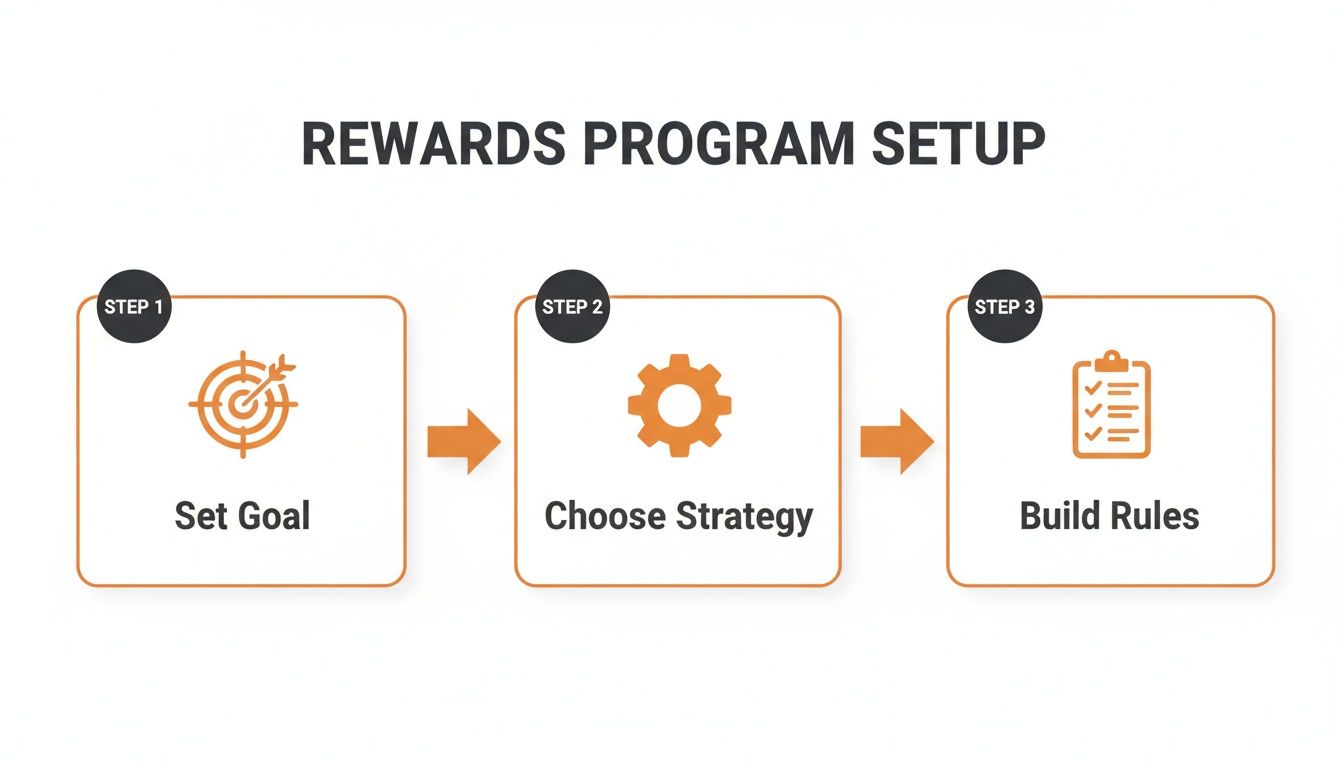
As you can see, the rules you build are the direct result of the goal you set and the strategy you choose. It's a top-down approach.
The table below gives some concrete examples of how to link your business goals directly to the earning and spending rules within your program.
Matching Program Goals with Point Strategies
| Business Goal | Earning Strategy Example | Redemption Strategy Example |
|---|---|---|
| Increase Purchase Frequency | Award 2x points on a second purchase within a month. | Offer a small, easily attainable reward like free shipping for 500 points. |
| Boost Average Order Value | Give 500 bonus points for any order over $100. | Offer tiered discounts, like $10 off for 1,000 points and $25 off for 2,000 points. |
| Drive Customer Acquisition | Offer 1,000 points to both the referrer and the new customer on their first purchase. | Allow new members to redeem a welcome bonus, like a 15% off coupon for 250 points. |
| Build Community & Engagement | Give 50 points for leaving a product review and 25 points for a social media follow. | Offer exclusive access to a new product or early sale access as a redemption option. |
By aligning every part of your program with a specific outcome, you ensure it’s working for you, not just costing you money.
Why Loyalty Matters More Than Ever
Investing in a well-designed rewards system isn't just a "nice-to-have" anymore; it's becoming essential for modern retail. The global loyalty management market is on a massive growth trajectory, expected to jump from $6.47 billion in 2023 to $28.65 billion by 2030.
This explosion shows that businesses everywhere are realizing that nurturing existing customers is one of the smartest, most sustainable ways to grow. By defining your goals upfront, you're setting your brand up to ride this wave, turning customer loyalty into a predictable and powerful part of your business.
How to Set Up Your Points Earning and Redemption Rules
Alright, you've figured out why you need a rewards program. Now for the fun part: building the actual system. This is where you design the "points economy" for your brand—making it generous enough to delight customers but smart enough to protect your margins.
The trick is to perfectly balance how people earn points with how they spend them. Get this right, and you'll have an engine that drives repeat business.
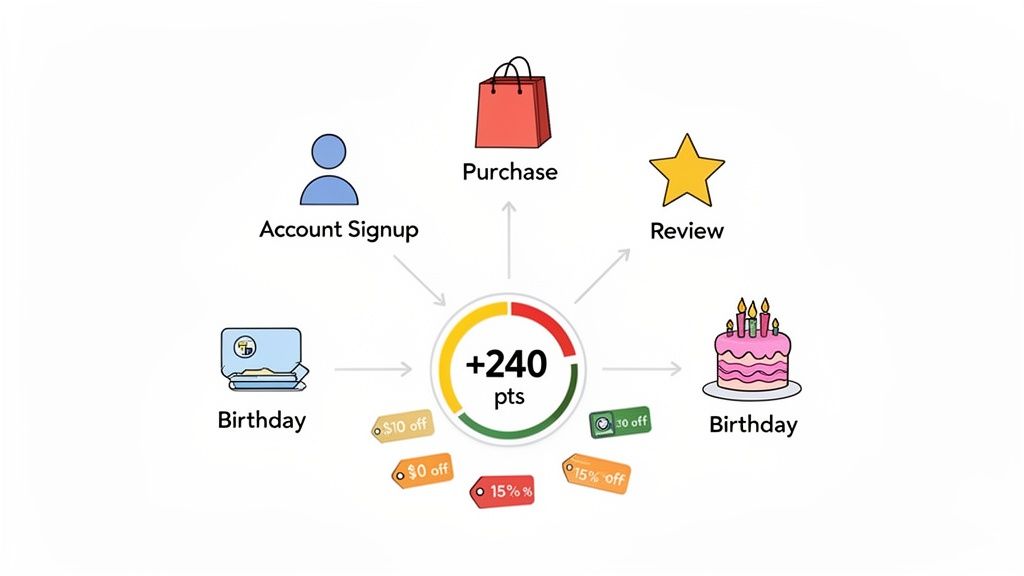
Most brands start by awarding points for purchases, and for good reason. A simple 1 point for every $1 spent is a classic, easy-to-understand baseline. But if you stop there, you're leaving a massive opportunity on the table. The real magic happens when you reward every valuable interaction.
Designing Smart Ways for Customers to Earn Points
Think bigger than just the checkout. The strongest loyalty programs reward customers for being part of their community, not just for being a walking wallet. These non-purchase actions are signs of real engagement, and they deserve to be recognized.
Here are a few proven ways to award points that customers love:
- Create an Account: Start them off with a win. A welcome bonus of 100-200 points for simply signing up gives new members instant value and a reason to stick around.
- Leave a Product Review: Let's be honest, user-generated content is pure marketing gold. Offer 50 points for a written review or bump it up to 100 points if they include a photo.
- Engage on Social Media: Turn customers into brand advocates. Give them 25 points for following you on Instagram or sharing one of your posts. It’s a low-cost way to boost your organic reach.
- Celebrate a Birthday: Who doesn't love a birthday gift? An easy 200 points on their special day is a fantastic personal touch that builds a genuine connection.
When you diversify how points are earned, you keep customers engaged with your brand even when they aren't actively shopping. Every little action deepens their loyalty.
Structuring Redemption Options That Actually Motivate
Earning points is exciting, but cashing them in is where the real satisfaction comes from. If your rewards are boring or a hassle to claim, you'll see engagement drop off a cliff. You need a mix of options that appeal to different types of shoppers.
Think about offering a few popular redemption models:
- Fixed Dollar Discounts: This is as straightforward as it gets (e.g., 1,000 points = $10 off). Customers instantly grasp the value, which makes it a very effective and popular choice.
- Percentage-Based Discounts: Rewards like 15% off for 1,500 points can be a huge motivator, especially for customers with bigger carts. The potential savings grow with their order size, making the reward feel even more valuable.
- Exclusive Perks: Sometimes the best rewards aren't about money. Offering a members-only product, early access to a sale, or free shipping for a low point cost can feel far more special than a simple discount.
One of the biggest shifts we've seen is the move toward letting customers apply points directly at checkout. This "Pay with Points" model is now a customer expectation, not just a nice-to-have. In fact, research shows nearly 80% of U.S. consumers prefer this kind of immediate, flexible reward that directly lowers their total cost.
Your redemption options are the finish line. If you make them desirable and easy to get to, customers will be excited to run the race again. A clunky or underwhelming process can completely kill the momentum you've built.
One last thing—don't let points live forever. Setting up a points expiration policy creates a healthy sense of urgency, nudging customers to come back and use their rewards. It also keeps your long-term liabilities in check. For a deeper dive, check out our guide on https://www.buildwithtoki.com/blog-post/how-to-set-up-an-expiration-policy-for-earned-rewards-or-points.
By getting both sides of this coin right—earning and redeeming—you’ll turn your rewards program into a powerful loyalty-building machine.
Using Tiers and Gamification to Boost Engagement
A basic points system is a solid start, but if you want to turn casual shoppers into die-hard fans, you need to make it more exciting. This is where tiers and gamification come in. They can shift your program from a simple discount tool into an experience customers actually enjoy and want to be a part of.
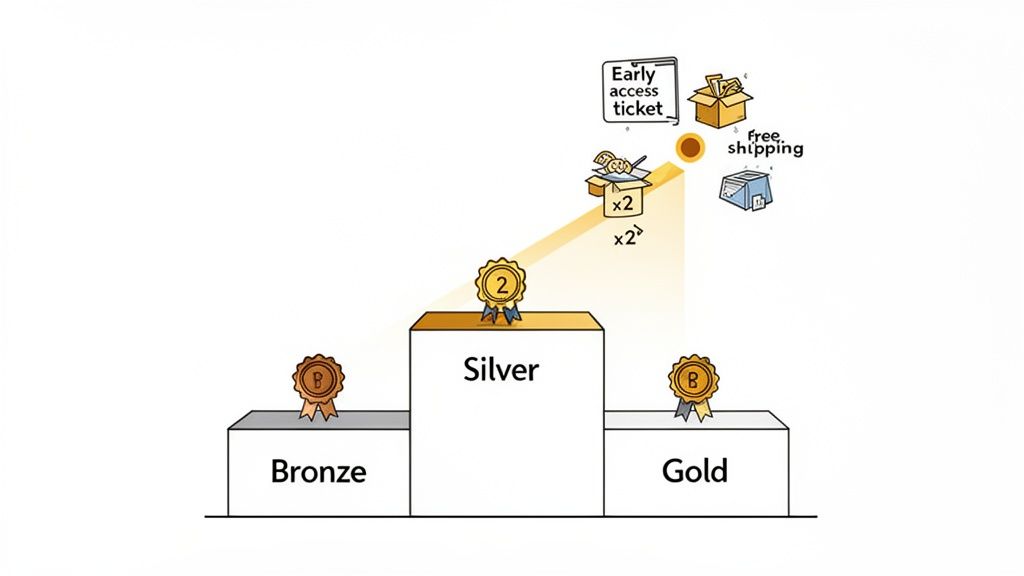
These strategies work because they tap into basic human psychology—our love for status, achievement, and a little friendly competition. When customers feel like they're climbing a ladder or unlocking an exclusive status, their connection to your brand goes way beyond just transactions.
Designing Your Loyalty Tiers
Tiers give your customers a clear path forward, something to strive for. The trick is making each level feel like a legitimate upgrade. A classic Bronze, Silver, and Gold structure works well, but the real magic is in the perks you attach to each one.
The best rewards feel both aspirational and exclusive. Don’t just bump up the point multiplier by a tiny fraction. Think about what your absolute best customers would find valuable and give it to them.
Here are a few ideas for high-value perks that really work:
- Early Access: Let your top-tier members shop new arrivals or big sales 24 hours before everyone else. The sense of being an insider is incredibly powerful.
- Free Shipping: This one's a classic for a reason. For your highest tier, consider offering it with no minimum spend—it’s a huge driver of loyalty.
- Members-Only Products: Create a special item, maybe a unique colorway or a piece of branded merch, that only Gold or Platinum members can buy.
- Bonus Points Events: Run special promotions where top-tier members earn 2x or 3x points on their purchases. It helps them feel valued and speeds up their path to the next reward.
Tiers give customers a tangible goal to shoot for. It’s no longer just about passively collecting points; it’s about earning a status that comes with real, visible privileges. This simple shift changes the whole dynamic from just saving a few bucks to joining an exclusive club.
Make sure your entry requirements are challenging but not impossible. A common way to structure this is by basing tiers on points earned or total spend over a rolling 12-month period. For instance, getting to Silver might require 1,000 points, while hitting Gold takes 2,500 points.
To give you a clearer picture, here’s what a simple three-tier structure might look like:
Sample Loyalty Tier Structure
| Tier Name | Entry Requirement (e.g., Points Earned) | Key Benefits & Perks |
|---|---|---|
| Bronze | Sign-up (0 points) | • Earn 1 point per dollar spent • Birthday reward (100 bonus points) |
| Silver | 1,000 points in 12 months | • All Bronze benefits • Earn 1.25 points per dollar • Early access to sales |
| Gold | 2,500 points in 12 months | • All Silver benefits • Earn 1.5 points per dollar • Free shipping on all orders |
This table shows a clear progression, where the rewards get noticeably better as the customer's loyalty increases. If you want to dive deeper, our guide on designing effective tiered loyalty programs breaks down more advanced strategies.
Adding Gamification to Your Rewards Points System
Beyond tiers, gamification injects a dose of fun and competition into the shopping journey. This is where you can get really creative and encourage specific actions that help your business. It's all about making engagement feel less like a chore and more like a game.
A fantastic place to start is with challenges and badges. They give customers small, satisfying "wins" that keep them engaged between purchases.
Try putting some of these gamification ideas into practice:
- "Review Pro" Badge: Award a special badge and 100 bonus points to any customer who leaves five product reviews.
- "Social Sharer" Challenge: Offer extra points to customers who share three of your products or blog posts on social media within a month.
- "Brand Advocate" Status: Unlock a unique title and a big point bonus for members who successfully refer three new customers to your program.
This approach turns every little interaction into an opportunity for a win. Instead of one big, distant goal (like the next tier), customers have lots of smaller achievements they can hit along the way. Every badge they earn gives them a little dopamine rush, strengthening their connection to your brand and making your rewards system that much more compelling.
Integrating Your Program for a Seamless Experience
A rewards program should feel like a natural part of shopping with you, not a clunky afterthought. If customers have to jump through hoops to find their point balance or remember a special code to redeem a reward, they just won't bother. The whole point is to make it easy and rewarding, not a chore.
The real magic happens when you weave your loyalty program into the very fabric of your business—both online and in-person. This is what we call an omnichannel experience. It means a customer can earn points on their laptop at midnight and spend them in your store the next day without a single hiccup. That kind of consistency is what builds real trust and keeps people coming back.
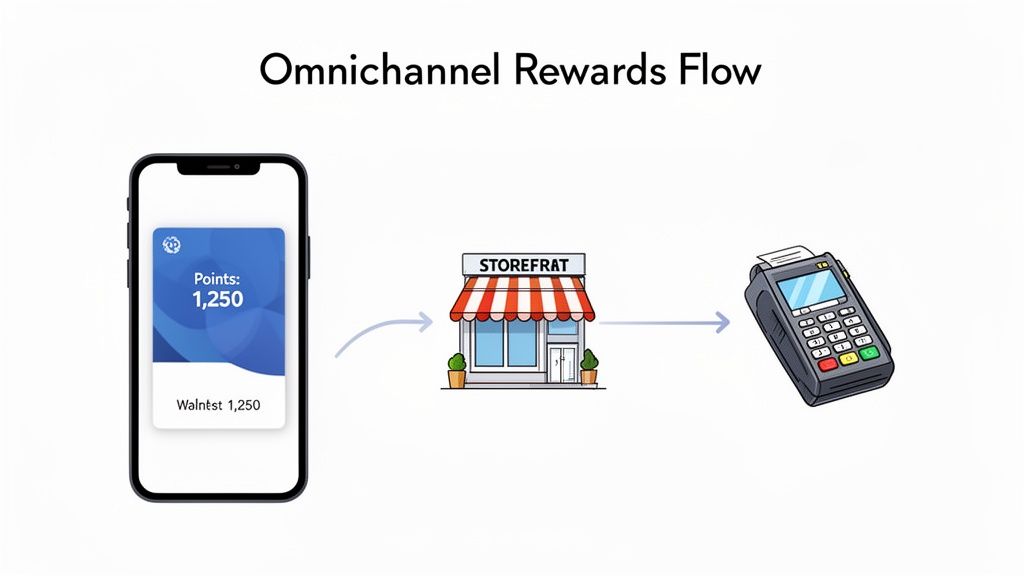
This unified approach makes sure every single interaction counts. A customer might buy something from your website but need to exchange it in-store. If your systems aren't talking to each other, you risk creating a confusing mess with their points. When everything is connected, your data stays clean and the customer experience remains flawless.
Connecting Your E-commerce Platform and POS
For most brands, the starting point is getting the program hooked into your e-commerce platform. If you're running on Shopify, for instance, there are plenty of great loyalty apps that plug right in. A solid integration should automate the essentials:
- Point Accrual: Automatically giving customers points for purchases, creating an account, or leaving a review. No manual entry needed.
- On-Site Display: Clearly showing a customer’s point balance on their account page and, more importantly, at checkout where it can influence their purchase.
- Easy Redemption: Letting customers apply their points for a discount with just one click in the shopping cart.
But if you have a physical storefront, a Point of Sale (POS) integration isn't optional—it's essential. This is what syncs your online program with what’s happening at the cash register. Your staff should be able to look up a customer by their name or email, see their points, and apply a reward directly to their purchase.
A disconnected system is a broken system. If a customer earns points on your website but can't use them in your physical store, you've created a frustrating dead end. It completely undermines the goal of building loyalty.
This omnichannel link turns your program from a simple online tool into a brand-wide asset. You get a complete 360-degree view of your customer’s spending habits, and they get rewarded for every single dollar they spend with you, no matter where it happens. For a deeper dive, check out our guide on successful loyalty program integration.
Bringing Your Program to Your Customer's Phone
To really elevate the experience, you need to meet customers where they are: on their phones. The most convenient place for someone to check their loyalty status isn't buried in your website—it's in their mobile wallet. Modern loyalty tools now let you issue digital wallet passes for Apple Wallet and Google Wallet.
This is a complete game-changer for keeping your brand top-of-mind. Instead of having to log into an account, your customer can see their point balance and tier status right next to their credit cards.
This simple move brings some powerful advantages:
- Top-of-Mind Awareness: Your brand literally lives in their pocket, making your program a part of their daily routine.
- Push Notifications: You can send timely updates directly to their lock screen. Think bonus point events, new reward alerts, or a gentle nudge that their points are about to expire.
- Frictionless Access: It gets rid of physical loyalty cards and forgotten passwords, making it incredibly easy for customers to engage anytime, anywhere.
By integrating your rewards program across your website, POS, and digital wallets, you remove all the friction. You're creating a smooth, intuitive journey that encourages customers to participate more deeply, turning your program into a genuine engine for growth.
Getting the Word Out: Launching and Promoting Your Rewards Program
So, you’ve designed a fantastic rewards program. That's a huge step, but it’s only half the battle. If your customers don’t know the program exists—or worse, don't understand why they should care—even the most generous points will just sit there, collecting dust.
A successful launch isn't a one-and-done event. It's a strategic campaign that builds hype, drives a wave of initial sign-ups, and then settles into a consistent rhythm that keeps people engaged. Let’s break down how to nail it in three phases: the pre-launch buzz, the big reveal, and the long-term promotion.
Building Hype with a Pre-Launch Teaser
About a week or two before you go live, it's time to start dropping hints. Your goal here isn't to spill all the beans, but to spark curiosity and make your loyal customers feel like they're in on a secret. You want them leaning in, waiting for the announcement.
A simple, coordinated teaser campaign across your main marketing channels works wonders.
- Email Marketing: Send a "Something exciting is coming..." email to your list. Keep it mysterious, but hint at a new way to get more from your brand and tell them to watch their inbox.
- Social Media: Get creative with cryptic graphics or short video clips. Instagram Stories countdown timers are perfect for building that sense of urgency.
- Website Banners: A subtle banner on your homepage with a message like, "A new way to get rewarded is on its way. Get ready," is all you need.
This pre-launch phase warms up your audience. When launch day finally arrives, they're already primed and paying attention, turning a cold start into a warm welcome.
Making a Splash on Launch Day
When it's time to go live, your message needs to be loud, clear, and everywhere. This is your moment to make an offer that’s impossible to ignore. From my experience, the single most powerful tactic for a new program is a can't-miss sign-up bonus.
A generous welcome bonus is the best way to get people off the fence. Offering 250 or 500 bonus points just for creating an account gives new members instant value. They get a real head start toward their first reward, which makes the decision to join a no-brainer.
On launch day, you need a multi-channel blitz. Every place a customer interacts with your brand should scream, "We have a new rewards program, and you get free points for joining!"
Your Launch Day Playbook
| Channel | Your Move | Example Message |
|---|---|---|
| Email Announcement | Send a dedicated email to your whole list, breaking down the benefits. | "Introducing [Your Brand] Rewards! Earn points on every purchase and get 500 bonus points just for signing up today." |
| Homepage Takeover | Use a bold hero banner or a friendly pop-up to grab every visitor's attention. | "It's Here! Join Our New Rewards Program and Get Your First Reward Faster with a Free Point Bonus." |
| Social Media Blast | Announce it across all your social channels with eye-catching visuals. | "Say hello to more rewards! Our new loyalty program is live. Sign up now and we'll start you off with enough points for free shipping!" |
This concentrated push ensures your launch makes a huge splash. You'll drive that critical mass of early members who become the bedrock of your program's success.
Keeping the Momentum Going with Ongoing Promotion
That initial launch-day surge feels great, but the real win is turning that momentum into a long-term habit. Your promotional efforts need to become a standard part of your marketing calendar, constantly reminding customers of the value waiting for them.
Weave program promotion into your everyday communications.
- Post-Purchase Emails: This is a golden opportunity. Include a customer's new point balance right in their order confirmation or shipping emails. It reinforces the value they just earned and shows them how close they are to their next reward.
- Dedicated Program Emails: About once a month, send an email that’s all about the program. You could highlight new ways to earn, feature a popular reward, or run a double points weekend to spark a burst of activity.
- On-Site Reminders: Use small, helpful nudges on your site. For instance, on a product page, a little note that says, "Buy now and earn 150 points towards your next discount!" can be incredibly effective.
By consistently threading your rewards program into the entire customer journey, you keep it top-of-mind. It stops being a one-time event and becomes a powerful, value-driving engine for your business.
Measuring Success and Dodging Common Mistakes
Getting your rewards program live is a huge step, but it’s definitely not the finish line. Honestly, that’s where the real work begins. Now you need to track its performance to make sure it's actually making you money and not just costing you.
To do this right, you have to look past the vanity metrics, like the total number of sign-ups. The real question is: are you changing customer behavior for the better? Without solid data, you're just flying blind.
What to Actually Measure in Your Rewards Program
To get a true feel for how your program is doing, you need to keep a close eye on a few key performance indicators (KPIs). These numbers tell the story of how engaged your members are and whether that loyalty is turning into real business growth.
-
Redemption Rate: This is simply the percentage of points that customers are actually cashing in. If this number is dipping below 20%, it’s a big red flag. It could mean your rewards aren't exciting enough, are too hard to earn, or maybe people just don't know about them.
-
Repeat Purchase Rate: This one is critical. You need to compare the percentage of loyalty members who come back for a second purchase against the rate for your non-member customers. If you see a healthy lift in the member group, you know you're onto something.
-
Customer Lifetime Value (CLV): Are your program members more valuable over the long haul? You should be tracking the average CLV of members versus non-members. A successful points system will absolutely increase the long-term value of your best customers.
Sidestepping the Traps That Tank Loyalty Programs
I've seen so many loyalty programs fall flat over the years. It’s rarely because the idea was bad; it’s almost always due to simple, avoidable mistakes in how they're run. Knowing what these traps are ahead of time can help you steer clear.
Here are a few of the most common missteps I see:
-
Making It Too Complicated: If your customers need a calculator and a flowchart to understand your points system, they'll just give up. Your rules for earning and spending points need to be dead simple and intuitive.
-
Offering Lame Rewards: Nothing kills excitement faster than a reward that feels cheap. Offering a tiny $5 off coupon that takes a customer a year to earn is a classic example of what not to do. Make sure your rewards feel valuable and, just as importantly, achievable.
-
Forgetting to Promote It: You can't just launch your program and expect customers to find it. You have to shout about it from the rooftops—or at least from your email newsletters, social media channels, and website homepage. Keep it top of mind, always.
The best rewards programs I've seen are treated like a core product, not some forgotten side project. They're constantly being monitored, promoted, and tweaked based on real customer feedback and performance data. The quickest way to kill your program is to launch it and forget it.
By keeping an eye on the right data and actively avoiding these common blunders, you can keep refining your strategy. This ensures your rewards system doesn't just launch well but becomes a powerful engine for building genuine customer loyalty and driving sustainable growth.
Your Top Questions About Rewards Points, Answered
When you're building a rewards program from the ground up, a lot of questions pop up. I've seen brands grapple with these same issues time and again, so let's tackle some of the most common ones.
How Do I Figure Out What a Point Is Worth?
The classic, go-to model is 1% back. It's simple, clean, and customers get it right away.
Think of it like this: if a customer spends $1 and earns 1 point, and they need 100 points to get a $1 reward, you're giving them a 1% return on their spending. This is a solid starting point that’s easy to communicate. You can always tweak this based on your margins, but starting here keeps things straightforward.
What’s a Good Redemption Rate, Anyway?
You should aim for a redemption rate of 20% or higher. If you’re seeing numbers well below that, it’s a red flag that something isn't clicking with your customers.
A low rate usually points to one of a few culprits:
- The rewards aren't compelling. Are you offering things people actually want?
- It takes too long to earn anything. If the finish line is too far away, customers will just give up.
- Members are in the dark. They might not even know they have points or what they can get with them.
Should I Make My Points Expire?
Absolutely. Setting an expiration date is a smart move for both you and your customers. A common policy is to have points expire after 12 months of inactivity.
This little bit of urgency nudges customers to come back and shop before they lose their hard-earned rewards. It’s a great way to re-engage someone who hasn't visited in a while.
From a business standpoint, expiring points is crucial. Without an expiration policy, unredeemed points just sit on your books as a long-term financial liability. A clear, well-communicated policy protects your bottom line while motivating customers.
How Do I Tell Customers We're Changing the Program?
Transparency and timing are everything here. If you need to make changes—especially if you're devaluing points or raising reward thresholds—you have to give your members a heads-up. Plan on giving at least 30-60 days' notice.
Don't just send one email and call it a day. Use all your channels: email, social media, and a prominent banner on your website. Be clear about what's changing and why. If you can, frame the updates in a positive light, explaining how they'll lead to a better program for everyone in the long run. This helps you keep the trust you’ve built with your most loyal customers.
Ready to turn casual shoppers into brand champions? With Toki, you can launch a powerful rewards points system, tiered memberships, and referral programs in minutes. Discover how Toki can drive repeat sales for your Shopify store.