How to Create a Referral Program That Actually Works
Learn how to create a referral program that drives real growth. Our guide covers incentives, launch strategies, and optimization for maximum impact.
Building a solid referral program boils down to three core things: setting clear goals, picking rewards people actually want (for both the person sharing and their friend), and making the whole sharing process dead simple. The real trick is to create something your happiest customers are genuinely excited to use, turning their authentic trust into your best marketing channel.
Why Most Referral Programs Fail (And How Yours Can Succeed)
Let's be real for a second. A lot of referral programs are launched with big dreams, only to fizzle out completely. They end up as just another link buried in the website footer, totally ignored by the customers who are supposed to be driving it.
The biggest reason they tank? A fundamental misunderstanding of what a referral program actually is. It’s not just another marketing tactic; it’s a growth engine that runs on human psychology and real, genuine trust.
Too many brands approach it like a sterile transaction: "Give us a name, we'll give you a discount." This completely misses the point. A program that actually works taps into the excitement your best customers already feel for your brand. It doesn't magically create advocates—it just gives their existing passion a way to shine and a reason to share.
The Real Power of Word-of-Mouth
At its heart, referral marketing is all about harnessing the most powerful conversion tool in existence: a recommendation from someone you trust.
Think about it. When a friend raves about a new brand of running shoes they love, you pay attention. Their endorsement cuts straight through the endless noise of paid ads and sponsored posts because it comes with built-in social proof. Your referral program is simply the system that formalizes and scales those everyday conversations.
This isn't just a hunch; the numbers are there to prove it. Customers who come to you through a referral are, by almost every measure, more valuable than those you get from other channels.
Referred customers have a 37% higher retention rate, and their lifetime value (LTV) is 25% higher than customers acquired through other channels. This isn't just a small bump; it’s a massive financial upside that comes from investing in real relationships. You can dive deeper into these and other powerful referral marketing statistics from Talkable.
This means the people you bring in through referrals aren't just one-and-done buyers. They’re far more likely to stick around, spend more over time, and—here's the magic—become referrers themselves. This creates a powerful, self-sustaining cycle of growth.
That’s how you build a referral program that crushes it: you stop thinking about one-off transactions and start focusing on fostering long-term, loyal relationships.
Before we dive into the nuts and bolts, let's quickly put referral marketing side-by-side with traditional advertising. The difference is pretty stark.
Referral Marketing vs Traditional Ads At a Glance
| Metric | Referral Program | Paid Advertising |
|---|---|---|
| Customer Acquisition Cost (CAC) | Lower | Higher |
| Customer Lifetime Value (LTV) | Higher (25% higher on average) | Lower |
| Conversion Rates | Higher (often 3-5x higher) | Lower |
| Trust Factor | High (based on peer trust) | Low (often seen as biased) |
| Customer Retention | Higher (37% higher on average) | Lower |
| Lead Quality | High (pre-qualified by trust) | Varies (often low intent) |
As you can see, when you compare them directly, referrals don't just compete—they often outperform paid channels on the metrics that truly matter for sustainable growth. It's about acquiring better customers, not just more of them.
Nail Down Your Program’s Foundation First
Everyone wants to jump straight to the fun stuff, like figuring out the "give $20, get $20" offer. I get it. But hitting pause and laying some strategic groundwork first is the single most important thing you can do. It’s a classic mistake to rush the incentives, and it’s why so many referral programs just fizzle out.
A program that actually works—one that drives real growth—is built on a solid understanding of what you’re trying to accomplish and who your best messengers are.
So, before anything else, ask yourself this: What does success actually look like for my business? Are you trying to get a flood of new customers, or would you rather have fewer, higher-spending ones? Maybe the real goal is just to get existing customers to buy again.
Getting crystal clear on your number one objective is the compass for every other decision you'll make. Without it, you’re just guessing.
What’s the Real Business Goal Here?
Your program's goals need to be specific and directly tied to your bottom line. "More customers" is a wish, not a goal. You have to get more specific than that.
Think about what you truly need right now:
- Bring in New Customers: This is the big one for most stores. The aim is to acquire new shoppers for less than you'd spend on a Facebook or Google ad.
- Increase Customer Lifetime Value (LTV): Maybe your focus is on quality over quantity. The goal here is to attract new customers who spend more and stick around longer, just like your current best ones.
- Push a Specific Product: Got a new collection you want to highlight? Or maybe some extra inventory you need to move? A referral program can be a great way to put a spotlight on specific items.
- Generate Quality Leads: For some businesses, an immediate sale isn't the point. Instead, you might be looking for qualified leads that your sales team can follow up with later.
Once you know your primary goal, you can start thinking about the numbers you’ll track to see if it’s working. Things like your participation rate, share rate, and how many of those shares actually turn into sales.
Figure Out Who Your Best Advocates Are
Let's be honest: not every customer is going to be a great referrer. The programs that kill it are the ones that tap into the customers who already love what you do. These are your brand advocates.
Who are they? They’re the people who have bought from you multiple times. They leave glowing reviews without being asked. They’re the ones tagging you in their posts on Instagram. These customers are your program's secret weapon because when they recommend you, their friends listen. It’s coming from a place of genuine trust.
Don't underestimate this. A well-built program can become a massive revenue channel. In the software world, for example, it’s not uncommon for top companies to generate 15-30% of all new revenue from referrals. That’s the kind of power we’re talking about. You can dig into more stats like this in these insights on referral network economics from SoftwareOasis.com.
When you launch, focus your energy on getting these people on board first. By starting with your most passionate fans, you build a powerful, authentic word-of-mouth engine that will pick up steam on its own. It’s a targeted approach that ensures you start strong and attract new customers who are the right fit for your brand from day one.
Designing Incentives People Actually Want
The reward is the engine of your entire referral program. Let's be honest—if the incentive falls flat, the whole thing will stall out before it even gets started. The real challenge is finding that perfect sweet spot: an offer that gets your customers genuinely excited to share, but that also makes complete financial sense for your business.
So many brands just default to a simple percentage discount. It's easy, but it’s also the least imaginative option. Your incentives should be a reflection of your brand's value and tap directly into what motivates your audience. A generic offer feels cold and transactional, while a thoughtful one feels like a genuine reward for their loyalty and advocacy.
To get this right, you have to understand the psychology behind it. A cash reward might seem like the ultimate motivator, but some studies show that non-cash incentives can be up to 24% more effective. Think about it: store credit, for example, accomplishes two critical goals at once. It rewards the person who made the referral and all but guarantees they'll come back to spend it, directly boosting their lifetime value.
Finding the Perfect Reward Structure
From my experience, the best referral programs almost always use a two-sided incentive. This means you reward both the existing customer (the advocate) for sharing and the new customer (their friend) for making a purchase. This simple structure completely removes the social awkwardness that can come with referrals. Your advocate isn't just asking a friend for a favor; they're genuinely giving them something valuable.
Here are a few popular structures I’ve seen work wonders:
- Store Credit for the Advocate, Discount for the Friend: This is a classic for a reason. Imagine giving the advocate $25 in store credit and their friend 20% off their first order. It's a win-win that encourages repeat business from your loyal base while making it a no-brainer for the new person to give you a try.
- Cash for the Advocate, Discount for the Friend: This approach tends to work exceptionally well for higher-priced products or subscription services where the financial commitment is bigger. The cash feels tangible and significant, making the effort of referring feel genuinely worthwhile. If you're curious about different payment models, you can explore various effective commission structures to see what might fit.
- Exclusive Products or Early Access: Don't underestimate the power of exclusivity, especially if you have a passionate, cult-like following. Offering a free, limited-edition product or early access to a new launch can be incredibly powerful. It makes your advocates feel like true brand insiders, which is a reward in itself.
This image breaks down some of the most common types of referral incentives you can choose from.
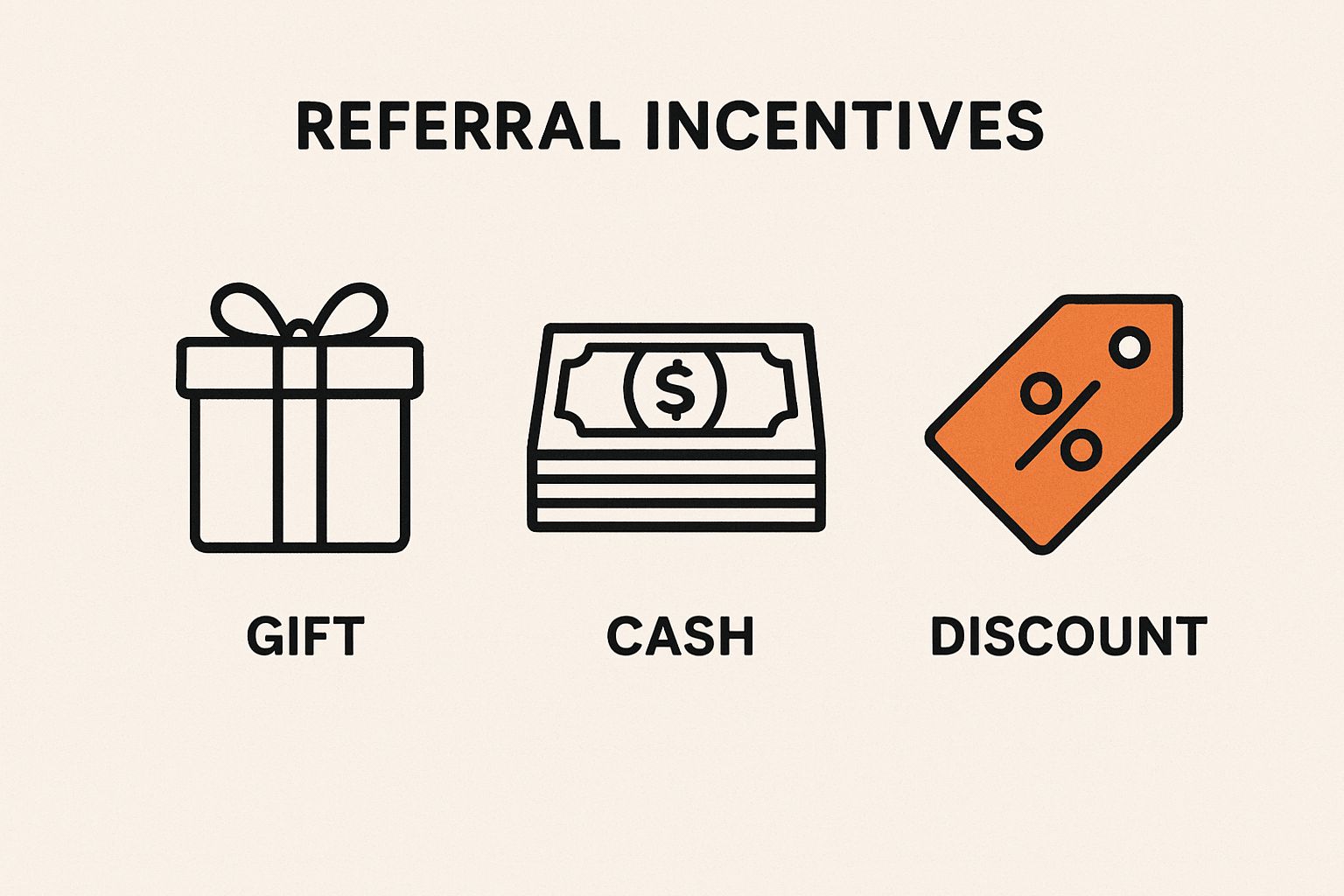
As you can see, every type of incentive—from a physical gift to cash to a simple discount—appeals to different customer motivations.
Matching Incentives to Your Audience
Ultimately, the "right" incentive depends entirely on what you sell and who you sell it to. A beauty brand could offer a free, best-selling lipstick. A coffee subscription service might give away a free bag of a special, limited-run roast. Your goal should be to offer something that has a high perceived value to your customer, even if its actual cost to you is relatively low.
Choosing the right incentive is a critical step, as it directly influences how much your customers will engage. The table below breaks down a few options to help you decide.
| Incentive Type | Best For | Key Consideration |
|---|---|---|
| Percentage Discount | Brands with a wide product range and frequent purchases. | Easy to implement, but can sometimes devalue the brand if overused. |
| Fixed Credit/Cash | High-value products or subscription services. | Feels more tangible and significant, motivating more effort from advocates. |
| Free Product/Gift | Brands with hero products or a strong cult following. | High perceived value, deepens brand loyalty, and feels like a special treat. |
| Tiered Rewards | Businesses looking to encourage multiple referrals from super-fans. | Rewards the most active advocates and can create a sense of gamification. |
No matter which path you choose, the key is to make your reward feel like an authentic gesture of appreciation.
Don't be afraid to get creative here. The most memorable referral programs I’ve seen offer rewards that are completely unique to the brand. This reinforces your brand identity and makes participating feel far more special than just getting another generic discount code.
When you get it right, the perfect incentive feels less like a marketing ploy and more like a genuine "thank you" for spreading the word. By aligning the reward with what your customers truly value, you’re not just building a program—you’re building a community that people are excited to be a part of.
For a deeper dive, our complete guide on choosing the best rewards for referrals is packed with even more ideas and inspiration.
Crafting a Seamless Referral Experience
Let's be honest: even the most amazing rewards won't matter if your referral process is a pain to use. A clunky, confusing experience is a guaranteed way to stop sharing in its tracks. The whole point is to make referring a friend feel like a natural, easy next step for your best customers.
This is the stage where you pick the engine for your program. You really have two main options: go with specialized referral software or build your own custom solution from the ground up. Each path has its own set of pros and cons, and the right choice depends on your business.
Software vs. Custom Build: Which Path Is Right for You?
For the vast majority of e-commerce brands, especially if you're on a platform like Shopify, using dedicated referral software is a no-brainer. These tools are built to get you live quickly—we're talking hours, not months. They take care of all the tricky stuff, like generating unique referral links, tracking who gets credit for a sale, and automatically sending out rewards.
Now, if you're a massive enterprise-level company with a complex tech stack or some very unique requirements, a custom-built solution might be on the table. It gives you total control, but be prepared for a serious investment. A custom build can easily run into tens of thousands of dollars and tie up your development team for months.
Here’s a quick breakdown to help you weigh your options:
| Feature | Referral Software (e.g., Toki) | Custom-Built Solution |
|---|---|---|
| Speed to Launch | Fast (Hours to days) | Slow (Weeks to months) |
| Initial Cost | Low (Monthly subscription) | High (Large upfront development cost) |
| Technical Skill | Minimal (Plug-and-play) | High (Requires a dedicated dev team) |
| Maintenance | Handled by the provider | Ongoing internal responsibility |
| Customization | Good, within the platform's limits | Unlimited, but complex |
Frankly, starting with a platform like Toki is the smarter play. It lets you test your offers, learn what works, and grow your program without the huge financial risk and headache of a custom project.
Creating Your Core Program Assets
Once you've decided how you'll run the program, it's time to build the actual pages and messages your customers will see and use. These are the critical touchpoints that guide both your advocate and their friend through the entire process, making it simple and compelling.
You'll need to create a few key things:
- A Crystal-Clear Landing Page: Think of this as your program's headquarters. It needs to immediately answer three questions: What’s in it for me? What’s in it for my friend? How do I start? Use a punchy headline, dead-simple instructions, and a big, obvious call-to-action button.
- Effortless Sharing Options: Don't force people to jump through hoops. Give them multiple, one-click ways to share, like copying their unique link, posting directly to social media, or sending a pre-written email. The less work it is, the more they'll share.
- Smart, Automated Communication: You'll want to set up automated emails to keep everyone in the loop. These should confirm when a referral is successful, let the advocate know their reward has arrived, and give the new customer a warm welcome. Good communication builds trust and keeps the excitement alive.
The name of the game at this stage is friction removal. Every single step, from a customer finding the referral page to their friend clicking the link, should be incredibly intuitive. If someone has to pause and think about what to do next, you've probably already lost them. A smooth experience shows you respect your customer's time and makes them want to be a part of it.
Promoting Your Program to Drive Participation

Getting your referral program live is a huge step, but the real work starts now. I’ve seen so many brands make the same critical mistake: they build a fantastic program and then just assume customers will stumble upon it. For this to really move the needle, you have to be proactive. That means a smart, multi-channel promotion strategy that gets your program in front of your most loyal fans.
Think of your launch less like a single event and more like the start of an ongoing campaign. The goal is to weave the referral program into the fabric of the customer journey, not just tuck a link away in your website's footer.
Your Initial Launch Blitz
A big, energetic launch is your best bet for building that initial buzz. Don't just fire off a single email and cross your fingers. You need a coordinated push across your main communication channels to grab as much attention as possible and encourage those first few sign-ups.
A solid launch campaign should have a few moving parts that all work together:
- Email Announcement: Send a dedicated email to your entire customer list. The tone should be celebratory and crystal clear, highlighting what’s in it for both the person referring and their friend. For some great ideas on what to say, these powerful referral email templates are a fantastic starting point.
- Social Media Campaign: Get the word out on all your social channels. Create some slick graphics or a quick video explaining how it works. You could even run a contest during launch week to reward the first handful of people who make a successful referral.
- On-Site Visibility: Make your program impossible to ignore on your website. Add a banner to your homepage, build out a dedicated landing page, and maybe even use a temporary pop-up to make sure everyone sees it.
Key takeaway: A successful launch comes down to repetition and genuine excitement. You have to clearly and frequently communicate the program's value across different touchpoints. If you aren't excited about it, why would your customers be?
Promoting at High-Engagement Moments
After the initial splash, the most powerful promotion happens when customers are already feeling good about your brand. This is where you can get really strategic, timing your asks for when people are most likely to share.
Look for opportunities to integrate referral prompts into key moments:
- Post-Purchase Confirmation: The thank-you page or the order confirmation email is prime real estate. A customer has just committed to you and is feeling that post-purchase glow. It’s the perfect time to ask them to share that excitement.
- After a Positive Review: Someone just left you a 5-star review. They’ve literally just told you they’re a huge fan. Follow up right away with a personalized message inviting them to your new referral program.
- Following a Great Support Interaction: Your team just went above and beyond to solve a customer's problem. This is a golden opportunity. Trigger an automated email that says something like, "Glad we could help! Know anyone else who would appreciate this level of service?" It feels natural and can be incredibly effective.
Tracking What Matters to Optimize Performance

Getting your referral program live is a huge first step, but it’s really just the starting line. The real growth comes from treating your program like a living, breathing part of your business—something you constantly fine-tune. A "set it and forget it" mindset is a recipe for a stalled program. If you want compounding returns, you have to dig into the data and make smart, iterative improvements.
That means looking past surface-level vanity metrics like clicks or impressions. You need to zero in on the key performance indicators (KPIs) that tell the true story of how well your advocates are turning their friends into new customers.
Key Metrics for Referral Program Success
The secret is to cut through the noise and focus on a handful of core metrics. These numbers paint a clear, actionable picture of your program’s health and point you directly to areas that need a little work.
To start, I always recommend tracking these three critical data points:
- Participation Rate: What percentage of your customer base has actually signed up for the program? This tells you if your promotional efforts are hitting the mark and getting people in the door.
- Share Rate: Of those who’ve joined, how many are actively sharing their referral link? A high participation rate but a low share rate is a huge red flag—it often means there’s friction in the sharing process or the incentive isn't quite right.
- Conversion Rate: This is the big one. What percentage of shared links leads to a successful purchase from a new customer? This metric tells you if your offer is compelling enough to get someone to actually pull the trigger.
Keeping a close eye on these metrics is non-negotiable. For context, SaaS companies typically see an average referral rate of around 4.75%, with most program participation rates falling between 5-15%. Monitoring your own numbers helps you automate rewards, nail your timing, and keep engagement high.
Turning Insights into Actionable Improvements
Once you've established a baseline for these metrics, the real fun begins. Now you can start experimenting to move the needle, turning a good program into a great one. The trick is to test one variable at a time so you can be confident about what’s actually causing the change.
For instance, if your share rate is in the gutter, maybe the sharing process is a clunky, multi-step ordeal. See if you can simplify it down to a single click. If the conversion rate is lagging, perhaps the friend's offer isn’t strong enough to create urgency. This is where A/B testing becomes your best friend.
Pro Tip: Don’t be afraid to experiment with your offers. Pit a 20% off discount against a $25 store credit. You might be surprised by what truly motivates your specific audience to take action.
This constant cycle of tracking, testing, and tweaking is the foundation of long-term referral success. It’s how you uncover what really resonates with your customers and their networks. To get even better at this, it’s smart to borrow ideas from other performance models, like learning how to boost affiliate marketing conversion rates.
By focusing on these core KPIs and running consistent, small-scale experiments, you'll unlock powerful insights. This data-driven approach is what allows you to continuously improve your results and turn your referral program into a predictable, powerful growth engine for your brand. For a complete overview, check out our guide on how to get started with https://www.buildwithtoki.com/blog-post/referral-program-tracking.
Answering Your Burning Referral Program Questions
Even with the best-laid plans, you're bound to hit a few practical snags once you start building your program. It's totally normal. Let's walk through some of the most common questions I hear from merchants so you can sidestep common pitfalls and build with confidence.
How Much Should My Referral Rewards Cost?
This is the big one, right? The answer always comes down to your own business math, specifically your Customer Acquisition Cost (CAC) and Customer Lifetime Value (LTV).
A simple rule of thumb: your referral reward needs to be significantly less than your average CAC. Think about it—if you already spend $50 in ad-spend to land a new customer, offering an existing customer a $20 reward to bring in a friend is a massive win. You just acquired a new, high-trust customer for less than half the price.
The point isn't to be cheap; it's to be cost-effective. A slightly bigger reward that actually gets people excited and sharing is far more profitable than a tiny one that gets ignored.
What Prevents People from Cheating the System?
Ah, fraud. The classic concern is someone just referring themselves with a different email to snag a discount. It's a valid worry, but it's largely a solved problem.
Modern referral platforms have sophisticated fraud detection built right in. They can automatically flag things like multiple referrals coming from the same IP address or device. You can also add your own guardrails, like requiring the new customer to meet a minimum purchase threshold before the reward is triggered.
When Exactly Do I Pay Out the Reward?
Timing is crucial here. You should only issue the reward after the referred friend’s purchase is complete and, most importantly, past your standard return window. This is non-negotiable.
This simple step protects your bottom line from paying out commissions on sales that ultimately get refunded. Make sure your referral software automates this; you definitely don't want to be stuck manually cross-referencing return dates with referral payouts.
A few other rapid-fire questions we get all the time:
- Can I run a referral program alongside an affiliate program? Yes, and you probably should! They target different groups. Referral programs are for your customers, turning them into advocates. Affiliate programs are for professional marketers, bloggers, and influencers.
- What if no one signs up at first? Don't sweat it. Promotion is a marathon, not a sprint. A great way to get early momentum is to personally invite your top 20 or so most loyal customers. Their success stories will provide the social proof you need to get the ball rolling.
- Should the rewards expire? Absolutely. Putting an expiration date on rewards (especially store credit) creates a little urgency. It nudges your advocates to come back and shop sooner. A 90-day expiration is a pretty standard and effective timeframe to start with.
Getting these details ironed out from the beginning will make your program stronger, safer, and way more effective in the long run.
Ready to turn your best customers into your most powerful marketing channel? With Toki, you can launch a fully automated referral, affiliate, and loyalty program in minutes. Stop guessing and start growing with a platform designed to build lasting customer relationships. Get started with Toki today.