Build a Referral Program That Actually Works
Stop guessing. Learn how to build a referral program that drives real growth with actionable strategies on incentives, promotion, and optimization.
A great referral program is more than just a marketing tactic; it’s a growth engine that turns your happiest customers into your most effective sales team. It’s about building a system that’s dead simple to use, genuinely valuable for everyone involved, and woven right into the fabric of your customer experience.
When you get this right, word-of-mouth stops being a hopeful accident and becomes a predictable, powerful way to acquire new customers.
Why Most Referral Programs Fail and How Yours Can Succeed
Let's get real for a moment. A lot of referral programs are launched with a bang and then quietly fizzle out. They fail not because the concept is bad, but because the execution completely misses the mark on what actually motivates customers.
The real reason to pour your energy into a referral program is the sheer quality of the customers it brings in. These aren't just random clicks from an ad; they walk in the door with a built-in layer of trust because a friend sent them. That initial trust makes all the difference.
The Real Value of Referred Customers
The impact of referral marketing isn't just a one-and-done sale. It creates a ripple effect, strengthening your customer base and boosting your bottom line for years to come. Referred customers are just… better. They start their journey already believing in you.
Here's what that looks like in practice:
- Higher Retention: They stick around longer, giving you a more stable and predictable revenue stream.
- Increased Lifetime Value (LTV): Over time, they consistently spend more than customers from other channels.
- Lower Acquisition Costs: Your own customers do the heavy lifting, making this an incredibly efficient way to grow.
This isn't just a hunch. The data is clear and compelling. According to a study by Deloitte, customers brought in through referrals have a 37% higher retention rate.
Even better, McKinsey found that word-of-mouth generates more than twice the sales of paid advertising. And to top it off, the Harvard Business Review notes that these customers often have a 25% higher lifetime value. The financial benefits are undeniable. You can explore more referral marketing statistics to see the full picture.
The goal here is to create a self-sustaining loop. Every happy new customer becomes another potential advocate, expanding your reach and building credibility in a way that paid ads simply can't match.
Setting the Foundation for Success
One of the biggest wins from a well-run referral program is its power to reduce customer acquisition costs. Instead of just throwing more money at ad platforms with diminishing returns, you're investing in the loyal customers you already have. It’s a smarter way to spend.
To avoid the common pitfalls, you have to build your program on two pillars: simplicity and value.
It needs to be ridiculously easy for your advocates to share their link and just as easy for their friends to claim the reward. Any friction—a clunky sign-up form, a buried referral link, confusing reward terms—will stop your program dead in its tracks. Focus on a frictionless experience from day one, and you’ll set yourself up for long-term success.
Designing Your Core Referral Incentive Structure
The heart and soul of any referral program that actually works? The incentive. A generic "give $10, get $10" offer is okay, but a thoughtfully designed reward can turn your happy customers into your most powerful marketing channel. The trick is to find that sweet spot—an offer that feels incredibly generous to them but is still smart and sustainable for your business.
Before you even start brainstorming rewards, you need to be crystal clear on your goal. Are you purely focused on acquiring a flood of new customers? Or is your main objective to get your existing customers to buy from you again? Your answer will shape the entire structure of your offer.
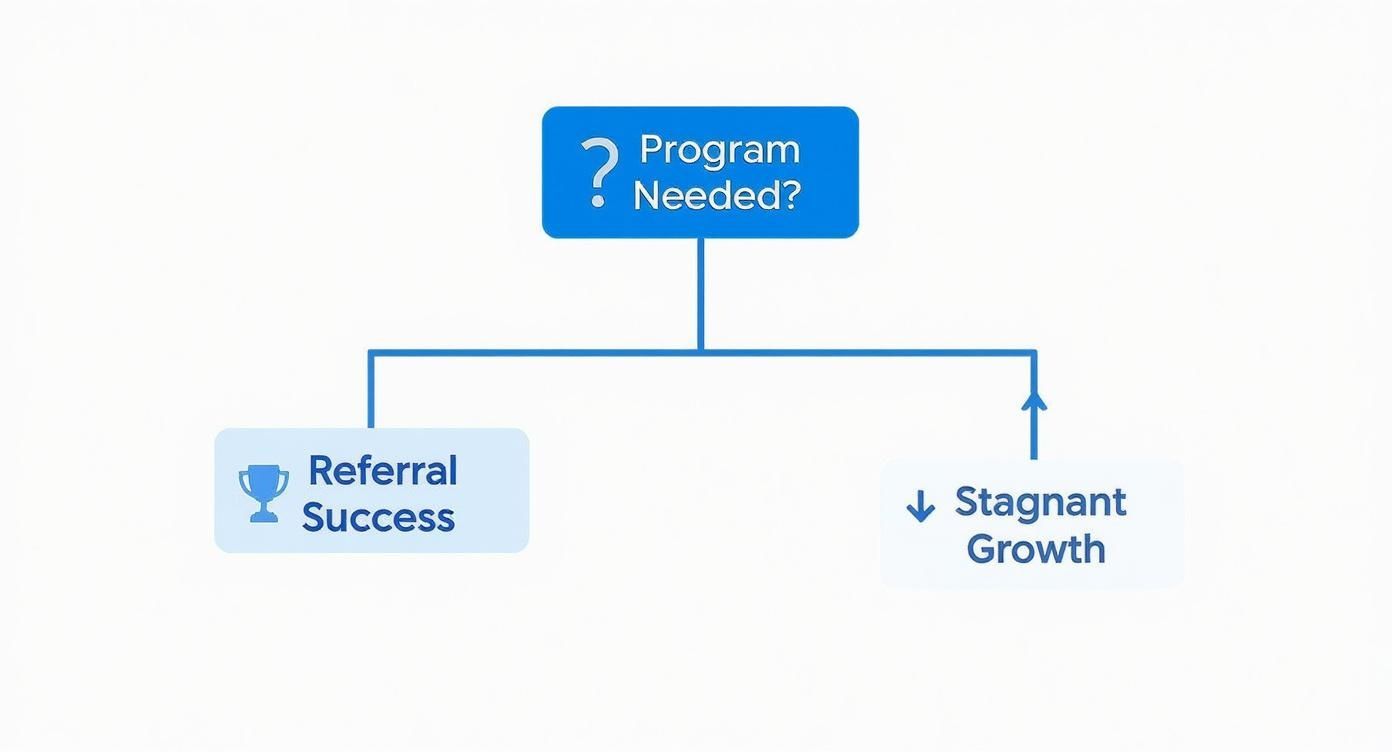
As you can see, investing time and resources into a referral program isn't just a "nice-to-have." It’s a deliberate strategy that turns your current customer base into a growth engine.
One-Sided vs. Two-Sided Incentives
One of the first forks in the road is deciding who gets the reward. You can either give a kickback just to the person doing the referring (one-sided) or reward both the referrer and their friend (two-sided).
While a one-sided program isn't unheard of, two-sided incentives are almost always the way to go. They make the entire exchange feel less transactional and more like a genuine recommendation. It's easier for your customer to say, "Hey, I can get you a discount!" It also gives the new person a compelling, immediate reason to give your brand a try. This win-win setup is a proven recipe for higher conversion rates.
I've seen it time and time again: over 90% of successful referral programs use a two-sided structure. It removes that awkward feeling of "selling" for the advocate and provides a clear, valuable call-to-action for their friend.
Think about a skincare brand, for example. They might give the original customer a $20 store credit (nudging them toward their next purchase) while giving their friend 20% off their first order (making it easier to say "yes"). Just like that, you're fueling both customer retention and new customer acquisition with a single offer.
Choosing the Right Referral Incentive Model
Deciding on the right reward structure can feel overwhelming. To help you map out the best path for your brand, here's a quick comparison of the most common models I've seen work in the wild.
| Incentive Model | Best For | Pros | Cons |
|---|---|---|---|
| Percentage Discount | Brands with a wide range of product prices and a desire to drive larger orders. | - Easy to understand. - Encourages higher AOV. - Feels like a significant saving. | - Can devalue premium brands. - Less predictable cost per acquisition. |
| Fixed Dollar Amount | Brands with a consistent average order value or lower-priced products. | - Simple and predictable cost. - Tangible, concrete value. - Great for impulse buys. | - May not feel impactful on high-ticket items. - Less incentive for a larger cart size. |
| Store Credit | Subscription models or brands with high customer lifetime value (LTV). | - Guarantees a repeat purchase. - Extremely cost-effective. - Builds long-term loyalty. | - Less appealing for one-time purchasers. - Can feel less immediate than cash. |
| Non-Monetary Reward | Brands with a strong community or exclusive products. | - Creates a sense of exclusivity. - Reinforces brand identity. - Can be more memorable than cash. | - Perceived value can be subjective. - Requires more creative effort to implement. |
Ultimately, the model you choose should feel like a natural extension of your brand. A luxury watch company probably shouldn't offer a 50% off coupon, just as a coffee subscription might find more success offering a free bag of a limited-edition blend than a simple $5 discount.
Monetary vs. Non-Monetary Rewards
While cash and discounts are the obvious go-to rewards, they aren't your only play. In fact, some studies have shown that non-cash incentives can be up to 24% more effective at boosting performance than their cash equivalents. Why? Because they feel more special.
- Monetary Rewards: Think percentage discounts, fixed dollar amounts, store credit, or even cash payouts. These are straightforward, universally appealing, and highly effective for most e-commerce brands.
- Non-Monetary Rewards: This is where you can get creative and reinforce what makes your brand unique. Think early access to new products, free swag, exclusive content, or bonus loyalty points.
If you're looking for more inspiration, you can explore some truly creative ideas for referral programs that move beyond the standard discount.
Structuring the Perfect Offer
There is no one-size-fits-all "perfect" offer. It all comes down to your product's price point and your customer lifetime value (LTV). A company selling $2,000 mattresses can—and should—offer a much bigger reward (like a $75 Amazon gift card) than a brand selling $15 bags of gourmet popcorn.
Ready to take it up a notch? Consider these more advanced structures.
Tiered Rewards A tiered system is a brilliant way to motivate your most passionate fans to keep sharing. Instead of a flat reward for every single referral, the value goes up as they bring in more new customers.
- Referrals 1-3: Get $10 store credit each
- Referrals 4-6: Get $15 store credit each
- Referrals 7+: Get $25 store credit each
This gamified approach turns your best customers into true super-advocates without inflating your initial acquisition cost.
Gamified Contests If you need a short-term boost in sign-ups, running a referral contest is a fantastic tactic. The person who brings in the most new customers in a single month wins a huge prize—maybe a year's supply of your product or a large gift card. This creates a powerful sense of excitement and urgency, driving a massive wave of shares in a short period.
At the end of the day, designing your incentive structure is all about getting inside your customer's head. When you align your business goals with an offer they find genuinely irresistible, you've laid the foundation to successfully build a referral program that will drive real, measurable growth for years to come.
Choosing the Right Tech for Your Referral Program
Once you've nailed down a killer incentive structure, it’s time to pick the technology that will actually run the show. Let’s be real: trying to manually track referral links, send out rewards, and crunch the numbers is a fast track to burnout. Good software does more than just prevent headaches—it makes your program smarter, more effective, and ready to grow with you.
Thinking you can build a referral program from scratch? It's a massive technical lift, and frankly, it's not where your time is best spent. The real choice for most e-commerce brands boils down to two main routes: a dedicated referral tool or an all-in-one loyalty platform.
Dedicated Referral Tools
Dedicated referral platforms do one thing, and they do it exceptionally well. These tools are purpose-built to handle every little detail of a refer-a-friend program, from generating unique sharing links to sniffing out fraud and fulfilling rewards automatically.
What I love about these specialized tools is their laser focus on the user experience for both the person sharing (the advocate) and their friend. They make the whole process feel effortless and intuitive, which is absolutely critical for getting people to actually participate. If you're looking for a best-in-class solution for referrals and you already have other systems for things like loyalty points, this is a fantastic way to go.
All-In-One Loyalty Platforms
For many online stores, an all-in-one loyalty platform like Toki is the smarter, more strategic play. These systems treat referrals as a key piece of a much bigger customer retention puzzle. Instead of just handling referrals in a silo, they manage everything—points, rewards, VIP tiers, and more—all under one roof.
This integrated approach has some serious perks. It creates a single, unified experience where referring a friend is just one of many ways customers can engage with your brand and earn rewards. The result? Higher overall engagement and a much stronger sense of brand community.
Pro Tip: Going with an all-in-one platform breaks down data silos. When your referral stats, points balances, and VIP data all live in the same place, you get a crystal-clear view of who your most valuable customers are. That's gold for creating smarter, more personalized marketing campaigns.
Essential Features Your Referral Tech Must Have
No matter which path you take, some features are simply non-negotiable for a successful e-commerce referral program. As you start comparing software, keep this checklist handy to make sure you’re picking a tool that can truly fuel your growth.
- Seamless E-commerce Integration: The software has to play nice with your e-commerce platform, whether it’s Shopify, BigCommerce, or something else. A clean integration means rewards are tracked and applied automatically, saving you from a world of manual data entry.
- Automated Reward Fulfillment: Manually emailing discount codes just isn't an option if you want to scale. Your system needs to automatically issue rewards to both the advocate and the new customer the moment a referral is completed successfully.
- Intuitive User Dashboards: Your customers need a dead-simple place to grab their unique link, check their referral status, and see the rewards they’ve earned. A clunky, confusing interface is one of the fastest ways to kill participation.
- Customizable Program Rules: You need the power to set the rules of the game. This means defining what counts as a "successful" referral (like a first purchase only), setting reward triggers, and configuring any minimum spend requirements.
- Actionable Analytics and Tracking: Forget vanity metrics. You need real, actionable data. Look for a platform that clearly shows your referral rate, share rate, and the conversion rate of referred friends so you know what's working and where to improve.
- Fraud Detection: To protect your margins, the software absolutely must have built-in safeguards to stop people from referring themselves or gaming the system. This usually involves things like IP address and browser cookie checks.
Picking the right tech is the foundational step to build a referral program that runs itself and delivers results you can actually measure. It’s the engine that powers the entire system, turning your great idea into a reliable customer acquisition machine. Your mission is to find a solution that automates the grunt work, gives you clear insights, and makes participating an absolute joy for your customers.
Spreading the Word: How to Launch and Promote Your Program
You’ve done the hard work. You’ve designed a killer incentive and picked the right software to make it all happen. But here’s the thing: the best referral program in the world is completely useless if nobody knows it exists. A great launch isn't just about flipping a switch. It's about a smart, strategic push to make sharing feel obvious, easy, and even a little exciting for your customers.
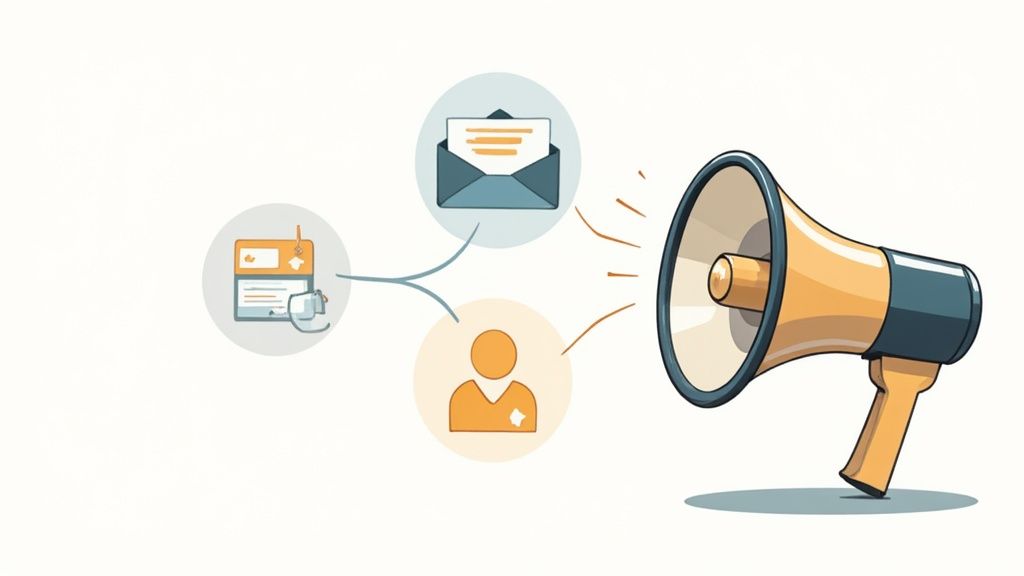
The real goal is to weave your program into the customer experience so smoothly that sharing feels like a natural next step, not some clunky marketing ask. This means hitting them with the right message, in the right place, at the right time.
Give Your Program a Home Base
First things first, your program needs its own dedicated landing page. Think of this as its central hub—a single, clear, and compelling spot where all the action happens. This page isn't just for logistics; it's your main sales pitch for why someone should bother sharing. It has to be easy to find, a breeze to understand, and effortless to share from.
Your landing page must immediately answer three questions:
- What’s in it for me? Lead with the reward. A bold, benefit-focused headline like "Give 20%, Get $20" or "Share the Love, Get a Free Month" works wonders.
- How does this work? Break it down into super simple, visual steps. Use icons and short phrases, not a wall of text.
- How do I get started? The unique referral link or code should be front and center. A one-click "copy link" button is an absolute must-have.
A great referral page removes all friction. It should take a customer less than 10 seconds to understand the deal and grab their link. Any more complicated than that, and you'll see a massive drop-off.
Once you’ve built this page, don’t hide it! Link to it from your main navigation menu, your website footer, and especially from the customer account dashboard. Don't make your biggest fans hunt for it.
Weave Promotion into the Customer Journey
The absolute best time to ask for a referral is when a customer is already happy with your brand. Instead of just sending out a big announcement and hoping for the best, you need to strategically place referral prompts at key moments of delight. This turns your program from a separate campaign into a core part of your brand experience.
Here are a few high-impact touchpoints to get you started:
- The Post-Purchase Thank You Page: This is prime real estate. A customer just committed to you, and their excitement is at an all-time high. A simple prompt here—"Love your new gear? Share with a friend and you'll both get $15 off!"—can be incredibly effective.
- Order & Shipping Confirmation Emails: These emails get some of the highest open rates you'll ever see. A small banner or a P.S. note about your referral program is a simple, automated way to keep it top-of-mind.
- The Customer Account Dashboard: Your most loyal customers live here. Placing a permanent, visible section in their account dashboard makes it dead simple for them to grab their link whenever the mood to share strikes.
Announce Your Program With a Bang
While those passive, integrated promotions are key for long-term health, your initial launch needs a big, active push to get the ball rolling. A coordinated announcement across your main channels will build that critical first wave of momentum.
Your Email Marketing Launch Your email list is your direct line to your customers. A dedicated email blast announcing the program is non-negotiable. For an extra punch, segment your list and send a slightly different version to your VIPs or repeat buyers, making them feel like they're getting an exclusive first look. To help you get going, check out these powerful referral email templates.
A Social Media Blitz Get visual on your social channels. Create clean, simple graphics that clearly explain the two-sided offer ("Give X, Get Y"). To really light a fire, try running a launch week contest. Offer an extra prize to the person who drives the most successful referrals—it adds a fun layer of competition and urgency.
At the end of the day, it's all about making sharing feel like a no-brainer. When you build a referral program with promotion baked into its DNA from the start, you transform it from a passive tool into a customer-powered growth engine that consistently brings you high-value new business.
Measuring Success and Optimizing for Growth
Getting your referral program live is a huge step, but let’s be clear: that’s the starting line, not the finish. The real magic happens when you stop making assumptions and start digging into the data. This is how you turn a simple marketing channel into a powerful, self-improving growth engine.
To figure out what’s really working, you have to look past vanity metrics like shares and clicks. The goal is to focus on the key performance indicators (KPIs) that actually move the needle for your business. This is how you prove the program's value and, more importantly, find the weak spots that are holding you back.
Identifying Your Core Program KPIs
You can’t improve what you don’t measure. Your referral software dashboard will probably be overflowing with numbers, but a few core metrics tell most of the story. If you lock in on these, you'll get a crystal-clear picture of your program's health.
- Referral Rate: What percentage of your customers are actually sharing their referral links? A low number here often points to a promotion problem—your customers might not even know the program exists.
- Conversion Rate: This is the big one. It’s the percentage of referred friends who follow through and make a purchase. If this is lagging, the offer for the new customer probably isn't compelling enough, or maybe your landing page is causing friction.
- Customer Acquisition Cost (CAC): Take the total cost of your referral rewards and divide it by the number of new customers you gained. A healthy referral program should have a significantly lower CAC than your other channels, like paid social or search ads.
Tracking these numbers is step one. For a much deeper dive into the nuts and bolts of setting this up, our complete guide on referral program tracking lays out the entire process.
I've seen brands get fixated on the "share rate" alone. But a high share rate with a low conversion rate is a red flag. It means people are sharing, but their friends aren't buying. That points to a problem with the friend's incentive, not the advocate's motivation.
As you get into the rhythm of measuring and optimizing, it’s also critical to analyze your referral traffic to see how these new visitors behave on your site compared to people coming from other sources.
A/B Testing Your Way to Higher Conversions
Once you have a baseline for your KPIs, the fun really starts. A/B testing is just a fancy way of saying you’re comparing two versions of something to see which one performs better. By methodically testing different parts of your program, you can make small tweaks that lead to massive improvements.
The golden rule? Don't try to test everything at once. Isolate one variable at a time to get clean, reliable data.
What to Test in Your Referral Program
Almost every single part of your program is a candidate for testing. I always recommend starting with the elements that are most likely to have the biggest impact on your core KPIs.
Here are a few high-impact areas to get you started:
- The Advocate's Reward: Try pitting a $20 store credit against a 25% off coupon. The credit might encourage more repeat business, while the coupon could feel more valuable upfront.
- The Friend's Offer: Does a bigger discount actually drive more first-time buyers? Test your standard 15% off against a more aggressive $25 off a $75 purchase to find out.
- Landing Page Headline: Test a benefit-driven headline like "Give Friends $20 Off, Get $20" against a softer, community-focused one like "Share the Love and Get Rewarded."
- Call-to-Action (CTA) Button: Even tiny text changes can make a difference. Compare "Get My Link" with "Start Sharing" and see which one gets more clicks.
- Promotional Email Subject Lines: When you announce the program, test subject lines. "A Gift For You & Your Friends" might pull in more opens than a straightforward "Join Our Referral Program."
For example, I once worked with a subscription box company that tested offering a free box (a non-monetary reward) against a $30 credit (a monetary one). They discovered that the perceived value of a free product drove far more shares and conversions, even though its actual cost to the business was lower than the credit.
This continuous cycle of measuring, testing, and refining is the secret sauce. It’s what transforms a program that just exists into one that truly thrives, constantly adapting to your customers and delivering a powerful return.
Common Questions About Building a Referral Program
As you start turning your referral program from a plan into a real-world tool, you're bound to hit a few practical questions. I see it all the time. Getting these details right is often what separates a program that takes off from one that just sputters out.
Let's walk through some of the most common hurdles I help merchants clear when they decide to build a referral program.
How Much Should I Offer as a Reward?
Everyone asks this, and the honest answer is: there's no single magic number. The perfect reward for your brand depends entirely on your product cost, profit margins, and what your customers are actually worth over time—your customer lifetime value (LTV). You're looking for that sweet spot where the offer is juicy enough to get people sharing, but not so generous that it eats up your profits.
A great place to start is by looking at your average order value (AOV).
- If you sell lower-priced items, a percentage discount like 20% off usually feels like a bigger win. It can even nudge people to add a little more to their cart.
- If you sell higher-priced goods, a flat dollar amount—say, $50 off—often feels more concrete and valuable.
The bottom line is making sure the reward pays for itself. Don't be afraid to test a couple of different offers. Your data will quickly tell you what gets your customers excited.
What Is the Difference Between One-Sided and Two-Sided Incentives?
This is a core decision that will shape how your entire program feels and performs. A one-sided incentive just rewards the person doing the referring (your advocate). It’s a simple "thank you" for sending a new customer your way.
A two-sided incentive, on the other hand, gives a little something to everyone. The advocate gets a reward, and their friend gets a discount on their first purchase.
I can't stress this enough: Over 90% of the most successful referral programs are two-sided. It completely changes the dynamic from a sales pitch to a genuine gift. The advocate feels good about giving their friend a real perk, and the friend has an immediate reason to try your brand.
It's a win-win, and it almost always drives better results. It just makes the whole experience feel more natural and less transactional, which is exactly what you want.
How Can I Prevent Referral Fraud?
It's a smart question. You don't want people gaming the system by referring themselves with a different email just to snag a discount. This kind of fraud can definitely hurt your bottom line if you're not careful.
The good news is that modern referral platforms are built with this in mind. They come with some pretty sophisticated fraud-prevention tools baked right in.
These systems automatically keep an eye on things by:
- Tracking IP addresses to spot multiple referrals coming from the same computer.
- Using browser cookies to identify someone who's already visited or purchased.
- Enforcing program rules, like blocking a referred friend from using the same shipping address as the advocate.
You can also set up your own simple guardrails. For instance, make it a rule that the reward only applies if the friend is a brand-new customer. A clear, easy-to-read terms and conditions page is also your best friend here—it sets expectations right from the start.
Ready to turn your best customers into your most powerful growth channel? Toki provides all the tools you need to launch, manage, and optimize a high-performing referral program, fully integrated with your loyalty and rewards system. Learn more at https://buildwithtoki.com.